South Korea’s cryptocurrency “kimchi premium” turns negative—The nation that once traded crypto now trades stocks.
TechFlow Selected TechFlow Selected
South Korea’s cryptocurrency “kimchi premium” turns negative—The nation that once traded crypto now trades stocks.
South Korean retail investors are exiting the crypto market, and the net outflow of funds has already left a clear imprint on the price structure.
 Navigating Web3 tides with focused insights
Author: Doo (Compound Foundation)
Translation & Editing: TechFlow
TechFlow Intro: South Korea has long been one of the world’s most fervent retail crypto markets—“kimchi premium” once surged as high as 20%. Now, for the first time ever, that premium has turned negative—a development reflecting not only the collapse of altcoins but also a large-scale exodus of retail capital from the crypto market, offering critical insight into current market sentiment.
The South Korean cryptocurrency premium is turning negative—an extremely unusual occurrence, given that South Korea typically exhibits a premium. Incidentally, premiums or discounts in South Korea arise primarily because capital controls impede arbitrage.
Below are some thoughts on why this discount is emerging.
1. The speculative market is cooling down
The South Korean market is renowned for speculation, having previously driven the premium above 20%. Yet as the broader crypto market continues to struggle—especially altcoins—market interest has steadily declined.
2. The South Korean stock market is performing far better, drawing liquidity away from crypto
The South Korean stock market has nearly doubled since last year, with several tech firms—including Samsung and SK Hynix—leading the gains. This means liquidity previously deployed in crypto is now migrating to the domestic equity market.
3. Upcoming cryptocurrency taxation in South Korea is shifting market preferences
South Korea’s cryptocurrency tax has been postponed multiple times, due both to insufficient infrastructure for collecting such taxes and its highly unpopular status as a political issue. However, the current administration has at least confirmed that cryptocurrency taxation will begin next year.
Translator’s Note: Real-time data confirms the discount is underway
Real-time monitoring data from the South Korean Telegram channel “Kimchi Premium Immigration Office” (“Kimph Immigration Office”) provides direct corroboration of the above analysis. This channel specifically tracks the premium or discount of South Korea’s crypto market relative to international markets. Below are three sets of data recorded on the same day:
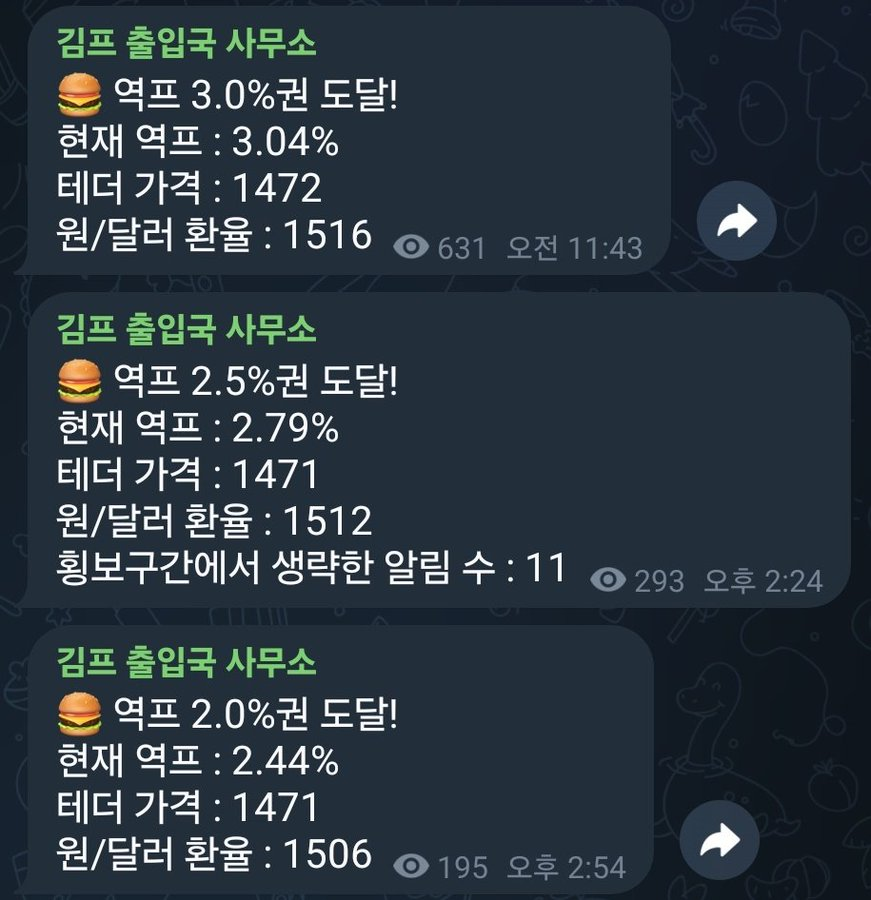
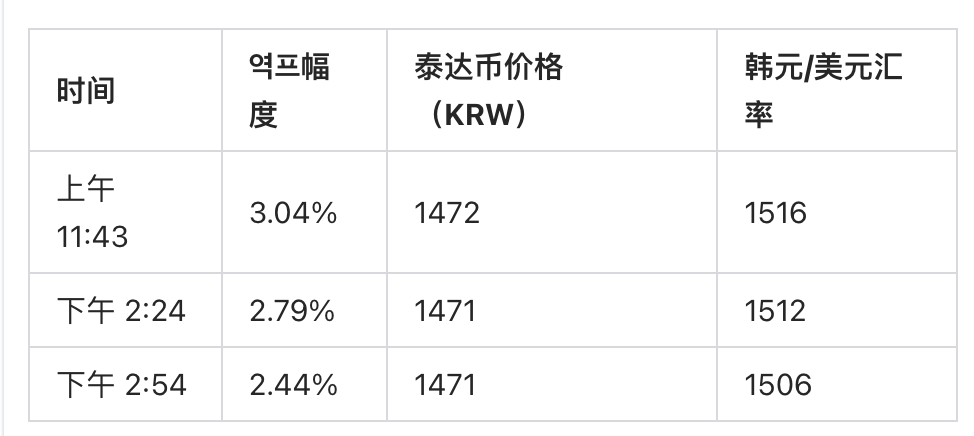
“Yeokpeu” is short for “Yeok Kimchi Premium,” meaning reverse kimchi premium—i.e., crypto asset prices in South Korea are lower than global prices, meaning it’s cheaper to buy crypto in South Korea than overseas.
Several details emerge from the data:
First, the discount narrowed from 3.04% to 2.44% over the course of the day—but remained consistently above 2%, indicating this is not a transient fluctuation but rather a sustained market condition.
Second, Tether (USDT) traded stably between KRW 1,471–1,472, while the KRW/USD exchange rate stood between 1,506–1,516 during the same period. The gap between these two figures constitutes the discount’s direct source—insufficient demand for stablecoins in the South Korean market, with notably weak buying pressure.
Third, the channel omitted 11 alert notifications within this sideways range, suggesting the discount has persisted over an extended period—its magnitude simply hasn’t varied enough to trigger alerts.
This dataset corroborates the article’s core thesis at a micro level: South Korean retail investors are exiting the crypto market, and the net outflow of capital has already left a clear imprint on price structure.
Notably, the emergence of such a sophisticated, grassroots premium-monitoring system in South Korea itself underscores how deeply entrenched the “kimchi premium” has long been as a core trading signal in the country’s crypto market.
That this signal has flipped negative for the first time carries symbolic significance far beyond the number itself.
Data shows that the total market capitalization of South Korean listed companies surged 86% this year to reach USD 5 trillion—while India’s fell to USD 4.8 trillion. So far this year, South Korea’s stock market has successively overtaken those of Canada, Germany, the UK, and France—rising to sixth place globally by total market cap.
Join TechFlow official community to stay tuned
Telegram:https://t.me/TechFlowDaily
X (Twitter):https://x.com/TechFlowPost
X (Twitter) EN:https://x.com/BlockFlow_News
 @DooWanNam