Goldman Sachs Research Report Analysis: Grid Expansion Takes Eight Years, Data Centers Can't Wait, Energy Storage Starts Taking Orders
TechFlow Selected TechFlow Selected
Goldman Sachs Research Report Analysis: Grid Expansion Takes Eight Years, Data Centers Can't Wait, Energy Storage Starts Taking Orders
From CATL to Tesla, from FLNC to Energy Vault, energy storage companies are becoming the invisible arms dealers of AI infrastructure.
 Navigating Web3 tides with focused insights
By: Rita
TechFlow Guide
Data centers are undergoing an electricity crisis. It takes only a few milliseconds for a GPU to ramp from 0% to 100%, and the power grid simply cannot withstand such fluctuations. On July 16, Goldman Sachs released an energy storage report with a direct conclusion: traditional grid expansion takes four to eight years, while energy storage can be done in twelve to eighteen months, becoming the fastest "queue-jumping" solution for data centers.
The U.S. electricity demand growth rate was just raised by Goldman Sachs' Utilities team from 2.6% to 3.2%, with data centers being the biggest variable. Of this, 0.5 percentage points come from the "behind-the-meter" model where data centers generate and store their own power, equivalent to about 3GW of DC power demand annually by 2030.
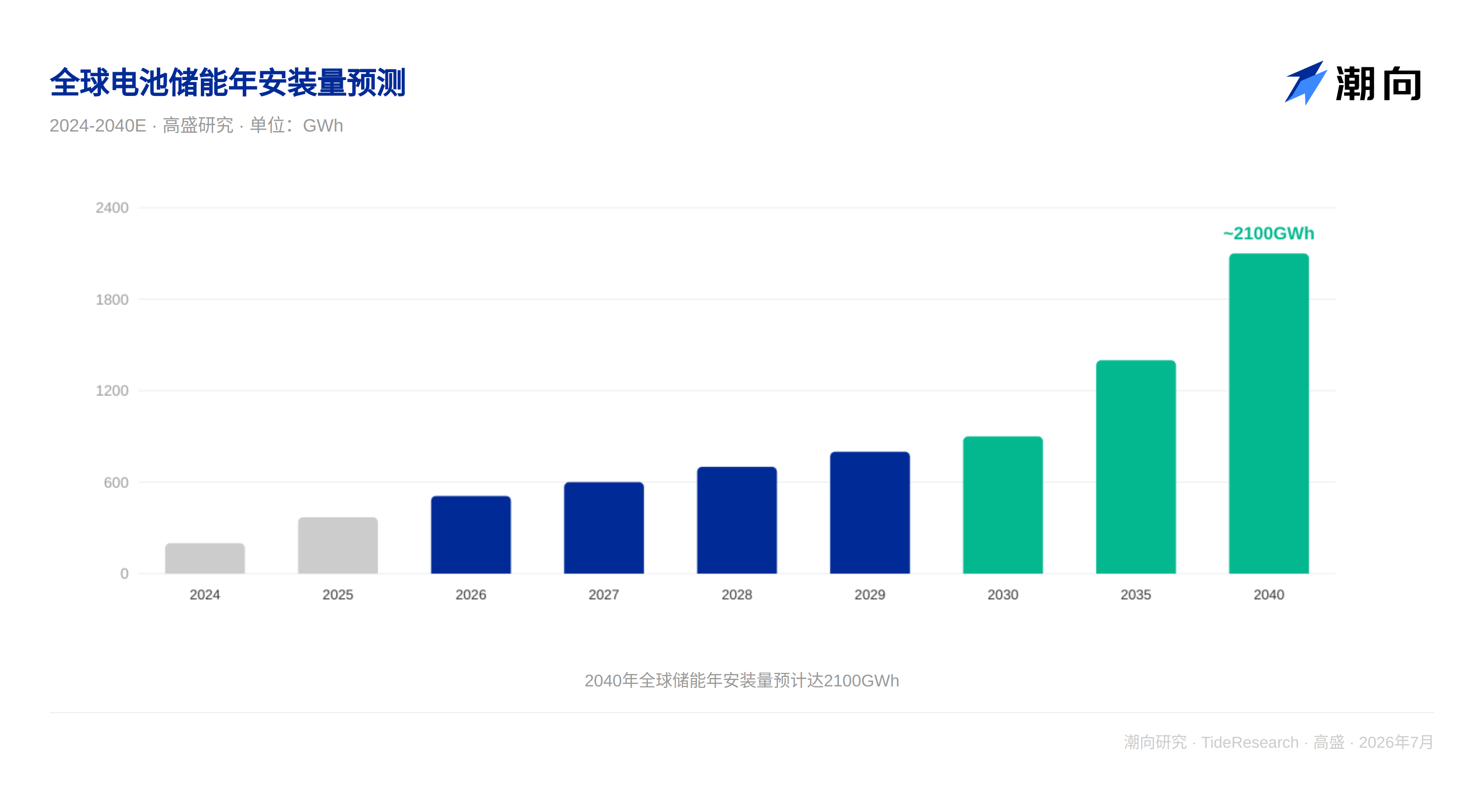
Goldman Sachs estimates that solely in the U.S. market, behind-the-meter energy storage will see an increment of about 50GWh by 2030. The global energy storage market is expected to reach an annual installation volume of 2100GWh by 2040. From CATL to Tesla, from FLNC to Energy Vault, energy storage companies are becoming the invisible arms dealers of AI infrastructure.
The Grid Cannot Keep Up with GPU Speed
The electricity consumption logic of data centers has changed. Previously 5 to 10 megawatts, now 100 to 200 megawatts, with large campuses capable of gigawatt levels. Rack density has surged from 5 to 10 kilowatts to over 50 to 100 kilowatts. More critically, GPU load can spike from 0% to 100% within milliseconds, causing a huge shock to the power grid.
Gas turbines are not built for this task. Industry feedback indicates that gas turbines can only start and stop twice a day; frequent switching accelerates wear and tear. Cases show that some new combined-cycle gas turbines suffered shaft fractures within seven months due to frequent load fluctuations.
Energy storage can solve this problem. Response time is at the millisecond level, and the deployment cycle is 12 to 18 months, much faster than grid expansion. Bypassing the congested interconnection queue is energy storage's biggest competitive advantage. Goldman Sachs is defining it as an independent business model, not just the concept of a backup power supply.
Where Does the 50GWh Increment Come From
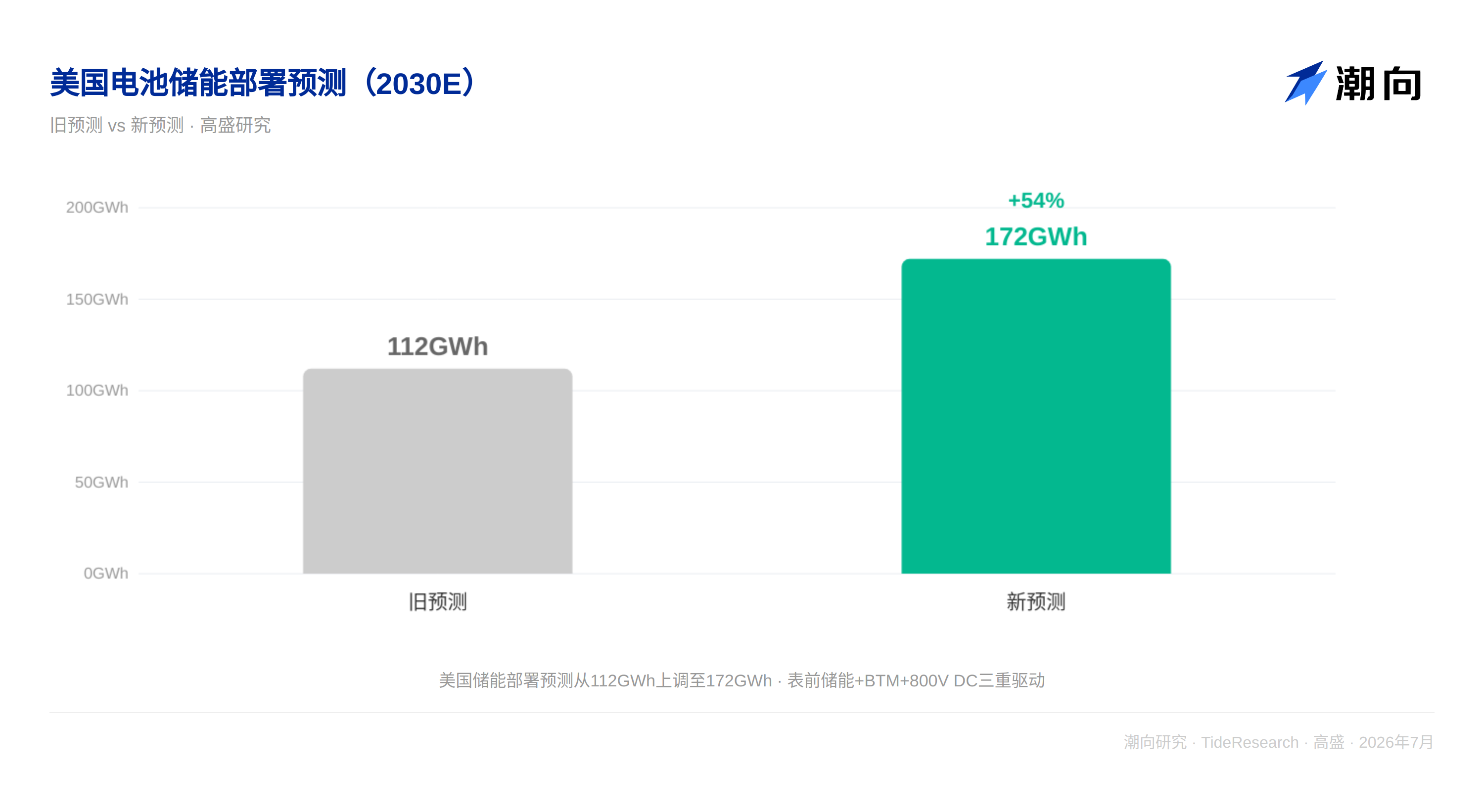
Goldman Sachs' Asia Battery team estimates that by 2030, U.S. behind-the-meter energy storage opportunities will bring an increment of about 50GWh. Plus 11GWh from 800V DC data centers, total U.S. energy storage deployment will reach 172GWh. This figure is significantly raised from the previous 112GWh.
Goldman Sachs' Utilities team just raised the U.S. electricity demand growth rate from 2.6% to 3.2%, with 0.5 percentage points coming from the behind-the-meter model, equivalent to about 3GW of DC power demand annually by 2030. This is a structural change, not a marginal one.
Globally, Goldman Sachs expects global annual energy storage installations to reach about 2100GWh by 2040. Data center energy storage demand is becoming an important variable on this growth curve. Forecasts for the EMEA region were raised from 83GWh to 142GWh, with Germany, Spain, and Portugal being the main drivers. Residential energy storage in Australia is also doubling.
Energy Storage Companies Are Becoming Arms Dealers of AI Infrastructure
Goldman Sachs detailed companies worth watching in the energy storage supply chain in the report:
FLNC (Buy, Target Price $22) secured exclusive battery partner qualification for NVIDIA's DSX Vera Rubin reference architecture. It has signed master supply agreements with two hyperscale customers and is bidding on 12GWh orders. As of the second fiscal quarter of 2026, data center pipeline projects reached 12GW, a 30% quarter-over-quarter increase. Goldman Sachs estimates this business will contribute about 8% to 14% of 2028 revenue.
CATL (Buy) holds about 30% share in the global energy storage battery market and has explicitly listed data centers as a core application scenario. The TENER 6.25MWh system has been used in the Shanghai SenseTime AI Data Center, reportedly reducing electricity costs by 7%. Sodium-ion energy storage is expected to begin delivery by the end of 2026.
Tesla (Neutral) achieved a record energy storage deployment of 46.7GWh in 2025, expected to be higher in 2026. Megapack and Megablock are becoming key grid stability infrastructure for hyperscale data centers. Goldman Sachs expects Tesla's energy business revenue to reach $29 billion in 2028, accounting for about 21% of total company revenue.
Energy Vault (Neutral, Target Price $2.5) is transitioning from an energy storage system supplier to an energy infrastructure platform. Goldman Sachs included the Asset Vault business in valuation for the first time, giving it a 6x EV/EBITDA valuation. The business's EBITDA margin is expected to be about 64% in 2028.
LGES (Buy) is converting five production bases in North America to ESS dedicated lines, with North American capacity expected to reach 50GWh by the end of 2026. Energy storage revenue share rose from about 14% in 2025 to about 31% in 2026. Through subsidiary Vertex, it provides a "one-stop" solution of battery plus software, also bundling the group's own liquid cooling and data center design services.
Other targets worth watching: Canadian Solar (Sell, subsidiary e-STORAGE has 81GWh project reserves), Ford (Neutral, Ford Energy expected to contribute $3 billion revenue in 2028), Samsung SDI (Neutral, ESS battery revenue share rose to about 26%), Shoals (Buy, BESS products expected revenue $30 to 35 million in 2026), Sungrow (Neutral, energy storage contributes about 42% of revenue).
TechFlow Perspective
The most important contribution of this Goldman Sachs report is turning "data center energy storage" from a concept into a quantifiable market. The 50GWh behind-the-meter energy storage increment means that energy storage is changing from "supporting equipment for renewable energy" to "an essential demand for AI infrastructure".
This identity shift will change the valuation logic of the entire industry. Energy storage companies no longer just follow the rhythm of photovoltaics and wind power; they directly benefit from the expansion of AI capital expenditure. Goldman Sachs raised FLNC's target price from $20 to $22; the logic is that visibility of data center orders is strengthening.
But this report also needs to be read in reverse. The targets mentioned in the Goldman Sachs report include Buy, Neutral, and Sell; investors need to distinguish which ones are truly supported by orders and which are just conceptually related. FLNC has NVIDIA's exclusive agreement, CATL has real shipments, and Tesla has deployment data. The gap between these and those companies "developing related products" is real.

Disclaimer
This article is a compilation and interpretation by TechFlow Research of a third-party broker research report (Goldman Sachs, July 16, 2026). The ratings, target prices, earnings forecasts, and related judgments cited in the text are the views of the broker's analysts, represent only the position of their affiliated institution, do not represent the views of TechFlow Research, and do not constitute any investment advice.
The market involves risks; decisions must be independent. This article should not be used as a basis for buying or selling any securities.
Join TechFlow official community to stay tuned
Telegram:https://t.me/TechFlowDaily
X (Twitter):https://x.com/TechFlowPost
X (Twitter) EN:https://x.com/BlockFlow_News
 深潮TechFlow