Tiger Research Report: How to Make Money After Issuing Stablecoins?
TechFlow Selected TechFlow Selected
Tiger Research Report: How to Make Money After Issuing Stablecoins?
The true winners are not the players with the largest issuance volume, but the participants who capture the value of the underlying settlement layer.
 Navigating Web3 tides with focused insights
Author: Tiger Research Reports
Compiled by: TechFlow
TechFlow Editor's Note: Everyone is watching the issuance revenue of Tether and Circle, but the real opportunity lies after issuance. This report breaks down the complete value chain of stablecoins from on-ramp, transfer, payment to yield generation, revealing that the strategy of mainstream players is not to "rebuild the financial system," but to integrate the efficiency advantages of stablecoins onto traditional financial infrastructure—only in the yield generation link can traditional finance not enter, requiring separate professional capabilities.
Key Points
Beyond the oligopolistic issuance market dominated by Tether and Circle, this report analyzes the actual business structures generated in the five stages of the stablecoin value chain (on-ramp, remittance, payment, yield generation).
The mainstream strategy is not to "rebuild the system," but like Stripe acquiring Bridge, to overlay the efficiency advantages of stablecoins (instant settlement, low-cost remittance) onto existing traditional financial infrastructure. However, yield generation is an area difficult for traditional finance to enter, requiring separate professional capabilities.
As interest rate cuts weaken the attractiveness of issuance revenue and competition intensifies, market value is shifting towards the "underlying settlement layer." Stablecoins are not meant to replace traditional finance, but rather present a model of vertical integration with the regulated financial system.
It's Time to Look at the Complete Stablecoin Value Chain
To date, discussions about the stablecoin industry have focused on the issuance stage. The performance of major issuers like Tether and Circle, as well as regulatory responses from various countries, are treated as key market indicators, but this is only the starting point of the stablecoin value chain.
The complete value chain of the stablecoin industry includes the economic "flow" circulating after token issuance. It is defined as a five-stage value chain: Issuance, On-ramp, Transfer, Payment, and Yield Generation.
Analyzing the industry from a value chain perspective clearly shows that although the issuance market is held by a few players in an oligopolistic structure, the downstream layers thereafter involve more competitors, creating market opportunities.
From Issuance to Yield: Tracking $1,000
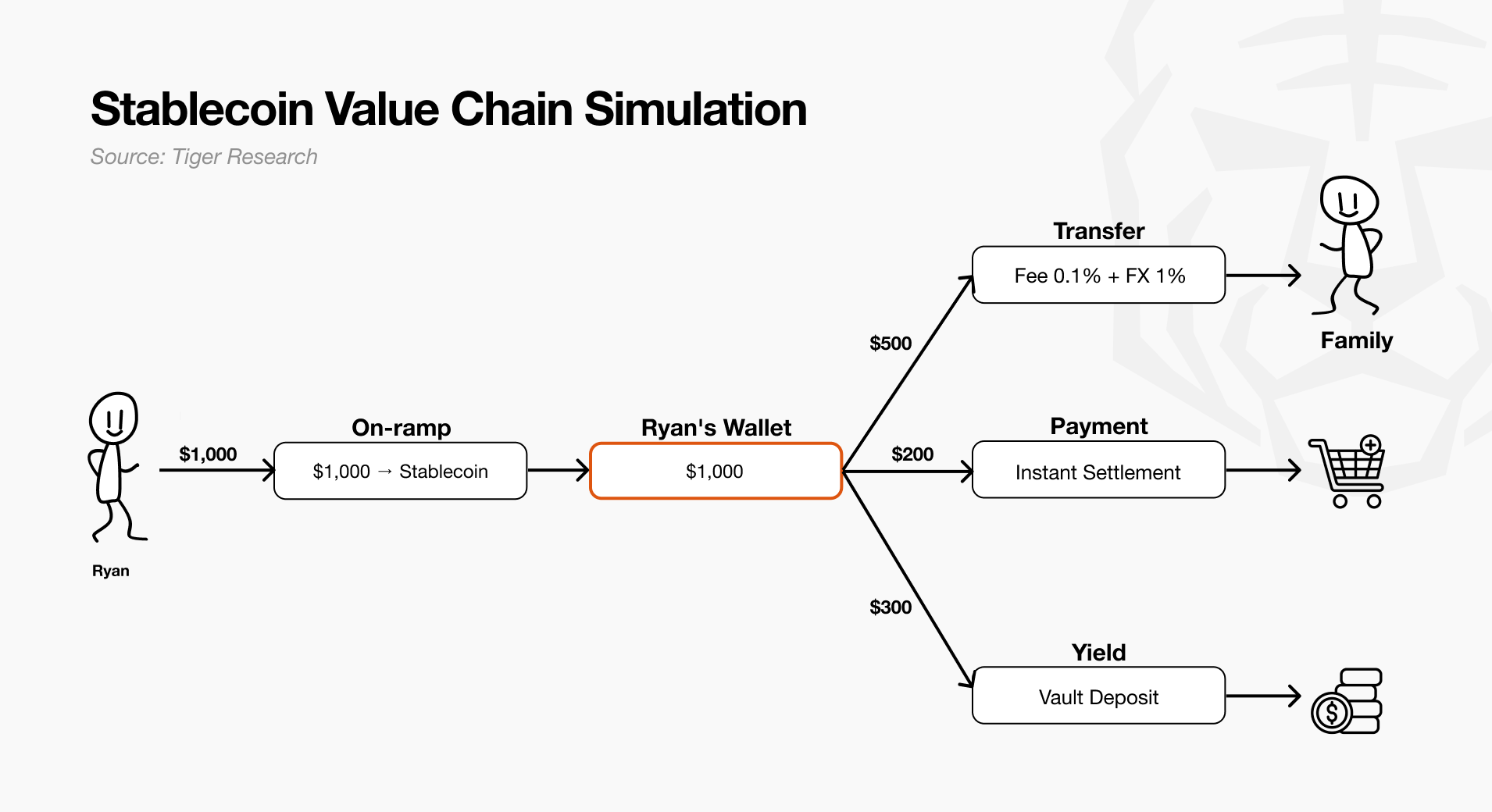
Consider how $1,000 in Ryan's bank account circulates within the stablecoin ecosystem. Understanding this requires examining the five-stage value chain from issuance to yield generation in order.
- Issuance: Major issuers mint stablecoins using collateral such as U.S. Treasury bonds, providing sufficient liquidity for the market.
- On-ramp: When Ryan requests to convert his $1,000 into stablecoins via an on-ramp service, the on-ramp provider processes the request and sends the tokens to his wallet. At this point, assets exit the fiat system and are converted into on-chain liquidity.
- Transfer: Ryan remits $500 to his family in Mexico for living expenses. The transfer infrastructure processes this instantly, and the recipient converts the funds into local currency for use.
- Payment: Ryan then uses the remaining $200 to pay at a grocery store. Here, the payment infrastructure executes settlement instantly.
- Yield: The remaining $300 in the wallet is not idle. Instead, it is deposited into a vault of a yield protocol, where it is managed as a financial asset generating returns.
Through this process, Ryan's $1,000 converts from fiat to stablecoin, and evolves into a cross-border payment method and asset management tool. Every layer through which Ryan's funds flow corresponds precisely to the value chain of the stablecoin industry.
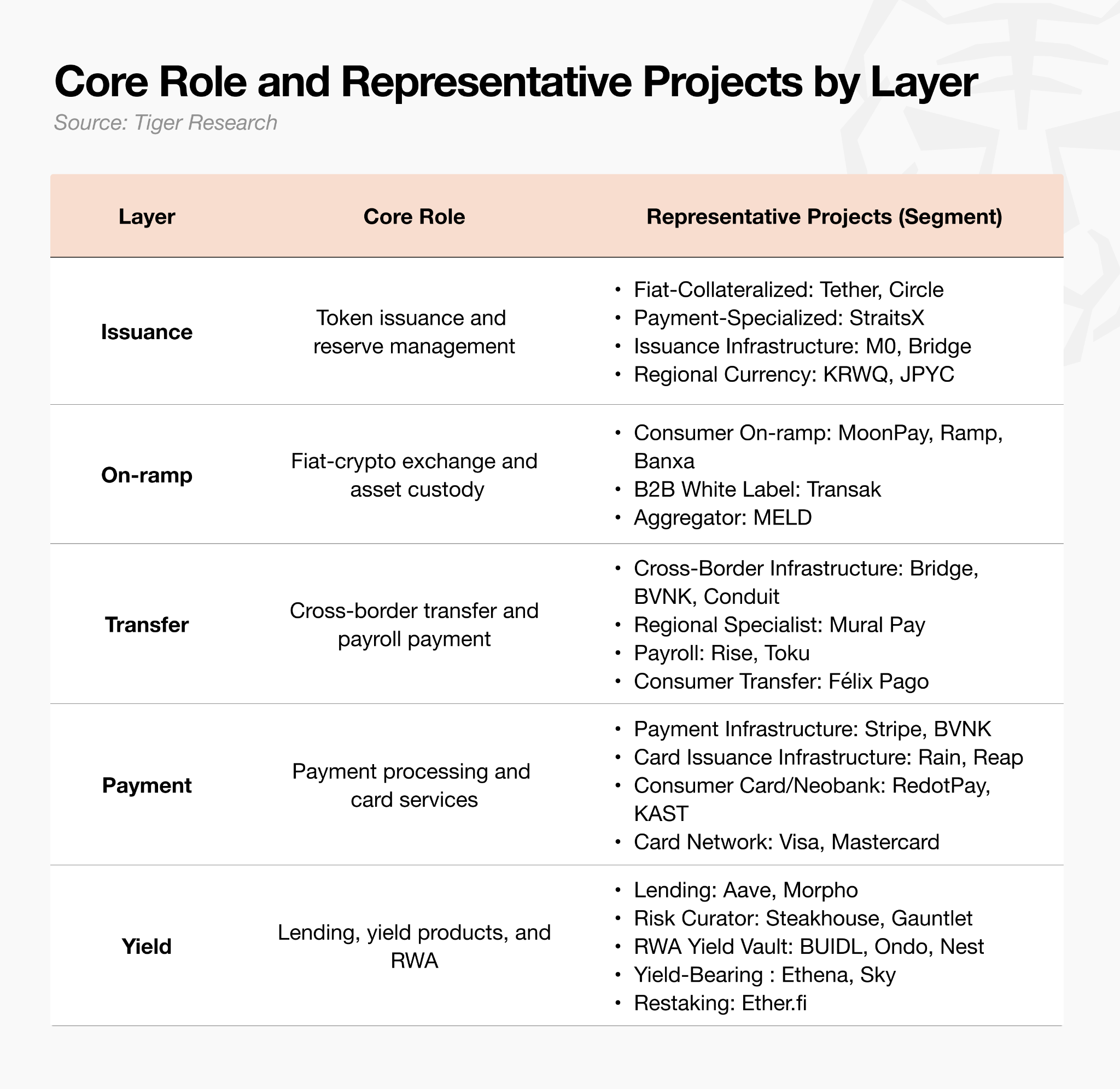
Issuance
The issuance market is a market of economies of scale, with entry barriers built on trust and liquidity. First-mover issuers Tether and Circle hold an oligopoly, and latecomers need differentiated strategies beyond the reserve interest model.
Industry Structure
Stablecoin issuance is the process of minting and burning tokens against reserves (mainly U.S. Treasury bonds) to peg their value. The total market is approximately $300 billion, of which USD-pegged assets account for 99.99%. Tether and Circle collectively hold about 83% of the market share; economies of scale dynamics are deeply entrenched, where deeper liquidity simultaneously increases transaction convenience and trust.
As the industry matures, functions once monopolized by a single issuer are undergoing specialization and unbundling. Issuers appear to be a single entity on the surface, but internally, four functions—licensing (regulatory qualifications), reserve management and custody, token minting and burning, and distribution—are shared by different parties. Through this process, issuers are allocating most of the actual operational responsibilities.
For example, Circle delegates a significant share of distribution to Coinbase, and Tether delegates most of its reserves to custodian Cantor Fitzgerald.
Business Model Types
- Reserve Interest: Revenue mainly comes from returns on reserve management, which is an advantage for leading issuers with large liquidity pools (Tether, Circle).
- Payment Fees: Revenue comes from fees generated when tokens are used for payment and settlement. Profitability is determined by transaction speed rather than market cap (StraitsX).
- Issuance-as-a-Service: Does not directly issue tokens, but leases infrastructure and licensing and charges a spread. Growth comes from network effects rather than scale (M0, Paxos, Bridge).
- Regional: Providers gain exclusive liquidity by being the first to enter regions with unclear regulation or non-USD currency markets (KRWQ, JPYC).
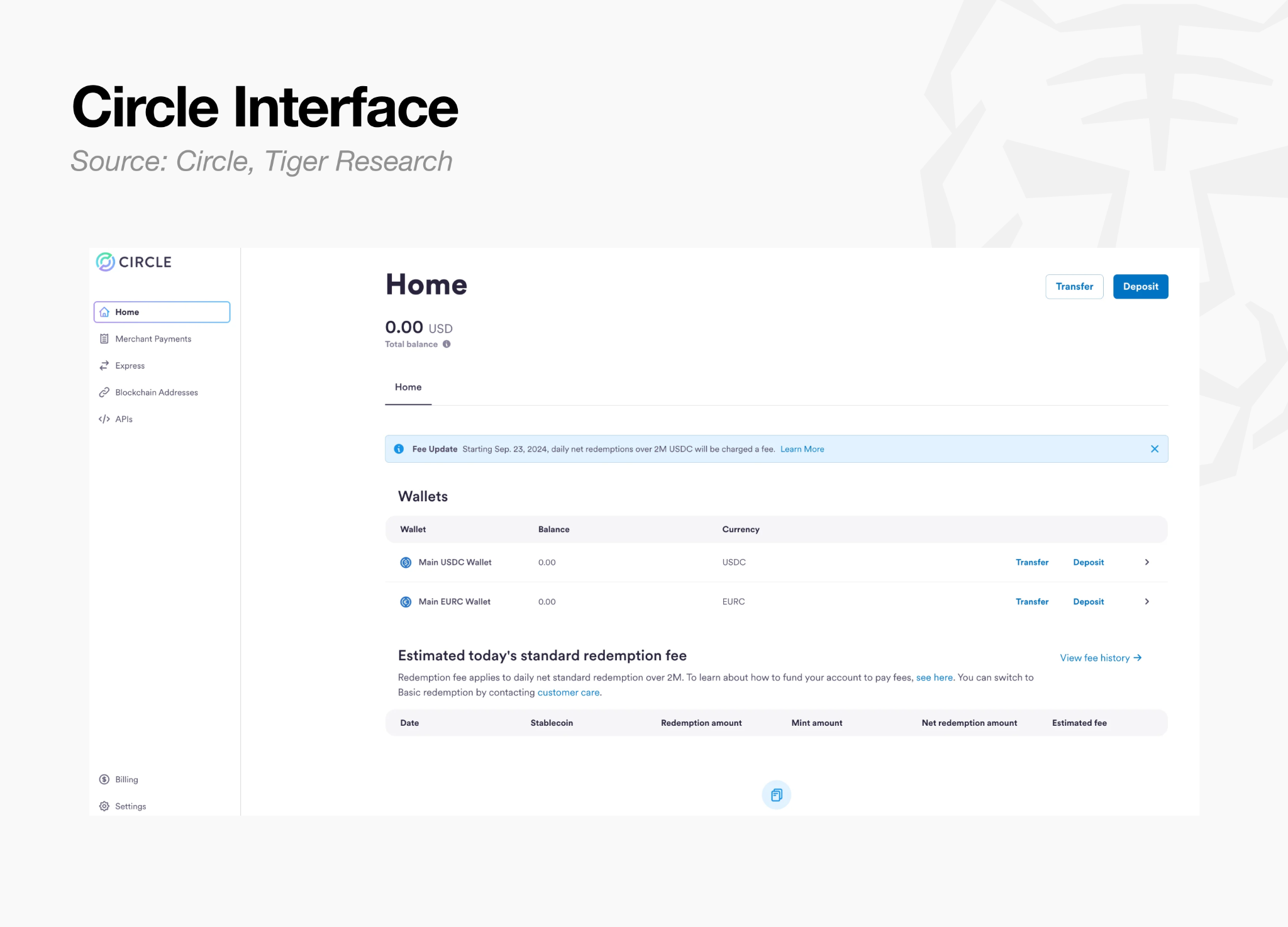
Case Study: Circle
When institutional clients deposit USD into Circle Mint (Circle's on-ramp and off-ramp platform), Circle mints USDC at a 1:1 ratio. Because Circle's main revenue comes from interest earned on these deposits, it does not charge a separate minting fee upon issuance; its operational core is to maximize the scale of this non-interest-bearing float. Deposited USD is held in the Circle Reserve Fund (an SEC-registered money market fund managed by BlackRock), along with cash and cash equivalents, primarily invested in short-term U.S. Treasury bonds.
Circle distributes this interest income through agreements with distribution channels. According to the cooperation agreement signed in August 2023, Circle and Coinbase distribute the interest generated by USDC reserves as follows:
- USDC held on the Coinbase platform: Coinbase receives 100% of the interest income generated by the corresponding reserves.
- USDC held on Circle's own platform: Circle retains 100% of the interest income generated by the corresponding reserves.
- USDC held outside both platforms (remaining interest income): Interest generated by reserves supporting USDC circulating outside both platforms (including third-party exchanges, individual and institutional wallets, and DeFi) is distributed by Circle and Coinbase at 50:50.
This reflects a well-considered strategy. By carefully constructing on-platform and off-platform incentives with core distribution partners, Circle shares part of the issuance revenue in exchange for maximizing USDC's distribution base and ecosystem share.
Key Takeaways
Stablecoin issuance is a market of economies of scale; first-mover advantages and the scale of available liquidity are decisive factors, making the entry barriers for latecomers pursuing a direct issuance model extremely high. Therefore, new entrants should focus on the functional unbundling of the value chain rather than getting stuck on issuance itself.
A more effective strategy is to build unmatched professional capabilities at specific levels of the value chain, such as licensing, asset custody, settlement infrastructure, or distribution channels, and establish a middleware status that other players cannot replace. In other words, the essence of future competition lies not in who issues the largest volume of stablecoins, but in which players capture value in the complete process of stablecoin flow and consumption, and gain strategic position there.
On-ramp
On-ramp revenue comes from fees and spreads charged on transaction volume. The fees actually experienced by consumers vary greatly depending on the payment method: 2-4% for bank transfers, 4-7% for bank cards, but according to Banxa's data, the net rate actually obtained by providers is about 3%. The conversion function itself is difficult to differentiate, and competition is so fierce that aggregators exist to route transactions to the lowest-cost options.
Industry Structure
This layer consists of on-ramp services (converting fiat to tokens) and wallet and custody providers (holding the resulting assets). The two are closely linked because one handles conversion to stablecoins, and the other handles their storage.
On-ramp revenue comes from fees and spreads tied to transaction volume, with profit margins varying greatly across different payment methods. However, the conversion function itself is difficult to differentiate, so multiple providers compete with basically similar products, and net rates are converging towards around 3%.
Business Model Types
- Consumer On-ramp: Directly provides currency conversion to end users and charges transaction fees and spreads. Due to difficulty in differentiation, competitiveness depends on licensing coverage, breadth of payment networks, and reputation, reflected in conversion rates (MoonPay, Ramp Network, Banxa).
- B2B White Label: Embeds on-ramp rails into wallets and applications, and shares about 1% of per-transaction fees with partners. This gains distribution without a consumer-facing brand; the deeper the integration with large partners, the stronger the switching costs function as a moat (Transak).
- Aggregator: Routes transactions between multiple on-ramp channels to find the optimal path and earns intermediary fees. As the number of individual on-ramp channels increases, its value grows, although reliance on the partner network is also a limitation (MELD).
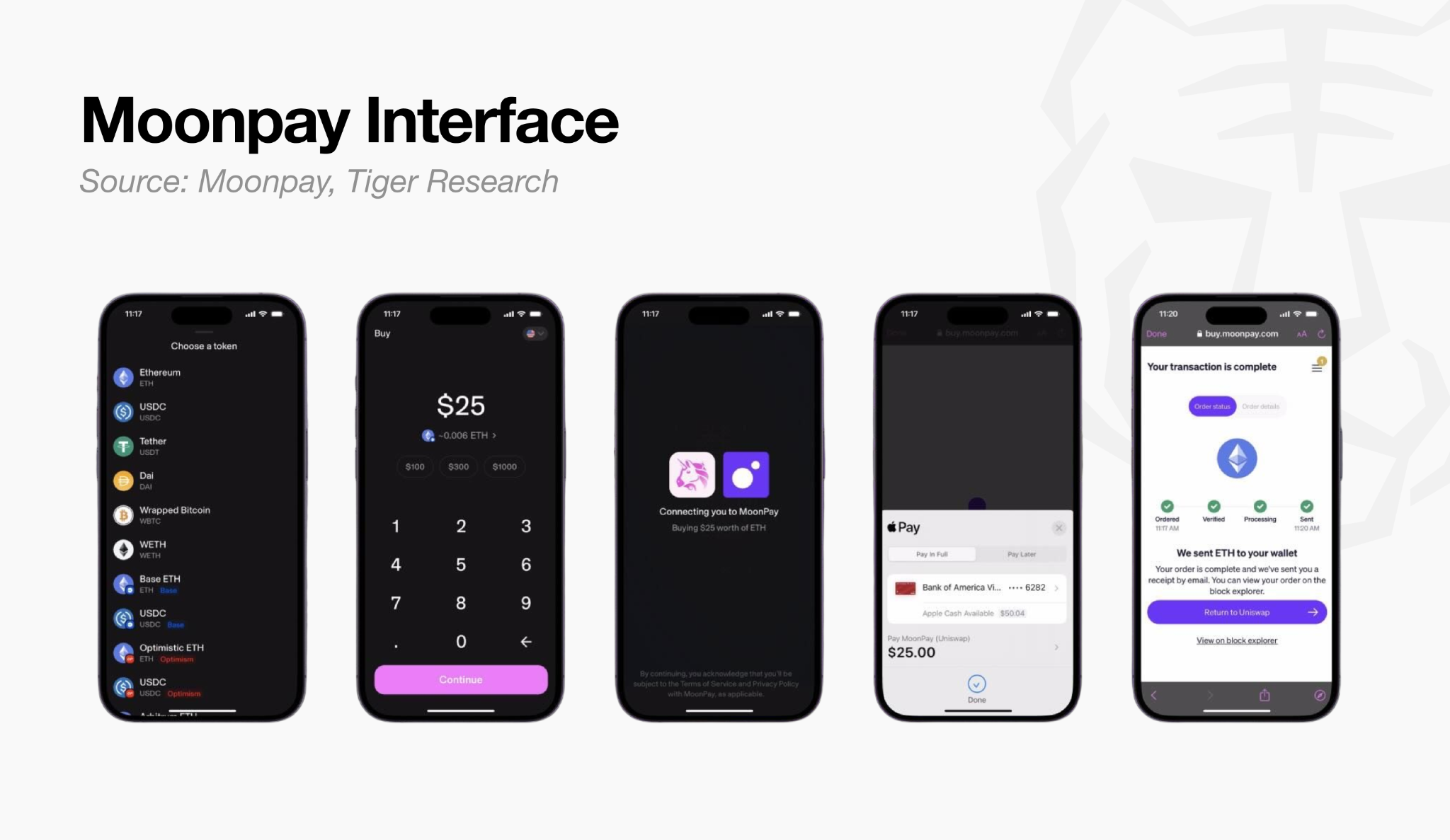
Case Study: MoonPay
MoonPay is a non-custodial on-ramp platform where users purchase tokens with fiat and send them directly to their own wallets. Its main revenue comes from fees and transaction spreads per transaction: 1% for bank transfers, 4.5% for credit cards, with a minimum charge of $3.99 for small transactions. The public fee structure is divided into three tiers, reflecting how MoonPay allocates revenue and builds its distribution system.
MoonPay's revenue structure is divided into two channels: direct traffic and transactions embedded through partners. Its model of embedding solutions into over 500 wallets and apps is particularly critical; partners can set their own fees, which is the core driver enabling MoonPay to efficiently acquire large-scale distribution and share revenue with partners.
Key Takeaways
Fee revenue from simple on-ramp services faces severe margin pressure because this service is becoming commoditized, and price competition is intensifying. Therefore, building a sustainable business requires transforming a one-time fee structure into stable recurring revenue.
Consumer on-ramp service providers are expanding downstream along the value chain, such as into issuance and settlement infrastructure. MoonPay's acquisition of Iron and entry into branded issuance services is an example of this shift, but the financial results of this recurring revenue strategy have yet to be validated.
The "embedded" strategy allows service providers to integrate services into larger platforms, producing two distinct outcomes. Some providers have established independent competitive advantages and maintained independent moats (Transak, Turnkey), while others have been acquired by larger payment and custody companies, such as Stripe acquiring Privy and Fireblocks acquiring Dynamic.
It is too early to judge which outcome will become the dominant model, but the on-ramp and wallet layers obviously play a key role in the industry.
Transfer
The transfer layer is responsible for the flow of stablecoins. This includes transfers for individuals and businesses, as well as paying wages to global employees.
This segment attracts attention because it demonstrates the cost advantages of stablecoins in the most concrete and measurable form. The average cost of traditional cross-border transfers exceeds 6%, while using stablecoins can significantly reduce this cost.
Industry Structure
Fees and forex spreads appear at both ends of the process, i.e., the links where USD is converted to tokens and tokens are converted back to local currency, but the on-chain flow of the tokens themselves is actually free.
In other words, revenue is not concentrated on the transfer itself, but on the conversion at both ends and the licenses required to legally process transfers. Since obtaining Money Transmitter Licenses (MTL) in U.S. states takes 12 to 24 months, leasing the licenses themselves as infrastructure, i.e., the "Compliance-as-Infrastructure" model, has become a powerful revenue model.
Business Model Types
- Cross-border B2B Infrastructure: Coordinates cross-border payments and settlements between enterprises, usually earning transfer fees (about 5-10 basis points) plus forex spreads (from dozens of basis points to about 1%, depending on the channel and transaction volume). Some companies go further, issuing their own stablecoins to obtain reserve interest income, such as Bridge's Open Issuance (Bridge, BVNK, Conduit).
- Payroll Payment: Focuses on payroll payments, owning terminal relationships with employees and employers. In addition to SaaS subscription fees (fixed monthly rate per contractor, plus about 25 basis points off-ramp fee), this model also overlays a second layer of revenue stream by investing the float of funds awaiting payroll payment and obtaining interest, such as Rise Earn (Rise, Toku).
- Consumer Transfer: A model focusing on individual cross-border transfers, using stablecoins to reduce backend costs, and expanding their own profit margins by maintaining fixed fees cheaper than traditional service providers (Félix Pago).
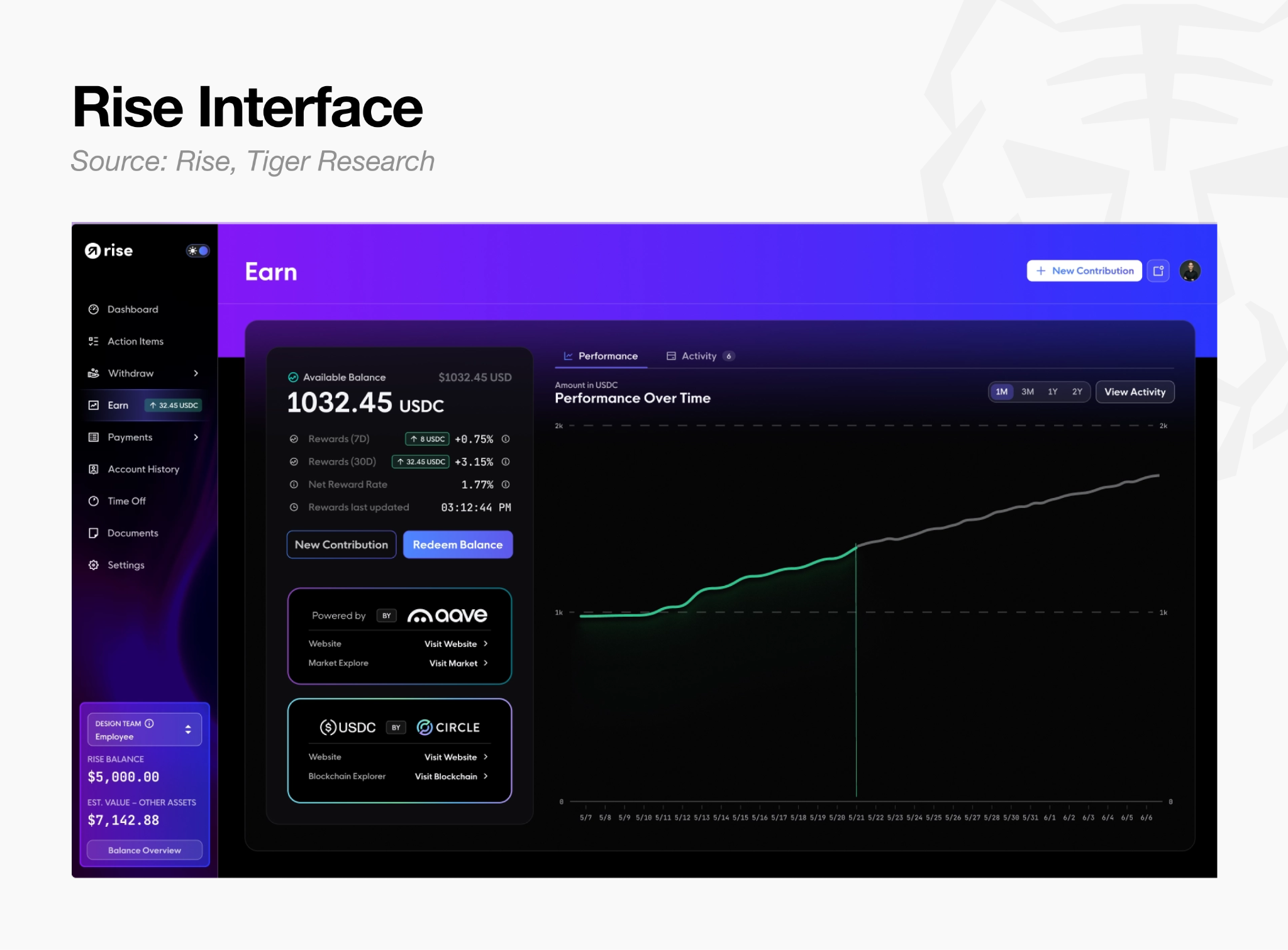
Case Study: Rise
Rise is a stablecoin payroll payment platform through which companies pay wages in fiat (USD) or USDC. Employees choose their payment method from over 90 local currencies and stablecoins in each pay cycle; of the $1.5 billion cumulatively processed, more than half of recent withdrawals are in stablecoins. But what Rise really charges for is not token transfers, but employment relationship management. The platform automates KYC and AML reviews, generates country-specific contracts, and issues tax documents, charging recurring fees for this service.
Rise's revenue builds three layers along the flow of payroll funds.
- Subscription and Transaction Fees: Employers can choose a fixed subscription fee of $50 per contractor per month or 3% of the payment amount, plus a transfer fee of $2.50 per transaction. Since payroll payment itself is recurring, this revenue is recurring rather than one-time.
- Assuming Legal Liability (EOR/AOR): A premium service where Rise itself becomes the legal contracting party and absorbs the risk of employee misclassification. Employer of Record (EOR) services charge $399 per employee per month. Compared to simple payment processing, the eight-fold price difference comes from compliance liability, not transfer functionality.
- Float Management (Rise Earn): Rise invests funds reserved by companies before payroll distribution, and USDC balances not yet withdrawn by employees after receiving wages, into Aave lending pools on Arbitrum. It does not charge deposit or custody fees, but charges a 1% commission on the interest generated, collected upon withdrawal (launched in March 2026).
Since payroll payment is a cash flow that inevitably occurs monthly, funds naturally accumulate on the platform, both before distribution and after employees receive but have not withdrawn funds. Rise's three-layer structure is precisely monetizing this characteristic. In an environment where on-chain transfers are actually free, this can be interpreted as a deliberate strategy to sequentially expand charging points from employment relationships (subscription) to legal liability (EOR) to idle funds (yield), rather than charging for the transfer itself.
Key Takeaways
The winners of the transfer market will not be just the cheapest service providers for transferring tokens. Rather, they will be comprehensive players that acquire conversion and licenses at both ends (Mural Pay, Yellow Card) to control customer touchpoints, own substantial customer relationships through payroll payment (Rise), and overlay yield revenue on this basis (Rise Earn).
Cross-border infrastructure service provider BVNK was ultimately acquired by credit card network Mastercard for up to $1.8 billion, indicating that settlement infrastructure under the transfer and payment layers will merge into one.
Payment
Payment is the core layer of the value chain, where stablecoins settle payments for goods and services. Merchant payments and card services are leading this segment, but economic reality remains immature relative to market expectations. The retail circulation velocity of on-chain stablecoins is only about one-twentieth of the money supply indicator M1, because users recharge and consume intermittently, rather than following the conventional financial cycle where wage income and daily expenditures are interconnected.
Industry Structure
Interchange fees are fees charged by card networks and issuing banks on every transaction, are the core source of payment revenue, and scale with payment volume. However, low turnover rates make single-card profitability weak, and existing revenue is split between card networks, issuing banks, and payment gateways (PG). Therefore, the real profit pool is not in consumer-facing card brands, but in the card issuing and settlement infrastructure behind them.
Most consumer card service providers lack their own issuing authority and rely on this infrastructure, making their revenue structure limited, mainly built on exchange spreads.
Business Model Types
- Payment Infrastructure: Coordinates merchant payments and settlements. In addition to payment fees, service providers obtain reserve interest income by issuing their own stablecoins. Stripe's Bridge Open Issuance distributes the reserve revenue structure obtained by Circle to enterprises, making it one of the most profitable businesses at this layer (Stripe, BVNK).
- Card Issuing Infrastructure: Supports the backend for enterprise card issuing. Service providers obtain a share of interchange fees through principal membership in major networks like Visa, and generate revenue through program management and forex spreads. The core differentiation point is USDC-based T+0 on-chain settlement, which reduces collateral requirements by up to 60% compared to existing methods, significantly improving capital efficiency (Rain, Reap).
- Consumer Cards and Neobanks: Provides cards and accounts to end users. Revenue combines interchange fee shares and forex spreads plus membership subscription fees or profits from managing deposited funds. Since these service providers are not issuing banks themselves, their access to reserve interest is limited, and most rely on card issuing infrastructure like Rain or Reap (Cypher, KAST).
- Card Networks: Networks for payment authorization and settlement. Interchange fees belong to issuing banks, while card networks benefit from increased transaction volume through network fees per transaction. Card networks are integrating stablecoin settlement as a backend layer, which strengthens lock-in with partner banks (Visa, Mastercard).
Case Study: Rain
Rain is B2B backend infrastructure that helps wallets, exchanges, and neobanks issue their own branded consumer cards. Partners design card programs through single API integration; Rain, as a principal member of Visa and Mastercard, handles network sponsorship, compliance, as well as issuance and operations on their behalf.
When a user swipes a Rain-based card at a merchant, the processing flow is as follows:
- Authorization (Real-time): The payment is authorized on the Visa or Mastercard network, just like any standard card. The experience for merchants and consumers is exactly the same as traditional cards; stablecoins are invisible on the surface.
- Balance Deduction and Ledger Management: The user's on-chain balance is converted and the authorized amount is deducted in real-time; Rain manages the ledger for the entire program.
- Network Settlement (Daily): Rain's settlement with card networks uses USDC exclusively. Since settlement is not limited by bank cut-off times, settlement occurs every day of the year, including weekends and holidays, so payment funds on weekends and holidays are not delayed for several days.
- Fund Recovery and Working Capital: In credit structures, user repayment times are later than settlement times, so the issuer must fill this gap. Rain tokenizes card receivables and uses them as collateral for on-chain loans to raise settlement funds before collecting from users, with cumulative borrowing and repayment exceeding $175 million. Therefore, its collateral requirements are 60% lower than traditional issuers.
In short, when consumers use Rain-based cards, all behind-the-scenes work from authorization to settlement and funding is handled by Rain.
Key Implications
The core of payment revenue is not visible card payment fees, but the reserve interest brought by the issuer identity, and the capital efficiency gained through T+0 settlement. Most consumer card brands are just front-end customer touchpoints layered on top of this infrastructure.
Major card networks have begun to directly acquire cross-border payment infrastructure, such as BVNK, while Visa, Mastercard, Stripe, and Google are pushing the joint stablecoin alliance Open USD. This can be interpreted as a vertical integration strategy to bring platforms in-house to protect their exclusive reserve interest income.
Yield Generation
Yield is the endpoint of the value chain, and the layer where the most complex business structures form. Interest that issuers cannot pass on to cardholders is ultimately returned to users here; this lending business is evolving into a complete asset management industry.
Industry Structure
Early on-chain lending merged all assets into a large pool, so default on any single asset could spread risk throughout the system. This structural limitation was later solved by introducing isolated or modular models, which separate collateral and loan terms by market, clearly dividing core infrastructure (immutable lending protocols) and yield management layers (operated by risk curators).
This structural separation spawned a true on-chain asset management industry. Risk curators, like traditional asset managers, earn performance fees (up to 50%) and management fees (up to 5% annualized) from the vaults they operate; the top four participants collectively control about 65% of the curated Total Value Locked (TVL), making this sub-market exhibit an oligopolistic structure.
Above this yield infrastructure is the layer of financial products actually consumed by end users, including Real World Asset (RWA) products that tokenize U.S. Treasury bonds and private credit, yield-bearing synthetic dollars, and restaking.
Business Model Types
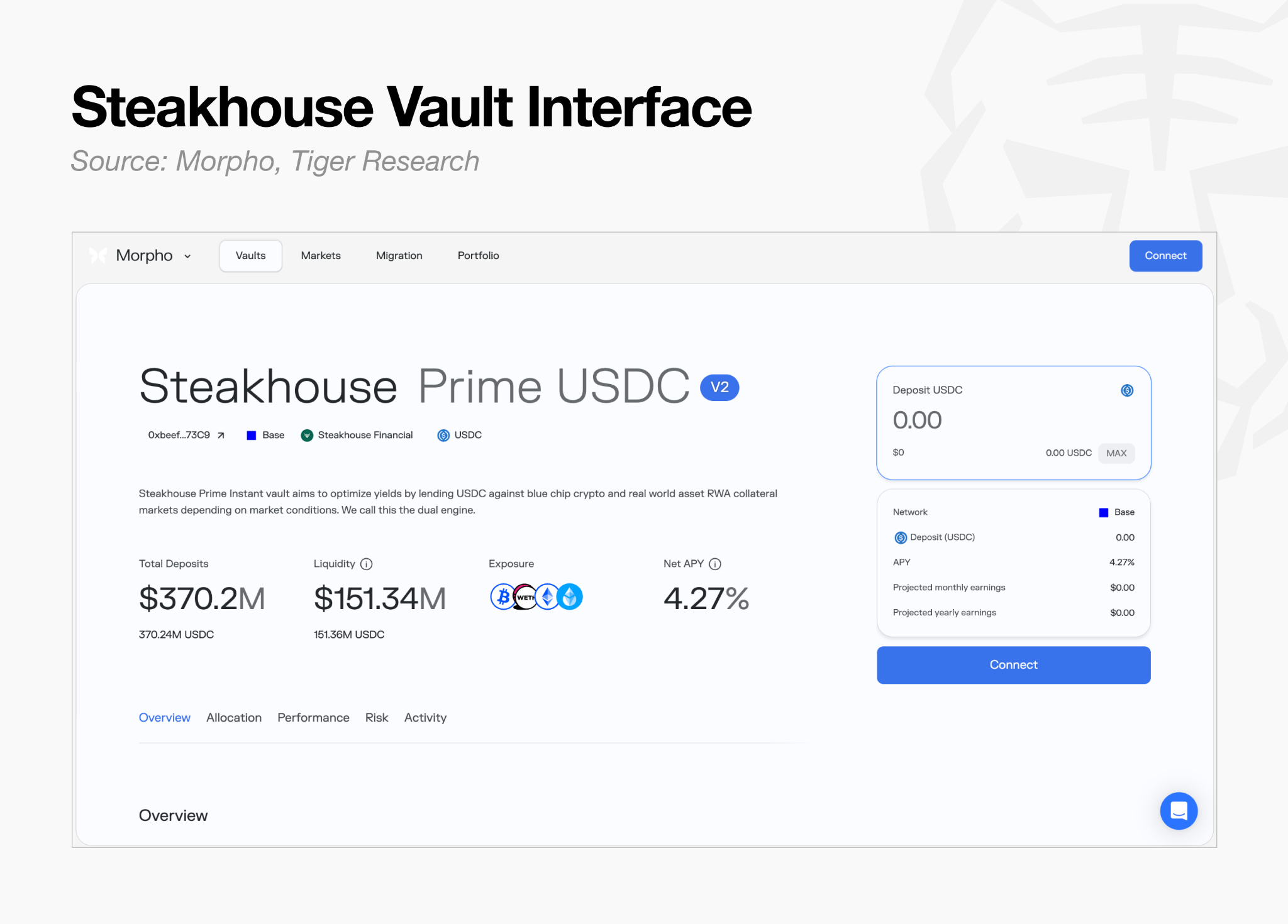
- Lending Infrastructure: Extracts a portion of the spread between deposits and loans as a Reserve Factor, or obtains protocol revenue from interest generated by issuing their own stablecoins (such as Aave's GHO). Different models represented by Morpho close their own protocol fees, instead redistributing this value to downstream curators and token ecosystems to develop the network (Aave, Morpho).
- Risk Curators: Design asset allocation and risk models on top of lending protocols, and charge vault management fees. For example, Steakhouse manages about $1.7 billion in assets with a team of fewer than 20 people, and extracts about 5% of interest income. It represents this operational model of on-chain asset managers, whose cost structure is far more efficient than traditional financial institutions (Steakhouse, Gauntlet).
- RWA Yield Vaults: Issue and distribute tokenized U.S. Treasury bonds or Money Market Funds (MMF), and charge management fees of about 0.15% to 0.5% annualized. BlackRock's BUIDL serves as the underlying asset, Ondo Finance repackages it for the Decentralized Finance (DeFi) ecosystem, and Plume Nest distributes it through a Layer 1 blockchain built specifically for RWA (BUIDL, Ondo, Nest).
- Yield-bearing and Synthetic Dollars: Generate returns through Delta-neutral basis trading or managing Net Interest Margin (NIM) of interest rates, then pay the returns as interest to token holders. This category is divided into two types: models relying on crypto-native derivatives yields, and models relying on stable Treasury collateral (Ethena, Sky).
- Restaking: Liquidizes assets that have already been staked; this process is called restaking, to obtain additional yield. Some providers go further, vertically integrating the entire value chain, from collecting DeFi vault management fees to directly linking consumer card payments (Ether.fi).
Case Study: Steakhouse
Steakhouse Financial is a risk curator, a type of on-chain asset manager. It does not build its own lending protocols, but operates on top of existing infrastructure like Morpho, undertaking a sub-advisor role: selecting collateral assets, designing risk parameters such as Loan-to-Value ratios, and allocating capital between various markets.
Its revenue structure is also similar to traditional asset management, collecting a portion of the generated interest as performance fees and management fees. Since lending protocols like Morpho handle operational infrastructure, accounting, settlement, and custody, curators can effectively scale their business based solely on risk design expertise without bearing separate infrastructure costs.
Key Implications
On-chain curators currently manage about $7 billion in assets, approximately one twenty-thousandth of the global traditional asset management market (about $147 trillion). This huge gap represents the long-term runway for the expansion of the on-chain asset management market.
However, high yields only make sense if the underlying system remains stable. Recent de-pegging events and a series of shocks in the restaking field have exposed operational risks and tail risks (extreme situations beyond normal expectations); simple smart contract audits themselves cannot detect these risks.
Therefore, market funds are shifting from high-yield synthetic dollars to products collateralized by Treasury bonds with relatively lower yields, because institutional investors fundamentally want not high Annual Percentage Yield (APY), but predictability, i.e., the ability to control risk.
Direction of Development for the Stablecoin Value Chain
The success of the stablecoin market does not depend on solely expanding issuance scale, but on which participant controls specific customer segments. However, building infrastructure from scratch in a crypto-native way progresses slowly and carries a heavy cost burden.
The most realistic and executable strategy is to overlay stablecoin efficiencies (such as same-day settlement, 24/7 operations, low-cost transfers, and programmable yield) onto established traditional financial infrastructure (rails). Recent major M&A activities, including Stripe's acquisition of Bridge and Mastercard's partnership with BVNK, all point to this combination of traditional financial infrastructure and stablecoin efficiency.
This opportunity is being amplified by two broad trends working together: the proliferation of regional currencies and integration with regulated finance.
- Proliferation of Regional Currencies: Governments and institutions preparing stablecoins denominated in their local currencies are more likely to adopt already validated issuance infrastructure and local banking channels rather than building systems from scratch.
- Integration with Regulated Finance: Regulated financial institutions such as JPMorgan, Visa, and BlackRock also clearly prefer to use validated infrastructure rather than developing their own technology.
Due to these trends, market opportunities are expected to continue expanding at various levels through which regulated finance must pass to enter this market, including card issuance and settlement, custody infrastructure, and the yield layer.
The conclusion is that issuers need to move beyond the fierce competition surrounding stablecoin issuance, because stablecoins are not a standalone product, but a technical upgrade to improve the efficiency of existing financial rails. The real winners will be those participants who acquire the infrastructure layers built upon existing traditional rails.
In this structural shift, the industry focus is moving "downward" and "inward." As interest rate cuts weaken the economic benefits of issuance itself, the value of the underlying settlement layer grows with increased usage, so the focus moves downward, towards the settlement layer. At the same time, stablecoins are not replacing existing systems, but are being rapidly absorbed into the regulated financial system, with local currency stablecoins organically integrating by filling the gaps left by the USD network.

The shift in industry focus has become an irreversible core issue. The EastPoint: Seoul 2026 to be held on September 28 will provide a platform for in-depth discussion of this industry transformation. At that time, traditional financial institutions and the digital asset industry will gather together to jointly discuss the stablecoin ecosystem and other related topics; this grand event is regarded as an important step to break existing barriers and achieve true integration.
Join TechFlow official community to stay tuned
Telegram:https://t.me/TechFlowDaily
X (Twitter):https://x.com/TechFlowPost
X (Twitter) EN:https://x.com/BlockFlow_News
 @tiger_research