The Moutai Moment: When Liquidity Dries Up, Everyone Clings Together Around HYPE and ZEC
TechFlow Selected TechFlow Selected
The Moutai Moment: When Liquidity Dries Up, Everyone Clings Together Around HYPE and ZEC
The end of herd behavior is either a rising tide lifting all boats—everyone profits and exits together—or a stampede-style escape, where the last person to enter ends up holding all the chips.
 Navigating Web3 tides with focused insights
Author: TechFlow
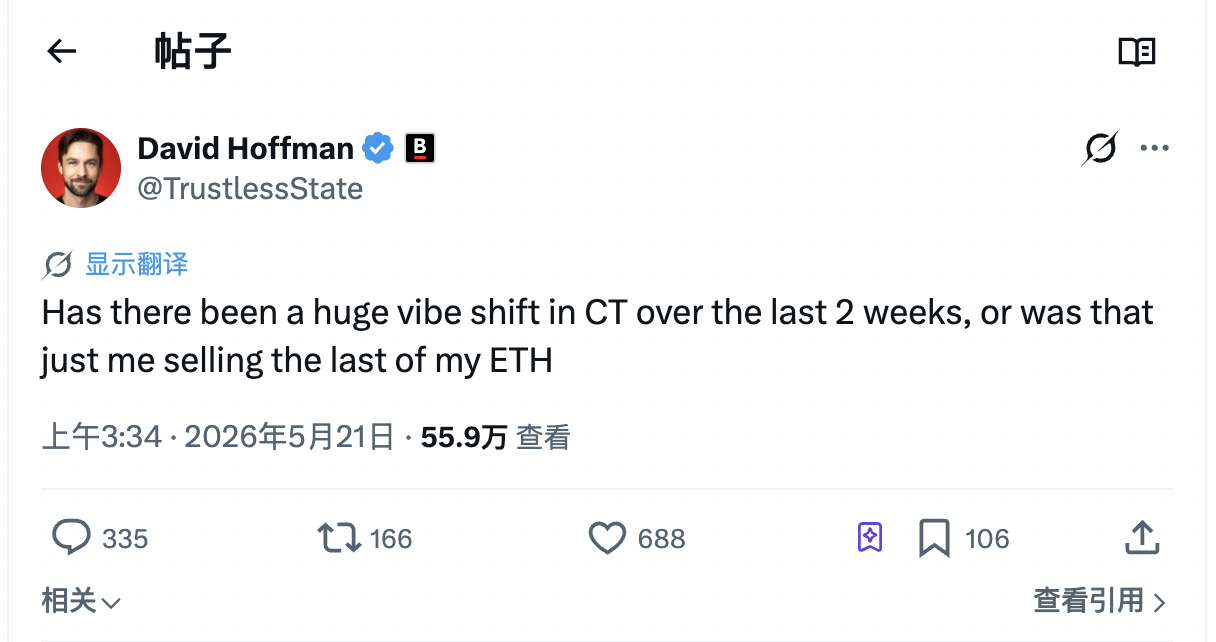
David Hoffman posted a tweet in the early hours of May 21, 2026.
It contained just one sentence: “Has the sentiment around crypto Twitter genuinely shifted over the past two weeks—or did I just sell my last ETH?”
David Hoffman is co-founder of Bankless and has been one of Ethereum’s most prominent public advocates over the past six years. On his personal profile, he once wrote: “99% of wealth isn’t in banks—it’s on Ethereum.” He authored *Ether: The Triple Point Asset* and is among the core evangelists behind the “ultrasound money” narrative for ETH.
Now he’s sold out completely.
If last year some still viewed ETH as “bonds for the future world” and SOL as “NASDAQ on steroids,” by May 2026 the market has completed a full-scale de-anchoring—voting with prices. ETH is currently struggling near $2,100, down nearly 58% from its August 2025 peak of $4,946.
Meanwhile, in that same market, HYPE sits just shy of its all-time high of $59.39, up 15% over the past seven days; ZEC has more than doubled over the past month and surged over 1,400% year-to-date, vaulting into the top 20 by market cap.
One market. Two climates.
The Former “Baijiu” (Chinese Liquor)
This isn’t the first time such a schism has emerged in crypto—but you’ll need to look away from your screen and back to China’s A-share market in 2020.
From late 2020 through early 2021, liquidity in the A-share market peaked and began receding. Public mutual funds faced a stark choice: spread positions evenly across more than 3,000 stocks and settle for mediocre beta returns—or concentrate firepower on a narrow set of core assets with clear, future cash flow narratives. Everyone chose the latter. The result? Kweichow Moutai and Wuliangye soared skyward, while the rest of the market was relegated to “garbage time.”
That year coined an exact phrase: “core asset consolidation.” Its essence wasn’t collusion among fund managers—it was an inevitable response under tightening liquidity: When water levels fall, every fish swims toward the deepest corner.
Crypto markets are now swimming toward that deepest corner.
What happened over the past year? Bitcoin ETFs absorbed roughly $70 billion in capital during 2024–2025, transforming BTC into “an asset priced by Wall Street.” But this also means BTC’s marginal demand has become increasingly tethered to macro interest rates and equity market risk appetite. Q1 2026 inflation data came in hotter than expected—and Bitcoin ETFs saw a $1 billion net outflow in a single week—sending shockwaves across the entire market.
Even more damaging was the collapse of the narrative. In early 2026, Citi slashed ETH’s 12-month target price from $4,304 to $3,175, citing “stalled market-structure legislation and weakening on-chain activity.” JPMorgan’s report dated May 19 put it more bluntly: “ETH needs stronger network growth and DeFi adoption to reverse its relative weakness versus Bitcoin.” Short-seller Culper Research even launched a public short position on ETH, publishing a report claiming the Fusaka upgrade weakened EIP-1559’s burn mechanism—robbing ETH of its prior deflationary property.
Solana, meanwhile, faces a different dilemma. It remains the best chain for DePIN, memecoins, and on-chain trading experience—but when markets enter risk-averse mode, its greatest historical asset—high beta—becomes a liability. Tushar Jain of Multicoin, the man who once carried Solana out of the rubble, publicly announced at Consensus Miami in May that Multicoin had heavily bought into Zcash.
This was a watershed moment: Solana’s earliest and largest backer began shifting its faith elsewhere.
HYPE and ZEC Consolidation
So where did the capital go?
The answer is strikingly consistent: HYPE and ZEC.
Hyperliquid’s story was seeded back in November 2024 with what many called a flawless airdrop. Led by Harvard-trained Jeff and Iliensinc, and staffed by alumni from Caltech, MIT, Citadel, and Hudson River Trading, the team accomplished something almost no one had managed in the past decade of crypto: distributing 76% of tokens directly to users—with zero VC allocation.
If you only see this, you’re only seeing its “moral story.” What truly propelled HYPE’s counter-cyclical rally amid 2026’s liquidity drought was its “cash flow story.”
HYPE is not a traditional “narrative token.” It’s a full-fledged chain—or more precisely, a high-speed, on-chain cash machine. As the largest decentralized perpetual futures exchange today, it generates over $1.2 billion in protocol revenue annually. It has also struck a deal with Circle to share 90% of USDC reserve yield—a single stream projected to fuel $135–160 million per year in token buybacks. This week (May 19), Bitwise announced it added HYPE to its balance sheet and launched an HYPE-based ETF product.
HYPE’s open interest currently stands at $2.1 billion, and funding rates have turned positive—indicating fresh long-side capital inflows, not false euphoria from squeezed shorts.
ZEC’s story belongs to an entirely different dimension. It’s not a “cash flow story”—it’s a “fear story.”
Arthur Hayes wrote plainly in his January essay: “Privacy is the dominant narrative this year—and ZEC will be the privacy beta. To outperform Bitcoin and Ethereum, I’ll sell BTC to fund my privacy position.” His fund, Maelstrom, began accumulating ZEC as early as Q3 2025.
Then, in early May, Tushar Jain of Multicoin Capital doubled down publicly at Consensus. CoinDesk’s March research labeled ZEC “encryption supremacy”—signaling that privacy networks have evolved into a foundational infrastructure layer. The logic rests on three simultaneous developments: AI’s growing ability to batch-deanonymize user identities on transparent chains; quantum computing threats introducing long-term uncertainty into current wallet encryption schemes; and quarterly on-chain transaction volume surpassing $100 billion for the first time—turning “wealth visible to the entire network” into a tangible source of fear.
Supply locked in ZEC’s shielded addresses now accounts for 30% of total supply—the highest level ever recorded—providing quantifiable, on-chain evidence of real privacy demand—not just literary storytelling. On May 20, the SEC formally closed its over-two-year investigation into the Zcash Foundation without issuing any enforcement recommendations. Robinhood has already listed ZEC, and Grayscale’s ZEC ETF filing has moved front-and-center.
Hayes forecasts ZEC’s market cap will eventually reach 10% of Bitcoin’s—implying a price multiple of 15–20x its current level.
Will the Consolidation Break?
When does consolidation break?
A-share “baijiu consolidation” broke after Chinese New Year 2021—not due to deteriorating fundamentals, but because central bank policy shifted, moving markets from a zero-sum game back to a positive-sum one. When water levels rise again, fish no longer need to crowd into the deepest corner.
When will crypto’s pool refill? That depends on when the Fed cuts rates, when ETF inflows resume, when stablecoin market caps hit new highs, and when traditional finance moves more capital onto-chain.
But another risk looms: consolidation may self-destruct—not from external pressure, but from excessive tightness. ZEC’s open interest surged 40% to $1.3 billion in the past 24 hours—a concentration that itself signals risk. Hayes, Multicoin, retail traders, and Robinhood users are all crowded into the same trade. That means any marginal buyer stepping back could trigger cascading long liquidations. HYPE’s funding rate has turned positive and continues climbing—leverage costs are piling up.
The endgame of consolidation is binary: either rising tides lift all boats—and everyone exits profitably—or it ends in a stampede, leaving the last entrant holding all the chips.
Where are we now? No one can say for sure. But there’s a question every reader should ask themselves:
If even David Hoffman has sold, is the ETH still sitting in your wallet there because you believe in it—or because you simply forgot it was there?
The next question is even more practical: When only two names remain viable for consolidation, what will the third be? Aave? Maker? An undiscovered privacy L2? A high-performance chain yet to launch its token?
Those who figure this out first will be the earliest entrants in the next round of consolidation.
Those who don’t? They’ll be the last ones holding the bag when the next consolidation unravels.
Join TechFlow official community to stay tuned
Telegram:https://t.me/TechFlowDaily
X (Twitter):https://x.com/TechFlowPost
X (Twitter) EN:https://x.com/BlockFlow_News
 深潮TechFlow