








From a Solana die-hard to a Hyperliquid loyalist—why have I shifted my all-in focus?
TechFlow Selected TechFlow Selected
From a Solana die-hard to a Hyperliquid loyalist—why have I shifted my all-in focus?
The curiosity and objectivity that initially led me to Solana ultimately led me to Hyperliquid.
 Navigating Web3 tides with focused insights
Author: jords
Translated by: TechFlow
TechFlow Intro: From standing by Solana since 2021—gifting SOL to friends for free so they could experience its ecosystem—to fully transitioning to Hyperliquid in 2025, jords’ shift wasn’t born of lost faith, but rather of the same conviction finding a team with stronger execution capability. This long-form post has sparked extensive discussion across English-language forums, with Solana co-founder Toly even appearing in the comment section.
Lately, many people have asked me what I think about Solana’s current state. I understand why—they’re asking because from 2021 through 2024, I was arguably Solana’s most vocal bull. I still remember my first experience using Solana: it felt dramatically smoother than Ethereum, to the point that I later grew to dislike using ETH altogether.
I was an early user of the Solana ecosystem. Sometimes I gaze out the window, nostalgic for the days of Sollet, $COPE, and SolPunks. My Twitter following grew largely by promoting what was happening on Solana—convincing Ethereum-native users that a world without gas fees was possible. Back then, the prevailing narrative painted Solana as a broken chain—the butt of countless jokes.
I even had a real-life friend who refused to believe my pitch about SOL when it was under $20. So I simply sent him 1 SOL along with a list of protocols to try—just to show him. He never tried it, and still laments how his life might have turned out differently. I can confidently say I was once an extremely committed Solana ambassador. I co-founded BOOGLE, attended every Breakpoint and Hacker House, and hosted other events myself. I contributed significantly to early NFT liquidity. Along the way, I made many close friends—and I still deeply admire those still building there today.
Yet all this leads directly to where I stand now. I essentially took a full year off in 2025. At the end of 2024 and around the U.S. presidential inauguration, I sold all my crypto holdings—tired of the industry and having achieved my goals for this cycle. I traveled, though I occasionally kept tabs on things. $TRUMP launched while I was offline for a week; so did $MELANIA. I missed both entirely. I know friends made or lost millions during that time—while I was reading books. I wouldn’t change that choice.
The intellectual curiosity that once led me to believe Solana was the best L1—something my Ethereum friends heavily criticized—felt obvious to me. Toly talks about a NASDAQ operating at light speed, and I truly believed Solana stood the best chance of achieving that.
Yet somehow, no great DEX ever emerged on Solana—I still don’t understand why. Over the years, I’ve tried them all: Drift, Mango, Adrena. Too many times I was promised the moon, only to discover yet another mediocre DEX. Even today, this keeps happening—I’m still being pitched Phoenix Trade (yet another mediocre DEX). Jupiter is a phenomenal swap product—one I’d cite as an example—but nothing comparable exists for trading.
To those now questioning my position bias, they may not recall that my first public post about Hyperliquid expressed sadness that the best DEX was only accessible via Arbitrum. I couldn’t believe I had to leave Solana to access the very product meant to validate Solana’s core thesis. I hold no emotional attachment to Arbitrum, nor do I buy into the L2 narrative—but the product speaks for itself, and that was crystal clear to me. The same curiosity and objectivity that first drew me to Solana ultimately led me to Hyperliquid.
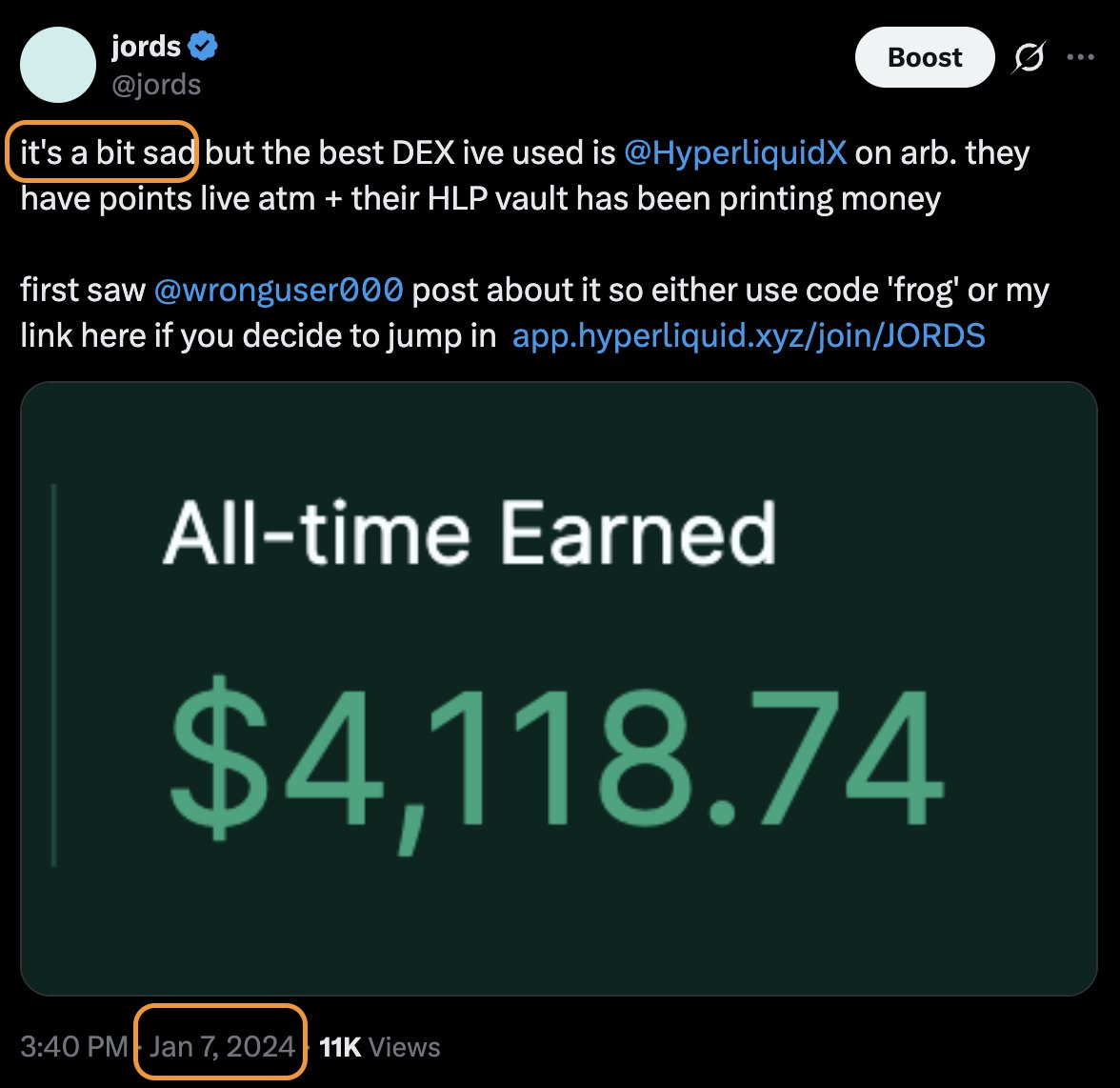
I do feel compelled to reiterate: I don’t believe Solana must fail for my positions to succeed—that mindset is immature. What frustrates me is that Solana, as a blockchain, appears unable to meaningfully advance toward its stated goal of becoming a “light-speed NASDAQ.”
I deeply respect many teams on Solana and their ability to build robust infrastructure. I have nothing negative to say about the many good people doing valuable work within this ecosystem—but I no longer believe Solana possesses the capacity to achieve its stated objectives. I see Hyperliquid’s core team actively building toward becoming the “home of all finance,” and I believe their odds of succeeding are substantially higher.
Solana has indeed partnered with NASDAQ (via xstocks/Kraken), yet all serious trading volume flows through HL’s HIP-3—even with that partnership in place.
This post wasn’t intended as a direct HL vs. Solana comparison—but that’s precisely why people are asking me for my take right now. I believe HL’s lack of a foundation will create challenges—just as Solana’s foundation has created its own set of issues. In fact, I have many ideas about how HL could improve. They’re almost Solana’s mirror image: their core team tends to ignore or deprioritize building an L1 and cultivating the cultural layer needed to onboard new mainstream users (e.g., HyperEVM). Yet they are laser-focused on their stated mission of becoming the “home of all finance.”
There’s no perfect solution—but personally, this is where my conviction currently stands, and why I’m now so vocally supportive of Hyperliquid. It’s the same thesis, backed by the same belief—only now entrusted to a team I believe is far more capable of executing it. Solana remains an excellent chain, and I think it can continue capturing market share via memecoins—but I don’t believe it will become the home of all finance.
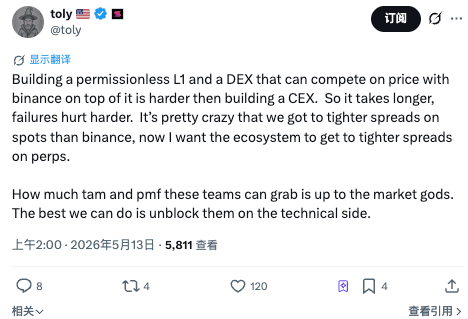
Toly’s reply in the comments:
Building a permissionless L1 *and* a DEX built atop it—capable of competing with Binance on pricing—is harder than building a CEX.
So it takes longer, and failures hit harder. That we’ve already achieved tighter spreads than Binance on spot trading is genuinely wild—and now I hope the ecosystem achieves similarly tight spreads on perpetuals.
How much TAM (total addressable market) and PMF (product-market fit) these teams capture depends on the whims of the market gods. The best thing we can do is remove technical roadblocks for them.
Join TechFlow official community to stay tuned
Telegram:https://t.me/TechFlowDaily
X (Twitter):https://x.com/TechFlowPost
X (Twitter) EN:https://x.com/BlockFlow_News
 @jords


