Is HYPE Still Undervalued? Implied Growth Expectations vs. Harsh Reality at a $900M Market Cap
TechFlow Selected TechFlow Selected
Is HYPE Still Undervalued? Implied Growth Expectations vs. Harsh Reality at a $900M Market Cap
From RMB 11.5 billion to RMB 4.7 billion in revenue: A reverse DCF model reveals that HYPE’s current valuation has already priced in most of the optimistic assumptions.
 Navigating Web3 tides with focused insights
By: Donovan
Translated by: AididiaoJP, Foresight News
Hyperliquid is a world-class product. Its team consists of only 12 people, generating $600–800 million in annual revenue, with near-zero customer acquisition costs, and has already returned over $1 billion to token holders via buybacks.
Yet, at a $9 billion circulating market cap, does HYPE still offer attractive valuation? What expectations are token holders effectively paying for at this price level?
To answer these questions, I applied a reverse discounted cash flow (DCF) model to uncover the growth expectations implicitly priced into HYPE’s current valuation, then cross-validated those assumptions using a bottom-up approach to estimate the realistic size of the perpetual futures market.
Reverse Discounted Cash Flow Model
Assuming a terminal growth rate of 30% over four years, HYPE’s current $9 billion market cap implies the following.
First, under the base case—assuming a terminal P/E ratio of 15x and a net profit margin of 50%—Hyperliquid’s revenue would need to grow to approximately $11.5 billion by 2030. That represents a compound annual growth rate (CAGR) of 110% over the next four years, starting from its current annualized revenue of $601 million—a pace far exceeding normal historical precedent.
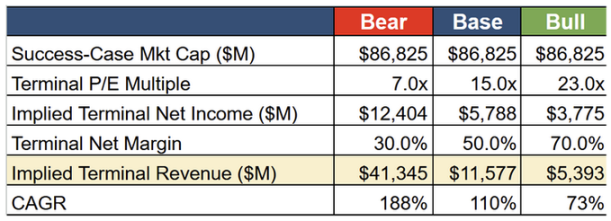
No traditional financial exchange has achieved organic growth at this pace over a four-year period—not even during their most aggressive expansion phases. The Chicago Mercantile Exchange (CME), Nasdaq, Intercontinental Exchange (ICE), and Chicago Board Options Exchange (CBOE) all fall short. Admittedly, traditional exchanges face regulatory and geographic constraints that limit comparability with Hyperliquid—a fair point. As the closest analog, Binance achieved over 200% CAGR between 2018 and 2021 and, like Hyperliquid today, benefited from minimal regulatory oversight and global market access. Yet replicating such growth would still require exceptionally favorable market conditions.
Second, the model requires the total addressable market (TAM) for perpetual futures to expand faster than any comparable market. Global annualized perpetual futures trading volume currently stands at ~$95 trillion, with decentralized exchanges (DEXs) accounting for ~10% (~$7–9 trillion). As of March 2026, Hyperliquid commands ~30% of the DEX perpetual futures market, representing ~$2 trillion in annualized volume. To justify the base-case valuation, Hyperliquid’s trading volume would need to reach $51 trillion annually—calculated as $11.5 billion in revenue divided by a 2.25 bps fee rate—roughly 25× its current level.
Third, such growth presumes Hyperliquid maintains its dominant market share amid intensifying competition in the perpetual futures space. Historical leadership has shifted frequently across market cycles: GMX and Synthetix led in 2021; dYdX in 2023; and now Hyperliquid. Sustaining dominance is inherently challenging.
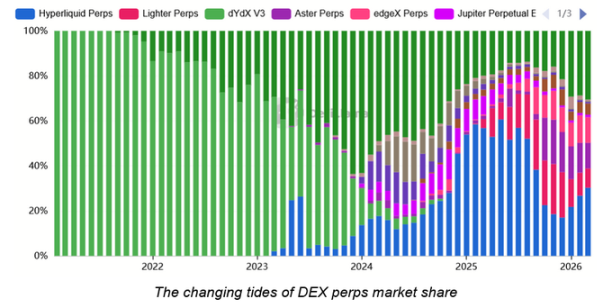
Dynamic shifts in DEX perpetual futures market share
Hyperliquid currently boasts margins above 85% with a team of just over a dozen—reflecting extraordinary capital efficiency. Yet these high margins have attracted new competitors, including Aster and Lighter. Recently, Binance, Coinbase, and Kraken launched equity and commodity perpetuals, directly entering the RWA perpetual market that previously fueled Hyperliquid’s growth. Centralized exchanges’ distribution power is formidable: hundreds of millions of verified users, mature institutional sales infrastructure, and balance sheets robust enough to sustain long-term fee competition. While Hyperliquid has countermeasures—including HIP-3 and builder code mechanisms—even under optimistic assumptions, rising market-share defense costs will likely exert structural downward pressure on margins.
Overall, the reverse DCF model suggests HYPE’s valuation is elevated at a $9 billion market cap. Current pricing presupposes a market environment requiring sustained revenue growth rates unmatched by any exchange in history, dependence on a market whose scale remains unproven, and reliance on a moat already being eroded by competitors. While such an outcome isn’t impossible, for fundamentals-oriented investors it should serve—at minimum—as the base case, not a tail scenario, to justify buying today.
Bottom-Up Valuation Model
To assess HYPE’s fair value more conservatively, we adopt a bottom-up framework to answer two questions: What share of the global derivatives market could perpetual futures capture—and what portion of that market could Hyperliquid claim?
Perpetual futures’ core advantage lies in offering directional leverage seekers a simpler, more capital-efficient instrument—no expiry, no physical settlement, and no broker dependency. By 2030, perpetuals could absorb substantial volume from the following markets. Per Syncracy Capital’s “Great Perpetualization” framework, current global major derivatives market sizes are:
- U.S. options: ~$1,000 trillion/year
- Global futures: ~$938 trillion
- Contracts for Difference (CFDs): ~$250 trillion
- Crypto perpetuals (CEX + DEX): ~$95 trillion
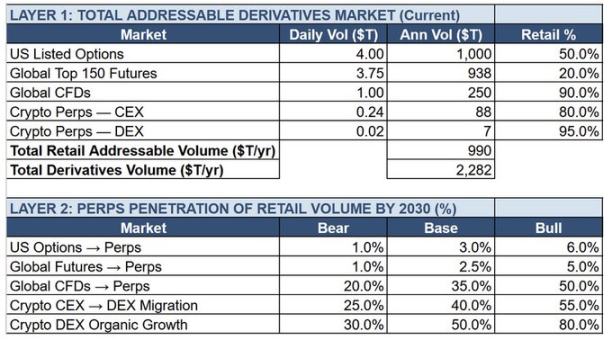
Penetration assumptions differ across markets. We view CFDs as the most readily substitutable, given their retail-speculative orientation and structural disadvantages—opaque OTC brokers and counterparty risk—that perpetuals avoid. Options and futures markets are harder to displace: institutional hedgers require expiry mechanics and physical settlement—features perpetuals cannot replicate—and regulated futures exchanges possess client relationships and compliance infrastructure that DEXs struggle to match.
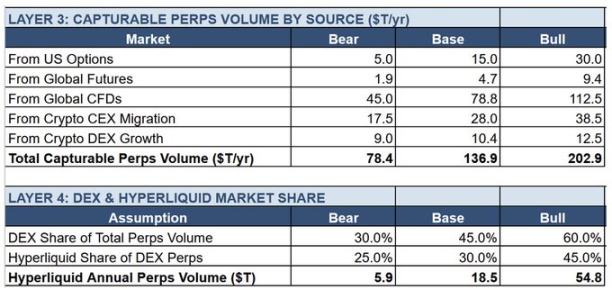
Collectively, our base case assumes that by 2030, DEXs capture 45% of total perpetual futures volume—reflecting ongoing migration of execution from centralized to on-chain venues—and that Hyperliquid holds ~30% of that DEX market.
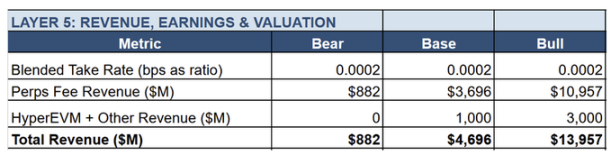
Assuming a 2 bps fee rate, Hyperliquid’s 2030 revenue is projected to range from $4.7 billion (base case) to $14 billion (bull case).
The base case is plausible—but only if multiple conditions align: the overall perpetual TAM expands as expected; Hyperliquid retains its market share; margins remain stable; and HyperEVM’s annualized revenue grows from $800 million today to $3 billion (implied by HIP-4’s forecast market expansion). Failure on any one front leads to a bear case insufficient to support current valuation.
Conclusion
In summary, both models indicate that HYPE’s current price already reflects most positive catalysts, leaving limited margin of safety.
Under the base case, the $11.5 billion revenue required by the reverse DCF model diverges by ~2.5× from the $4.7 billion derived from the bottom-up model.
Current pricing is only sustainable under the bull case, where the bottom-up model yields $14 billion in revenue—significantly higher than the $5.4 billion threshold implied by the reverse DCF model. Yet this bull case demands simultaneous achievement of three conditions: DEXs capturing 60% of the rapidly expanding perpetual market; Hyperliquid retaining 45% of that DEX segment; and HyperEVM revenue growing from $800 million to $3 billion.
Note that the reverse DCF model is highly sensitive to the assumed 30% discount rate. Accepting a lower required return materially alters the valuation conclusion, as shown in the table below.
At a 30% discount rate, the base case indicates the current price already prices in most expected value. Investors buying at this level are essentially purchasing exposure to right-tail scenarios—and have paid a fair price for that optionality.
Join TechFlow official community to stay tuned
Telegram:https://t.me/TechFlowDaily
X (Twitter):https://x.com/TechFlowPost
X (Twitter) EN:https://x.com/BlockFlow_News
 @donovanchoy