The SEC will approve on-chain trading of tokenized stocks this week—a development more significant than the CLARITY Act.
TechFlow Selected TechFlow Selected
The SEC will approve on-chain trading of tokenized stocks this week—a development more significant than the CLARITY Act.
For DeFi infrastructure projects, this is the largest policy validation in three years.
 Navigating Web3 tides with focused insights
Author: Etan Hunt
Translated and edited by TechFlow
TechFlow Intro: According to Bloomberg, the U.S. Securities and Exchange Commission (SEC) is preparing to release its “Innovation Exemption” framework this week—enabling tokenized securities to trade on blockchain networks for the first time under full regulatory compliance. This isn’t about classifying crypto assets; it’s about moving the entire U.S. equities market onto the blockchain. The NYSE is building a tokenization platform; Nasdaq has already received SEC approval; BlackRock’s BUIDL tokenized fund has grown to nearly $3 billion—infrastructure is in place, and the regulatory gate is about to open. For DeFi infrastructure projects, this represents the most significant policy validation in three years.
Apple, Tesla, Amazon—trading on-chain, 24/7, accessible globally to anyone with a crypto wallet. No brokerage account required. No central counterparty. No settlement delay. Instant execution.
This isn’t crypto-native fantasy. It’s what the SEC is preparing to greenlight this week.
Per Bloomberg, the “Innovation Exemption” framework may go live within the next few days. Here’s why it matters more than anything else that’s happened in crypto regulation this year.
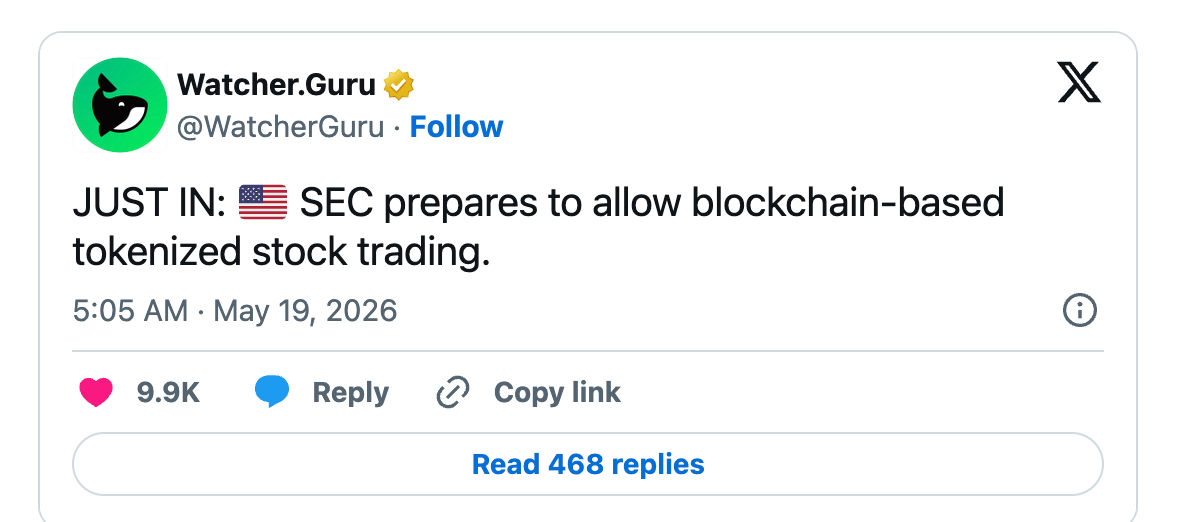
What the SEC Is Actually Doing
SEC Chair Paul Atkins has been laying the groundwork for months. In his April speech at the Economic Club of Washington, D.C., he stated the SEC was “imminently releasing” a framework permitting tokenized securities to trade on blockchain networks for the first time—within a formal regulatory framework.
This framework establishes a 12- to 36-month regulatory sandbox. Eligible firms may issue and trade tokenized securities on-chain without full SEC registration—but must comply with trading volume caps, KYC, and anti-money laundering (AML) requirements, and submit regular reports. Trading may occur on DeFi automated market makers (AMMs) and permissionless public blockchains. Upon sandbox expiration, firms must either complete full regulatory compliance or demonstrate sufficient decentralization.
Infrastructure development began well before the exemption framework was drafted. The New York Stock Exchange is developing a tokenized securities platform. Nasdaq has already secured SEC approval to support tokenized stock trading. The Depository Trust & Clearing Corporation (DTCC) is running a blockchain-based settlement pilot. BlackRock’s BUIDL tokenized fund has approached $3 billion in size and has even been accepted as collateral by Binance. The rails are laid—now the SEC is saying the train can depart.
Why This Matters More Than the CLARITY Act
The CLARITY Act addresses classification: which crypto assets qualify as commodities versus securities. Its significance is undeniable—the Senate Banking Committee passed it 15–9, triggering a sharp market rally.
But the “Innovation Exemption” is different. It doesn’t just impose rules on existing crypto assets—it moves the entire U.S. stock market onto the blockchain.
Investors anywhere in the world can hold tokenized Apple shares or U.S. Treasuries as easily as portfolio managers in New York. Settlement happens in seconds. Fractional ownership becomes trivial. As Atkins put it plainly: “A share is a share—whether printed on paper, recorded in DTCC’s ledger, or represented as a token on a blockchain.”
What This Means for Crypto Infrastructure
All the bets placed over the past three years by DeFi infrastructure projects have now received regulatory validation.
Hyperliquid built a decentralized exchange faster than any traditional venue. When 21Shares launched the HYPE ETF, we noted what it meant for an 11-person team generating $880 million in annual trading fees to gain institutional recognition. A framework enabling tokenized equities to trade on DeFi AMMs and permissionless public blockchains formally validates projects like Hyperliquid and Uniswap. They built the rails—and the SEC has confirmed the train is coming.
The Kevin Warsh Factor
Kevin Warsh assumed the role of Federal Reserve Chair on May 14. As we analyzed earlier, being “Bitcoin-friendly” is not the same as being “Bitcoin-bullish.” His “quantitative tightening first, then rate cuts” framework introduced tangible uncertainty.
The “Innovation Exemption” shifts part of that calculus. A Fed Chair supportive of DeFi derivatives—and an SEC Chair approving tokenized equities on DeFi AMMs—are moving in unison. That’s policy alignment—not coincidence. Crypto assets are becoming core financial infrastructure, and that infrastructure is now being brought into the regulatory fold.
The Bottom Line
This is the most substantively meaningful regulatory development in crypto finance history—not the flashiest, not the one most likely to move Bitcoin’s price in a single day, but the one with the deepest, most lasting impact.
The day the SEC releases the “Innovation Exemption,” the question “Are blockchain and traditional finance two separate systems?” receives its permanent answer: No. The only remaining question is when regulators will officially acknowledge it.
That moment appears to be this week.
Join TechFlow official community to stay tuned
Telegram:https://t.me/TechFlowDaily
X (Twitter):https://x.com/TechFlowPost
X (Twitter) EN:https://x.com/BlockFlow_News
 @dailycoinposts