SEC vs. CFTC: Who Will Hold the “Power of Life and Death” Over the Crypto World Under the CLARITY Act?
TechFlow Selected TechFlow Selected
SEC vs. CFTC: Who Will Hold the “Power of Life and Death” Over the Crypto World Under the CLARITY Act?
The CFTC and the SEC have distinct responsibilities.
 Navigating Web3 tides with focused insights
By: Cointelegraph
Translated by: AididiaoJP, Foresight News
The CLARITY Act proposes a clear division of responsibilities between the U.S. Securities and Exchange Commission (SEC) and the Commodity Futures Trading Commission (CFTC), aiming to clarify how digital assets, exchanges, disclosures, and regulation should operate within the U.S. cryptocurrency market.
Key Takeaways
- Clarifying Definitions and Responsibilities: The bill seeks to resolve years of regulatory ambiguity through a structured framework—defining what constitutes a digital asset, clarifying the roles of intermediaries, and specifying required disclosures.
- Distinct Roles for the CFTC and SEC: Spot trading of most qualified tokens will fall under CFTC oversight, while the SEC retains authority over primary-market offerings, disclosures, and investor protection.
- Regulating Both Assets and Conduct: The bill addresses not only the nature of assets but also market behavior—establishing registration and conduct standards for exchanges, brokers, and dealers to enhance market integrity and transparency.
- Complementing Stablecoin Legislation: While stablecoins are primarily governed by the GENIUS Act, the CLARITY Act plays a supplementary role—for instance, in areas involving disclosures or reward mechanisms tied to stablecoin usage.
The CLARITY Act (the 2025 Digital Asset Market Structure Clarification Act) attempts to break the legislative deadlock in the industry through a two-pronged approach: first, precisely defining digital assets; second, assigning regulatory authority based on their actual functional roles in the market. This legislation aims to shift away from case-by-case enforcement toward a comprehensive framework covering asset classification, intermediary responsibilities, and mandatory disclosures.
This article explains what the CLARITY Act is and why it matters, outlines its objectives, and explores how it intends to regulate stablecoins. It also covers the concept of “mature” blockchains, major criticisms of the bill, and its current legislative status.
Why the CLARITY Act Matters
The CLARITY Act tackles a long-standing challenge in crypto: regulatory uncertainty.
For years, digital asset firms have struggled with unclear jurisdictional boundaries between the SEC and the CFTC. The SEC frequently treats many tokens as securities, while the CFTC classifies them as commodities. This gray area has slowed innovation, complicated compliance efforts, confused investors, and created significant challenges for crypto businesses.
The CLARITY Act aims to break this impasse by clearly defining digital assets and allocating regulatory responsibility according to asset type and associated activities. With a pre-established, transparent framework, market participants can know from the outset which rules apply—rather than facing uncertainty arising from reactive enforcement actions.
Main Objectives of the CLARITY Act
The bill establishes its regulatory system primarily through three mechanisms:
More Precise Classification of Asset Types
The CLARITY Act introduces the concept of a “digital commodity”—a digital asset whose value derives primarily from the use of its underlying blockchain system. This definition explicitly excludes traditional securities and stablecoins. As a result, spot trading of many qualifying tokens would fall under CFTC jurisdiction. Reflecting real-world blockchain operations, the definition places particular emphasis on functionality and the degree of decentralization of the network.
Clarifying Regulatory Boundaries
The bill allocates regulatory authority by function:
- The CFTC gains primary authority over digital commodity trading—particularly in secondary markets, spot markets, and on trading platforms.
- The SEC retains authority over primary-market offerings, investor protection, mandatory disclosures, and initial sales.
- The bill also encourages joint rulemaking by both agencies in overlapping areas such as disclosure requirements.
Establishing Uniform Disclosure and Conduct Standards
To protect investors and uphold market fairness, the bill mandates standardized disclosures by developers and issuers—covering technical details of the blockchain, tokenomics, and key risks—so market participants can make comparable assessments across projects. Intermediaries—including digital commodity exchanges, brokers, and dealers—are required to register, report, and submit to oversight, with transaction-related activities falling mainly under CFTC jurisdiction.
Overall, the CLARITY Act seeks to replace ambiguity with clarity—supporting industry innovation while safeguarding investors and ensuring market integrity.
Debates over cryptocurrency market structure are influencing policymakers’ thinking about how to regulate artificial intelligence models, as both involve challenges in assigning responsibility and rapid iterative innovation.
How the CLARITY Act Regulates Stablecoins
The GENIUS Act, passed in 2025, established a federal regulatory framework for payment stablecoins. It stipulates that qualified stablecoins meeting strict reserve, redemption, and oversight requirements will not be classified as securities or commodities.
The CLARITY Act does not override or duplicate this stablecoin regulatory regime. Instead, its provisions serve a complementary function—particularly regarding rewards linked to stablecoins, related disclosures, and how stablecoins interact with the broader digital asset market.
The Concept of a “Mature” Blockchain
Recognizing that assets evolve over time, the CLARITY Act provides a pathway for blockchains to achieve “maturity” once they meet certain thresholds of decentralization and other functional criteria.
Once deemed “mature,” associated tokens would be reclassified as “digital commodities” and thus subject to CFTC oversight. If other conditions are satisfied, this could significantly reduce regulatory burdens—for example, potentially eliminating the need for registration.
The “mature blockchain” concept reflects the principle that as networks become more decentralized and widely distributed, their regulatory treatment should adapt accordingly. It offers projects a clearer path toward future compliance under more flexible regulatory standards.
In past regulatory disputes, courts have occasionally applied decades-old securities law precedents to determine the nature of crypto tokens—highlighting how existing legal frameworks have been awkwardly retrofitted onto entirely new digital markets.
Ongoing Criticisms of the CLARITY Act
Although the bill aims to bring clarity, skepticism remains. Critics argue its definitions may still contain loopholes—especially in decentralized finance (DeFi), where projects often resist traditional regulatory categorization.
Others contend the bill’s investor protections fall short of existing securities law standards. Additional concerns center on potential jurisdictional overlaps—for instance, how the SEC’s anti-fraud authority would apply within domains primarily overseen by the CFTC, particularly for tokens exhibiting hybrid characteristics.
Legislative Progress of the CLARITY Act
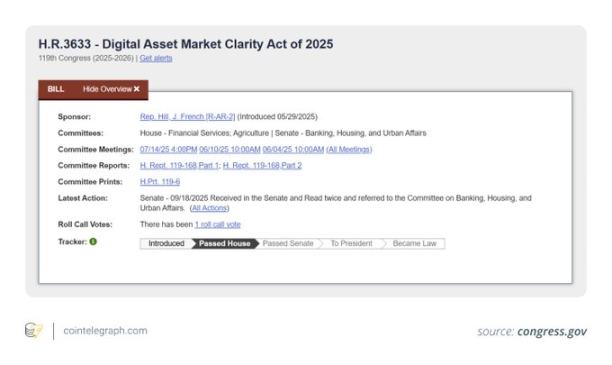
The U.S. House of Representatives passed the CLARITY Act (H.R. 3633) in July 2025 with bipartisan support. As of January 2026, the bill awaits Senate action and has been referred to the Senate Committee on Banking, Housing, and Urban Affairs for consideration. The legislative process also involves input from the Senate Committee on Agriculture, Nutrition, and Forestry on matters relating to CFTC oversight.
As of January 2026, relevant Senate committees have held hearings, released discussion drafts, proposed amendments, and advanced versions of broader market-structure legislation. However, revisions and refinements to the bill face delays and adjustments due to controversies over issues such as stablecoin yield and investor protection. Harmonization efforts between the Senate draft and the House-passed version remain ongoing, and the Senate has yet to hold a final vote.
If ultimately enacted in a harmonized form, the CLARITY Act would become the first comprehensive federal legal framework addressing digital asset market structure in the United States.
Some blockchain networks now publish real-time transparency dashboards showing validator concentration, token velocity, and governance participation. Regulators sometimes reference these metrics when assessing whether a network is “sufficiently decentralized.”
Assessing the CLARITY Act’s Blueprint
At its core, the CLARITY Act seeks to resolve a persistent problem in crypto: unclear regulatory boundaries—which both hinder innovation and lead to reactive enforcement rather than proactive compliance.
By clarifying asset classifications, mandating uniform disclosures, and delineating responsibilities between the SEC and CFTC, the bill aims to create a more predictable regulatory environment—allowing market participants to understand from the outset which rules apply to them.
Of course, legislation is only the first step. Implementation, development of detailed rules, and potential future adjustments will ultimately determine the CLARITY Act’s real-world impact. Whether it delivers the clarity it promises will profoundly shape U.S. crypto policy and industry competitiveness over the coming years.
Join TechFlow official community to stay tuned
Telegram:https://t.me/TechFlowDaily
X (Twitter):https://x.com/TechFlowPost
X (Twitter) EN:https://x.com/BlockFlow_News
 @Cointelegraph