Joint Offensive: A Detailed Look at CFTC's "Crypto Sprint Initiative" and SEC's "Project Crypto" Strategic Roadmap
TechFlow Selected TechFlow Selected
Joint Offensive: A Detailed Look at CFTC's "Crypto Sprint Initiative" and SEC's "Project Crypto" Strategic Roadmap
The entire industry is waiting for a landmark event, an accelerating signal moving from "establishing a friendly stance" to "fully establishing rules."
 Navigating Web3 tides with focused insights
Author: Luke, Mars Finance
Prologue: Clearing the Policy Legacy of the Old Era
August 22, 2025—over seven months since the new administration took office. Since January of this year, Washington's friendly stance toward the crypto industry has become a clear policy direction. Yet, despite this overarching shift, obstacles left behind by the previous administration still litter the path forward. The "enforcement-first" regulatory approach championed by former SEC Chair Gary Gensler before his departure in January 2025 has left behind hazards like submerged reefs after a receding tide. Though their impact has diminished, numerous unresolved lawsuits and ambiguous rule definitions continue to constrain the industry’s potential.
Under Gensler, the SEC operated on the principle that most digital assets should be classified as securities, using litigation rather than legislation to define boundaries. The consequences of this strategy are evident: industry leaders like Coinbase still face legal challenges; the controversial Staff Accounting Bulletin No. 121 (SAB 121) restricts banks from offering large-scale crypto custody services; and developers and project teams still lack a clear, predictable "safe harbor" defining what constitutes a security.
Thus, for the crypto industry in 2025, the challenge is no longer confronting a hostile regulator, but collaborating with a supportive government to efficiently dismantle the scaffolding of the old era and rapidly build a clear, robust legal framework capable of supporting a decade of future growth. The entire industry has been awaiting a landmark moment—a signal accelerating the transition from "friendly gestures" to "comprehensive rulemaking."
The Acceleration: Coordinated Action from Washington
That signal arrived clearly on August 22. This was not a sudden policy reversal, but a long-anticipated, coordinated effort to formalize and systematize pro-crypto policies. Two major U.S. financial regulators—the Commodity Futures Trading Commission (CFTC) and the Securities and Exchange Commission (SEC)—launched a synchronized joint initiative, marking the official start of a "major campaign" to establish clear rules for America’s crypto sector.
CFTC Acting Chair Caroline D. Pham announced the launch of a new "Crypto Sprint Initiative," with the core objective of swiftly implementing recommendations from the President’s Digital Asset Market Working Group report, making the federal establishment of spot markets for digital commodities its top priority. This marks a full transition from policy declaration to efficient execution and implementation.
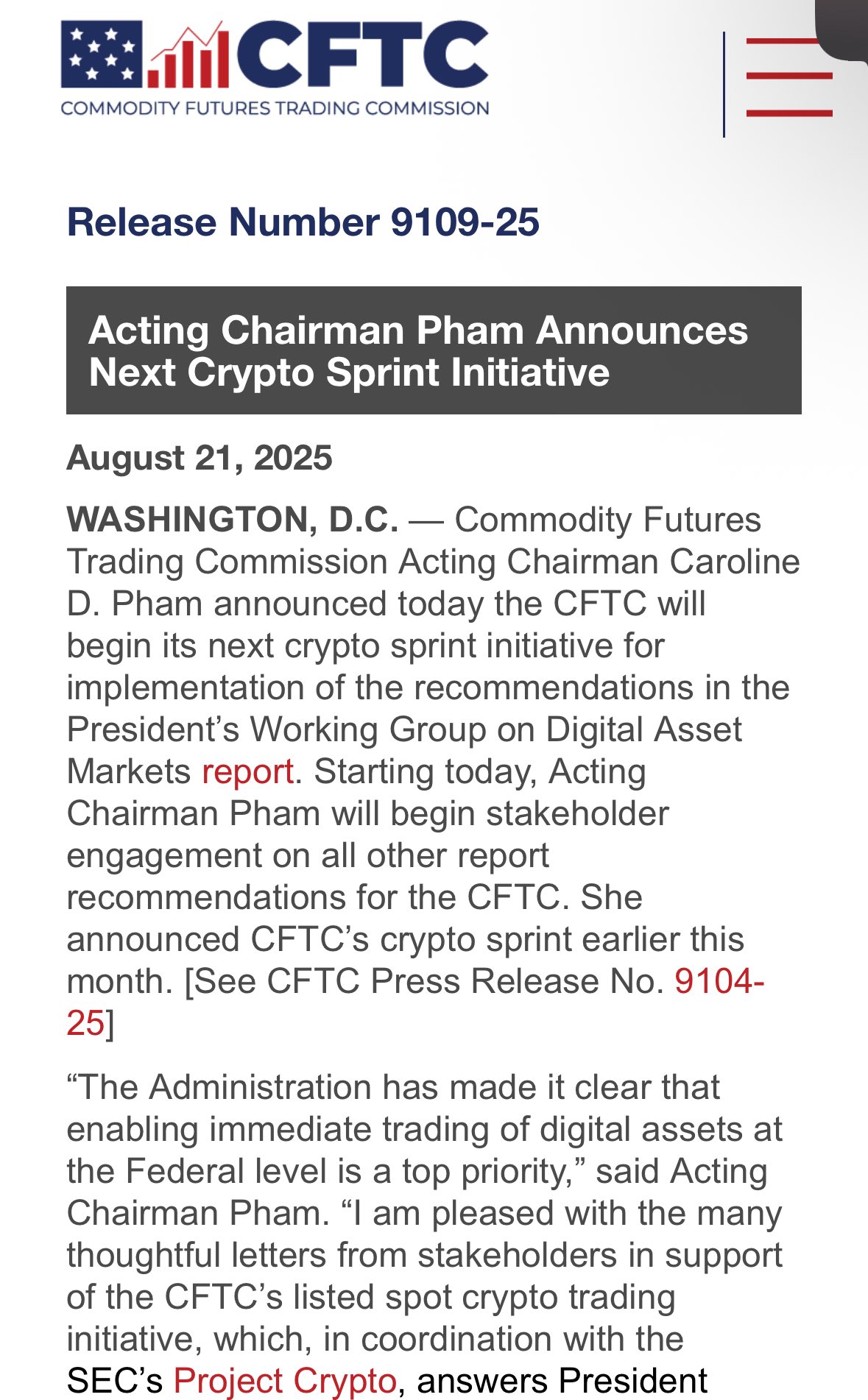
The SEC also officially unveiled its complementary master plan—"Project Crypto." Designed to work in tandem with the CFTC, this project aims to co-develop a regulatory framework for digital asset markets that protects investors while maximizing innovation. Both agencies have aligned their messaging around the presidential working group’s report titled *Strengthening U.S. Leadership in Digital Financial Technology*, signaling that all actions will operate within a unified national strategic framework.

The significance of this coordinated action is profound: regulators are no longer operating in silos, but as a unified "coalition force" resolving legacy issues and jointly building the future. This marks a definitive shift in U.S. crypto regulation—from correcting past errors to establishing foundational systems.
The New Regulatory Duo: Blueprints of "Sprint" and "Project"
The "Crypto Sprint Initiative" and "Project Crypto" function as complementary forces at the heart of this regulatory transformation.
The CFTC’s "Crypto Sprint" acts as a pragmatic engineering unit, focused on clearing the most critical pathways. Its central mission is to establish a federally recognized, compliant spot market for digital commodities such as Bitcoin and Ethereum—the bedrock of industry growth. By proactively soliciting public feedback on specific trading rules like leverage and margin requirements, the CFTC demonstrates an open and efficient approach, aiming to rapidly build a high-speed highway connecting digital commodities to mainstream finance.
In contrast, the SEC’s "Project Crypto" serves as the visionary chief architect, tasked with designing the comprehensive blueprint for the future of digital finance. Its agenda is highly forward-looking: first, reforming outdated custody regulations to pave the way for repealing SAB 121, enabling traditional banks to securely and compliantly hold digital assets at scale; second, creating an "innovation safe harbor" allowing startups to issue tokens under specific disclosure conditions, providing crucial early-stage breathing room for innovation; and most revolutionary, promoting the "super-app" model—permitting a single compliant entity to offer both digital commodity (CFTC-regulated) and digital securities (SEC-regulated) trading services, thereby dismantling artificial business barriers.
One focuses on rapidly clearing obstacles, the other on long-term architectural planning. Together, they transform the current administration’s pro-crypto stance into an actionable, predictable roadmap.
Wall Street’s Beachhead Landing
Once a clear regulatory framework begins taking shape, Wall Street capital is the first to seize the opportunity. For these financial giants, this coordinated action signals a full-scale entry into the digital asset arena. The friendly overtures of the past seven months had already primed them for action, and now concrete regulatory blueprints give them the confidence to deploy substantial resources.
A flood of institutional capital: The CFTC’s clear oversight of spot markets, combined with anticipated SEC reforms on custody rules, means the final compliance barriers preventing pension funds, sovereign wealth funds, and other deep-pocketed institutional investors from entering the market are being removed. Capital inflows will shift from a trickle to a torrent.
Upgraded financial infrastructure: The role of U.S.-based exchanges like Coinbase will be elevated. They will transition from entities striving to prove compliance to becoming core financial infrastructure formally recognized by two federal regulators. Under the "super-app" framework, they could emerge as "super gateways" linking traditional finance with the digital world, ready to process massive volumes of orders from Wall Street.
The return of the innovation engine: The concept of an "innovation safe harbor" holds immense appeal for global Web3 talent and projects. It sends a clear message: the U.S. doesn’t just welcome crypto companies—it will provide the world’s most favorable environment for innovation. A reverse migration of intellectual capital and a surge in domestic innovation are imminent.
As the regulatory framework gradually takes effect, market pricing power will accelerate its shift from early adopters to institutional investors. Wall Street’s arrival will bring unprecedented depth, liquidity, and stability to the market.
Epilogue: Securing a Decade of Leadership
Of course, Rome wasn’t built in a day. Full implementation of the new policies will require resolving countless technical details, and debates over the classification of new token types will continue under the new framework. But these are no longer existential struggles—they are technical discussions within a construction process.
The fundamental shift is that the U.S. has completed the critical leap from "friendly attitude" to "clear rules." The regulators’ role has firmly transformed into that of market partners and builders. This joint initiative by the CFTC and SEC is not merely about cleaning up policy debris from the past—it is about laying a solid foundation for America’s dominance in digital finance over the next decade.
Globally, amid fierce competition from hubs like Hong Kong and Dubai, the U.S. has responded with a coordinated, efficient, and visionary regulatory overhaul. A rules-based America will become the ultimate destination for capital, talent, and innovation in the global digital economy era.
Join TechFlow official community to stay tuned
Telegram:https://t.me/TechFlowDaily
X (Twitter):https://x.com/TechFlowPost
X (Twitter) EN:https://x.com/BlockFlow_News