The $12.6 trillion repo market is quietly migrating to Ethereum—yet no one seems to be talking about it.
TechFlow Selected TechFlow Selected
The $12.6 trillion repo market is quietly migrating to Ethereum—yet no one seems to be talking about it.
Traditional financial giants are quietly adopting Ethereum as settlement infrastructure, and the overnight repurchase market’s daily trading volume exceeds the total cryptocurrency market capitalization by more than tenfold.
 Navigating Web3 tides with focused insights
By: Eli5DeFi
Translated by: AididiaoJP, Foresight News
BlackRock, JPMorgan Chase, Apollo, Société Générale, and the Bank of France—all these institutions are currently experimenting with Ethereum as financial infrastructure.
Not buying ETH. Not launching crypto products for retail investors. Not issuing press releases about a “Web3 strategy.”
They are deploying Ethereum as production-grade financial infrastructure to move trillions of dollars. Meanwhile, 99% of crypto Twitter remains preoccupied with debating whether crypto is dead—or which coin to pump next.
Let me clarify this, because it has been almost entirely underreported.
First: What Exactly Is a Repo?
A repo (repurchase agreement) is arguably the simplest transaction in finance.
Suppose you need $100 in cash tonight, and you hold a U.S. Treasury bond worth $100. You walk into a bank and say: “Buy this bond from me today for $100. Tomorrow, I’ll repurchase it from you for $100.02.” The bank agrees. You get your cash; they earn $0.02 in interest. Tomorrow, the bond returns to you, and the cash returns to them.
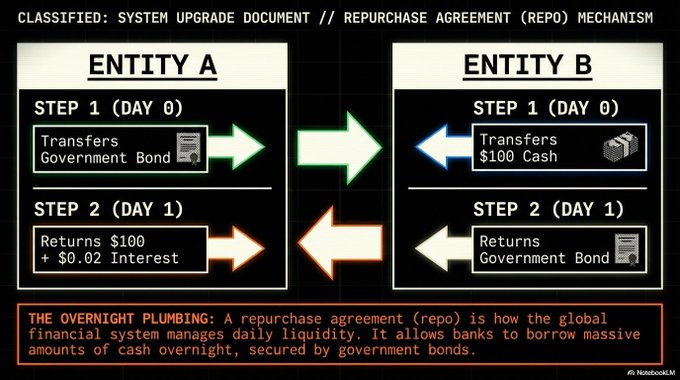
That’s a repo. “Repo” refers to the agreement to repurchase the bond; the $0.02 difference is the interest. The Treasury bond serves as collateral—making the transaction secure.
Now scale this up to the entire financial system.
Every day, banks, hedge funds, money market funds, and broker-dealers run variants of this transaction to manage liquidity. A bank that receives a large deposit on Tuesday but needs cash on Wednesday will execute a repo. A hedge fund needing overnight financing for its Treasury position will do a repo. A money market fund holding idle cash and seeking risk-free yield will act as the counterparty.
The repo market is the financial system’s overnight plumbing.
It’s how banks maintain liquidity day after day. It determines the cost of borrowing against Treasuries—and that cost subsequently influences nearly every other interest rate you encounter.
As of Q3 2025, this market alone handles $12.6 trillion in daily volume in the U.S. Add Europe’s €10.9 trillion, and you’re looking at roughly $25 trillion in daily turnover.
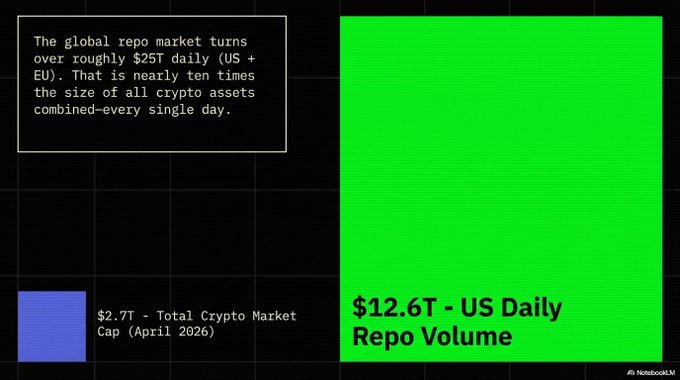
For context: In April 2026, the total market capitalization of the entire crypto market stood at ~$2.7 trillion. The repo market’s daily turnover is nearly ten times the combined value of all crypto assets.
Most long-term ETH holders—those who’ve held since Ethereum’s genesis—have never even heard of this.
The Day the Global Financial System Almost Ground to a Halt
To understand why institutions are willing to spend hundreds of millions of dollars moving repos onto Ethereum, you must first grasp what happened on September 17, 2019.
On September 16, two routine events collided:
- Corporate quarterly tax payments came due. Corporations withdrew approximately $35 billion from money market funds to pay taxes.
- Simultaneously, $54 billion in newly issued U.S. Treasuries settled, landing instantly on primary dealers’ balance sheets. These dealers needed overnight repo financing to fund their inventory.
Together, these two events drained $120 billion in liquidity from the banking system in under 48 hours.

This exposed the system’s fragility. The Federal Reserve had been shrinking its balance sheet for two years prior, steadily reducing bank reserves.
By September 2019, reserves had fallen below $1.4 trillion. Removing $120 billion from $1.4 trillion may sound manageable—but it wasn’t, because reserves weren’t evenly distributed.
Some banks held abundant reserves; others held none. And at the time, no efficient mechanism existed to route funds from surplus banks to deficit banks.
Consequently, the Secured Overnight Financing Rate (SOFR) spiked—from 2.43% on September 16 to 5.25% on September 17, peaking intra-day at 10%. For a market where movements are typically measured in basis points, this was like an earthquake striking a building you assumed was structurally sound.
Yes—it was chaotic.
The Fed was forced to inject $75 billion in emergency liquidity on September 17 itself. Daily liquidity operations continued through June 2020.
The official post-mortem identified two key factors that significantly exacerbated the rate spike: limited transparency (price information did not flow across different segments of the repo market), and market fragmentation (funds could not flow efficiently between different corners of the system).
In short: money existed. Liquidity existed. But the system couldn’t deliver it fast enough, at the right time, to the right place.
And precisely this failure point is one that on-chain settlement is structurally designed to fix—something no centralized infrastructure can achieve.
Ethereum Enters (Quietly—No Press Release)
No one officially announced, “The repo market is migrating to Ethereum.”
Institutional finance doesn’t operate that way. Instead, throughout 2024, 2025, and into 2026, a series of decisions were made—one after another—by institutions known for near-zero error rates:
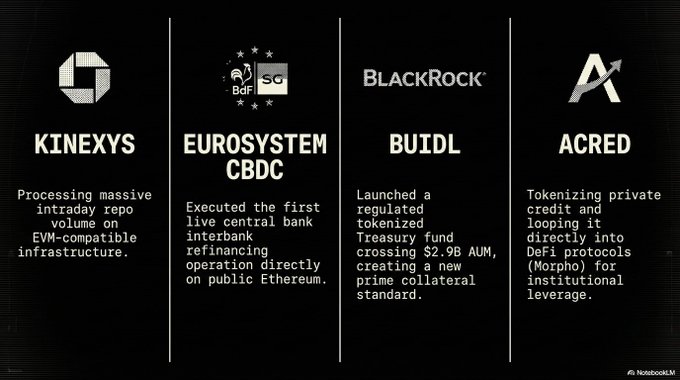
JPMorgan Chase: Over $300 Billion in Blockchain Repos (Already Live)
JPMorgan began building blockchain-based intraday repos back in 2019, when its platform was still called Onyx (now rebranded as Kinexys).
How it works: Institutions deposit tokenized collateral on Kinexys to borrow intraday funds, repaying cash before market close.
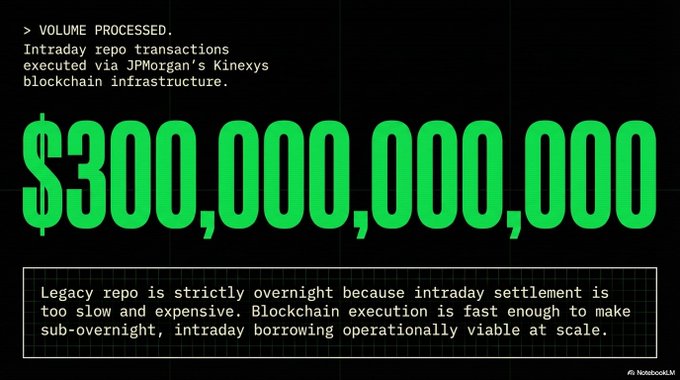
Why emphasize “intraday”? Because traditional repos are mostly overnight.
In traditional finance, intraday repos are costly and operationally cumbersome—most institutions avoid them altogether. On a blockchain, however, execution, settlement, and reversal can all occur within the same trading day, with negligible cost.
The result:
Kinexys has processed over $300 billion in intraday repo transactions since launch.
Total transaction volume across the full platform—including repos, cross-border payments, and FX—has surpassed $1.5 trillion, with daily volumes averaging $2 billion.
Clients include Siemens, BlackRock, and Ant International.
In December 2025, JPMorgan doubled down—launching My OnChain Net Yield Fund (MONY), a tokenized money market fund, directly on Ethereum Mainnet. MONY launched with $100 million in seed capital and is redeemable in USDC.
With $4.6 trillion in assets under management, JPMorgan is now the first global systemically important bank (G-SIB) to operate a tokenized fund on a public blockchain.
Société Générale + Bank of France: First Central Bank Repo on Ethereum Public Chain (2024)
In December 2024, Société Générale’s digital asset subsidiary SG-FORGE executed the first blockchain-based repo transaction with a Eurosystem central bank. The structure was as follows:
SG-FORGE deposited bonds issued on Ethereum Mainnet in 2020 as collateral.
The Bank of France—the French central bank—issued wholesale central bank digital currency (wCBDC) in exchange.
The end-to-end repo was executed as a live, on-chain trade.
The Bank of France described the trial as demonstrating “the technical feasibility of interbank refinancing operations directly on a blockchain.” In plain English: “We tested it. It works. We’re considering wider adoption.”
The European overnight repo market totals €10.9 trillion. The Eurosystem is both participant and regulator. A live repo conducted by a national central bank on Ethereum Mainnet is a policy signal—not a hackathon project.
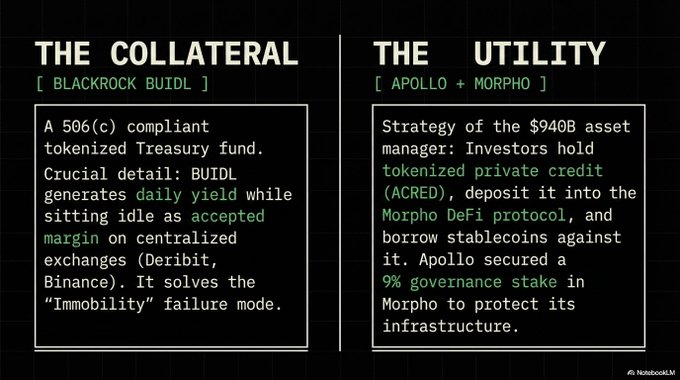
BlackRock BUIDL: Tokenized Treasuries Are Becoming the New Collateral Standard
BlackRock launched its USD Institutional Digital Liquidity Fund on Ethereum Mainnet in March 2024.
BUIDL holds short-dated U.S. Treasuries and cash equivalents, distributing daily yields directly to crypto wallets—with near-instant settlement. By mid-2025, its peak assets under management approached $2.9 billion—accounting for 42% of the tokenized Treasury market.
What matters for overnight repos: BUIDL is now accepted as collateral by Deribit, Crypto.com, and Binance. It also serves as reserve backing for Frax stablecoins and as margin for derivatives trading. JPMorgan launched its direct competitor, MONY, in December 2025.
What’s truly happening here is that tokenized money market funds are becoming a new class of repo collateral—and they’re superior to traditional repo collateral because they generate yield while sitting idle as margin.
In traditional finance, when you pledge a Treasury bond as collateral, it simply sits dormant in a clearinghouse—earning zero incremental return. With BUIDL or MONY, yield accrues continuously—even while the asset is pledged as collateral.
Apollo + Morpho: Private Credit Enters the DeFi Lending Stack
Apollo Global Management manages $940 billion in assets. In early 2025, it tokenized its Apollo Diversified Credit Fund via Securitize and deployed the tokens as collateral on the DeFi lending protocol Morpho.
This created a circular strategy:
- Investors hold tokenized ACRED (a private credit fund share).
- ACRED is deposited into Morpho as collateral.
- Stablecoins are borrowed against it.
- The borrowed liquidity is redeployed into other on-chain strategies.
- The spread between ACRED yield and borrowing costs is captured.
This is a “looping” strategy. In traditional finance, achieving this would require prime brokerage relationships and mountains of paperwork. Onchain, it’s just a few smart contract interactions.
This marks the first time a private credit fund has been used in an on-chain structured product. Apollo’s own description: “Tokenization enables accessibility, and onchain financial infrastructure creates new utility.”
In February 2026, Apollo deepened its commitment—entering a partnership to acquire up to 90 million MORPHO tokens (9% of total supply) over 48 months. These tokens grant governance rights over Morpho’s protocol parameters and fee structure. Apollo isn’t just using DeFi infrastructure—it’s becoming a stakeholder in it.
Morpho currently holds over $10 billion in deposits across major EVM chains (per Messari). Coinbase’s Morpho-powered crypto-backed lending product—launched in late 2025—has already accumulated $1.7 billion in collateral (primarily ETH and BTC) and $960 million in active loans.
Bitwise launched a USDC yield vault on Morpho in January 2026. This is evolving into infrastructure—not a niche DeFi application.
What On-Chain Overnight Repos Actually Solve
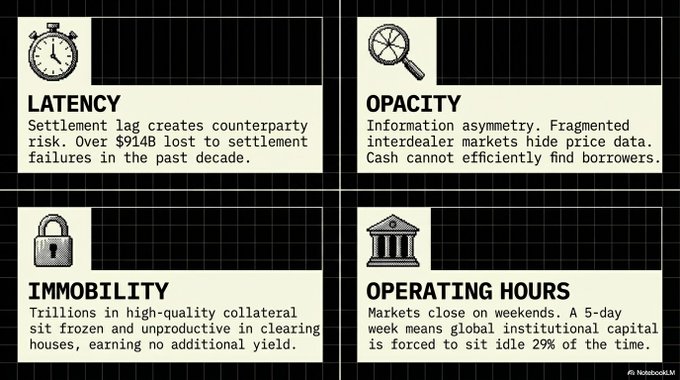
Traditional overnight repos suffer from four structural problems:
Problem One: Settlement Delays Create Counterparty Risk
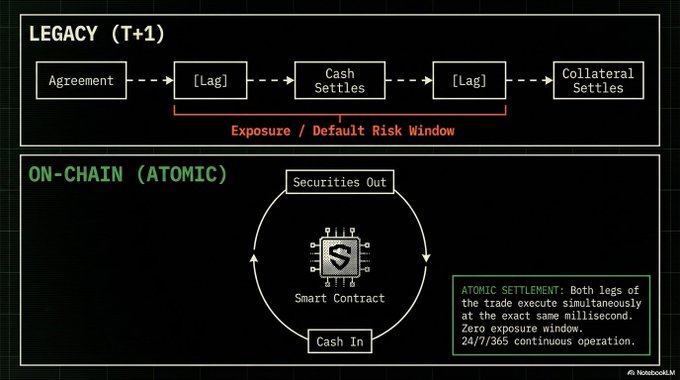
In traditional overnight repos, you agree to a trade today—but actual movement of securities and cash takes time. During this window, your counterparty could default—and you’d be left holding nothing. According to JPMorgan, settlement failures have cost market participants over $914 billion in the past decade.
On-chain solution: Atomic settlement. In a blockchain transaction, both legs—security out, cash in—settle simultaneously. Either both happen, or neither does. No exposure window exists. JPMorgan has already partnered with Chainlink and Ondo Finance to test cross-chain trades in live environments—settling tokenized U.S. Treasuries against dollar deposits across two distinct blockchain networks in real time.
Problem Two: Information Cannot Flow Across Market Segments
The severity of the September 2019 crisis was amplified partly because different repo market segments—tri-party repos, cleared bilateral repos, and dealer-to-dealer markets—did not share price information in real time. Banks holding excess liquidity didn’t know where to deploy it. Borrowers couldn’t locate cheap cash. The pipeline was clogged.
On-chain solution: A shared, transparent ledger. Every trade, every rate, every collateral position is visible on-chain in real time. All market participants read from the same world state. The information asymmetry that worsened the September 2019 crisis is structurally mitigated.
Problem Three: Collateral Is Frozen and Non-Productive
When you pledge a Treasury bond as repo collateral, it’s locked in a clearinghouse—serving no further purpose for you. In a $12.6 trillion-per-day market, the opportunity cost of frozen collateral is enormous.
On-chain solution: Programmable, composable collateral. A tokenized bond on Ethereum knows its owner, automatically transfers upon condition fulfillment, earns yield while staked, and can be used simultaneously across multiple protocols under predefined rules. BUIDL deposited as margin on Binance continues earning daily yield from underlying Treasuries—an impossibility in traditional finance.
Problem Four: Markets Have Business-Hours Constraints
Traditional overnight repo markets close on weekends. Banks compress balance sheets ahead of quarter-end reporting—recalling loans to clean up books—creating predictable stress events every 90 days. With markets open only five days per week, capital sits idle 29% of the time.
On-chain solution: 7×24 settlement—Ethereum has no business hours. JPMorgan explicitly markets its blockchain deposit accounts as enabling “7×24 same-day settlement.” The viability of intraday repos on Kinexys stems precisely from blockchain settlement speed—making sub-overnight lending operationally feasible.
What This Means for ETH Itself (Three Demand Vectors)
ETH remains highly sensitive to macro drivers. Early 2026 saw it fall ~23%, from $2,200 to ~$1,700, under tariff-related pressure—trading predominantly as a risk asset across most market conditions.
This institutional migration to on-chain repos won’t override short-term price dynamics.
But it does create structural, long-term demand—demand invisible to funding rates or retail sentiment. There are three mechanisms:
Blockspace Demand
Every on-chain overnight repo transaction, every BUIDL transfer deposited as collateral, every stablecoin loan taken out against ACRED on Morpho consumes Ethereum blockspace. EIP-1559 burns part of every transaction fee. More institutional-grade blockspace demand equals more fee burns—and thus, net supply reduction over time. JPMorgan processes $2 billion in daily transactions on Kinexys (primarily on EVM-compatible infrastructure)—establishing a baseline level of institutional blockspace consumption that simply didn’t exist three years ago.
ETH as High-Quality Collateral
Standard Chartered reported in early 2026 that corporate treasuries and ETH spot ETFs had collectively acquired ~3.8% of circulating ETH since June 2025. Corporate treasuries alone purchased ~2.3 million ETH in roughly two months—a pace nearly twice that of Bitcoin’s comparable accumulation phase. Coinbase’s integration with Morpho currently supports $1.7 billion in active loans backed by collateral—predominantly ETH. ETH is functioning as high-quality collateral in institutional credit operations.
Staking Yield as the On-Chain Reference Rate
As more institutional activity settles on Ethereum—and as institutional idle liquidity parks in ETH-denominated yield instruments—ETH staking yield (~3.8% for solo stakers) is emerging as the de facto on-chain risk-free rate. This represents a structural anchor for ETH staking demand, scaling proportionally with on-chain institutional settlement volume.
Transparent Risk Inventory
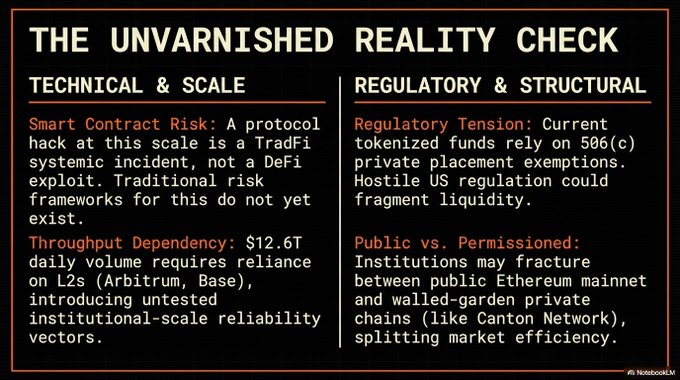
Institutional-scale smart contract risk. Morpho holds over $10 billion in deposits. Apollo has governance exposure to a single protocol. A critical vulnerability wouldn’t just make headlines in DeFi news—it would constitute a traditional financial event. No risk-management framework yet exists in traditional finance for exposures of this kind.
Regulatory uncertainty remains real. BUIDL and MONY operate under SEC Rule 506(c) private placement exemptions—carefully engineered workarounds for regulatory gaps that remain unfilled. An adverse U.S. regulatory action targeting on-chain money market fund structures would force institutional activity back onto permissioned private chains, fragmenting the ecosystem.
Tension between public and permissioned chains. JPMorgan’s core Kinexys infrastructure remains a permissioned chain. Canton Network—though public—is purpose-built for institutional use and includes privacy controls. Not every institution will opt for Ethereum Mainnet. Part of this migration may ultimately land on purpose-built institutional chains—not public-chain Ethereum.
Oracle dependency at scale. Programmable collateral requires reliable price feeds. Chainlink currently fulfills this role in live institutional pilots. An oracle failure or manipulation at repo-market scale carries fundamentally different risk implications than a DeFi liquidation cascade.
Throughput. Ethereum Mainnet cannot—and does not need to—process $12.6 trillion in daily settlement volume. L2 rollups (e.g., Base, Arbitrum) handle transaction load, while Ethereum Mainnet provides finality and data availability. Yet institutional-grade L2 reliability hasn’t yet been stress-tested at this scale—and, as we know, Ethereum’s roadmap still has a long way to go.
The Big Picture
Step back and observe what’s actually happening:
The overnight repo market has a known failure mode—publicly demonstrated in September 2019. The root causes are specific: settlement delays during liquidity crunches, market fragmentation, and information asymmetry. These are engineering problems—with corresponding engineering solutions.
Blockchain settlement eliminates settlement delays. A shared on-chain ledger eliminates information asymmetry. Programmable collateral eliminates frozen collateral. 7×24 operation eliminates calendar-driven stress events.
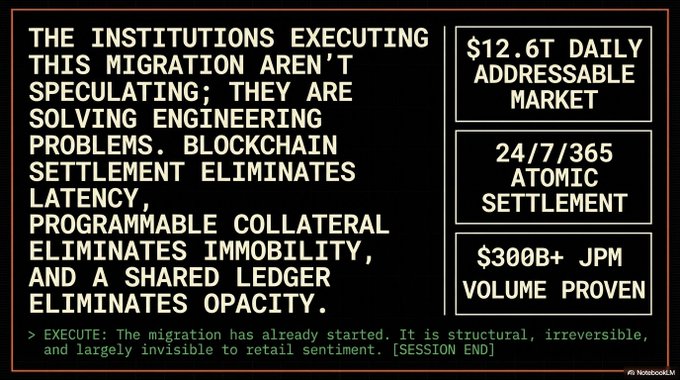
The institutions executing this migration aren’t speculating on crypto—they’re solving operational problems with operational tools:
JPMorgan runs $1.5 trillion in blockchain transactions—not because its digital assets team believes in ETH. It does so because it’s objectively better than the alternatives.
Apollo acquires 9% governance rights in a DeFi protocol—not for yield farming. It does so because it raised $228 billion in new capital in 2025 and needs infrastructure capable of handling institutional-scale credit—customizable, globally accessible, and scalable.
The Bank of France executes live overnight repos on Ethereum Mainnet—not as PR theater. It does so because the European repo market stands at €10.9 trillion, and it’s evaluating whether CBDCs can improve collateral liquidity within it.
None of this guarantees ETH’s price. Markets are irrational. Macro conditions are harsh. Institutional adoption can coexist with multi-month corrections (see every ETF launch in history).
But the structural demand being built at the protocol layer—by institutions whose infrastructure decisions must endure for a decade—is real, growing, and largely invisible to retail sentiment.
This migration has already begun.
Join TechFlow official community to stay tuned
Telegram:https://t.me/TechFlowDaily
X (Twitter):https://x.com/TechFlowPost
X (Twitter) EN:https://x.com/BlockFlow_News
 @eli5_defi