Bringing ChatGPT Together with Cryptocurrency Trading: Exploring Anoma's Intent-Driven Trading Architecture
TechFlow Selected TechFlow Selected
Bringing ChatGPT Together with Cryptocurrency Trading: Exploring Anoma's Intent-Driven Trading Architecture
Anoma's vision is bold, and if successful, Anoma will change the world.
 Navigating Web3 tides with focused insights
Author: Winter Soldier
Translation: TechFlow
What if you could combine ChatGPT with cryptocurrency? What if you could execute transactions through simple text prompts? How would that change our behavior? What would the future look like? As I explored Anoma and their intent-centric architecture, these questions kept coming back to me.
Anoma's vision is bold. Through this narrative, I hope you'll grasp the impact of what they're building—so that by the end, after your own research, you’ll feel the same way I do: if they succeed, Anoma will change the world.
Intent vs Transaction: What’s the Difference?
A transaction specifies an execution path.
For example, I go to a McDonald’s two blocks away to buy a Big Mac meal with fries and Coke for $8. This is your typical on-chain transaction:
-
Specific store (DEX);
-
Specific location (chain);
-
Specific item (token);
-
Specific price.
By specifying the execution path, you designate a counterparty and trust it to maintain the quality and availability of your purchase. However, neither factor is under your control. If the cook undercooks the fries during peak hours, your fries turn soggy. If that McDonald’s runs out of patties, you don’t get your burger—and you’ve wasted time and resources.
This isn't an ideal dynamic for us as buyers, but we’ve grown accustomed to it.
An intent, on the other hand, specifies desire.
For example, I want a burger with fries and a Coke. As a buyer, we express an intent, allowing third parties to fulfill our desires in exchange for value. You specify your requirements and fulfillment conditions—without specifying where it comes from or how it’s obtained.
Think of intents as incomplete transactions. McDonald’s can fulfill your intent. So can Five Guys, In-N-Out, or the small shop on the corner. Most of us are already using intent-based applications.
Whenever you use Bananagun, Trip.com, or Uber Eats, you’re leveraging an intent network—which typically offers more information, broader seller access, and more efficient and effective transaction completion.
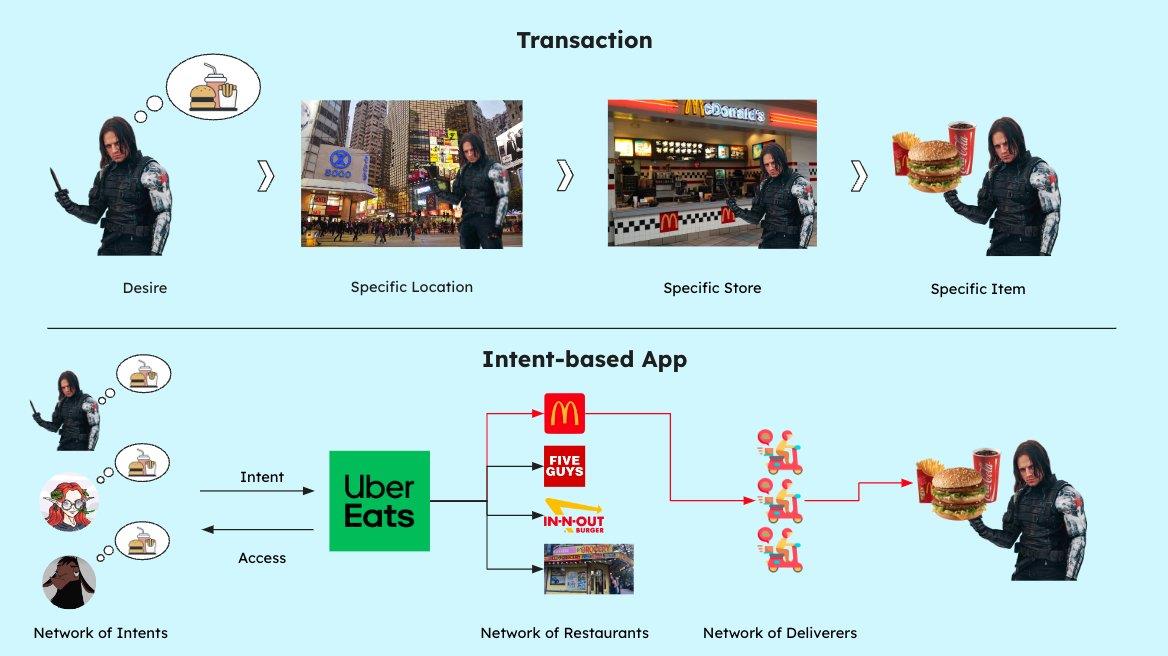
However, the effectiveness of intent-based applications is limited by the size and structure of their networks, imposing constraints on all participants. There are several key issues on both supply and demand sides—I’ve listed some below:
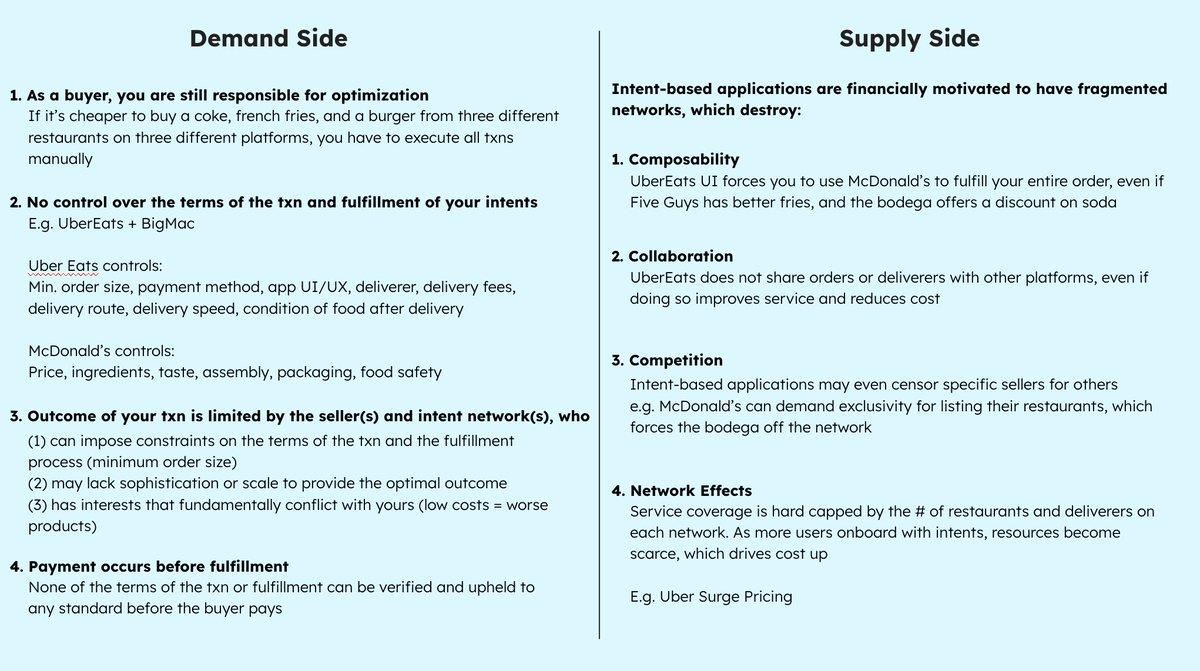
In the context of UberEats, real-world examples of these problems include:
-
Surge pricing during peak hours;
-
Minimum order amounts + delivery fees;
-
Geographic barriers or restaurants not offering delivery.
To quote a phrase: intent-specific applications aren’t scalable—but intent itself is scalable.
Which makes for the perfect segue into...
Anoma
Anoma is a blockchain architecture—more specifically, one that allows an unlimited number of users (intenders) and sellers (solvers) to join and scale the network.
Anoma’s structure can be broken down as follows:
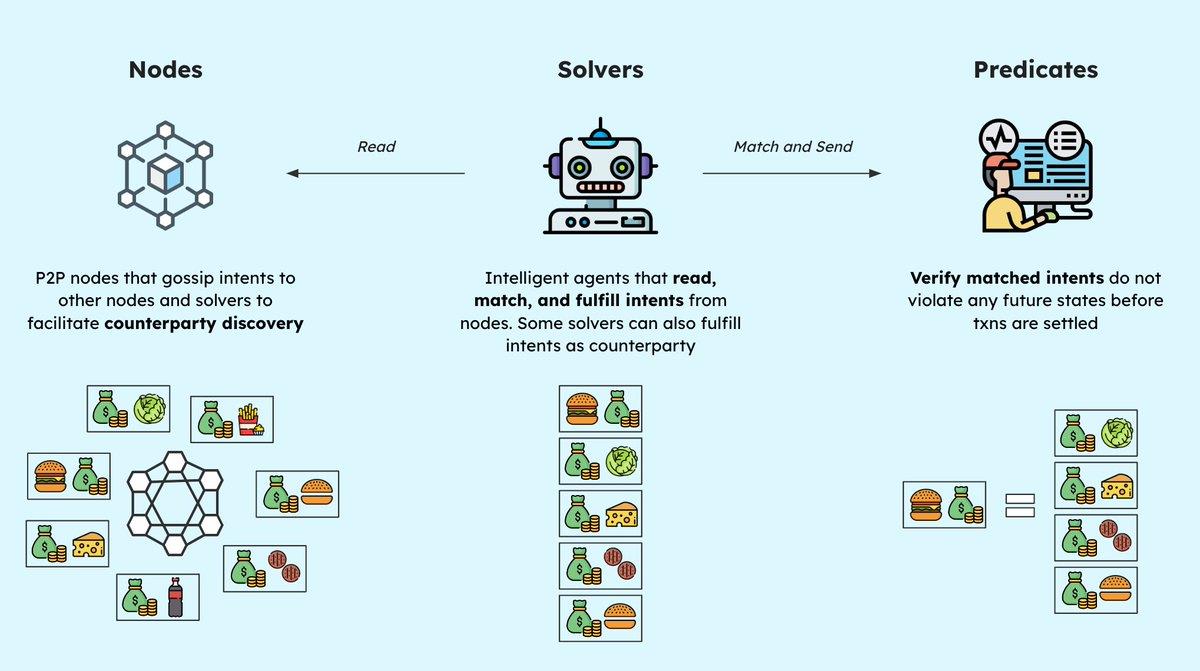
Anoma’s intent lays the technological foundation for a hyper-efficient, decentralized economy.
When you express an intent in Anoma, you can specify transaction and fulfillment terms—and literally “market-make” them. Users can customize intents with unparalleled modularity, even running complex algorithms as intents. Intents are shared across nodes to maximize visibility.
Once a node receives an intent, it signs the message and forwards it to other nodes, who repeat the process. When an intent is fulfilled, all nodes along the signing path are eligible for rewards, further increasing the efficiency of counterparty matching.
Solvers compete to match and fulfill intents to earn rewards. Solving is computationally intensive, making it best suited for AI agents—either bootstrapped from communities with specific needs or built to support core infrastructure. If successful, the combination of Anoma as the base layer, AI as solvers, and intent interfaces as the norm could change the world.
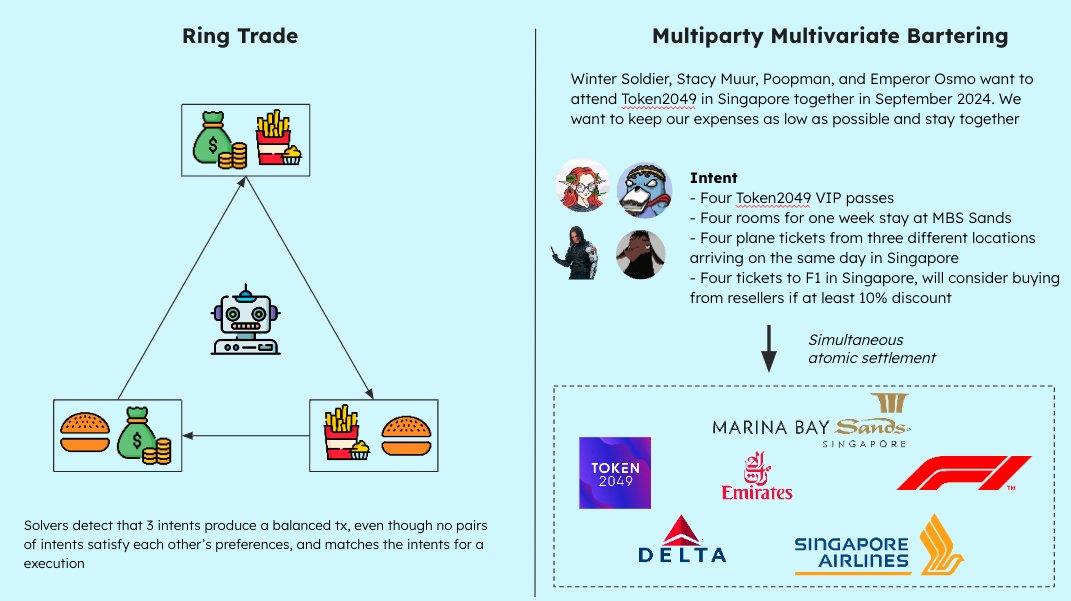
Imagine:
(1) Specifying all parameters of a trade via a ChatGPT prompt;
(2) Broadcasting it to an efficient, incentive-aligned network of coordinators and solvers;
(3) Matching that intent with millions of others to achieve atomic settlements.
That is the promise of Anoma’s intent.
Join TechFlow official community to stay tuned
Telegram:https://t.me/TechFlowDaily
X (Twitter):https://x.com/TechFlowPost
X (Twitter) EN:https://x.com/BlockFlow_News
 @WinterSoldierxz