Interview with Anoma Co-founder: No Innovation After Ethereum, and Intent Will Change Everything
TechFlow Selected TechFlow Selected
Interview with Anoma Co-founder: No Innovation After Ethereum, and Intent Will Change Everything
Step into Anoma's product design philosophy centered on intent, ecosystem development progress, and future roadmap planning.
 Navigating Web3 tides with focused insights
Author: TechFlow
On September 29, 2025, Anoma, the intent-centric decentralized operating system, officially launched its native token $XAN, simultaneously listing on Binance Alpha and Binance Futures, while正式启动 the deployment of the Anoma mainnet.
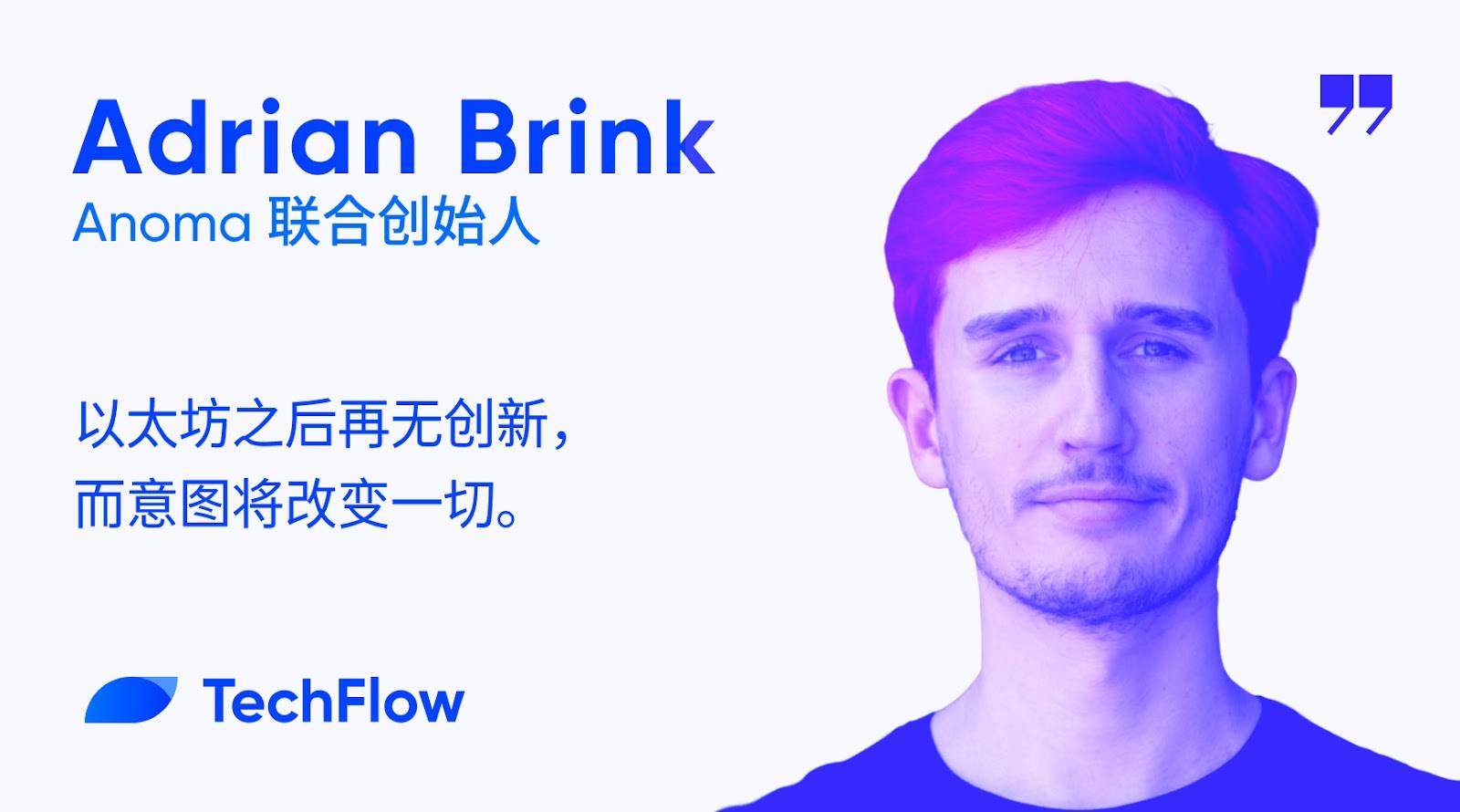
Prior to this series of key project milestones, TechFlow conducted an in-depth face-to-face conversation with Anoma co-founder Adrian Brink at Blockchain Week Korea.
At the bustling event venue, Adrian stood out easily—this founder who once bought beer with ETH back in 2016 sports red hair and was actively participating in panels, keynote speeches, and various interactions. Smiling, Adrian said:
We launched Shrimpers (Anoma's official NFT project)—fun, unique, and visually appealing. We hope Shrimpers can help us better engage with the community. I personally own a red-haired Shrimper, which has become my personal symbol.
When discussing Anoma’s broader vision, Adrian, coming from a technical background, shared insights that were both rigorous and accessible:
Since Ethereum’s launch, the industry hasn’t seen real innovation. Emerging applications require more suitable infrastructure. Anoma is an intent-driven decentralized operating system that frees users and developers from being locked into any single tech stack, enabling seamless interaction across different security models. We can think of Anoma as the Web3 version of Windows 95—supporting applications running seamlessly across chains—or as the Web3 version of Linux: fully open-source, highly interoperable, and very user-friendly.
At Blockchain Week Korea, Adrian also emphasized his focus on Asian markets, particularly Chinese-speaking communities:
In terms of public interest in cryptocurrency and availability of developer talent, both China and Korea are leading. Korean communities tend to lean toward financial use cases, while Chinese communities place greater emphasis on developer ecosystems.
When asked about priorities after the TGE and mainnet launch, Adrian expressed high expectations:
We’ve moved beyond discussing “what underlying technology this is” to now focusing on “what concrete applications intents enable.” In the future, Anoma will concentrate on the application layer, building truly compelling super apps. There will definitely be some very cool things coming in the next few months.
In this article, let’s dive into Anoma’s intent-centered product design philosophy, ecosystem progress, and future roadmap through Adrian’s insights.
Buying Beer with ETH, Bringing the "Windows 95" Moment to Web3 with Intents
TechFlow: It’s great to have this deep conversation with you. Some Chinese-speaking users may not yet be familiar with your background. To start, could you introduce yourself and share some past experiences and your current responsibilities?
Adrian:
Hello everyone, I’m Adrian. Great to be here.
I joined the crypto space around 2016 when Ethereum was just gaining attention. My thesis focused on using Ethereum for censorship-resistant electronic voting. I bought some ETH and installed Trust Wallet when ETH was around $2. Back in university, I even used ETH to buy some beer.
In 2017, I encountered the Tendermint consensus algorithm and later became a core developer for Cosmos, working across its entire tech stack—including the Tendermint consensus layer and IBC cross-chain communication.
In 2019, I co-founded Cryptium Labs. At the time, PoS was still a new concept, and Cryptium Labs was among the world’s earliest companies dedicated to PoS validators. At our peak, we managed around $10 billion in assets.
By early 2021, I felt the crypto industry had stagnated. Everything seemed similar—just variations of virtual machines. That made me reflect on what the industry truly needed, which ultimately led to the creation of Anoma.
Anoma focuses on creating a cross-chain, intent-driven design so users and developers can seamlessly interact across different security models. Fundamentally, Anoma is a distributed operating system—chains are no longer the focus. Developers and users can build and use applications anywhere.
TechFlow: If you had to summarize in one or two sentences what Anoma does, how would you describe it? And could you give a vivid example?
Adrian:
Anoma is a Web3 distributed operating system where your favorite applications can run seamlessly across different blockchains, regardless of where they’re hosted.
We can imagine Anoma like Windows 95: whether the underlying hardware is an Intel CPU or AMD CPU, software like Microsoft Word runs “out of the box.” Similarly, Anoma allows your applications to run wherever the operating system exists.
I use the Windows analogy because it’s more widely known, but Anoma is actually fully open-source, closer to early versions of Linux—except Anoma emphasizes usability. Early Linux was extremely hard for most people to use, whereas Windows struck a balance between openness and ease of use. That’s exactly the goal we’re pursuing with Anoma.
TechFlow: Although there’s been growing discussion about Anoma in Chinese-speaking circles recently, I understand Anoma has actually been building for several years. Could you tell us the story from Anoma’s founding to today? What was the original vision?
Adrian:
Anoma emerged from a realization about the industry: since Ethereum’s launch, there’s been no real innovation. Projects like Solana made improvements, but fundamentally, Solana and Ethereum remain very similar—both are sequential execution virtual machines. Looking across the industry, we realized that while attention focuses on app development, the necessary supporting infrastructure is missing.
One key insight we had:
Users express “intents,” not just transactions. For example, if you want to trade, you can’t directly create an immediately executable transaction on Ethereum. You can only perform partial actions and must find a counterparty to complete it. This inspired our intent-based design—the foundation of Anoma.
Ultimately, Anoma was born because we saw that no one was building the infrastructure needed to support these emerging applications. We wanted to create a system that empowers developers to build applications more flexibly, operating across different trust models and chains.
TechFlow: Could you share more about the Anoma ecosystem and highlight some partner projects you’re especially excited about?
Adrian:
Anoma is an open ecosystem where users can choose components without being locked into a full tech stack. This makes it highly attractive for developers. For instance, Anoma applications can run on Ethereum while still leveraging Anoma’s flexibility and openness.
One area I’m particularly excited about is stablecoins and payments. We’re collaborating with teams like Noble and Anoma Pay to build a seamless ecosystem enabling everyday stablecoin payments, centered on users’ preferred security models. This is crucial for making crypto more mainstream.
We’re also working on more complex integrations, such as defragmenting liquidity across networks. Currently, liquidity is fragmented across Ethereum, Solana, and various Rollups. We’re partnering with multiple teams to solve this—though I can’t reveal many details yet. But expect some very cool developments in the coming months.
TechFlow: Recently, increased user discussions have coincided with the launch of the Shrimpers NFT. Can you share the vision behind launching this NFT?
Adrian:
To be honest, I’m not deeply familiar with NFTs, especially physical art. But with Shrimpers, we simply wanted to create something fun and unique. I love Shrimpers—not for any specific utility, but because I think they look great. It’s a fantastic way to engage with the community and bring a lighthearted vibe.
The Shrimp NFT aims to provide a simple, enjoyable way for people to connect within the ecosystem. Personally, I own a red-haired Shrimper—a nod to my own style. Back in 2017 during Blockchain Week San Francisco, I was remembered for wearing a red jacket. Over the years, red has become my signature. Now, my red-haired Shrimper has become one of my personal symbols.
China and Korea Lead in Crypto, Especially China’s Developer Community
TechFlow: We noticed Anoma’s rewards for Kaito Yapper specifically highlight Chinese and Korean communities. What characteristics do you see in these markets? Are there differentiated strategies for growth and engagement in each?
Adrian:
When analyzing market adoption curves, I found that both China and Korea lead in public interest in crypto and depth of developer talent. When I think about which countries are truly advancing crypto through large-scale building, China and Korea consistently come to mind.
Personally, I really enjoy both countries. I’ve had wonderful times in Shanghai and Seoul, which is another reason I naturally focus on these regions.
Thirdly, and more concretely, we’re already seeing a surge of developers emerging in China and Korea. This is why I emphasize the importance of these two markets.
TechFlow: In your view, what are the differences between the Chinese and Korean communities?
Adrian:
The differences are subtle. The Korean community leans more toward financial use cases, while the Chinese community places stronger emphasis on developer ecosystems. It’s not black and white, but if I had to point to one distinction, that would be it.
I’m familiar with the Nervos team, who built an early blockchain with their team based in Hangzhou. Many excellent Chinese developers I know come from Hangzhou.
I’ve always been a fan of China, especially its developer community. My connection dates back to early Cosmos days when I spent a lot of time in Shanghai. The developer ecosystem in China, particularly in cities like Hangzhou, left a deep impression on me.
When considering Anoma’s potential role in China, I believe our visions align. Unlike Ethereum’s global trust model, I think different regions should have dedicated chains—like a “Swiss chain” or “Chinese chain.” For many users, a more suitable trust model is local, relying on their government or regional institutions. I’m not a decentralization extremist—I just want systems to integrate seamlessly so applications can function across various trust models.
TechFlow: AI is booming in China, and many Chinese AI companies are based in Hangzhou.
Adrian:
This is where Anoma becomes especially relevant.
I’m not entirely sure how the convergence of blockchain and AI will evolve, but I’m nearly certain Anoma will play a significant role.
The core idea is this: when thinking about user interaction, every person might eventually have thousands of AI agents—some running locally on their phones. This raises a key question: how do these agents communicate with each other?
They need “intents” to avoid being tied to any single chain, plus a mechanism to distribute, coordinate, and settle those intents.
Here’s how we envision it: I input a request into my local AI agent (say, built by DeepSeek) on my phone. The AI converts my needs into structured intents, presents them to me for confirmation. Once I approve, my AI agent uses these intents and Anoma’s open-source framework to collaborate with other agents—finding overlaps, matches, and solvable problems. It assembles a solution and notifies me: “I found a good flight + hotel combo for you—does this work?” After my approval, the intents are aggregated and executed across the network.
I believe there will be highly compelling intersections between blockchain and AI, especially at the end-user level. If every user ends up with thousands of AI agents, today’s infrastructure cannot support efficient collaboration—say, between 1,000 agents from DeepSeek and 1,000 from ChatGPT. We need an open framework enabling real interaction and coordination. That’s exactly what Anoma is built for.
Upgrading Web2 Financial Infrastructure with Intents Will Drive Real Adoption
TechFlow: Recently, AI and RWA have gained momentum. From an ecosystem perspective, are there specific sectors you hope to attract builders from? Will there be ecosystem incentive programs?
Adrian:
If you want to build on Anoma, feel free to reach out to me on Telegram—we can discuss how best to support you.
What excites me about AI and RWA right now is that most people are still in the “pre-intent” phase. While some are designing specialized intent solutions for specific trading scenarios, AI-driven RWA applications will require thousands of general-purpose intents—but there’s almost no infrastructure today capable of supporting this scale.
Anoma is currently the only place where you can begin building on an open, intent-native infrastructure—whether for AI or RWA applications.
I don’t favor any particular RWA team, but a few are quite interesting. RWA is closely tied to local markets. For example, tokenizing Chinese stocks likely involves teams in Hong Kong; tokenizing US stocks, teams in the US. The challenge lies in connecting these globally. We need multi-trust models enabling users to handle both tokenized Chinese and US stocks within a single app.
This is where Anoma shines—providing strong support for such applications and use cases.
Thinking about Anoma’s mission, I’m also excited by our progress: today’s financial systems are built on 1960s–1980s technology—designed for a pre-internet era with limited users and attack vectors. These systems are now outdated.
Anoma is rebuilding the financial coordination layer: offering a modern coordination infrastructure that banks, nations, and communities can use to build their own financial systems. In this sense, Anoma’s open-source tech stack is the ideal path to upgrade legacy financial systems for a new era. As internet scale grows, we need more robust financial coordination infrastructure—and Anoma is the perfect solution.
I’m especially excited about enterprise adoption, particularly from Web2 companies. No company will trust the global Ethereum network to secure their systems—they’d rather maintain sovereign infrastructure. Anoma is built for this: you can deploy Anoma internally and decide exactly which data and interoperability features to expose. Once you publish certain information, applications can not only interface with your sovereign stack but also connect to the global Anoma network and even Ethereum-based apps—enabling full-scale collaboration. For example, if a bank wants to support ETH deposits, today it requires custom integration with Ethereum. In the future, they can simply integrate Anoma—running a local Anoma instance internally—so users can transfer ETH directly into that local instance.
This is what excites me most: upgrading outdated infrastructure used by Web2 companies and existing financial systems will drive real adoption, and Anoma’s technology will play a pivotal role in this transformation.
TechFlow: From a broader perspective, we can think of Anoma as analogous to Linux—an “intent infrastructure.”
Adrian:
Exactly. The Linux analogy fits well. Linux offers strong interoperability: with a kernel underneath, you can build highly specialized systems on top. Anoma provides similar capabilities—maintaining interoperability while allowing customization and specialization based on your application needs.
TechFlow: Intent seems to be a key term for Anoma. I recall intense discussions about intents last year, but now the focus has shifted to AI, RWA, and stablecoins. Do you think intents will regain widespread attention? Could AI accelerate this?
Adrian:
I believe so. Last year, we focused more on the underlying intent infrastructure. But to scale AI or other use cases, you actually need intents. I believe we’ve now transitioned from asking “what is this underlying tech?” to “what concrete applications can intents enable?” We’ll focus on the application layer, building more and more apps.
I believe most future applications will use intents. Discussions about intents will shift from conceptual explanations to showcasing intent-powered applications.
TechFlow: So you also believe AI will accelerate the development of intents?
Adrian:
Yes. Currently, the capabilities supported by crypto are still very limited. If all transactions must settle via some form of global consensus, your apps face high latency and high costs. But with intents and Anoma, you could process 50 transactions per second—something unfeasible today. This opens the door to applications previously impossible.
Building Truly Compelling Super Apps
TechFlow: Anoma recently unveiled the $XAN token model—an important milestone. After the token TGE, what will be the team’s primary focus?
Adrian:
Our main focus—and what we’ve consistently prioritized—is continuing to build core infrastructure.
After TGE, we’ll shift significant effort toward vertical-integrated applications—delivering user-friendly products that real end users can adopt. We’ve talked for years in crypto about how “apps matter,” but until now, the foundational infrastructure wasn’t mature enough to support truly great user experiences. With Anoma, that’s finally changing.
Going forward, we’ll place greater emphasis on end users—building truly compelling applications, including intuitive payment apps, trading apps, RWA apps, or even a “super app” integrating all these capabilities.
Our core vision remains simple: I want a local chatbot on my phone delivering a conversational experience like Telegram or WeChat. For example, I message my local bot: “Find me the best yield opportunities.” It performs local computation, presents me with a set of intents for review and approval, then finds the optimal execution path. That’s what excites me—building more truly usable applications.
TechFlow: Based on your insights, Anoma is shaping up to be a massive ecosystem, making developers critical. What specific initiatives are you taking to attract developers?
Adrian:
Currently, we don’t have specific incentive programs. Once incentives are clearly defined, they often attract spam—flooding the ecosystem with low-quality submissions that are difficult to manage.
For developers, we welcome you to explore Anoma GitHub: if you start building and hit roadblocks, just reach out—we’ll help.
We may launch incentive programs in the future, but announcing specific rewards tends to trigger a rush of low-effort projects. I’d rather focus energy on genuine builders aiming to create real applications. So for now, no formal incentives. But if you have a cool project, please get in touch.
Join TechFlow official community to stay tuned
Telegram:https://t.me/TechFlowDaily
X (Twitter):https://x.com/TechFlowPost
X (Twitter) EN:https://x.com/BlockFlow_News
 深潮TechFlow