








Cosmos Ecosystem Potential Protocols Overview (Part 2): Zero-Knowledge Proofs, MEV, and Novel Stablecoins
TechFlow Selected TechFlow Selected
Cosmos Ecosystem Potential Protocols Overview (Part 2): Zero-Knowledge Proofs, MEV, and Novel Stablecoins
Quick overview of 8 highly promising protocols in the Cosmos ecosystem.
 Navigating Web3 tides with focused insights
By Morty
In the previous article, we introduced seven protocols including Osmosis, Celestia, and GNO Land. Now, we will continue with another eight protocols within the Cosmos ecosystem.
Polymer Labs
Polymer Labs is a modular networking protocol built on IBC, aiming to enable decentralized, secure, and permissionless cross-chain communication.
Polymer’s core advantage lies in enabling seamless inter-chain communication through zero-knowledge proofs. ZK-IBC will allow different blockchain protocols to communicate without relying on trusted third parties, thereby achieving higher throughput, faster speeds, and lower costs for multi-chain interactions.
Anoma Network
Anoma Network is a privacy-focused multi-chain protocol, designed for decentralized discovery of counterparties and conducting multi-chain atomic swaps.
Atomic swaps refer to peer-to-peer cross-chain transactions executed in a decentralized manner without third-party involvement.
Anoma achieves its functionality using zero-knowledge proofs, with its key advantage being atomic transactions across multiple chains. As described by the team, Anoma is “a New Language for Value.”
Quicksilver Protocol
Quicksilver Protocol is an interchain liquid staking protocol built within the Cosmos ecosystem. Users can stake their assets into Quicksilver to receive qASSETs, which can then be used in DeFi applications to improve capital efficiency.

Quicksilver’s core strength is its support for all assets from chains connected via IBC, and it operates entirely permissionlessly.
Archway
Archway is a developer-friendly Layer 1 blockchain whose design philosophy centers on rewarding DApp developers to drive sustainable ecosystem growth.
Archway features an integrated reward system that enables developers to earn rewards in three ways—gas rebates, inflationary emissions, and contract premiums. This means that on Archway, developers who launch successful applications receive significant economic returns.

Archway’s competitive edge lies in its strong economic incentives for developers. Thanks to the openness of the Cosmos ecosystem, deploying DApps on Archway does not face cross-chain barriers.
Quasar
Quasar is a vault-based asset management application chain built on the Cosmos ecosystem.
Quasar addresses two major pain points:
-
Complexity of DeFi operations: Quasar provides users with a powerful suite of DeFi tools to lower the barrier to entry for on-chain investing;
-
Liquidity fragmentation in the Cosmos ecosystem: As an application chain, Quasar aims to consolidate liquidity across the ecosystem through superior product design, enhancing capital efficiency.
These constitute Quasar’s core competitive advantages.
Skip Protocol
Skip Protocol is an MEV solution built and deployed on individual chains within the Cosmos ecosystem. It aims to democratize MEV and protect users from harmful MEV strategies. In Skip’s own words: “Skip amplifies good MEV (arbitrage and liquidations) while reducing the impact of bad MEV (front-running and sandwich attacks).”
Currently, the team is building products on chains such as Juno, Evmos, and Terra2.
Skip’s core competitiveness stems from its alignment with ATOM 2.0. While ATOM 2.0’s Interchain Scheduler and Interchain Allocator address cross-chain MEV issues, Skip complements this by solving intra-chain MEV problems within the Cosmos ecosystem.
Mekatek
Mekatek is an MEV marketplace operating across the Cosmos blockchain internet, building an open, transparent blockspace market for Cosmos users. It allows users to freely express their preferences and ensures fair fee distribution to all participants on target chains.
Mekatek’s key innovation is the transparency of its blockspace market. With the launch of its product Zenith, Mekatek has become the first blockspace marketplace on Cosmos.
Canto
Canto is a Cosmos SDK-based EVM Layer 1 chain dedicated to serving DeFi. The protocol offers three core products: Canto DEX, Canto Lending Market, and the stablecoin $NOTE.
The stablecoin $NOTE was fully minted at launch, and users can borrow $NOTE by depositing collateral in the lending market.
According to data from DeFiLlama, Canto’s TVL (Total Value Locked) stands at $89 million.
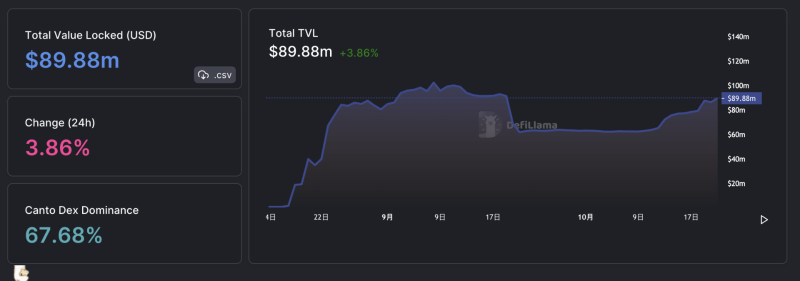
Canto DEX (forked from Solidly) and the Canto Lending Market (forked from Compound) aim to stabilize the price of $NOTE by adjusting demand through interest rate mechanisms in the lending market and incentivized stablecoin pools on the DEX.
Canto’s core competitive advantage lies in the rollout of the $NOTE stablecoin. Learning from the collapse of $UST, $NOTE employs a more robust algorithmic mechanism with lower risk, while fulfilling the long-standing demand for a stablecoin within the Cosmos ecosystem.
Join TechFlow official community to stay tuned
Telegram:https://t.me/TechFlowDaily
X (Twitter):https://x.com/TechFlowPost
X (Twitter) EN:https://x.com/BlockFlow_News






