Why does the Cosmos ecosystem never get attention?
TechFlow Selected TechFlow Selected
Why does the Cosmos ecosystem never get attention?
ATOM (Cosmos Hub) with its falling price does not equal Cosmos.
 Navigating Web3 tides with focused insights
Author: Cryptocito, Co-founder of Stakecito
Translation: Aelx Liu, Foresight News
I came across a tweet from Rooter, co-founder of Solend and Suilend, asking: "Why has Cosmos never received the same level of attention as Solana?" Here are my thoughts:
1. Cosmos ≠ Cosmos Hub
Cosmos is often mistakenly seen as just the Cosmos Hub, meaning that if ATOM's price performs poorly, Cosmos is considered a "failure."
In reality, the Cosmos ecosystem is highly diverse and dominates entire verticals—or at least has strong contenders across various fields.
Fetch, Cronos, Injective, dYdX, Thorchain, MANTRA, Akash Network, Celestia, Saga, Dymension, Sei, and others are receiving significant attention in their respective domains.
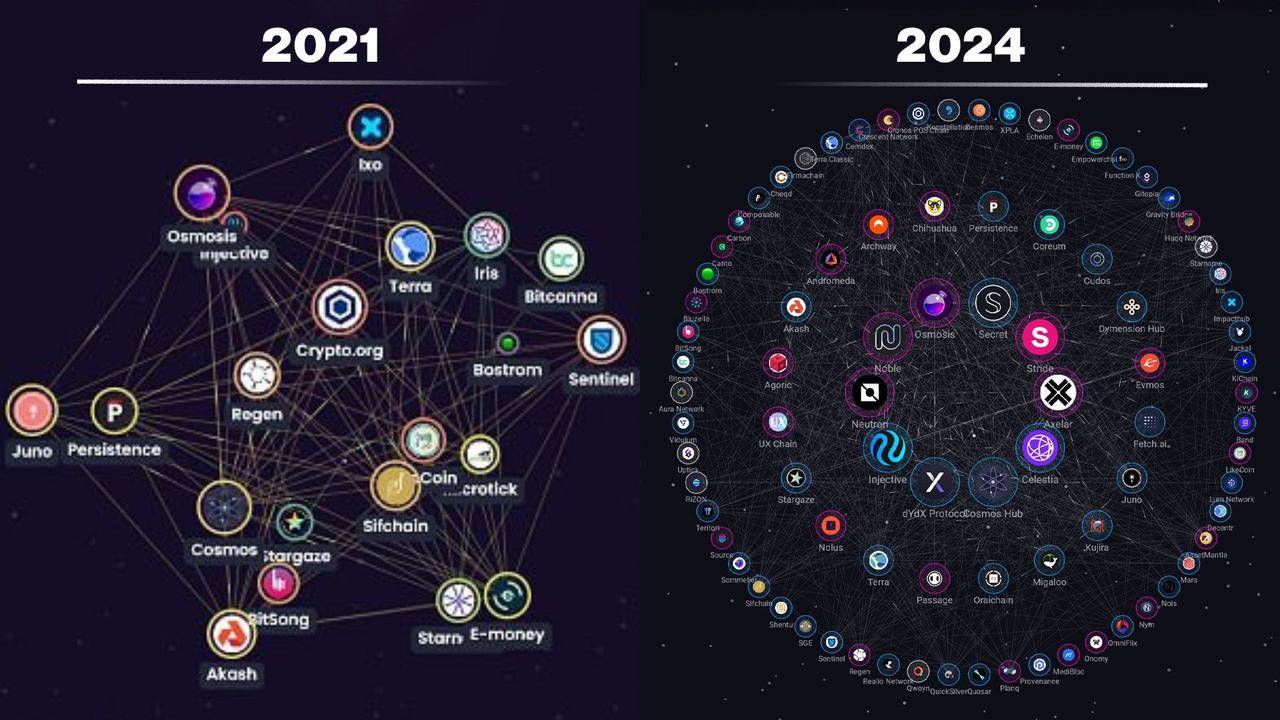
Evolution of Cosmos ecosystem projects
All of the above are Cosmos-based chains. The difference is that they are sovereign, self-governing chains with their own ecosystems, foundations, marketing strategies, brands, and more.
Even larger chains like Polygon or BNB Chain have partially adopted Cosmos technology. (Translator’s note: Polygon PoS uses Tendermint consensus; BSC uses Cosmos SDK.)
There are also major upcoming projects such as Babylon, Berachain, or Nillion that leverage Cosmos technology. Some are more openly identified as "Cosmos projects," while others aren’t—but that’s okay. (Translator’s note: Despite using Cosmos SDK for its build, Berachain has consistently resisted being labeled a "Cosmos project.")
Therefore, the first reason why Cosmos is perceived as unattractive is that it’s still frequently equated solely with Cosmos Hub and ATOM.
2. Inaction by the Interchain Foundation
Secondly, unlike organizations such as the Solana Foundation or Ethereum Foundation, the Interchain Foundation does not play a central role in coordinating marketing, developer onboarding, community initiatives, and development—at least not currently.
The advantage of this approach is minimal reliance on a single organization, but the downside is a lack of consistency, difficulty in coordination, fragmented vision, and unclear accountability.
Thanks to the Solana Foundation, Solana moves extremely fast. The foundation takes a highly proactive approach—hosting large-scale events like Breakpoint, funding Superteams worldwide, and strategically incentivizing all market participants to join and learn about Solana.
This is fantastic—in fact, we’re actively trying to replicate this model for the Cosmos ecosystem. However, doing so without sufficient funding is very challenging.
3. No "unified currency" for the ecosystem
Third, it's important to note that Cosmos is fundamentally designed around interoperable yet sovereign chains, which means there is no single "unified currency" ruling over all these chains.
There isn't one foundational chain or token underpinning the entire ecosystem—not because they "forgot" to include one, but because that's precisely the nature of Cosmos.
I wasn’t around when ATOM launched in 2019, but I’ve been told it was an intentional design decision—not directly tying IBC adoption to ATOM’s value, but instead letting the market decide.
Cosmos’ principles make it highly adaptable, which benefits long-term sustainability—but matter less during short-term hype cycles.
Terra (Translator’s note: Terra (LUNA) was built using Cosmos SDK; its collapse in 2022 dealt a massive blow to the Cosmos ecosystem) demonstrated the application-specific chain theory under extreme conditions. Tendermint, now Comet BFT, has existed for a long time and is widely adopted. IBC has proven flexible, has never been hacked, and has been integrated into countless projects.
That said, I still hope ATOM performs well and establishes itself firmly, as it helped bootstrap this $30 billion ecosystem, proved its technology, and even after five years of existence, remains within the top 40 by market cap.
Here’s what I believe needs improvement:
-
Rebrand Cosmos as the "Interchain"
-
Improve developer onboarding processes;
-
Replicate the Solana Superteam model;
-
The Interchain Foundation should take a more proactive role
The Interchain Foundation is currently undergoing structural changes and may begin taking more active steps from now on.
There’s still much to consider and many aspects to figure out, but these are my overall thoughts.
Join TechFlow official community to stay tuned
Telegram:https://t.me/TechFlowDaily
X (Twitter):https://x.com/TechFlowPost
X (Twitter) EN:https://x.com/BlockFlow_News