Cosmos Rebuilding Heaven in Hell: A SWOT Analysis of Atom
TechFlow Selected TechFlow Selected
Cosmos Rebuilding Heaven in Hell: A SWOT Analysis of Atom
In the context of the entire industry, Cosmos may already be approaching the realm of "too big to fail."
 Navigating Web3 tides with focused insights
Author: Andrey Didovskiy
Translation: SevenUp DAO
Note: SWOT analysis evaluates a project's fundamental, operational, technical, social, economic, and to some extent managerial aspects. It is not a model intended for trading purposes. (NFA – Not Financial Advice; please verify independently)
The SWOT framework consists of four elements: Strengths, Weaknesses, Opportunities, and Threats. It provides a high-level understanding of a project’s overall condition, offering a bird’s-eye view that can aid in decision-making, identifying areas needing greater attention, setting performance goals, and organizing foundational insights into the project’s direction.
This method is rarely used in the cryptocurrency space—now is the time to apply this classic evaluation approach to the digital asset domain.
Today, we will conduct a SWOT analysis on Cosmos (ATOM), a pioneer of interoperability and the creator of IBC.
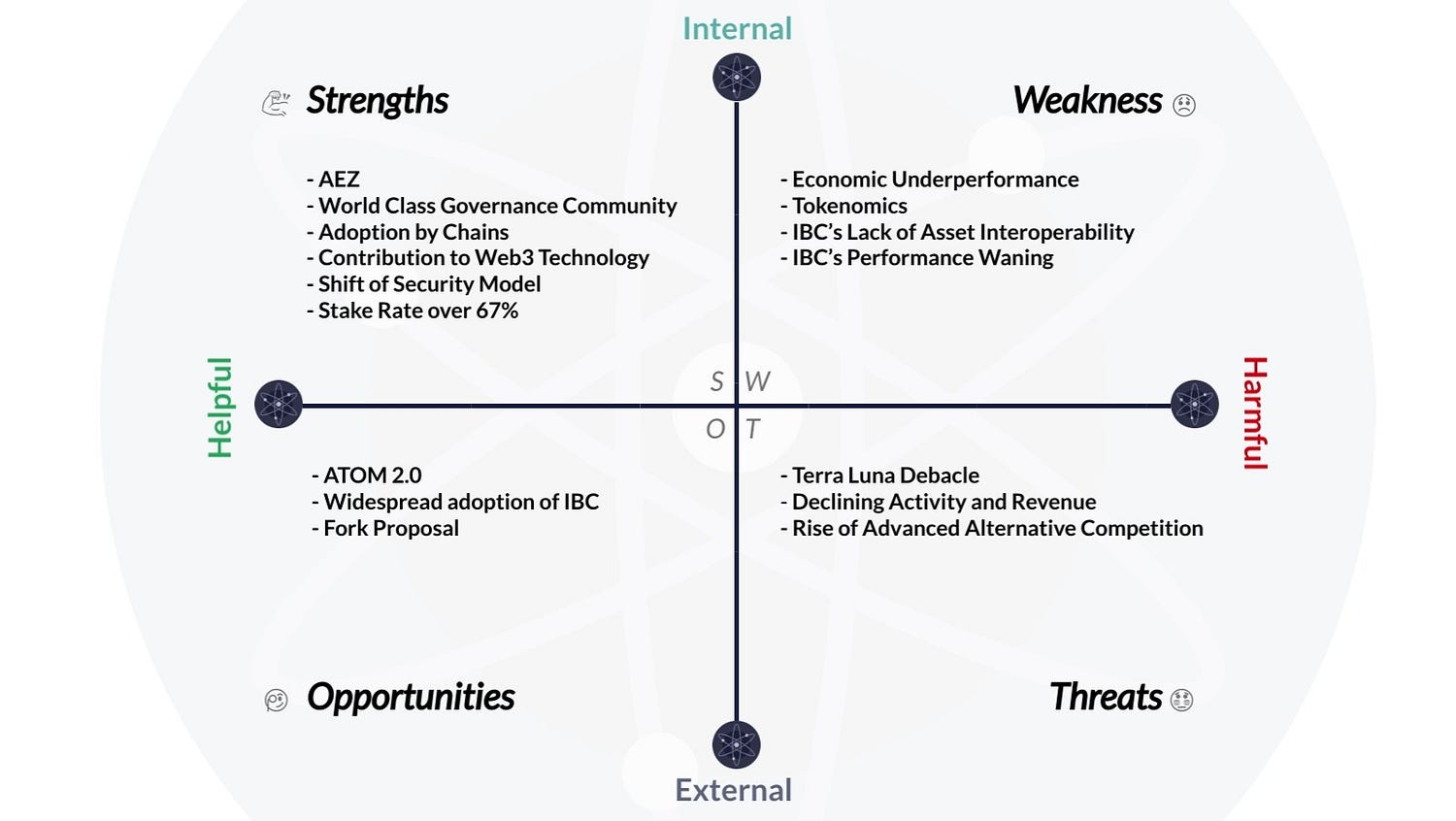
1. 💪 Strengths (Internal) (Beneficial)
1. AEZ
The Atomic Economic Zone (AEZ) lies at the heart of Cosmos’ upcoming techno-economic reform. The purpose of the economic zone is to align the ecosystem more closely with the ATOM token. Numerous networks—including Kujira, Agoric, Osmosis, Stride, Neutron—have already integrated and committed to this initiative. The primary focus of AEZ is to establish ATOM as a foundational element in cross-chain activities and to unify chains through a governance framework applicable across individual chains.
2. World-Class Governance Community
Cosmos achieves incredible engagement through its social and governance platforms—either due to legendary community-building prowess, a shrewd team, or both. The core community remains consistently active and involved in advancing the project, helping steer its development while upholding the intriguing promise of decentralization.
3. Chain Adoption
A large number of projects have emerged within the Cosmos ecosystem. To date, over 46 networks have been hosted, many of which are considered ones to watch (e.g., Osmosis, KUJI, Cronos, ThorChain, Injective, Secret, KAVA, Akash), along with a pipeline of leading new projects such as Celestia and dYdX. In the broader context of the industry, Cosmos may already be approaching the “too big to fail” territory.
4. Contributions to Web3 Technology
From consensus mechanisms (CometBFT) to the Inter-Blockchain Communication Protocol (IBC) and the application-specific blockchain paper, many solutions leverage technologies developed by Cosmos and delivered via its Software Development Kit (SDK). Value is available in the form of new technological primitives found in its excellent documentation. If a project can truly be evaluated by its contributions, Cosmos would far surpass 99% of other base-layer projects.
5. Shift in Security Model
Cosmos is undergoing massive architectural transformation. Previously, the Cosmos Hub acted as a relay point; now it will serve as a unified security provider. This shift emphasizes the importance of shared security—where multiple distinct networks share the same validator set.
While there are valid theoretical counterarguments regarding using economic primitives (price) as a proxy for security—given the implied relationship between price and security—this debate remains largely theoretical and conclusions can only be drawn after certain events occur. The new model could be sufficient to help Cosmos stand out among the growing number of infrastructure providers in Web3.
6. Over 67% Staking Rate
The staking rate directly reflects the willingness of an ecosystem’s community to support the project. More than two-thirds of all ATOM tokens are staked, placing it among the highest levels in comparable networks. Despite ATOM being one of the worst-performing major cryptocurrencies over the past year purely from a price perspective, long-term holders have not abandoned their positions—in fact, their holdings have increased by 62% compared to last year—demonstrating deep commitment. A higher staking rate means a more limited circulating supply, making the relationship between demand and price increasingly sensitive. If this trend continues, ATOM is likely to reflect this dynamic.
Considering ATOM has been one of the poorest performers among top-tier crypto assets over the past year (purely from a price standpoint), the fact that long-term holders have maintained their positions (and in fact increased them by 62% year-on-year) demonstrates profound commitment. The higher the staking rate, the tighter the circulating supply, and the more sensitive the link between demand and price becomes. If this trend persists, ATOM is very likely to reflect it.
2. 😞 Weaknesses (Internal) (Detrimental)
1. Poor Economic Performance
Although SWOT analysis typically does not consider price movements, it's undeniable that ATOM has been one of the weakest performers among tier-one cryptocurrency projects. While independent Cosmos chains and the broader market have experienced parabolic growth, market participants appear uninterested in ATOM. Interest manifests similarly to liquidity—a self-reinforcing mechanism where interest breeds more interest.
2. Tokenomics
A long-standing issue surrounding Cosmos concerns the design of its core system; despite exceptional technology and real adoption, the ATOM token’s economics have failed to capture value effectively. Due to a relatively high double-digit perpetual inflation rate, lack of requirement for ATOM in chain transaction fees, and early failure to address these issues, the token has underperformed for a period—largely due to inefficiencies in initial implementation that forced the project to absorb invisible costs incurred by early community formation. This issue can (and currently is) being fixed, but there is no guarantee the new model itself won't have flaws.
3. Lack of Asset Composability in IBC
One less-discussed nuance in the technical design of the Inter-Blockchain Communication Protocol (IBC) involves the accounting system during asset transfers between chains. Each transfer creates its own unique path. For example, ETH on Osmosis (osm-ETH), when moved from Osmosis to Kujira, becomes (osm-kuji-ETH). If transferred further to Cronos, the asset becomes (osm-kuji-cro-ETH). As a result, it loses composability because different ETH paths vary depending on their transfer history.
Suppose Party A holds 10 ETH in a liquidity pool on KAVA, and Party B wants to provide liquidity in the same pool. When Party B transfers their 10 (osm-kuji-cro) ETH to KAVA, their asset becomes (osm-kuji-cro-kava) ETH, which differs from Party A’s (kava) ETH in the pool. Therefore, Party B cannot join the KAVA liquidity pool unless complex custom handling is performed or the path of their ETH is specifically tracked.
4. Declining IBC Performance
Once hailed as one of the most promising innovations in the interoperability space, the Inter-Blockchain Communication Protocol (IBC) contributed significantly to the rise of over 45 independent chains hosted on Cosmos. However, over the past year, demand for IBC appears to be declining. Total transfer volume has dropped by over 38%, and unique senders and receivers have declined by 48% respectively. If this trend continues, we may soon witness this once-celebrated technology fade into obscurity.
3. 🧐 Opportunities (External) (Beneficial)
1. ATOM 2.0
The foundation has launched a series of initiatives to reform ATOM’s tokenomics. These aim to address centralization, value accrual, and inflation through various parameter adjustments. Implementation has begun gradually via governance proposal 848, reducing the staking ratio from around 14% to 10%, and lowering the real yield from 19.3% to 13.4%. With reduced inflation, users are more likely to hold their assets and seek DeFi applications. Value accumulation will be achieved by combining independent environments with cross-chain settlements facilitated by the ATOM token. Regarding centralization, Cosmos currently scores an 8 on the Nakamoto coefficient, meaning only 8 out of 177 validators could compromise the network. Under the new system, incentives discouraging excessive concentration will be introduced—such as a tax that increases with validator balance, economically encouraging end-users to delegate to smaller validators.
2. Widespread Adoption of IBC
This is an unknown variable with immense positive potential. If the new ATOM token model successfully captures value as promised, and if IBC delivers seamless interoperability as intended, Cosmos stands a strong chance of penetrating deeper into the industry through accelerated adoption.
3. Fork Proposal
Jae Kwon, founder of Tendermint and co-creator of Cosmos, is known for his assertive and radical stance. Recently, he suggested that given Cosmos’ current governance shortcomings, a fork might be preferable. Generally, forks are events prone to complications—they can negatively impact the integrity of the original chain and lead to community fragmentation.
However, in Cosmos’ case, a fork may carry opposite potential—it could resolve ongoing disputes within the network and provide holders with new tokens. Whether driven purely by speculative airdrop hunters or representing a brilliant economic solution, discussions around a possible fork have actually been relatively well-received in the crypto market. This could exert a strong short-to-medium-term impact on price, as participants attempt to front-run each other and qualify for the hard fork.
4. 😳 Threats (External) (Detrimental)
1. Terra Luna Event
Terra was a network built using the Cosmos SDK and compatible with IBC, processing billions of dollars in UST transactions. Following its spectacular collapse, it wiped out hundreds of billions in market capitalization from the crypto market within days, severely impacting the entire industry. Cosmos lost over 75% of its value in the two months following the event. Frankly, there is no direct value linkage between Cosmos and Terra Luna; however, the fact that Terra used the Cosmos SDK has cast a shadow over Cosmos’ reputation—one associated with arguably the most prominent failure in crypto history.
2. Declining Activity and Revenue
Despite extremely optimistic market sentiment, Cosmos has seen a decline in utilization. Daily active addresses have decreased from >17,000 to approximately 16,000, and daily transaction counts have dropped nearly 33%, falling from about 63,000 to roughly.
Join TechFlow official community to stay tuned
Telegram:https://t.me/TechFlowDaily
X (Twitter):https://x.com/TechFlowPost
X (Twitter) EN:https://x.com/BlockFlow_News
 Andrey Didovskiy