Saga Airdrop Explained: Targeting Loyal Users, Building a Gaming Hub for Cosmos
TechFlow Selected TechFlow Selected
Saga Airdrop Explained: Targeting Loyal Users, Building a Gaming Hub for Cosmos
The Saga system aims to make block space abundant, enabling developers to launch applications without worrying about costs.
 Navigating Web3 tides with focused insights
Author: Revelo Intel
Translation: TechFlow
Saga is a Cosmos-based blockchain that enables applications built on the protocol to adopt their own L1 or multiple L1s. Designed specifically for user onboarding in gaming and entertainment, the protocol recently conducted an airdrop with a notably unique eligibility criterion for recipients of the SAGA token.
Saga's Airdrop Criteria
-
Diversified airdrop campaigns across different communities have proven to be an effective marketing strategy; establishing early relationships with ecosystems is key to successful airdrops.
-
Rebecca Liao, co-founder of Saga, said the response to the protocol’s airdrop has been overwhelmingly positive.
-
She added that the team prioritized Cosmos and ATOM wallets due to their strong collaborative relationship with Saga.
-
Six percent of Saga’s genesis supply was allocated for the airdrop, with more phases planned in the future.
-
Notably, the airdrop implemented geographic restrictions excluding users from the United States.
-
Saga has also established partnerships with Celestia, Polygon, Avalanche, and Solana, having collaborated closely on various initiatives.
-
Rebecca offered insights for projects planning their own airdrops:
-
Building early relationships with ecosystems is crucial for more effective airdrops.
-
Randomly distributing airdrops without prior familiarity or engagement within an ecosystem may fail to achieve desired outcomes.
-
Value Creation and Airdrops
-
According to Rebecca, holding $SAGA grants access to various games and can generate value for token holders.
-
The project’s airdrop campaign allowed players to earn $SAGA through gameplay participation and leaderboard rankings.
-
Multiple games have their own tokens, offering dual airdrops on top of SAGA rewards, thereby enhancing user retention.
-
The team stated that the airdrop campaign has been highly effective in attracting $SAGA users.
-
Additional airdrops are planned at each stage of mainnet launch, providing further opportunities for token holders.
-
Staking $SAGA may also yield additional benefits during these airdrops.
-
An interesting aspect of the airdrop is that ATOM stakers had to increase their staked balance during a specific period to qualify.
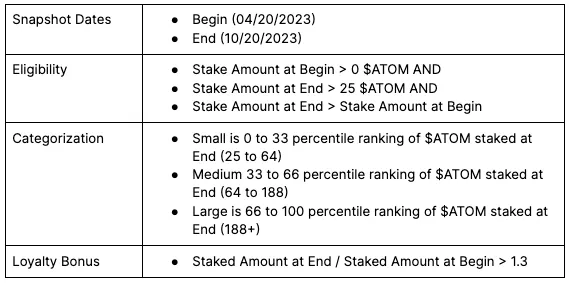
SAGA eligibility criteria for ATOM stakers as shown in the image
-
The rationale behind this rule is that the team wants to distribute tokens to loyal users—those who increased their stake between April and October 2023 demonstrated strong confidence in the Cosmos ecosystem while others may have hesitated.
-
Other chains eligible for the airdrop rewarded users who maintained staking activity over a defined period.
-
Polygon wallets that bridged 0.4 ETH or more to Polygon zkEVM were also qualified, rewarding those deeply interested in trying new protocols and technologies.
-
Some criticized this specific criterion as being overly strict.
-
Future airdrops from other protocols may begin incorporating similar measures to prevent Sybil attacks.
-
For example, Manta Network’s airdrop clearly rewarded users who actively participated in Galxe quests more than those who simply staked ETH.
Building Games on Saga and Upcoming Plans
-
Saga is an L1 blockchain where each launched application becomes its own L1 or multiple L1s.
-
Developers can deploy smart contracts via web applications, with deployment taking only minutes.
-
The platform is EVM-first, meaning applications are written in Solidity.
-
Due to Cosmos integration, the CosmWasm smart contract platform is also widely adopted.
-
Multiple ecosystem partners are building Tendermint-compatible VMs (virtual machines), including a JavaScript VM.
-
The platform aims to become the preferred environment for developers building applications.
-
Developers can choose the environment they are most familiar with, aiming to make application deployment seamless and easy.
Focus on Gaming and Entertainment
-
Although Saga is general-purpose infrastructure, it focuses primarily on gaming and entertainment.
-
They have showcased numerous games through their Innovators Program.
-
Scalability has long been a major challenge for Web3 gaming—games generate high transaction volumes but relatively low transaction values.
-
Single chains struggle to accommodate this level of scalability.
-
Rebecca noted cost as another challenge, as most users expect games to be free and frictionless. Gas tokens and fees create barriers for players.
-
She added that gaming heavily depends on delivering a seamless user experience. Complex login systems, ads, or any friction could cause players to leave. Web3 must minimize such frictions to effectively attract gamers.
Platform Scalability and Economic Model
-
The platform leverages Cosmos Interchain Security for scalability. Each launched chainlet shares the same validator set and security model as the mainnet. Developers can deploy onto chainlets without requiring governance approval. (Editor’s note: chainlet refers to smaller or component chains within a blockchain network)
-
The platform aims to commoditize blockspace, much like servers or AWS instances. Developers can affordably own their own chainlet until they no longer need it.
-
This economic model differs from the Hub approach used by $ATOM.
-
Rebecca suggests starting games on auxiliary chains and compressing state back to required chains as user traffic decreases, enabling elastic scaling—an approach inspired by cloud deployments to offer Web3 developers a similar experience.
-
The goal is to make blockspace more affordable by commoditizing it, avoiding rising costs caused by application-specific blockspace demands.
Commoditized Blockspace and Abundance
-
The Saga system is designed to make blockspace abundant so developers can launch applications without worrying about costs.
-
Validators participate in auctions to determine the true cost of providing security, with each chainlet costing $500 per month.
-
Gas fees are not directly charged to end users, allowing developers to decide how they want to monetize their applications.
-
Developers can even choose to make their applications completely gas-free, though this is not recommended due to potential DDoS attack risks.
-
To address this, recycled tokens can act as a gating mechanism, allowing user access while preventing abuse.
-
Recycled tokens work similarly to arcade tokens—they are returned after use, making the system free for users from the start.
Motivation for Web3 Gaming
-
Rebecca said traditional gaming experiences often frustrate players due to centralized control over in-game assets.
-
Web3 gaming offers players true ownership of their intellectual property and the ability to monetize it across different communities.
-
Players increasingly want to be creators and be treated as such—a desire that aligns perfectly with Web3 capabilities.
-
User-generated content (UGC) is a growing trend in gaming and may be one of the most suitable use cases for Web3.
-
Some of the most mainstream games, such as Fortnite and Minecraft, feature UGC as a core gameplay element.
-
Developers motivated by Web3 gaming are committed to building innovative technologies in this space.
Cosmos as a Gaming Hub?
-
Rebecca said Cosmos is excited about becoming a hub for gaming.
-
The app-chain model and scalable chains are critical considerations for blockspace utilization.
-
Rebecca said that innovations both on-chain and off-chain are creating opportunities beyond cryptocurrency. They are opening new operating systems and spaces for business and gaming.
-
Abundant blockspace can foster greater innovation across various industries.
Join TechFlow official community to stay tuned
Telegram:https://t.me/TechFlowDaily
X (Twitter):https://x.com/TechFlowPost
X (Twitter) EN:https://x.com/BlockFlow_News
 Revelo Intel