Interpreting Binance LaunchPool Project Saga: A Modular One-Click Blockchain Platform for Gaming
TechFlow Selected TechFlow Selected
Interpreting Binance LaunchPool Project Saga: A Modular One-Click Blockchain Platform for Gaming
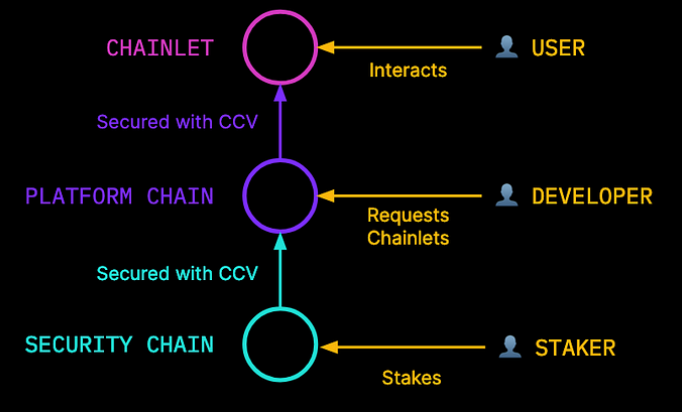
Saga's architecture is primarily divided into three layers: Security Chain, Platform Chain, and Chainlet, all of which are built entirely using the Cosmos SDK.
 Navigating Web3 tides with focused insights
Author: Chen Jian Jason, ThreeDAO Builder at Wanwu Island
Let’s talk about Saga, which is即将 launching on Binance LaunchPool. First, a one-sentence summary: Saga is a modular, one-click chain deployment platform built on Cosmos, focused on gaming. I have to say, the Cosmos ecosystem keeps delivering incredible projects. After reading through Saga’s documentation, I found it quite technical—I’ll try to break it down.
Modular one-click chain deployment is a hot trend this cycle, but due to its popularity, many of us (myself included) have become somewhat desensitized to the concept. However, Saga stands out by reorganizing the modular architecture in innovative ways, giving dedicated chains launched on it (which Saga calls Chainlets) higher performance, greater flexibility, and several interesting new capabilities.
Saga's architecture consists of three layers: Security Chain, Platform Chain, and Chainlet—all built using the Cosmos SDK.
Security Chain
The Security Chain powers Saga’s mainnet operations. Saga nodes run on this layer, handling token minting, staking, and burning. It provides the foundational security layer for dedicated chains launched via Saga. Notably, however, according to the documentation, Saga’s security isn’t limited solely to its own Security Chain—it can also leverage external blockchains such as Ethereum, Polygon, and Avalanche.
I must admit, I’m still unclear on how exactly this works. The official claim is that Saga can support over 1,000 parallel dedicated chains, implying that Saga nodes must handle massive concurrent workloads. To manage this, Saga has developed a node orchestration tool—a kind of control center for task allocation, upgrades, and maintenance. But if Saga extends its security model to third-party blockchains, those chains would naturally fall outside Saga’s direct node orchestration control. So how does it effectively support thousands of chains running in parallel? This part remains unclear in the documentation, and I haven’t figured out the implementation logic yet.
Platform Chain
The Platform Chain is where developers build and maintain their dedicated Chainlets on Saga. On this layer, Saga leverages Cosmos’ unique Cross-Chain Validation (CCV) mechanism to aggregate security, enabling elastic scalability of shared security. If malicious behavior occurs within a Chainlet, it is relayed back via the Platform Chain to the Security Chain, triggering slashing penalties.
Chainlet
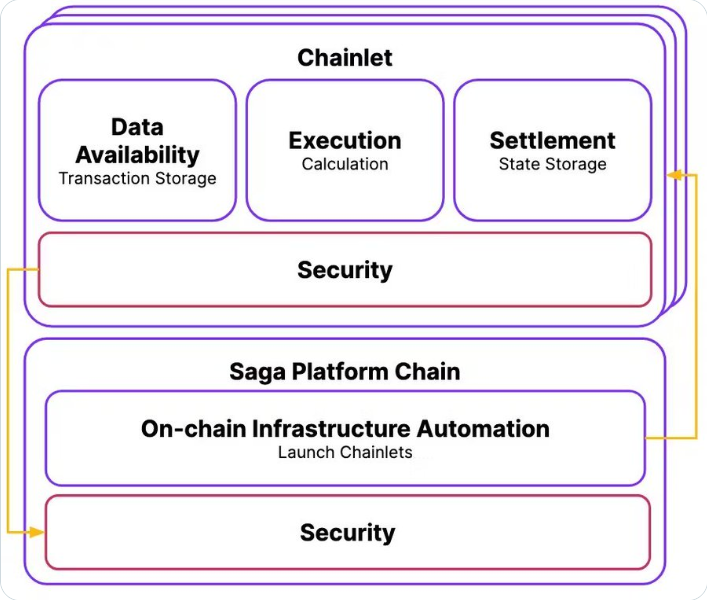
Chainlets are the final product—dedicated sovereign chains created using Saga. They offer high degrees of freedom. For example, each Chainlet can choose any token as its gas fee, or even eliminate gas fees entirely for end users (in which case the developer bears the node cost on the Security Chain). Since Chainlets inherit their security entirely from the Security Chain, they don’t need to set up their own validator sets—making them truly plug-and-play. Additionally, Chainlets operate as single-tenant independent virtual machines, supporting various VM types including EVM, CosmWasm, SolanaVM, and MoveVM—offering exceptional extensibility. According to the roadmap, Chainlets will later expand support to Avalanche subnets and Polygon CDK.
Co-founder Jin Kwon worked for 4 years at All in Bits as Vice President. All in Bits is the core development team behind Cosmos, responsible for building key components like Tendermint, the Cosmos SDK, and IBC. Thanks to this background, Saga enjoys strong resources and deep expertise within the Cosmos ecosystem.
According to disclosed funding information, Saga has raised $11.5 million from investors including Placeholder and GSR. Notably, Merit Circle—the leading gaming guild and chain—also invested in Saga. (Merit Circle trades as BeamX on Binance.) BeamX was actually one of the 10x gems I sold too early in this cycle.
This indirectly reflects that Saga has secured solid backing and resources in the gaming space. Saga has a total supply of 1 billion tokens, with 9% circulating at launch—a typical initial circulation ratio. However, it’s worth noting that Binance LaunchPool mining alone accounts for 4.5%, half of the entire initial circulating supply. So staking BNB to participate in mining looks like a very attractive move.
Join TechFlow official community to stay tuned
Telegram:https://t.me/TechFlowDaily
X (Twitter):https://x.com/TechFlowPost
X (Twitter) EN:https://x.com/BlockFlow_News
 @jason_chen998