Deep Dive into Saga: A Modular Layer1 Platform Tailored for the Gaming Industry
TechFlow Selected TechFlow Selected
Deep Dive into Saga: A Modular Layer1 Platform Tailored for the Gaming Industry
In less than two years, Saga has successfully attracted 350 projects, with 80% focusing on the gaming industry.
 Navigating Web3 tides with focused insights
Author: Greythorn
Project Name: Saga
Project Type: L1
Ticker: $SAGA
Crypto Rank: 221
Market Cap: $22.5M
Fully Diluted Valuation (FDV): $3.6B
Circulating Supply: 90M (9%)
Total Supply: 1B
Max Supply: ∞
Introduction
Modular blockchains offer a solution to the long-standing trilemma of decentralization, security, and scalability in blockchain technology. This innovative approach separates core blockchain functions—execution, settlement, data availability, and consensus—into distinct specialized networks. Unlike traditional blockchains that rely on a single network to handle all operations, modular blockchains distribute these tasks, significantly improving efficiency for each function.

Source: Binance Research
Modularity represents a promising path toward enhancing blockchain scalability, addressing critical challenges in decentralization and security that many blockchain projects are actively exploring and developing. Since the emergence of Celestia, the modular space has seen the development of various solutions, including shared sequencers, verification systems, interoperability protocols, order flow abstraction projects, and infrastructure providers such as rollup frameworks and Rollup-as-a-Service (RaaS).
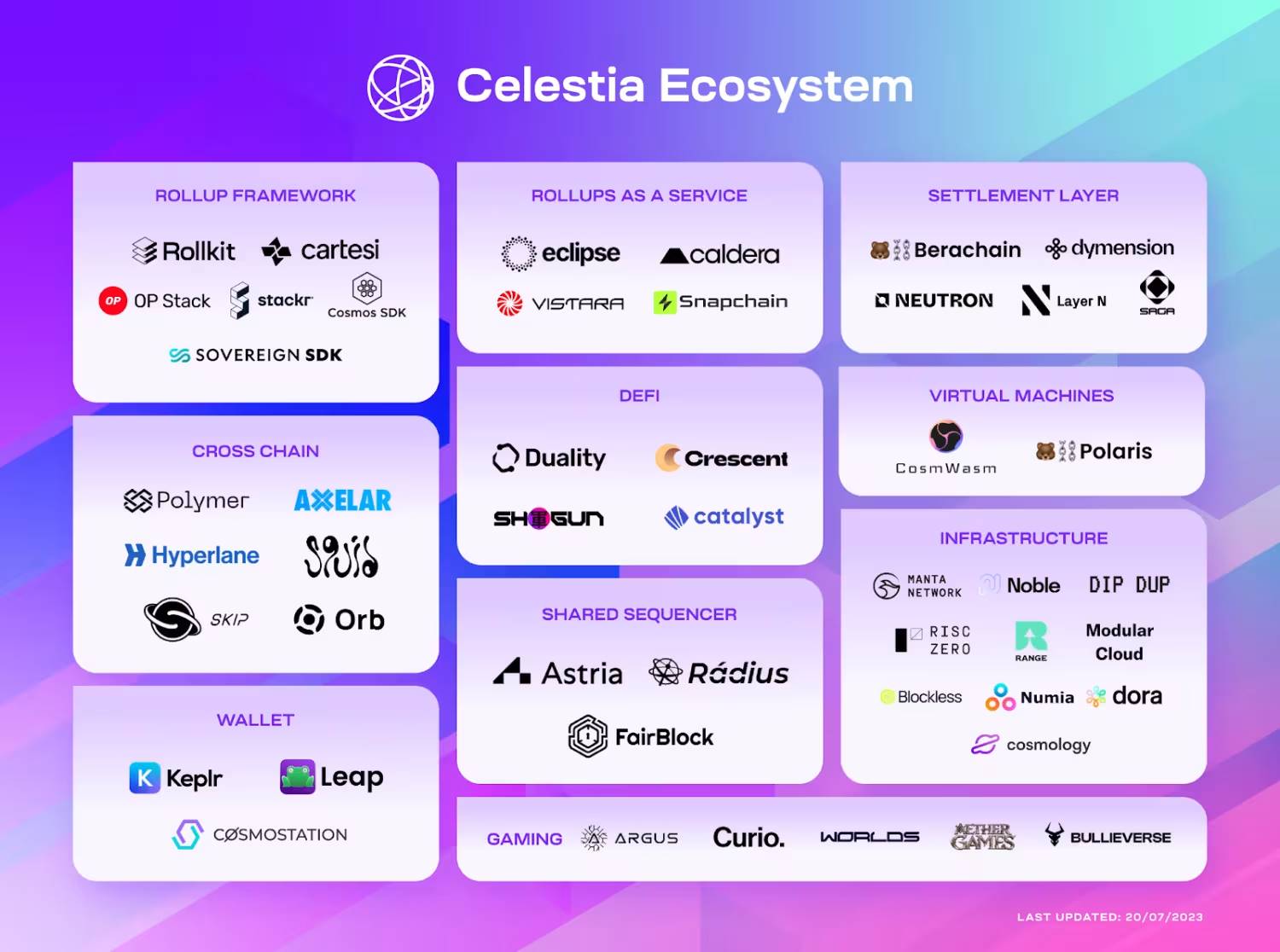
Source: Celestia
One notable project is Saga, a modular Layer 1 platform tailored specifically for the gaming industry, which has recently emerged as an innovative player in the crypto landscape.
Saga Overview
Launching a blockchain can be complex, as it requires developers to manage various technical aspects of blockchain infrastructure. The Saga protocol simplifies this process by offering Chainlets—dedicated blockchains that developers can launch as easily as deploying smart contracts. This solution integrates key components such as data availability, consensus, execution, and settlement, delivering a seamless product experience. By bundling these elements, Saga not only saves developers time but also reduces the typical complexity associated with modular systems.
The Saga protocol operates on a fully decentralized Proof-of-Stake model, ensuring that every Chainlet maintains the same high security standards as the Saga mainnet, using the same validator set.

Saga’s impact is evident in its rapid growth. In less than two years, it has successfully attracted 350 projects, with 80% focused on gaming. Strategic partnerships with industry leaders such as Polygon, Avalanche, and Celestia further highlight Saga’s capabilities in scaling infrastructure and supporting a broad range of blockchain applications.
Saga Architecture
Chainlets
Saga revolutionizes blockchain deployment through its product, Chainlets—interoperable, customizable, automated, and high-performance blockchains within the Saga ecosystem.
These Chainlets are secured and validated via a shared security model called "Interchain Security," benefiting from robust protection provided by the Saga blockchain. This model allows Saga to ensure that its Chainlets inherit the same level of security and decentralization as Saga itself, functioning similarly to Cosmos SDK app chains but without requiring developers to manage their own validator sets.
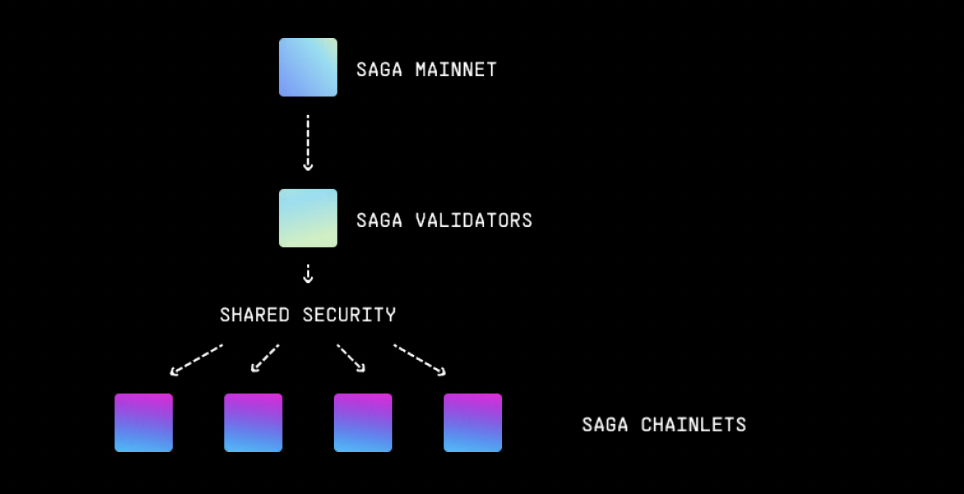
Source: Saga
Chainlets provide developers with a decentralized and secure way to deploy application-specific blockchains, allowing freedom to choose their preferred virtual machine. This flexibility was prominently showcased at the Saga Multiverse Summit, where Saga Realms was introduced, enabling developers to launch customizable chains on Saga with different features and services, such as tech stacks, security sources, and related obligations. Under the Realms framework, standard Saga Chainlets will become one of many supported domains, including future offerings for partners like Ethereum (Ethlets), Polygon, Avalanche, and Celestia.
Unlike the replicated security mechanism used by Cosmos Hub, launching a Chainlet is uniquely permissionless. Developers simply pay fees in $SAGA tokens to set up and maintain their Chainlet, similar to subscribing to a cloud service provider like Amazon Web Services—but paid in $SAGA.
Security Chain
The Security Chain, built using Cosmos-SDK, serves as the primary source of security for the Saga protocol. It handles $SAGA token minting, staking, and potential penalties for validator misbehavior.
Platform Chain
Also built on Cosmos-SDK, the Platform Chain is where developers launch and manage their Chainlets. It aggregates multiple security sources—including the Security Chain—and extends security to Chainlets via a process known as Cross-Chain Validation (CCV), while reporting any detected misbehavior back to the Security Chain for potential penalties.

Initially, the Platform Chain will primarily derive security from the Saga Security Chain, but plans are in place to incorporate additional sources such as Ethereum, Polygon, Avalanche, and other validators in the future.
Team, Adoption, and Alliances
Saga is led by a dynamic and experienced team of co-founders:
● Jin Kwon (Jin Kwon), Co-founder and Chief Strategy Officer, former VP at Ignite, holds a Master's degree in Computer Science from UC Berkeley.
● Jacob McDorman (Jacob McDorman), Co-founder and CTO, co-founded software consulting firm Cellaflora, holds a Bachelor's degree in Mathematics from Purdue University.
● Bogdan Alexandrescu (Bogdan Alexandrescu), technical expert and entrepreneur, active in the Bitcoin Foundation and multiple blockchain initiatives.
● Rebecca Liao (Rebecca Liao), Co-founder and CEO, also co-founded Skuchain, a global trade blockchain. Under her leadership, Skuchain processed over $5 billion in annual transactions and was recognized by the World Trade Organization as a top blockchain company in 2020.

As of April 26, 2024, the Saga Innovators Program includes 350 projects, with 80% focused on gaming, 10% on NFTs and entertainment, and the remaining 10% on decentralized finance (DeFi). These projects leverage Saga’s technological innovations and expand its blockchain applications.
Saga has partnered with several leading blockchain protocols to scale using its Chainlets technology:
● XPLA and Com2uS: In November 2022, Saga partnered with XPLA to provide scalable infrastructure for gaming-dedicated chains.
● Celestia Labs: In January 2023, Saga began implementing Sequencers-as-a-Service in collaboration with Celestia to scale rollup architectures.
● Polygon: In February 2023, the partnership automated Supernets, facilitating the deployment of app chain solutions.
● Avalanche: In April 2023, Saga automated the instantiation of subnets, enhancing app chain deployment.
Saga Origins, launched in March 2024, is dedicated to guiding Web3 games to market. The division actively supports game developers at every stage, from initial concept to final release. To drive success, Saga Origins offers a suite of services including influencer collaborations for visibility, financial support for user acquisition, and extensive promotional assistance to maximize impact and engagement.
Tokenomics
The $SAGA token serves multiple purposes within the Saga protocol. It is the currency developers use to pay network validators when launching and maintaining Chainlets. It also rewards users who stake tokens to support network security. Additionally, holding $SAGA grants users voting rights on future network decisions. Initially, one billion $SAGA tokens will be issued, with approximately 90 million—9%—released during the token generation event.
With a market cap of $22.5 million and a fully diluted valuation of $3.6 billion, there are currently 90 million tokens in circulation, representing 9% of the total supply of one billion.
Token Distribution:

Source: Cryptorank
Token Release Schedule:

Source: Binance Research
Funding History
In October 2021, the company successfully raised $2 million backed by Ignite. The following year, on May 19, 2022, it raised an additional $6.5 million in a seed funding round, with investors including Hypersphere Ventures, Maven 11 Capital, SamsungNext, Merit Circle, Polygon Studios, and LongHash Ventures. On November 20, 2023, it raised another $5 million in an extended seed round led by Placeholder Ventures and supported by LongHash Ventures, Com2uS, Red Beard Ventures, Dispersion Capital, and Tykhe Block Ventures.
Beyond these successful funding rounds, Saga’s landmark listing on Binance surpassed all previous Launchpool records on the platform, attracting over $13 billion in funding within less than 24 hours.
Positive Fundamentals
● Importance of Modularity: Modularity is key to solving scalability, decentralization, and security challenges in blockchain technology. As an early adopter of this model, Saga stands to benefit greatly once this paradigm gains widespread acceptance.
● Rise of GameFi: GameFi has emerged as one of the most promising sectors in the digital asset space, and Saga is making significant investments in this area to secure a prominent position within the industry.
● Strategic Partnerships: Saga has established strategic collaborations with major blockchain players such as Polygon, Avalanche, and Celestia. These partnerships strengthen Saga’s technical infrastructure, expand its ecosystem, and enhance its ability to support scalable and efficient blockchain applications.
● Strong Investor Backing: Saga has secured significant investments from reputable investors, providing financial stability to support ongoing development and expansion. Saga’s record-breaking launch on Binance highlights its market credibility and potential for success, underscored by strong community participation and investor confidence.
Negative Fundamentals
● Intense Market Competition: The blockchain space, particularly in gaming and decentralized finance (DeFi), is highly competitive, with many established players and new entrants emerging regularly. Saga’s success depends on its ability to continuously innovate and differentiate itself from other blockchain platforms in terms of scalability and efficiency.
● High Market Volatility: From an investment perspective, the cryptocurrency market is extremely volatile and highly sensitive to macroeconomic factors, liquidity cycles, and economic news. Despite the technology’s strong potential and Saga’s promising fundamentals, the speculative nature of the market often overshadows actual usage and demand.
● Regulatory and Legal Risks: Changes in regulations or unfavorable legal developments regarding cryptocurrencies could impact Saga’s operations, especially in key markets crucial to its growth.
Conclusion
As blockchain technology evolves, Saga stands out as a significant player in modular blockchain innovation, particularly within the gaming sector. By partitioning blockchain functions into specialized networks, Saga enhances efficiency, security, and scalability. The introduction of Chainlets and its commitment to scalable, interoperable, and cost-effective infrastructure position Saga not only to meet current demands for blockchain solutions but also to profoundly influence the future development of decentralized applications. Saga’s dedication to progress and innovation marks it as a pivotal and noteworthy entity within the blockchain ecosystem.
For more insights into the blockchain industry, contact us at Greythorn. Visit our website to learn more about how we contribute to the blockchain and crypto markets.
Join TechFlow official community to stay tuned
Telegram:https://t.me/TechFlowDaily
X (Twitter):https://x.com/TechFlowPost
X (Twitter) EN:https://x.com/BlockFlow_News
 Greythorn


![In-depth Analysis of Trade[XYZ]: How Were 92 Markets and 98% HIP-3 Trading Volume Established?](https://upload.techflowpost.com/upload/images/20260716/20260716061117965147.jpeg?x-oss-process=image/resize,p_50/quality,q_80)