Saga: A blockchain protocol that automatically configures specific applications across the multiverse
TechFlow Selected TechFlow Selected
Saga: A blockchain protocol that automatically configures specific applications across the multiverse
The protocol design fundamentally reimagines how developers and end users interact with blockchains to achieve scalability, sovereignty, and ease of setup.
 Navigating Web3 tides with focused insights
This session features Rebecca Liao, Co-founder & CEO of Saga, who provides a comprehensive introduction to Saga's operating principles, technical architecture, and the project's latest developments. The following is a refined summary of key points delivered by the guest speaker during the AMA.
Part One: AMA Summary
1. Founder’s Background and Team
-
After graduating from Stanford, founder Rebecca Liao began her career as a lawyer at financial institutions.
-
Driven by a long-standing passion for the tech industry, she joined the AI startup Globality Inc. around 2013–2014, where she first encountered Bitcoin and blockchain technology, quickly deciding to dive into blockchain entrepreneurship.
-
She met Zaki and co-founded SkuChain, a DeFi-focused blockchain project initially aimed at providing short-term liquidity to small and medium-sized enterprises outside the U.S., which achieved a transaction volume of $5 billion by early 2021.
-
Together with former Tendermint executives Jin Kwon and CTO Jacob McDorman, among other developers, she founded Saga with the mission of lowering development barriers for Cosmos builders, focusing particularly on gaming and entertainment to build the Saga Multiverse.
2. Saga Protocol’s Technical Approach and Features
Saga is a protocol designed to automatically provision application-specific blockchains across a multiverse environment. It fundamentally rethinks how developers and end users interact with blockchains, aiming to deliver scalability, sovereignty, and ease of setup. By leveraging shared security, innovations in validator sequencing, and automated CI/CD deployment pipelines standardized across single-tenant application VMs, Saga makes launching a dedicated blockchain—or "chainlet"—as simple as deploying a smart contract.
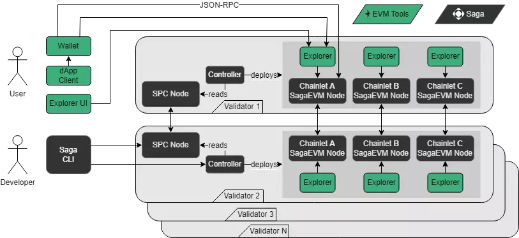
The Saga network serves as a scalable infrastructure layer for Web3 development. Its unique characteristics include:
-
No upfront costs to launch a chain on Saga, with predictable developer pricing for blockspace provisioning.
-
Automatic deployment of single-tenant applications onto their own dedicated, shared-security chains.
-
Dedicated shared-security chains for developers’ applications ensure high throughput, easy upgrades, and congestion mitigation—without dependency on other applications using Saga.
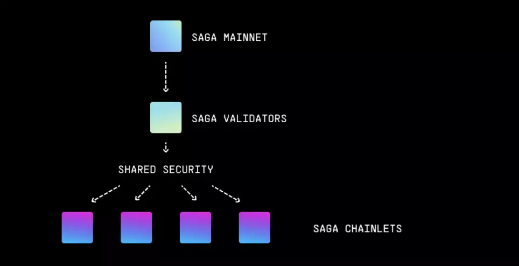
Saga’s mainnet functions as Layer 1. Building an app on Saga is akin to provisioning on-demand services via AWS. Developers typically create multiple chainlets on Saga for development, testing, and production environments—all interconnected via IBC. Development teams don’t need to worry about validators or chain security; the Saga mainnet provides a uniform security model across all chainlets.
3. Saga’s Economic Model and Business Development
Saga divides its token economy into two conceptual components: frontend and backend.
-
Frontend refers to the flow of tokens between Chainlet end users and Chainlet developers—the token interactions occurring directly within individual Chainlets.
-
Backend refers to the token flows between Chainlet developers and the Saga chain itself—essentially how developers pay for resources consumed on the broader Saga network.
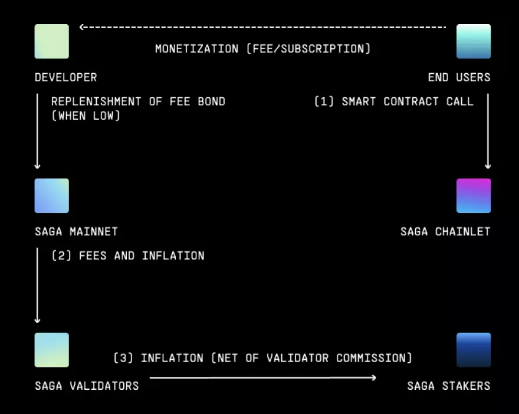
On Saga, end users of each application only interact with their respective Chainlet. All fees associated with running the Chainlet are paid by the application developer. Separating the token mechanism into two distinct layers brings notable usability advantages and value accrual opportunities for developers and partner chains. Thanks to Saga’s unique token model—which allows end users to pay fees in any Cosmos IBC-compatible token—these Chainlets can function either as dedicated application chains or serve as horizontal scaling solutions for other L1s and L2s.
4. Market Dynamics, Community Growth, and Incentives
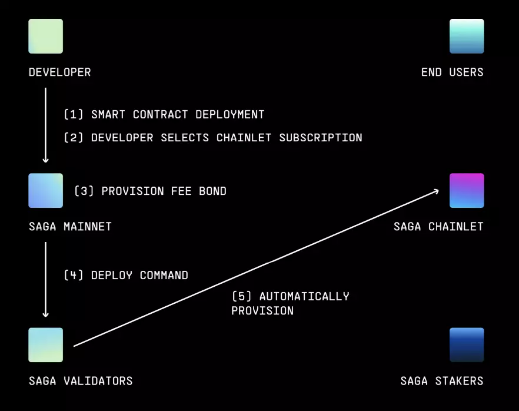
In the most recent Innovators Program announcement, 55 new projects were added, bringing the total number of applications in the Saga ecosystem to 224. Breaking it down: 80% of our ecosystem consists of gaming applications, contributed by independent game developers, studios, gaming enterprises, and publishers. Another 10% comes from teams working in music, art, animation, and AI-driven NFTs, with the remainder in DeFi. This distribution aligns perfectly with our strategic focus on gaming and entertainment. Currently, the Saga Cassiopeia testnet serves as the entry point for developers into the Saga ecosystem. Like most smart contract platforms, developers deploy their compiled smart contract binaries onto the Saga testnet. Upon initialization, Saga validators automatically provision a dedicated chain—or chainlet—containing the smart contract. The Saga team is now fully focused on launching the mainnet, and will soon roll out an incentivized testnet. We will continue rolling out developer reward programs, with direct incentives allocated to innovators building on Saga—especially early contributors—once the mainnet goes live.
Part Two: Community Q&A
IBCL asks: Regarding app-chains. We know that SAGA offers a feature where developers can write smart contracts and then SAGA helps them spin up an app-chain. How is this app-chain different from a regular Cosmos SDK-built chain?
Rebecca Liao: That’s a great question. Let’s look at dYdX—they’re an incredible team whom I deeply respect. They have some of the best engineers in the space. But even they took 14 months to build their Cosmos SDK-based chain. That was an amazing yet extremely challenging effort, clearly demonstrating the difficulty of launching a sovereign chain. On SAGA today, you can spin up your own Cosmos chain in just two minutes. We’ve taken a different approach: developers don’t need to worry about security at all. Simply by deploying a smart contract, they instantly receive a fully sovereign Cosmos blockchain. That’s exactly what Saga is built to solve.
Join TechFlow official community to stay tuned
Telegram:https://t.me/TechFlowDaily
X (Twitter):https://x.com/TechFlowPost
X (Twitter) EN:https://x.com/BlockFlow_News
 IBCL中文


![In-depth Analysis of Trade[XYZ]: How Were 92 Markets and 98% HIP-3 Trading Volume Established?](https://upload.techflowpost.com/upload/images/20260716/20260716061117965147.jpeg?x-oss-process=image/resize,p_50/quality,q_80)