








Coinbase CEO Becomes Wall Street’s Public Enemy No. 1
TechFlow Selected TechFlow Selected
Coinbase CEO Becomes Wall Street’s Public Enemy No. 1
Brian Armstrong is engaged in a fierce debate with banking titans such as Jamie Dimon over the future of finance.
 Navigating Web3 tides with focused insights
By Amrith Ramkumar, Dylan Tokar, and Gina Heeb, The Wall Street Journal
Translated by Luffy, Foresight News
During last week’s World Economic Forum in Davos, Brian Armstrong, CEO of Coinbase—the largest U.S. cryptocurrency platform—was having coffee with former UK Prime Minister Tony Blair when JPMorgan Chase CEO Jamie Dimon abruptly interrupted their conversation.
“You’re full of shit,” Dimon said, pointing directly at Armstrong’s face. The longtime cryptocurrency skeptic had previously called Bitcoin a “fraud.”
According to people familiar with the matter, Dimon’s core message was a demand that Armstrong stop spreading misinformation on television. Earlier that week, Armstrong had publicly accused banks of obstructing legislation aimed at establishing a new regulatory framework for digital assets during multiple business TV appearances.
This direct confrontation stood in stark contrast to Davos’s stated mission of fostering cooperation among global leaders.
As cryptocurrencies rapidly integrate into the U.S. financial mainstream, Wall Street titans have finally recognized the threat this sector poses. Although banks have embraced certain cryptocurrency applications—such as offering Bitcoin investment services to clients or leveraging digital assets to improve payment efficiency—they have drawn a firm red line when crypto encroaches upon their core business: personal deposit accounts.
A fundamental disagreement now exists between the banking industry and Coinbase over one central question: Do cryptocurrency exchanges have the right to pay regular yields to users holding digital tokens? These so-called yield rewards involve paying ongoing fees to stablecoin holders at an approximate annual rate of 3.5%.
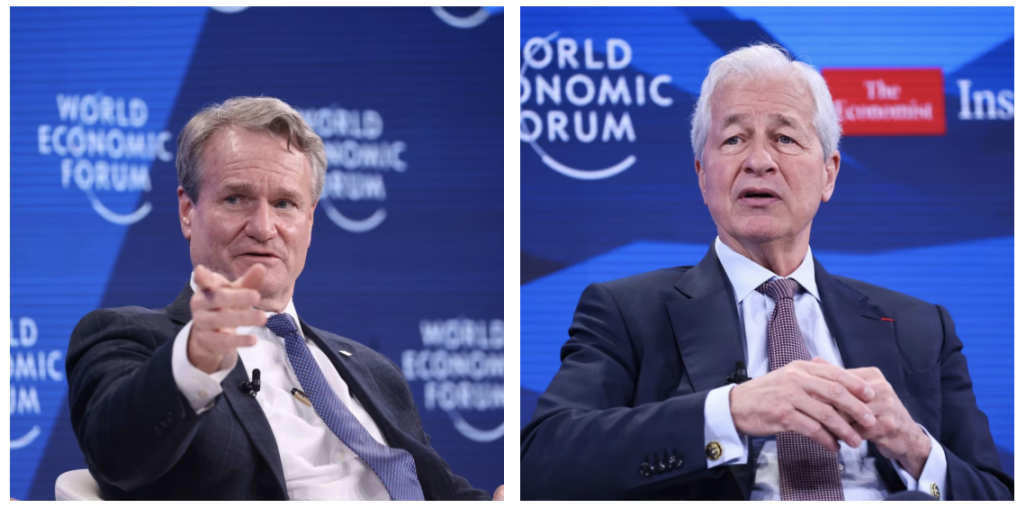
Brian Moynihan, CEO of Bank of America; Jamie Dimon, CEO of JPMorgan Chase
Banks contend that such yields paid by crypto exchanges are functionally identical to bank deposit interest. Since typical checking-account interest rates hover below 0.1%—far lower than crypto yields—banks fear consumers will shift massive amounts of capital into the crypto market. They warn this trend could severely damage community banks and undermine corporate lending operations. Armstrong and other crypto industry participants counter that markets should operate under free competition principles: if banks wish to compete with stablecoins, they can simply raise deposit rates—or enter the stablecoin business themselves.
The proposed Clarity Act could reshape the future of everyday financial services—including bank deposits and electronic payments.
According to sources familiar with the matter, the White House plans to convene a meeting this Monday between banking and cryptocurrency industry groups to broker a compromise. David Sacks, Trump administration’s Special Envoy for Artificial Intelligence and Cryptocurrency, is expected to attend. Several sources say Kara Calvert, Coinbase’s Head of U.S. Policy, is also slated to participate.
Brian Armstrong, 43, co-founded Coinbase in 2012 and has long led the cryptocurrency industry’s push for legitimacy and mainstream acceptance. As CEO of the roughly $55 billion company, Armstrong wields outsized influence in policy debates affecting the industry—including this high-stakes legislative battle in Washington. “No bill is better than a bad bill,” he wrote on X (formerly Twitter) the day before a Senate committee was scheduled to vote on a draft bill that, if passed, would effectively prohibit Coinbase and similar firms from paying yields to customers—or cost Coinbase billions of dollars. Hours later, the vote was abruptly postponed, sending shockwaves across the financial world.
“What’s happening now is increasingly seen as a battle between Coinbase and the banking industry—not the entire crypto industry versus banking,” said Ron Hammond, Head of Policy & Advocacy at prominent crypto market maker Wintermute.
Armstrong’s pushback did not end with his January 14 X post. In subsequent TV interviews, he reiterated his position, telling Bloomberg that bank lobbyists were “running around trying to kill competitors” and accusing banks of “lending out customer deposits without meaningful consent.” According to sources, these remarks triggered several awkward face-to-face encounters with bank CEOs at Davos.
“If you want to be in the banking business, get a banking license,” Brian Moynihan, CEO of Bank of America, told Armstrong during a 30-minute meeting at Davos’s main convention center last week. Though the tone remained cordial, the exchange felt stiff throughout.
Citigroup CEO Jane Fraser granted Armstrong less than a minute. Coinbase is a client of both Citigroup and JPMorgan Chase—and maintains commercial partnerships with numerous other banks.
Wells Fargo CEO Charlie Scharf wouldn’t grant Armstrong even one minute. When Armstrong approached him to speak, Scharf bluntly declared there was “nothing to discuss.” At the time, his former boss Jamie Dimon stood nearby.
Aiming to “Replace Traditional Banks”
Armstrong graduated from Rice University in Houston with degrees in economics and computer science and was an early proponent of digital currency concepts and underlying blockchain technology. He read Satoshi Nakamoto’s original 2008 Bitcoin white paper and, while working at Airbnb in 2011, experienced firsthand the difficulties of sending money to South America.
These experiences planted the seeds for Coinbase. At the time, many investors wanted to enter the cryptocurrency space but faced a core problem: no dedicated platforms existed for storing digital assets. Coinbase was founded to solve precisely that issue—and when some customers expressed interest in trading Bitcoin rather than merely holding it, Coinbase naturally evolved into a cryptocurrency exchange.
Coinbase began in a cramped San Francisco apartment—the company’s first office. In 2017, after its other co-founder departed, Armstrong became the undisputed leader.
Multiple former colleagues interviewed previously by The Wall Street Journal described Armstrong as reserved—even struggling at times to communicate smoothly with certain employees—and visibly uncomfortable when reprimanding staff. Some former employees likened his demeanor to that of Vulcans from Star Trek—a fictional alien race renowned for emotional restraint and stoic logic.

Brian Armstrong, Coinbase CEO, speaking onstage at TechCrunch Disrupt Europe (London), 2014
Yet Armstrong has never wavered on Coinbase’s vision. He positioned the company as a trailblazer for integrating cryptocurrency into the U.S. mainstream—and today, Coinbase’s operations span electronic payments, stock trading, commodities trading, and prediction markets.
“Our ultimate goal is to become the alternative to traditional banks in people’s minds,” he said last year in a Fox Business interview. “We want to build a super-financial app that delivers all kinds of financial services.”
As its footprint expanded, Armstrong invested millions to build the largest lobbying team in the cryptocurrency industry. After weathering multiple crypto bull and bear cycles, Coinbase went public in April 2021, briefly surpassing a $100 billion market cap—and Armstrong’s personal stake peaked at roughly $13 billion.

Coinbase employees celebrating the company’s IPO outside the Nasdaq exchange in New York, 2021
Having survived the 2022 industry crash and withstood regulatory pressure from the Biden administration in 2023, Armstrong launched a counteroffensive—and gradually found his voice. Once a manager who preferred coding quietly in his office wearing headphones and avoided public speaking, he is now crypto’s steadfast advocate in Washington—and Washington’s stance toward crypto is poised for a dramatic shift.
Through a series of super PACs, Coinbase spent approximately $75 million on the 2024 U.S. election cycle to oppose candidates skeptical of crypto—and established grassroots organizations to rally public support for crypto-related legislation. This super PAC announced Wednesday that its war chest has grown to $193 million.
Donald Trump’s 2024 election victory opened a decade-long window for Armstrong to secure policy breakthroughs. Armstrong hailed Trump as ushering in the “dawn of a new crypto era” and attended the “Crypto Celebration”—a Trump inauguration event headlined by Snoop Dogg. Today, the executive swaps his usual T-shirt and black jacket for formal wear at least once every two months to visit Capitol Hill.
“In the U.S., Coinbase is at the forefront of everything related to cryptocurrency,” said Anthony Scaramucci, founder of SkyBridge Capital and a longtime crypto investor.
Last summer, Trump signed the Genius Act, clearing the path for numerous companies to issue stablecoins—and directly fueling explosive growth in stablecoin business. While the law prohibits stablecoin issuers themselves from paying interest to users, it does not restrict exchanges like Coinbase or third-party entities. Banking groups view this omission as a legal loophole—and it lies at the heart of the current fierce battle over the Clarity Act.
A Long Legislative Road
The U.S. House of Representatives passed its version of the Clarity Act last year—but passage in the Senate is widely viewed as extremely difficult, partly due to lawmakers’ disagreements over what regulatory rules crypto firms should follow. The Senate Committee on Agriculture—which oversees legislation related to the Commodity Futures Trading Commission—approved its version of the bill draft this past Thursday. Lawmakers must ultimately secure full Senate passage of one version and then reconcile differences with the House version.
According to sources familiar with the matter, Moynihan’s core message to Armstrong was clear: if crypto firms like Coinbase wish to offer bank-like deposit services, the banking industry broadly believes those firms should be subject to the same regulatory standards applied to traditional banks. Regulators including the Federal Reserve and the Office of the Comptroller of the Currency conduct rigorous risk assessments of banks, regularly inspect their operations, and impose explicit capital requirements on their lending and investment activities.
“This dispute over yield rewards is an outlier in our relationships with banks. We maintain close partnerships with multiple banks and have already announced several joint initiatives,” said Faryar Shirzad, Coinbase’s Chief Policy Officer.
Coinbase enjoys a lucrative partnership with stablecoin issuer Circle, earning substantial revenue shares from the popular stablecoin USDC. Unlike other crypto firms, Coinbase leverages this exclusive relationship to pay 3.5% yield rewards to select USDC holders. The company says such incentives help attract users—and provide consumers more options amid historically low bank checking-account interest rates.
“There’s no reason to ban paying interest to consumers,” Armstrong told The Wall Street Journal last year.
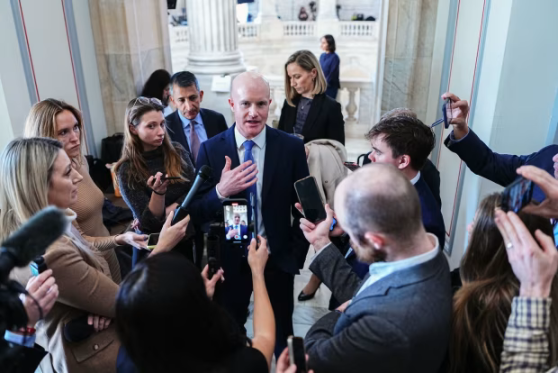
Brian Armstrong addressing the media on Capitol Hill
As the Clarity Act approaches a vote in Congress, banks have intensified behind-the-scenes lobbying efforts. Citing a government estimate, they warned senators that roughly $6.6 trillion in traditional financial-system deposits could be siphoned off into the crypto market. Their campaign proved effective: the nearly 300-page draft bill contains multiple provisions and potential amendments that Armstrong views as hostile to the crypto industry. He promptly withdrew his support—and hours later, Senator Tim Scott (R-SC), Chairman of the Senate Banking Committee, canceled the vote.
According to sources familiar with the matter, Armstrong has proposed his own solution to break the impasse. He told Moynihan the idea involves creating a new category of stablecoin issuers—entities that, if they meet stricter regulatory standards, would be permitted to pay yield rewards to users. In theory, this approach would enable fair competition between banks and Coinbase in the stablecoin space. Others have suggested banning most yield payments outright—but carving out narrow exemptions specifically for firms like Coinbase.
Any viable solution will require Armstrong’s backing.
“Right now, the fate of this bill is widely perceived as resting in Coinbase’s hands,” said Hilary Allen, a securities law professor at American University and a crypto skeptic. “It’s truly astonishing.”
Join TechFlow official community to stay tuned
Telegram:https://t.me/TechFlowDaily
X (Twitter):https://x.com/TechFlowPost
X (Twitter) EN:https://x.com/BlockFlow_News


