








After Coinbase Cuts 700 Jobs: One Person Replaces an Entire Team, and Managers Must Write Code Themselves
TechFlow Selected TechFlow Selected
After Coinbase Cuts 700 Jobs: One Person Replaces an Entire Team, and Managers Must Write Code Themselves
The cryptocurrency industry’s wave of layoffs is accelerating, and AI has become the unifying narrative.
 Navigating Web3 tides with focused insights
Author: Claude, TechFlow
TechFlow Intro: Coinbase announced layoffs affecting approximately 14% of its workforce—nearly 700 employees. CEO Brian Armstrong described the company as undergoing a fundamental reorganization into an “intelligence,” with humans operating at the “edge” to perform alignment. Alongside the layoffs, Coinbase is implementing aggressive organizational reforms: flattening its management hierarchy to five layers below the CEO and COO; eliminating pure management roles in favor of “player-coaches”; and piloting “one-person teams,” where a single individual leverages AI agents to handle engineering, design, and product development end-to-end. Mizuho analysts bluntly stated that the crypto winter—not AI—is the true driver behind the layoffs, calling AI merely a “convenient excuse.”
Coinbase announced on May 5 that it would cut roughly 14% of its staff—nearly 700 employees. In an internal memo to all employees, CEO Brian Armstrong characterized this move as a foundational operational restructuring—not simply a cost-cutting measure.
Armstrong shared the internal memo on X, citing two primary reasons for the layoffs: the cryptocurrency market is currently in a downturn, pressuring revenue; and AI is fundamentally transforming team productivity. According to documents filed with the SEC, the restructuring is expected to incur $50–60 million in expenses, primarily cash severance payments, which will be recorded predominantly in Q2 2026.
On the day the news broke, Coinbase’s stock fell approximately 2.5%. The company will release its Q1 2026 financial results this Thursday.

Crypto Winter Meets AI Narrative: Authentic Motives Under Scrutiny
Dan Dolev, analyst at Mizuho Securities, told Bloomberg that the crypto winter is “most likely the real reason” behind the layoffs—and AI is merely a “convenient excuse.”
This assessment is backed by data. Coinbase posted a net loss of $667 million in Q4 2025, ending a streak of eight consecutive profitable quarters. Net revenue for the quarter declined 21.5% year-on-year to $1.78 billion, while earnings per share came in at $0.66—well below the analyst consensus estimate of $0.92. Trading-related revenue plummeted nearly 37% year-on-year to $983 million. After Bitcoin peaked near $126,000 in October last year, it has since retreated significantly—though it rebounded to approximately $81,000 by the time of the layoff announcement, still down more than one-third from its all-time high.

Aleksandar Tomic, Deputy Dean of Strategy, Innovation, and Technology at Boston College, told Fortune that some CEOs are using AI-driven restructuring as a “positive framing” for layoffs. He noted that publicly attributing layoffs to “efficiency improvements”—rather than admitting underlying business problems (which the market interprets as negative)—often boosts stock prices.
OpenAI CEO Sam Altman previously warned about “AI washing”: companies falsely blaming AI for layoffs unrelated to AI adoption.
Armstrong’s Organizational Experiments: Five-Tier Structure, Player-Coaches, and One-Person Teams
The layoffs represent only part of Armstrong’s broader reform agenda. Even more radical is the complete overhaul of Coinbase’s organizational architecture.
In his X post, Armstrong wrote: “We’re not just reducing headcount or cutting costs—we’re fundamentally changing how we operate: rebuilding Coinbase as an ‘intelligence,’ with humans aligning at the edge.”
Four specific initiatives are underway:
• Flattening the management hierarchy to no more than five layers beneath the CEO and COO. Armstrong stated, “Layers slow things down and impose a coordination tax.”
• Eliminating “pure management roles”: All managers must also serve as high-performing individual contributors—what Armstrong calls “player-coaches.” Each manager will oversee at least 15 direct reports.
• Forming “AI-native pods”: cross-functional teams composed of the company’s most proficient AI users, granted greater leverage over output.
• Piloting “one-person teams”: individuals who simultaneously assume the full responsibilities of engineer, designer, and product manager—leveraging AI agents to accomplish work formerly requiring entire teams.
Armstrong claimed that engineers have already been able to “deliver in days what used to take a team weeks,” and non-technical staff are now using AI to write production-grade code.
The Rise of the “Megamanager”: Coinbase Is Not Alone
Coinbase’s managerial reforms align closely with the U.S. tech industry’s growing “megamanager” trend.
According to Gallup, the average number of direct reports per U.S. manager rose from 10.9 in 2024 to 12.1. Meta’s new applied engineering teams reportedly push this ratio as high as 50:1.
Coinbase’s target ratio of 15:1 falls between these extremes—but combined with experimental structures like “player-coaches” and “one-person teams,” its reform intensity is unmatched within the crypto industry.
Armstrong has long enforced strict AI tool adoption. He previously purchased GitHub Copilot and Cursor licenses for all engineers and mandated full tool proficiency training within one week—far shorter than the company’s earlier internal estimate of “several quarters.” Employees failing to comply were terminated outright.
Accelerating Layoffs Across Crypto: AI as a Unifying Narrative
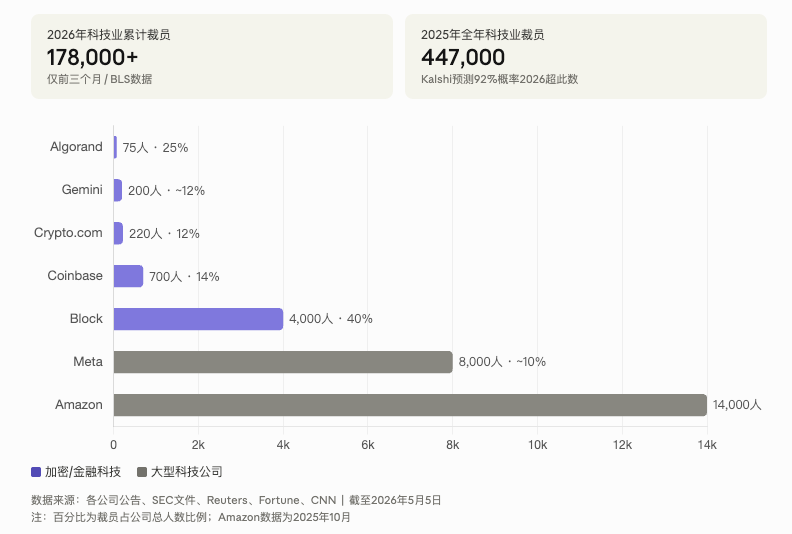
Coinbase is not an outlier. Since 2026, layoffs across crypto and fintech have formed a clear trend—with AI cited as a core justification by nearly every firm.
Block (formerly Square) cut roughly 40% of its workforce—over 4,000 people—in February. Founder Jack Dorsey attributed the cuts entirely to AI tools’ efficiency gains and predicted most companies would soon follow suit. Block’s stock surged nearly 18% on the day the layoffs were announced.
Additionally, Crypto.com recently cut 12% of its staff, and Algorand reduced headcount by 25%, both citing a combination of market weakness and AI-driven productivity improvements.
Per U.S. Bureau of Labor Statistics JOLTS data, the information sector shed 178,000 jobs in the first quarter of 2026. On prediction market platform Kalshi, traders assign a 92% probability that total tech-sector layoffs in 2026 will exceed the 447,000 recorded in 2025.
A Look Back at Coinbase’s Layoff History and Severance Terms
This is not Coinbase’s first major round of layoffs during a crypto winter. During the 2022 market crash, the company cut 18% of its staff. In this latest internal memo, Armstrong noted that Coinbase has weathered four crypto winters over the past 13 years.
U.S.-based employees affected by this round of layoffs will receive at least 16 weeks of base salary, plus two additional weeks per year of service. Severance terms also include accelerated next vesting cycle for equity grants and six months of COBRA health insurance coverage. System access for impacted employees was revoked immediately upon announcement—Armstrong called this “the only responsible choice to protect customer information.”
In closing his internal memo, Armstrong reaffirmed his strong conviction in the crypto industry, identifying stablecoins, tokenization, and prediction markets as key drivers of the “next wave of adoption.” The company has not scaled back investment in these areas.
Join TechFlow official community to stay tuned
Telegram:https://t.me/TechFlowDaily
X (Twitter):https://x.com/TechFlowPost
X (Twitter) EN:https://x.com/BlockFlow_News
 深潮TechFlow


