Robinhood Gives the Answer: Why Ethereum Becomes the Optimal Solution After Physical Businesses Enter the Market
TechFlow Selected TechFlow Selected
Robinhood Gives the Answer: Why Ethereum Becomes the Optimal Solution After Physical Businesses Enter the Market
The era of token narratives is coming to an end; the real economy will build on-chain businesses based on Ethereum L1+L2.
 Navigating Web3 tides with focused insights
Written by: @ryanberckmans, Ethereum community member
Compiled by: Saoirse, Foresight News
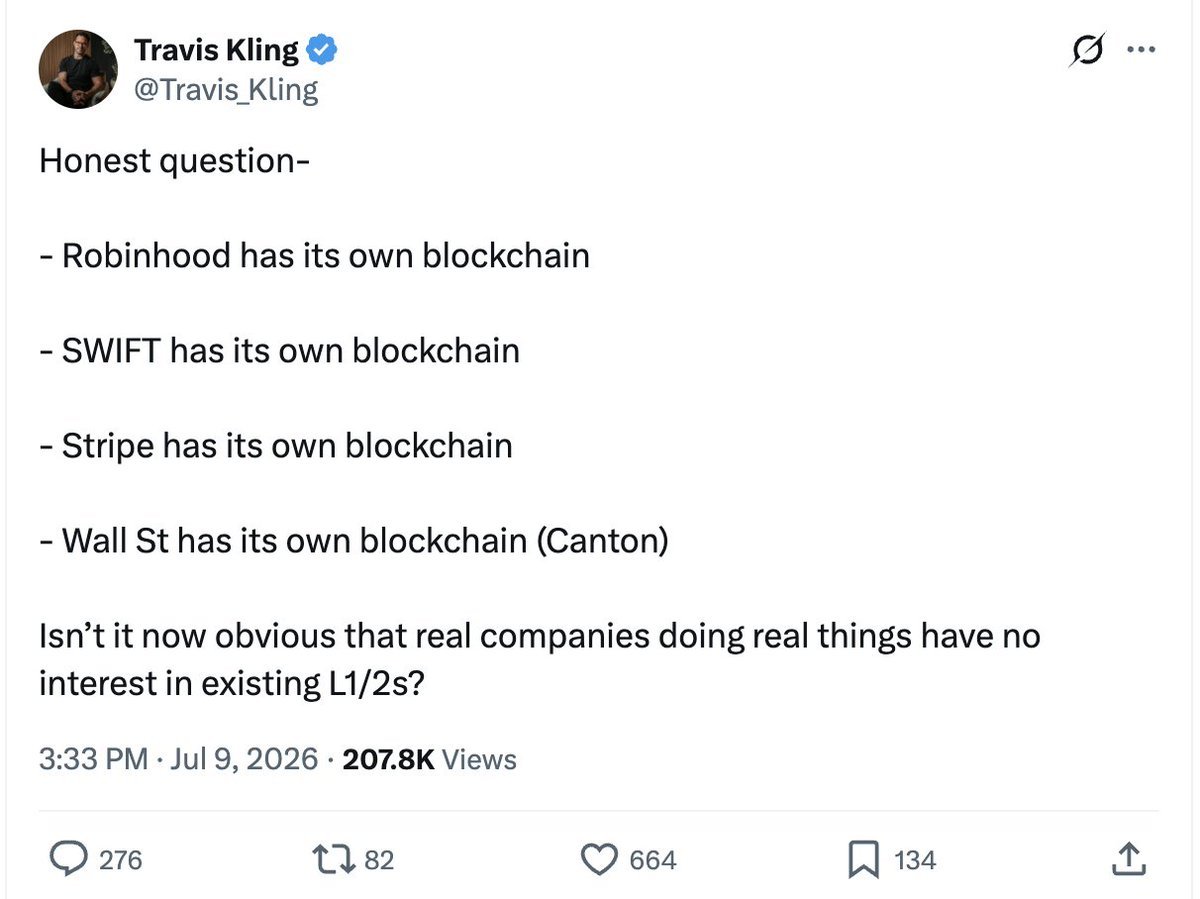
Travis Kling raised a point this week: Is there now an obvious conclusion — that enterprises genuinely conducting real business have no interest in existing various L1s and L2s? His first example was Robinhood. But Robinhood is precisely the perfect counterexample: when real-world enterprises make decisions based on business logic, the vast majority will choose the Ethereum L1+L2 architecture.
(Note: Travis Kling is the Founder and Chief Investment Officer of crypto asset management company Ikigai, with years of investment experience at Wall Street institutions such as Point72, and is a well-known crypto macro investor)
Robinhood chose Ethereum as the underlying L1, and subsequently built its own Ethereum Layer 2 network leveraging Arbitrum technology. Robinhood Chain relies on Ethereum Blobs for data availability, uses ETH as the native Gas token, and features a standard cross-chain bridge secured by Ethereum.
This by no means negates the Ethereum L1+L2 model; on the contrary, it confirms that this architecture is operating as originally intended.
The deeper core lies in the vastly different incentive mechanisms of different participants. In the early crypto industry, building public chains and selecting tech stacks aimed at token issuance; whereas the emerging real-world on-chain economy is gradually establishing Ethereum L1+L2 as the underlying standard for cash flow businesses.
The two types of participants have completely different objective functions. As the structure of market participants shifts, Ethereum's advantages will become increasingly prominent.
Old Crypto Economy: Everything Optimized Around Tokens
The "real-world enterprises serving real users" referred to in this article follow the classic corporate operation model: building products consumers need, earning cash flow by providing services, and enhancing the equity value corresponding to that cash flow.
The "real users" here have demands stemming from normal economic activities, rather than speculative demand driven solely by a new round of token issuance. Of course, crypto-native users also belong to real users.
This is not about judging whether various protocols are useful or whether builders have pure intentions; it is not about moral levels. The core distinction lies in the economic goals of the operating entities.
There are only three sources of value for a token:
- Cash Flow: Possessing reliable claims on future cash flows, similar to on-chain equity or bonds;
- Utility Value: Granting holders privileges to access, control, or govern a high-value system. Even without cash flow, tokens capable of controlling key resources still possess value;
- Monetary Premium: People are willing to hold the asset long-term, convinced that others will recognize and accept it subsequently. The asset transforms into a store of wealth, becoming an ultimate store of value, not just a voucher waiting to be exchanged for rights.
Monetary premium truly exists, but is extremely difficult to maintain. It requires forming strong network effects in market confidence, liquidity, ecosystem adoption, scenario integration, and practical application. Gold, US Dollar, Bitcoin, and Ethereum have each established different forms of monetary premium; almost no other assets have achieved this.
Looking back, since the popularization of programmable crypto assets, the vast majority of participants in the industry have not belonged to formal enterprises pursuing stable cash flows. Their business models mostly involve selling tokens, with token value supported by utility expectations, monetary premium brought by speculation, or cash flow stories that are out of reach and difficult to realize.
Some paths are very direct: develop a protocol and directly issue native tokens; some take a detour: receive grants from ecosystem projects that raised funds via tokens, then sell the received tokens for cash; some projects do plan to earn revenue in the future. But token valuations are seriously disconnected from reasonable expected cash flows; the essential business model still relies on market confidence in the token.
Almost everyone is copying similar playbooks, so this model slowly became the industry norm.
Of course, there are important exceptions: centralized exchanges mostly belong to pure cash flow businesses, naturally adopting multi-chain strategies, where accessing new public chains is like adding a new deposit and withdrawal channel; some stablecoin issuers are also real-world cash flow enterprises, earliest serving crypto circle users, now expanding towards the broader real economy.
But these exceptions instead confirm the core point: enterprises aiming to earn cash select infrastructure to maximize their own business revenue, not to boost token appreciation.
Incentive Mechanisms Ultimately Shape Technical Architecture
A subject's objective function determines technical route selection. If an enterprise's core mission is operating cash flow businesses, blockchain is just infrastructure. Enterprises choose public chains to reduce risk, optimize products, reach users, and protect profits.
If the primary goal is token monetization, the choice of public chain space will be extremely flexible. Whichever public chain's ecosystem grant is received, the project party will develop on that chain; seeing a certain type of protocol succeed on Chain A, they replicate similar products on Chain B, facilitating investors to benchmark token valuations; as long as they want to issue new tokens, brand new L1s, L2s, app chains, Gas tokens, governance systems, niche tech stacks can all be packaged as marketing highlights.
The problem is not technical diversity itself. The crypto field will continue to emerge with a large number of applications, protocols, Layer 2 solutions, and dedicated execution environments, welcoming a Cambrian explosion of innovation. The truly distorting industry trend is: whenever there is a new idea, one must independently build a sovereign ecosystem, separately build an L1, prepare security budgets, cultivate liquidity, issue native monetary assets, completely disregarding whether there is demand for the business itself.
As the industry focus gradually shifts to cash flow real-world businesses, innovation exploration will not stop, but will increasingly be built upon a unified underlying layer. Enterprises focus on application layers and Layer 2 for differentiated development, relying on Ethereum L1 for settlement, security guarantees, liquidity bearing, and value storage. Eventually, the industry will form a dumbbell pattern: edge applications flourish, underlying infrastructure continuously concentrates.
The common logic of the old crypto industry: build the entire technical architecture around tokens wanted to be sold to investors.
Market Participants Are Iterating
The future look of the crypto industry will inevitably differ from the past, the core reason — the players have changed.
The previous US government continuously suppressed on-chain industry development, now the wind direction has reversed. The "GENIUS Act" has officially landed, building a federal regulatory framework for payment stablecoins; EU MiCA regulations have fully taken effect. Brokerages, payment companies, banks, asset management institutions, and governments around the world have all begun to layout stablecoin, asset tokenization, and on-chain business strategies.
This does not mean all regulatory challenges have been solved, but large institutions can finally plan on-chain businesses for the long term.
We are at the beginning stage of the mass adoption S-curve.
When the industry develops maturely, crypto and traditional financial systems will no longer be separated. Assets, currency, transactions, finance, identity, trust will all be borne jointly by on-chain and off-chain systems. Eventually, the term "Web3" will slowly fade from public view like "Web2" once did, and everything will be collectively referred to as the Internet.
At that time, within the crypto market, the proportion of real-world enterprises serving ordinary users of the real economy will significantly increase. Not only will the number of enterprises rise, more critically, capital volume, user scale, total assets, and institutional influence will all tilt towards these entities.
They are no longer crypto projects struggling to find business models just to support token narratives, but real-world companies utilizing blockchain to improve existing businesses and create new cash flow tracks.
The market landscape is rewritten hereby. The infrastructure selection logic of the token economy era is completely inapplicable to cash flow real economies.
Real-World Enterprises Procure Blockchain Infrastructure
The infrastructure trial-and-error risk budget that real-world enterprises can bear is very low. Enterprises do not wish to additionally bear a pile of unrelated extra burdens such as consensus mechanisms, cross-chain bridges, validator systems, Gas assets, governance tokens, liquidity operations, etc. Any newly added technical module must be able to create user value, otherwise it belongs to liabilities.
Blockchain should serve business, not business accommodate blockchain.
Some businesses are naturally suitable for multi-chain layout: exchanges, wallets, stablecoin issuers, various asset issuance platforms need broad user coverage. But even doing multi-chain operations does not mean all public chains have equal status; usually, one core public chain is selected to bear liquidity, asset issuance, settlement, business data storage, and deep ecosystem integration.
The vast majority of on-chain businesses will focus on deeply cultivating one main chain or a few chains within the same system.
Enterprises generally have three types of choices:
- Ethereum L1: Chosen when business pursues extreme decentralization, trusted neutrality, lowest risk, deep liquidity. L1 transaction costs are higher, exchanging for the industry's strongest shared security environment;
- Build Own Ethereum L2: If enterprises need operational control, high customization, compliance capabilities, stable cost models, low latency, high throughput, then build exclusive Layer 2. Can operate independent blockchain according to own needs, while maintaining binding with Ethereum underlying layer;
- Use Mature Shared Layer 2: Business volume is insufficient to support independent Layer 2, directly deploy on ready-made public L2, Base, Arbitrum One, Robinhood Chain and other Ethereum Layer 2s all become universal development platforms.
Such enterprises will still carry out asset cross-chain, output products externally, connect with other networks. Having a core main chain does not mean closed isolation; asset interoperability, business external connection have become standard for on-chain businesses.
But the core home chain is crucial; it determines the security foundation, standard data state, liquidity exchanges, operation models, and long-term development dependence of the entire system.
Why Ethereum L1+L2 Architecture Fits Enterprise Needs
Ethereum precisely splits two core demands of large enterprises: L1 builds a highly decentralized, trusted neutral, liquidity-abundant global settlement hub; various L2s constitute a diversified execution environment market, achieving high speed, low cost, vertical customization, operator autonomous control.
The underlying layer remains solidly neutral, the upper layer flexibly adapts to different operating entities, different jurisdictions, differentiated products and user groups. Layer 2 not only achieves Ethereum scaling at the technical level, but also achieves scaling at the institutional level: institutions can operate businesses according to their own rules, without requiring the global underlying public chain to accommodate their needs.
Independent L1 can also provide operational autonomy and high performance. In some scenarios, fully controlling consensus and data availability has value. But full sovereignty requires paying a high price.
Brand new independent L1 must build from zero and continuously maintain security budgets, validator nodes, cross-chain trust assumptions, liquidity, development tools, ecosystem cooperation, institutional credibility.
It will form a brand new security and liquidity island, significantly increasing friction costs for interoperability with Ethereum L1 and the vast Layer 2 ecosystem. Enterprises are only worth bearing this expense when the independent consensus mechanism itself can create huge commercial value.
For the vast majority of enterprises, the benefits brought by building independent L1 cannot cover comprehensive costs.
Customized Ethereum Layer 2 can almost obtain the vast majority of advantages of independent L1: high TPS, control over execution logic, autonomous upgrades, custom fees, transaction ordering, latency control, access rules, product exclusive features.
At the same time, Layer 2 additionally possesses advantages that native L1 finds difficult to build in short term: relying on Ethereum for settlement and data availability, native standard cross-chain bridge, seamless docking with Ethereum existing capital assets, achieving cross-chain interaction with minimized trust requirements based on the same underlying layer.
Design details of Layer 2 solutions remain critical. Admin permissions, upgrade keys, proof systems, withdrawal guarantee mechanisms determine how much underlying security users can inherit.
Even Layer 2 where operators possess higher control permissions still relies on Ethereum L1 to establish an unbreakable settlement base. Enterprises purely conducting business do not need to independently operate and maintain, secure an underlying L1.
An Ethereum Layer 2 is both an independent blockchain and a component of the Ethereum economic system. Operators can customize execution environment, while reusing Ethereum for settlement, Blob data storage, cross-chain interoperability; most will deeply integrate ETH into the ecosystem, directly using ETH as Gas token; native standard cross-chain bridge allows L1 assets to flow into Layer 2 economy with low trust threshold.
Every newly added Layer 2 will form a differentiated product track, continuously amplifying Ethereum's network effects.
Robinhood's Choice Is Highly Referential
Robinhood's development path has textbook-like reference value. The company first launched stock token business on mature shared Layer 2 Arbitrum One; after business model worked out and own needs clarified, launched exclusive blockchain based on Arbitrum platform.
This is very likely to become the industry general development path: first rely on shared infrastructure to validate products, wait until business scale, product needs, profit models meet standards, then upgrade to build exclusive L2.
Robinhood Chain is customized for financial services. Relying on Arbitrum technology to achieve 100ms latency, predictable transaction prices, high throughput, the entire infrastructure matches all of Robinhood's requirements for performance, security, regulatory compliance.
At the same time, Robinhood Chain is essentially still an Ethereum Layer 2: relying on Ethereum Blobs to carry data, ETH serving as Gas, standard bridge connecting to Ethereum requires no third-party validator nodes.
This is the standard template for real-world enterprises building on-chain products.
Robinhood does not need to issue its own Gas token out of thin air, then prove to the market that the token possesses long-term monetary premium. Robinhood itself is a listed company owning equity, all revenue growth comes from cash flow brought by users, products, existing assets, transactions.
Blockchain is just infrastructure.
Choosing ETH to pay Gas is a purely reasonable business decision. Layer 2 itself needs to pay ETH to Ethereum, exchanging for L1 underlying services; ETH liquidity is sufficient, ecosystem fully native adapted. If issuing exclusive Gas token separately, it will only additionally increase promotion, liquidity maintenance, price volatility, reputation risks, unable to improve Robinhood core business.
The ruler judging Robinhood's success or failure is application layer products and off-chain derivative businesses, not whether it can build a brand new asset with monetary attributes.
Therefore, there are misconceptions in many people's understanding: some claim Robinhood's self-developed blockchain represents it abandoning existing L1/L2 systems. The fact is quite the opposite: Robinhood is just unwilling to share a set of execution environment with everyone, it has not abandoned Ethereum, but chose Ethereum as the underlying parent chain of its own blockchain.
Ethereum L1+L2 architecture is no longer just a theoretical concept.
Coinbase made the same choice when building Base. Coinbase is not an Ethereum advocacy institution, Brian Armstrong (Coinbase Co-founder and CEO) publicly stated long-term more bullish on Bitcoin. But when enterprises select underlying infrastructure for on-chain businesses, still built Base as an Ethereum Layer 2.
This choice is extremely persuasive — the decision starting point is business interests, unrelated to faith preferences.
When enterprise goal is to build cash flow businesses, not hold token issuance, ultimately will only make rational business judgments. Current stage default optimal business solution: Ethereum L1+L2.
What Landscape Changes Mean for Ethereum and ETH
Market participant structure shift is extremely bullish for Ethereum in the long term.
In the past, public chain track competition landscape was largely dominated by projects keen on issuing tokens, distributing ecosystem subsidies, relying on token valuation narratives.
Going forward, industry competition entities become real-world enterprises, decisions revolve around security, user expansion, operational control, market coverage, liquidity, cross-chain interoperability optimization, everything serves cash flow businesses.
Market demand will continuously gather towards Ethereum dumbbell architecture: L1 bears extreme security and liquidity demands; various L2s undertake scaling, customization, autonomous operation demands.
Ethereum's popularization path does not lie in forcing all enterprises to squeeze into the same shared execution chain, but becoming the universal settlement, security, liquidity, asset underlying layer for thousands of upper environments.
This is also bullish for ETH. ETH's growth logic relies on building global currency network, accumulating market consensus, it itself does not belong to cash flow business.
ETH is a high-quality store of value target, Ethereum global settlement layer native asset. Serving as collateral, liquidity carrier, treasury reserve asset, productive asset throughout the entire ecosystem, and continuously growing into ultimate store of value asset.
More and more real-world enterprises conducting business based on Ethereum will continuously popularize ETH to massive users, embed ETH into various products, continuously expanding application scenarios.
Liquidity and consensus continuously deepen, further consolidating ETH monetary premium, and monetary premium essence is powerful network effects.
Old crypto economy: design entire technical architecture around tokens wanted to be sold. Emerging on-chain real economy: select technical architecture around products wanted to be delivered to customers.
Two types of participants optimize goals completely differently, will shape completely different public chain competition landscapes.
Robinhood is not an exception, but a lighthouse.
Real-world enterprises choose Ethereum L1 when pursuing industry strongest neutrality, lowest risk, top liquidity shared environment; build Ethereum L2 when needing operational autonomy, customization capabilities, high performance; business volume insufficient to support independent blockchain, then deploy on mature shared Layer 2 (mostly Ethereum-series L2).
Enterprises choose this way, not because they are Ethereum extreme believers, purely out of business considerations.
Join TechFlow official community to stay tuned
Telegram:https://t.me/TechFlowDaily
X (Twitter):https://x.com/TechFlowPost
X (Twitter) EN:https://x.com/BlockFlow_News
 @ryanberckmans