Korean Stocks Plummet, Driving Retail Investors Away? Upbit Trading Volume Surges 436% in One Day, Capital Accelerates Flow Back to Crypto Market
TechFlow Selected TechFlow Selected
Korean Stocks Plummet, Driving Retail Investors Away? Upbit Trading Volume Surges 436% in One Day, Capital Accelerates Flow Back to Crypto Market
What investors need to pay attention to is: if the KOSPI finds support at current levels, funds from the crypto market's "spillover effect" may withdraw just as quickly.
 Navigating Web3 tides with focused insights
Author: Claude, TechFlow
TechFlow Intro: On July 13, the South Korean KOSPI index triggered the circuit breaker mechanism again. Samsung Electronics and SK Hynix plummeted by over 7% and 12% respectively, and the index has cumulatively drawn down more than 20% from its peak on June 19. Retail investors are voting with their feet: according to Coingecko data, South Korea's largest exchange Upbit saw its 24-hour trading volume surge to $4.12 billion, a single-day increase of 436%. The top five tokens by trading volume were BTC, XRP, ETH, T, and BLAST.
The continuous sharp decline in the South Korean stock market for nearly a week is driving retail capital into the crypto market.
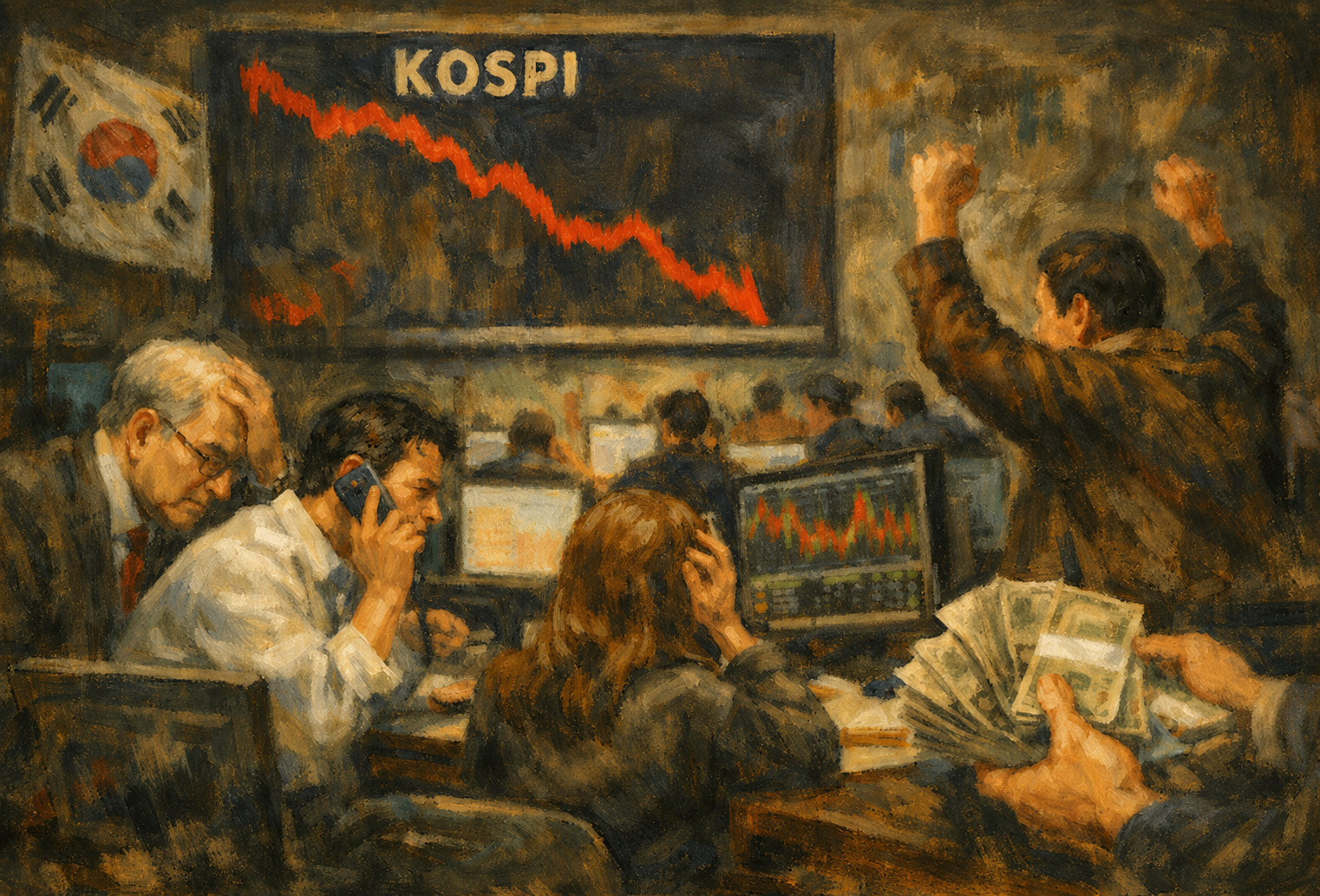
On July 13, the KOSPI index fell 63.91 points to 7,412.03 at the open. The decline continued to widen during the session. At 10:34 AM, the KOSPI 200 futures dropped by more than 5%, triggering the 18th sell-side temporary halt (sidecar) of the year. At the time of the trigger, KOSPI was quoted at 7,162.21, down 4.20% from the previous trading day.
Samsung Electronics fell more than 7.72% that day, and SK Hynix plummeted by over 12%. SK Square (the largest shareholder of SK Hynix) fell 15%, and Samsung Electro-Mechanics fell 17%.
KOSPI Draws Down Over 20% from Peak, Semiconductor Super Cycle Faces Trust Crisis
KOSPI has entered a technical correction from the intraday high of 9,385 points on June 19, with a cumulative drawdown exceeding 20%.
The volatility of the South Korean exchange in 2026 has surpassed that of the 2008 financial crisis. As of now, the South Korean exchange has triggered nearly 30 sidecars and multiple circuit breakers this year, breaking the historical record of 26 sidecars for the entire year of 2008.
Samsung Electronics and SK Hynix together account for about half of the KOSPI market capitalization, and the two almost determine the direction of the index's rise and fall. eToro market analyst Zavier Wong previously pointed out that the weight of these two stocks in the index was about a quarter at the end of last year, and has now risen to about half. Any significant fluctuation in either one will drag the entire index before the remaining more than 900 listed companies have time to react.
SK Hynix "Buy the Rumor, Sell the News" Combined with Lowered Earnings Expectations Drags Down Entire Semiconductor Sector
SK Hynix just listed its ADR on Nasdaq on July 10, with the first day of trading surging 12.8%, raising about $26 billion for the company. But three days later in the Seoul market, the stock price encountered the classic "buy the rumor, sell the news" pullback.
Korea Investment & Securities analyst Chae Min-sook released a report on July 13, predicting SK Hynix's Q2 operating profit to be 60.4 trillion Korean won, about 8% lower than the market consensus of 65 trillion Korean won. Her explanation is that SK Hynix's HBM (High Bandwidth Memory, high-speed storage technology core to AI chips) sales proportion is higher than competitors, resulting in its average selling price growth rate being lower than the industry average.
This expectation downgrade is particularly damaging in the current environment. Daishin Securities analyst Lee Kyung-min pointed out that due to excessive concentration in semiconductors, leveraged investment liquidation, and supply-demand shocks, KOSPI's forward P/E ratio has fallen to the level of the 2008 global financial crisis. However, he also mentioned that current valuations have entered an undervalued range, and even a small positive catalyst could trigger a rapid rebound.
But other voices in the market express caution regarding this. KOSPI's "Buffett Indicator" (ratio of market cap to GDP) reached 221% in June, far higher than the average level of 70.2% during the period from 2000 to 2025, suggesting there is still room for valuation adjustment.
Upbit Trading Volume Surges 436%, Capital Flows Back from Stock Market to Crypto Market
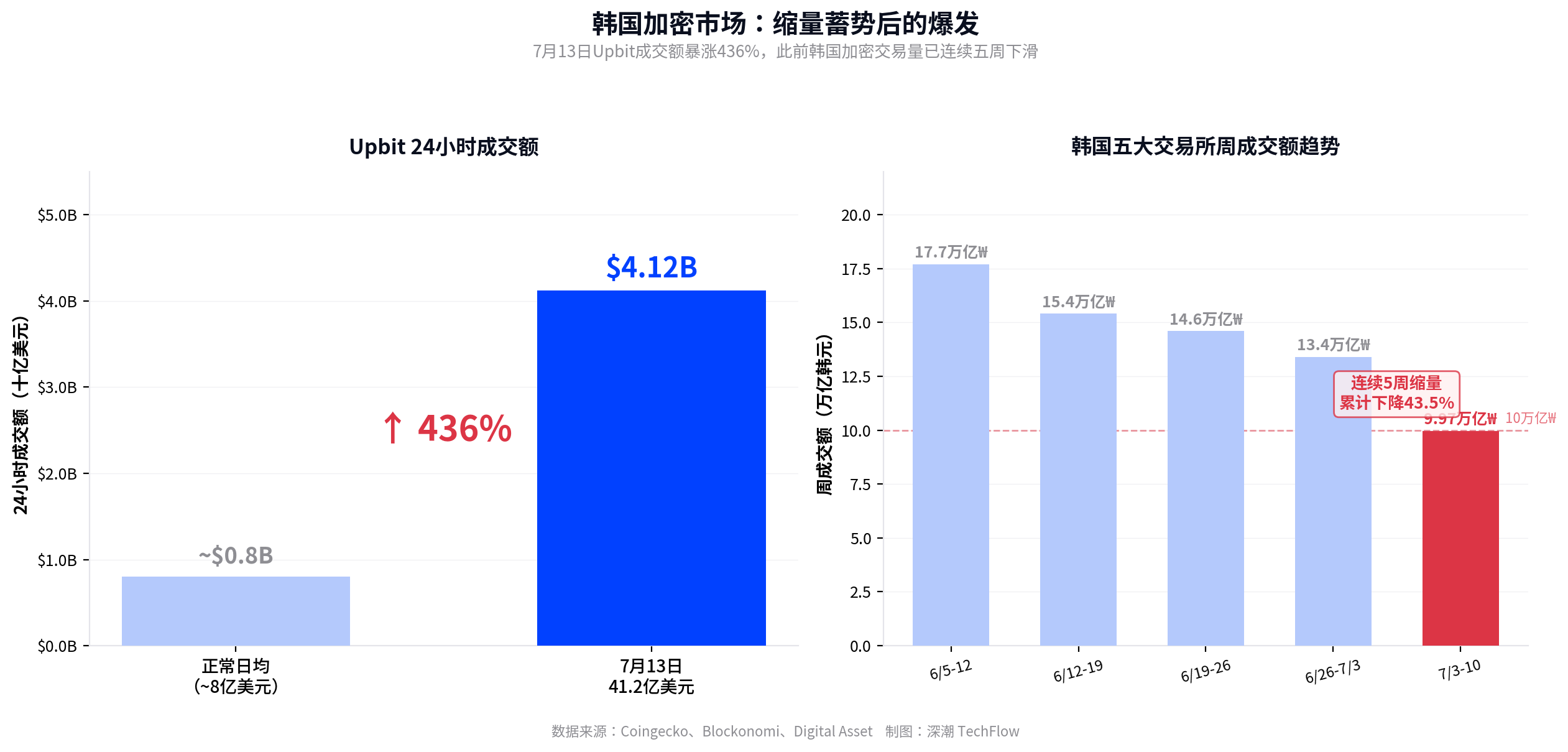
According to Coingecko data, Upbit's near 24-hour trading volume reached $4.12 billion, an increase of 436%. The top five tokens by trading volume were: Bitcoin, XRP, ETH, T (Threshold Network), and BLAST.
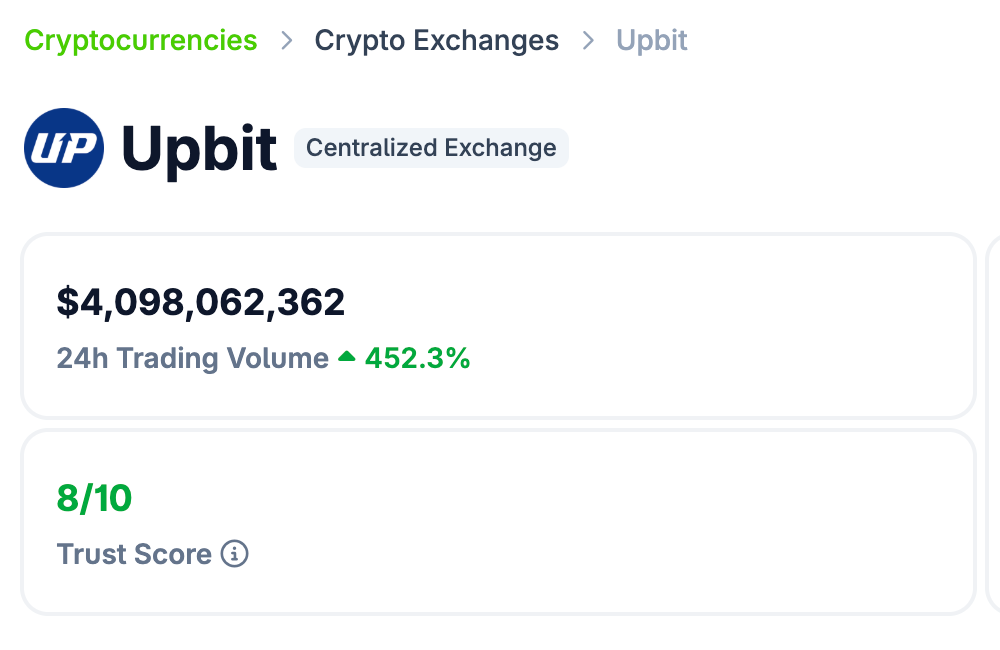
It is not new for South Korean retail investors to move from the stock market to the crypto circle. This round of capital flow is highly consistent with the script during several previous KOSPI plummets. During the KOSPI decline in May previously, XRP became the crypto asset with the highest trading volume on Upbit and Bithumb, with single-day trading volume exceeding Bitcoin and Ethereum.
Tiger Research analyst Ryan Yoon attributes this phenomenon to the group of South Korean retail investors aged 40 to 50, who are withdrawing capital from South Korean domestic stocks and US stocks and transferring it into the crypto market, with XRP being the preferred target.
Before this trading volume surge, the South Korean crypto market actually experienced five consecutive weeks of shrinking volume. From July 3 to 10, the combined trading volume of South Korea's top five Korean won exchanges (Upbit, Bithumb, Coinone, Korbit, Gopax) was 9.9676 trillion Korean won, down 25.75% from the previous week, falling below 10 trillion Korean won for the first time since September 2023.
The trading volume explosion on July 13 can be said to be a concentrated release during this period of shrinking volume and accumulation. Looking at trading varieties, Threshold (T) and BLAST appeared in the top five trading volumes, reflecting South Korean retail investors' speculative habit of preferring small and mid-cap altcoins. According to Bitcoin Sistemi data, T's 24-hour trading volume on Upbit reached $68.27 million, and the total trading volume on South Korean exchanges was about $76.75 million.
Seesaw Effect Between South Korean Stock Market and Crypto Circle: A Trading Logic Under Continuous Verification
South Korea is one of the few markets globally where retail capital switches on a large scale between the stock market and the crypto market. As of now, over 16.2 million people in South Korea own crypto accounts, accounting for about 32% of the total population, and the number of crypto holders has exceeded stock investors. According to Chainalysis data, South Korea has cumulatively received over $722 billion in crypto asset value, making it the second largest crypto asset recipient country globally after the United States.
Public data shows that from July 13 to 19, the stablecoin trading volume of South Korea's top five exchanges reached 2.226 trillion Korean won (about $1.62 billion). The high trading enthusiasm of South Korean investors began to show when they frantically bought XRP on July 11.
According to previous patterns, South Korean retail investors' aggressive position building is usually concentrated within 1 to 3 trading days after a KOSPI plummet, after which trading heat will gradually decline as the stock market stabilizes. What investors need to pay attention to is: if KOSPI finds support at the current level, the "spillover effect" capital in the crypto market may also retreat quickly.
Join TechFlow official community to stay tuned
Telegram:https://t.me/TechFlowDaily
X (Twitter):https://x.com/TechFlowPost
X (Twitter) EN:https://x.com/BlockFlow_News
 深潮TechFlow