Geopolitical Risks Subside: Samsung’s Q1 Earnings Far Exceed Consensus, Korean Stock Index Rebounds Strongly
TechFlow Selected TechFlow Selected
Geopolitical Risks Subside: Samsung’s Q1 Earnings Far Exceed Consensus, Korean Stock Index Rebounds Strongly
In the long term, South Korea’s two semiconductor giants remain in the most advantageous position amid the AI wave; however, their cyclical nature means “making quick profits is easy, but holding positions is difficult.”
 Navigating Web3 tides with focused insights
Author: 137 Labs
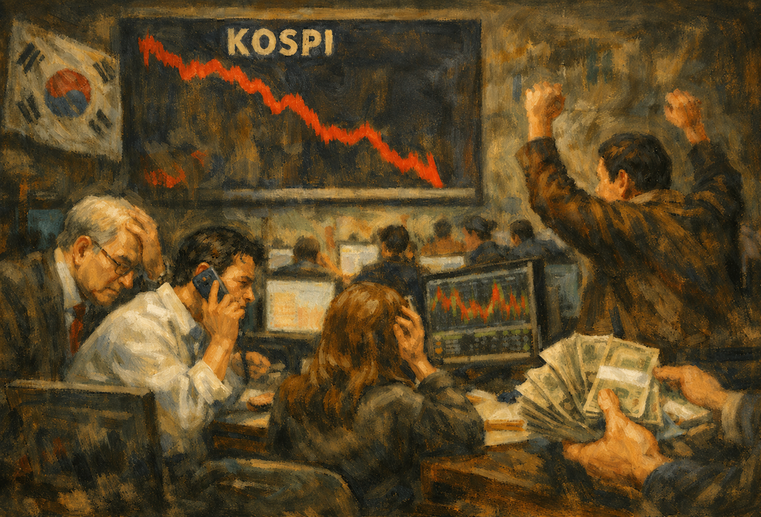
On April 8, 2026, the South Korean stock market staged a dramatic rebound. The KOSPI Index surged 6.87% to close at 5,872.34 points—up 377.56 points on the day—with an intraday high of 5,919.60, briefly triggering automated trading circuit breakers.
This sharp recovery in risk assets was driven by two simultaneous catalysts: a sudden drop in geopolitical risk (a temporary two-week ceasefire agreement between the U.S. and Iran, coupled with guarantees for safe passage through the Strait of Hormuz) and Samsung Electronics’ exceptionally strong Q1 earnings guidance. The semiconductor sector became the undisputed leader, with heavyweight stocks including Samsung Electronics and SK Hynix spearheading gains—propelling the entire Korean equity market out of its early-April slump.
Samsung Electronics’ Q1 earnings guidance, released after market hours on April 7, ignited investor sentiment: consolidated revenue of approximately ₩133 trillion (+68.1% YoY), operating profit of roughly ₩57.2 trillion (+755% YoY)—a single-quarter profit exceeding Samsung’s full-year 2025 total (₩43.6 trillion) and far surpassing consensus estimates (₩40–42 trillion). This marks not only Samsung’s strongest quarterly performance in history but also the most direct evidence yet of the AI-driven memory (DRAM/NAND/HBM) supercycle.
Yet before savoring this earnings bonanza, we must first revisit the “invisible risk” that dominated market attention over the past month—the potential impact of the Middle East conflict on Samsung’s chip supply chain. Below is a systematic breakdown based on the latest authoritative media reports and research findings from March–April 2026.
Geopolitical Risk Review: Impact of the Middle East Conflict on Samsung’s Chip Supply Chain
I. When Did the Impact Begin?
Clear timeline: February 28, 2026 (outbreak of Iran-related hostilities).
According to Reuters: “Samsung’s stock has fallen 14% since the war began on February 28.”
Government–corporate coordination timeline: Early March 2026 (around March 5), when the South Korean government held emergency consultations with Samsung and other major firms to assess supply chain risks.
Conclusion: February 28 — immediate impact on market sentiment and expectations; early March — formal entry into substantive supply chain risk assessment; mid-to-late March — initial transmission to manufacturing, PMI, and materials procurement.
II. Core Causes of Impact (Three Key Transmission Channels)
- Critical Materials: Helium Supply Shock [Most Critical] The Middle East—particularly Qatar—is a primary global source of helium (accounting for ~30–38% of global supply). Helium uses include photolithography machine cooling, vacuum environment maintenance, and leak detection—none of which have viable substitutes. Authoritative quote: “Helium is essential to semiconductor manufacturing—there is no alternative.” “Qatari facilities were attacked, disrupting helium supply.” Transmission mechanism: Middle East conflict → damage to Qatari gas fields/helium infrastructure → reduced helium supply → constrained wafer fab cooling/manufacturing → chip production risk.
- Energy Costs (the chip industry is extremely power-intensive) South Korea imports ~70% of its crude oil from the Middle East; fabs rank among the world’s most energy-intensive industrial operations. Transmission path: War → rising oil & gas prices → higher electricity costs → increased chip manufacturing costs → margin and capacity pressure.
- Logistics & Supply Chain (Strait of Hormuz) A globally critical maritime corridor for energy and chemical transport. War increases shipping risk—and potentially leads to closures. Impact: Delays in delivery of industrial gases, chemicals, and equipment; heightened supply chain uncertainty.
- Additional Demand-Side Factor: AI data center investment may be delayed due to rising energy costs; the Middle East itself is also a key market for Samsung’s home appliances and electronics.
III. How Significant Is the Impact? (Stage-Based Assessment)
(1) Short Term (Current: Q1 2026)
Actual impact: Very limited / no material disruption to production capacity yet.
Evidence: Samsung’s Q1 profit exploded (driven by the AI cycle); corporate statements cite “ample inventory and diversified supply chains”; industry assessments confirm “no significant production interruptions observed so far.”
Key reason: Semiconductor firms typically hold 3–6 months of critical materials inventory.
(2) Medium Term (3–6 Months)
Risk zone begins. South Korean firms rely on Qatar for ~65% of their helium; current inventory levels stand at ~6 months. If the conflict persists into Q3, line efficiency may decline or localized output restrictions could emerge.
(3) Long Term (6+ Months)
Potential for severe structural impact: reduced chip production capacity, deteriorating cost structure, and slower global AI industry expansion.
IV. What Matters Most to the Market Now?
Currently, the market is reacting more to *expected* than *actual* impact.
Manifestation: share price fell sharply (-14%), yet earnings hit record highs.
Interpretation: capital markets trade future risk; real-economy operations continue supported by inventory buffers and existing orders.
V. Summary of Impact Severity
The impact of the Middle East conflict on Samsung’s chip supply chain can be clearly segmented into three phases:
- Short Term (Now, Q1 2026): Low impact
Inventory buffers and robust AI-driven demand fully mask underlying risks. Actual production remains largely uninterrupted, and Samsung’s Q1 operating profit still surged +755% YoY.
- Medium Term (Next 3–6 Months): Moderate impact
Critical materials inventories—including helium—are gradually depleting. Should the conflict persist, line efficiency may decline or localized production curbs could emerge.
- Long Term (6+ Months): High impact
If the risk remains unresolved, actual chip production capacity could contract, manufacturing costs could worsen significantly, and global AI industry expansion could slow further.
At present, Samsung’s chip business has “not yet been hit”—but it is standing precisely at the tipping point of supply chain risk. The true shock depends entirely on whether hostilities last beyond six months. The April 8 ceasefire agreement effectively reset this risk to zero—directly fueling the Korean equity rally.
1. Revenue & Profit Analysis: The Perfect Storm of AI Memory Price and Volume Surge
- Revenue: ₩133 trillion, up +41.7% QoQ and +68.1% YoY. First time ever exceeding ₩130 trillion in a single quarter—primarily driven by explosive growth in the Device Solutions (DS, i.e., semiconductors) division. DRAM contract prices surged +90–95% QoQ in Q1, NAND prices rose sharply as well, while AI data center demand boosted shipment volumes—creating a powerful volume-price double-whammy.
- Operating profit: ₩57.2 trillion, up +755% YoY, with gross margins substantially expanded. The DS division contributed over ₩42 trillion in profit (~75% of total), almost entirely attributable to memory business performance.
Core driver: AI high-bandwidth memory (HBM) + broad-based DRAM/NAND shortages. Though HBM still accounts for a relatively small share of total revenue, its growth rate is the highest—and represents the most certain long-term growth vector.
2. Above or Below Expectations?
Massively above expectations. Consensus Q1 operating profit forecasts stood at ~₩40–42 trillion, whereas Samsung’s guidance of ₩57.2 trillion delivered a “+30%+ upside surprise.” This extraordinary beat stems fundamentally from AI compute demand vastly exceeding earlier projections—pushing both memory pricing and shipment volumes beyond expectations. It reflects a confluence of structural (AI-dedicated memory) and cyclical (broad memory shortages) forces.
3. Business Capability Breakdown: Financial Logic & How to Value the Business
Samsung’s financial reporting logic centers on “DS Division (Semiconductors) as King, all else as supporting cast.” Virtually all Q1 excess profits originated from DS:
- Memory business (DRAM + NAND + HBM): dual growth in volume (“bit growth”) and price (ASP). DRAM ASP rose ~+55% QoQ, NAND +53%; gross margins reached 67% and 52%, respectively. Calculation: volume growth × price increase × fixed-cost dilution = explosive gross margin expansion.
- HBM competition: SK Hynix still leads, but Samsung passed HBM3E validation and is accelerating HBM4 mass production—projected 2026 market share of 28–30%. Samsung’s edge lies in vertical integration and scale.
- Other businesses provide ballast: mobile and display panels cushion downturns in cyclical sectors—but currently contribute little.
Financial logic: The market closely watches “memory price sustainability.” Analyst models typically assume: Q1/Q2 prices locked at highs → Q3/Q4 faces capacity expansion risk. Even modest execution shortfalls relative to expectations trigger “sell” signals—a classic hallmark of highly leveraged cyclical stocks where expectations are stretched thin and error tolerance is near zero.
4. Valuation: P/E, P/S—Are Current Levels Justified?
Current valuation (as of April 9, 2026):
Trailing P/E (past 12-months): ~29–38x (highly volatile; historical neutral range: 12–15x). Forward P/E (2026 full-year forecast): extremely low—only 6.7–7.5x (optimistic models even reach 3.8x), reflecting strong market confidence in 2026’s massive profit growth.
P/S (Price-to-Sales, TTM): ~3.7–3.9x, implying a 3–4 year payback period.
Bull-market justification: During the “bull phase” of the AI memory supercycle, this valuation appears reasonable—or even conservative. Historical peaks saw P/S exceed 4x and forward P/E routinely dip below 10x. However, once the cycle turns, P/E expands rapidly. Today’s low forward P/E indicates the market has already priced in robust 2026 growth—but hasn’t yet overextended into 2027–2028—provided AI demand continues to exceed expectations.
5. Future Growth & Financial Risk: Is the Market Still Large Enough?
Upside: AI compute demand constitutes a “large, foreseeable market.” Global data center HBM/DRAM demand is projected to grow at a CAGR of over 30–40% from 2026–2030. Samsung and SK Hynix combined hold >70% market share, with clear growth vectors (HBM4/HBM5 evolution, AI PCs, edge computing).
Downside Risks (growth constraints):
- Cycle ceiling: The memory industry follows the classic pattern of “shortage → overinvestment → oversupply → price collapse.” With new capacity coming online in H2 2026, price corrections are highly likely. Any minor execution slippage could cause Q3/Q4 guidance to miss elevated expectations—triggering downside.
- Geopolitical supply chain risk: Though the ceasefire has temporarily eased tensions, helium inventory stands at only ~6 months. Renewed instability could still constrain growth.
- Front-loading risk: Much of HBM demand is locked in multi-year contracts (some extending through end-2026), and Samsung continues expanding capacity—no clear signs of premature order pull-forward yet.
- Mitigation measures: Yes—diversified businesses (mobile, displays, foundry), ample cash reserves, and high dividend payout (projected 2026 yield ~5%). Samsung has initiated helium recycling systems (HeRS) and diversified procurement partnerships with Linde and Air Products.
- Overall financial risk: Balance sheet remains healthy, with minimal leverage. However, should memory prices collapse in 2027 *and* geopolitical stress re-emerge, profits could halve and valuations reset. The market is currently pricing Samsung as a bull-market story—leaving little room for error.
Conclusion: Samsung’s Q1 results represent genuine AI-driven value realization. The April 8 Korean equity surge was a collective market affirmation of both the AI supercycle and the easing of geopolitical risk. Yet with sky-high expectations, cyclical exposure, and supply chain fragility, any execution shortfall—or emergence of new risks—could trigger a correction. Investors should closely monitor Q2 guidance, HBM market share progress, global AI capex trends, and the implementation of the Middle East ceasefire.
Longer term, Korea’s semiconductor duopoly remains best positioned to ride the AI wave—but the cyclical nature of the industry means “easy money, hard holding.”
Disclaimer: This article is for informational purposes only and does not constitute investment advice. Cryptocurrency markets are highly volatile—invest at your own risk and conduct independent research.
Join TechFlow official community to stay tuned
Telegram:https://t.me/TechFlowDaily
X (Twitter):https://x.com/TechFlowPost
X (Twitter) EN:https://x.com/BlockFlow_News
 @137LabsCn