Two rounds of increases exceeding 40% within 30 days: Bitget’s Pre-IPO emerges with a “true香” curve amid skepticism
TechFlow Selected TechFlow Selected
Two rounds of increases exceeding 40% within 30 days: Bitget’s Pre-IPO emerges with a “true香” curve amid skepticism
Whether the wealth effect can persist depends on who can transform the global narrative into user opportunities.
 Navigating Web3 tides with focused insights
Author: White Runner

SpaceX’s IPO prospectus went viral overnight.
The mega-unicorn has finally laid its books bare before the public market: Starship, Starlink, Elon Musk, the Mars mission—and a potential valuation as high as $1.75 trillion. According to Reuters, SpaceX’s listing could rank among the largest IPOs in history—and may even reshape how late-stage tech companies price fundraising and exits.
As one of the world’s most widely recognized privately held companies, SpaceX has drawn global attention—but access to its equity has remained restricted to a tiny circle of insiders, institutions, and primary-market investors.
The market, however, can no longer wait.
On Bitget, the SpaceX-related product preSPCX (formerly preSPAX) has surged over 40%. SpaceX’s IPO is still pending—but trading driven by anticipation has already begun.
Wealth Effects Are Shifting from “Crypto Narratives” to “Cross-Asset Opportunities”
In the past, CEXs attracted users primarily through crypto-native opportunities: new token launches, Launchpads, memes, perpetual contracts, and exchange tokens. Users focused on who could secure allocation in the next hot project—or acquire tokens ahead of listing.
But in a weak market cycle, this logic grows increasingly unsustainable. The density of pure crypto-native narratives is declining: new tokens peak at launch; meme trends rotate rapidly; and exchanges can no longer reliably generate wealth effects solely by “listing new assets.”
Meanwhile, external financial markets are offering fresh material. On one side, traditional overseas stock access has grown more sensitive; on the other, U.S. equities, AI, commercial spaceflight, and Pre-IPO assets continue drawing global capital. User interest in high-quality overseas assets hasn’t waned—it’s just that direct participation pathways are narrowing.
This creates a new misalignment: traders don’t necessarily want to trade only cryptocurrencies—they want to trade any asset with compelling return potential. U.S. equities, gold, forex, AI, SpaceX, OpenAI—even the pre-listing expectations surrounding these assets—can all become new tradable instruments.
SpaceX is the quintessential case. It hasn’t yet gone public—but in anticipation of its listing, platforms including Binance, Bitget, and Trade.xyz have launched related perpetual contracts, enabling users to trade SpaceX’s price expectations ahead of time. The Financial Times notes that such products do not confer stock ownership; rather, they let users bet on changes in SpaceX’s valuation before and after its IPO.
Against this backdrop, Bitget’s Pre-IPO initiative isn’t merely about adding a few new products—it reflects an outward expansion of CEXs’ asset supply frontier: shifting from “who can list the next trending token” to “who can earliest package global headline assets’ pre-listing expectations into tradable products.”
When new tokens lose their allure, pre-public giants become exchanges’ new narrative.
Bitget IPO Prime: From Skepticism to Reputation Reversal
When Bitget IPO Prime first launched, the market’s initial reaction was largely curiosity and skepticism.
This was understandable. Neither SpaceX nor OpenAI has gone public yet—so when ordinary users suddenly saw the chance to subscribe to their Pre-IPO-related products directly on an exchange, their first instinct wasn’t “opportunity knocking,” but rather: “Is this just vapor trading?” “Does this actually represent equity?” “Is the valuation too high?”
Subsequently, Bitget’s Greater China Head, Jack Xie, actively engaged on X (formerly Twitter), directly addressing user questions and concerns: explaining IPO Prime’s product logic, underlying asset sources, Republic’s role as issuer, and clarifying the boundaries between preSPAX/preOPAI and actual equity or economic rights.
He openly acknowledged early rule shortcomings, remarking, “All rule iterations emerge from criticism”; yet he consistently emphasized Bitget’s core intent behind IPO Prime: lowering the barrier to entry for primary-market opportunities historically reserved for institutions and high-net-worth individuals—making them accessible to broader retail users.
He also repeatedly stressed that preOPAI is “the only token globally backed by real equity”—a claim validated by multiple KOL analyses and affirmations. This “real equity backing” became a pivotal footnote in the shift of public sentiment.
Ultimately, the market was convinced by tangible returns. As price performance materialized, rules improved, and users gained deeper understanding of the product structure, initial skepticism gave way to discussions like “Can it double?” “What’s next?” and “How do I upgrade my VIP tier?”

In a sense, preSPCX bore the educational cost and reputational pressure for IPO Prime, while preOPAI achieved reputation reversal amid a more mature product narrative and clearer market expectations. Bitget IPO Prime thus evolved from a contested novelty into a trusted Pre-IPO asset gateway users willingly follow and engage with.
According to Bitget’s announcement, preSPCX—the inaugural IPO Prime project—has a total supply of 94,000 tokens, with total subscription value reaching $61.1 million at a subscription price of $650 per token. preOPAI—the second-phase project—had 29,082 tokens subscribed, with total subscription value approximately $21.08 million at $725 per token. Additionally, perpetual contract products SPCXUSDT and OPAIUSDT are available.
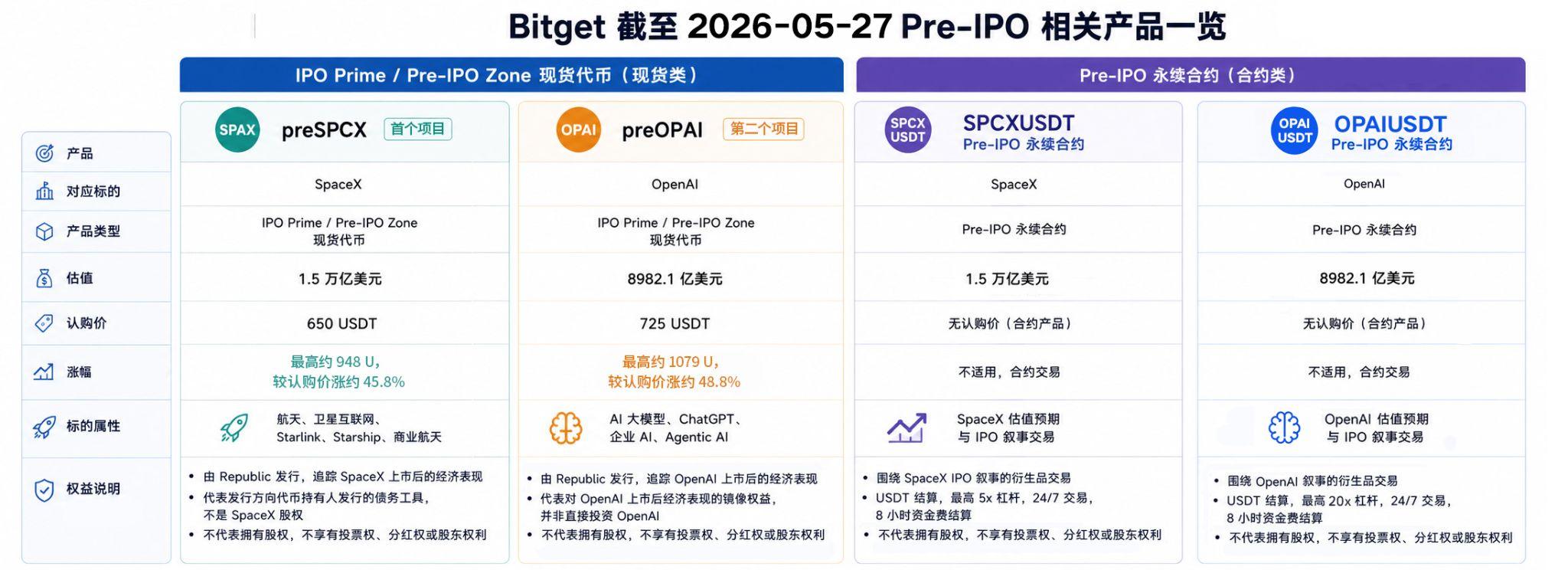
In terms of peak gains: preSPCX rose from $650 to $948—a 45.8% increase; preOPAI climbed from $725 to $1,079—a 48.8% surge—delivering clear paper profits. In my view, these gains stem from three layers:
First, the spread between subscription price and secondary-market pricing. Users participate via IPO Prime; once listed on spot markets, pricing resets around pre-IPO expectations for SpaceX and OpenAI. For traditionally illiquid Pre-IPO exposures, spot trading provides clearer exit, rebalancing, and short-term trading flexibility.
Second, lowered participation thresholds. Traditional Pre-IPO access is typically limited to institutions, high-net-worth individuals, and accredited investors—ordinary users rarely gain exposure to assets of SpaceX or OpenAI’s caliber. Bitget IPO Prime transforms such primary-market opportunities into subscription and trading products accessible to standard exchange users. Wealth effects arise not only from price appreciation—but also from “you weren’t invited before; now you at least have a doorway.”
Third, additional yield from VIP airdrops. Bitget ran two VIP airdrops tied to preSPCX: the first targeted existing VIP users, with a pool of 760 preSPCX tokens; the second rewarded newly upgraded VIP users during the campaign, allocating 190 preSPCX tokens—totaling 950 tokens. At the $650 subscription price, this represents a nominal value of ~$617,500 (currently valued at ~$860,500 at current prices). Thus, IPO Prime transcends simple subscription—it’s integrated into Bitget’s broader user benefits ecosystem.

(VIP5 users’ generous airdrop allocations sparked envy; Jack Xie’s responsiveness further boosted reputation.)
These three layers constitute what makes Bitget IPO Prime particularly noteworthy: subscription grants early positioning; spot markets provide liquidity; VIP airdrops embed Pre-IPO exposure into the platform’s user-rights framework; and SPCXUSDT and OPAIUSDT extend SpaceX’s pre-IPO expectations into the derivatives market.
Hence, market sentiment toward Bitget IPO Prime continues evolving. Early doubts centered on structure, valuation, and liquidity; today, focus has shifted to realized gains from the first two projects, incremental yields from VIP airdrops, and whether future offerings will include similarly elite-tier assets like SpaceX and OpenAI.
So far, Bitget IPO Prime has successfully validated its core thesis: converting expectations around top-tier private companies into a new wealth gateway—accessible to ordinary users, distributable by platforms, and tradable by markets.
From U.S. Equity Products to Pre-IPO: Bitget’s Universal Asset Strategy
Viewed from the perspective of long-term Bitget project participants, Bitget’s move into Pre-IPO isn’t an isolated action. Within the broader CEX competitive landscape, it forms part of a strategic expansion—from crypto-native assets toward global asset expectations—and extends Bitget’s UEX (Universal Exchange) vision.
In the past, exchanges competed on token listing speed, derivatives depth, Launchpad allocation, and exchange-token ecosystems. Now, competition is broadening horizontally. Users no longer just want to trade BTC, ETH, or memes—they also seek exposure to U.S. equities, gold, forex, AI, SpaceX, OpenAI, and even pre-launch expectations around those assets.
Looking at U.S. equity and Pre-IPO products, Binance, OKX, and Bitget have each carved distinct paths.
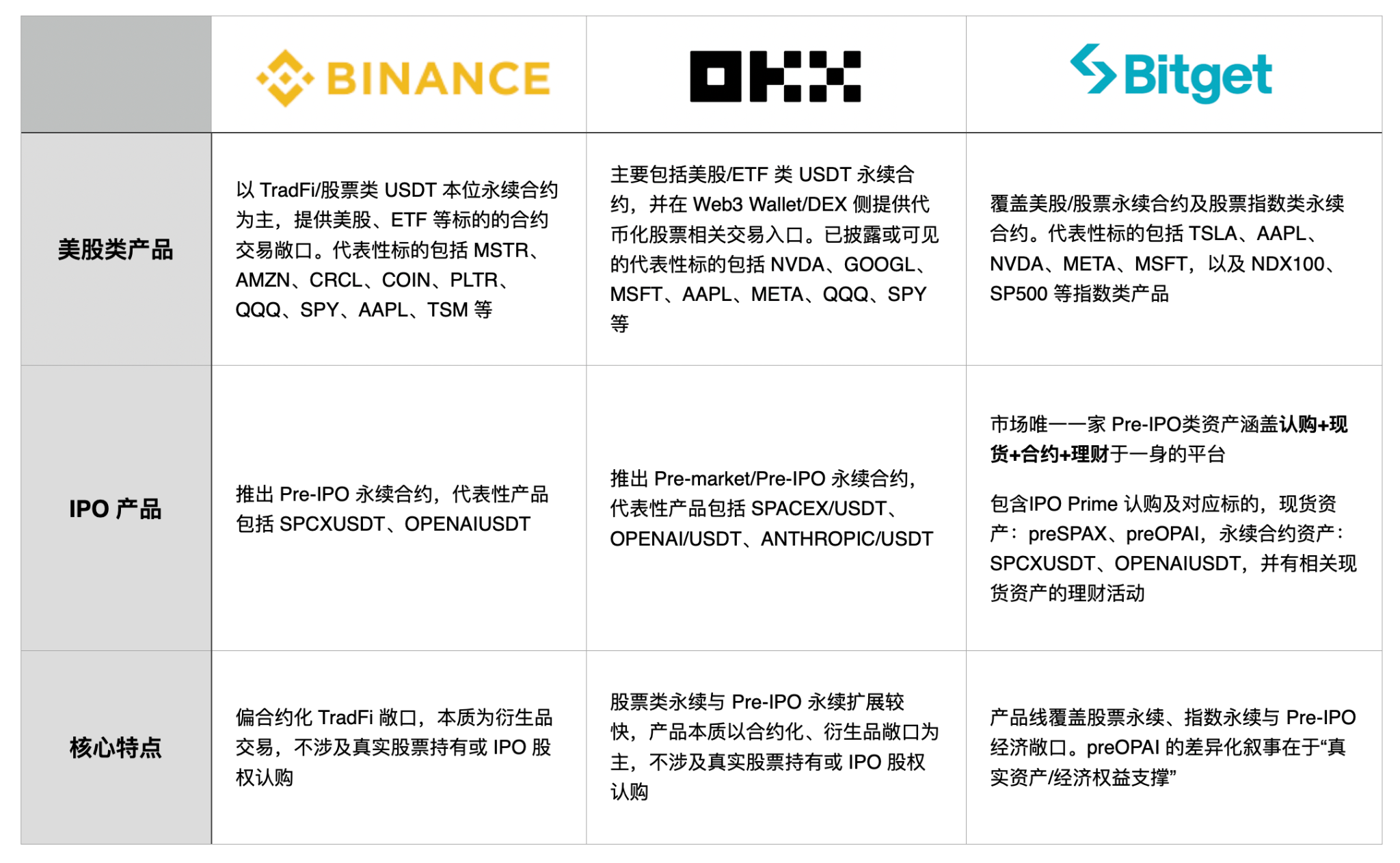
Overall, differences can be summarized as follows: Binance leans toward contract-based TradFi exposure; OKX prioritizes rapid expansion of equity and Pre-IPO perpetuals; Bitget emphasizes comprehensive product coverage, authentic asset backing, and builds a richer user-benefits ecosystem through mechanisms like subscriptions, spot trading, derivatives, and VIP airdrops.
Observing exchange developments, U.S. equity products have clearly emerged as the next growth vector for CEXs. Pre-IPO offerings, tokenized stocks, equity perpetuals, and RWA indices may appear structurally different—but fundamentally, they all address the same question: How can exchanges expand users’ scope from “crypto-only trading” to “trading globally significant assets”?
For exchanges, this means new asset supply, new trading contexts, and new user-retention models. For users, it signals a fundamental shift in what they trade: where they once hunted for the next new token on CEXs, they’re now searching for the next SpaceX or OpenAI—assets not yet publicly listed—or for globally significant assets ripe for tokenization, derivatives, or indexation.
Thus, Bitget’s Pre-IPO wealth effect shouldn’t be assessed solely by individual project gains. Rather, it serves as a vantage point into cross-asset CEX competition: whoever identifies high-awareness assets fastest—and packages them into tradable products—gains first-mover advantage in the next round of asset-supply competition.
Sustaining the Wealth Effect Depends on Who Can Turn Global Narratives into User Opportunities
SpaceX’s significance extends beyond launching a rocket company onto capital markets. What it truly brings to the public market is a composite vision encompassing commercial spaceflight, the Starlink network, orbital infrastructure, AI, and the future space economy. An IPO’s value lies not merely in enabling shareholder exits—but in subjecting this extraordinary, long-private-market narrative to open, global pricing for the first time.
Bitget’s UEX strategy follows similar logic—not simply adding more U.S. equity or Pre-IPO products, but packaging globally high-quality assets—including U.S. equities, gold, and forex—into a 24/7 crypto-native trading interface for crypto users.
We’ve seen Bitget’s SpaceX- and OpenAI-related products surge over 40% in under a month—and distribute VIP airdrops worth $617,500 (at subscription price) to users. Subscription spreads, secondary-market liquidity, VIP benefits, and derivatives trading collectively generate a powerful wealth effect—rarely seen in today’s bearish, fear-laden market environment.
As this article is written, Bitget has announced a new initiative: the RWA protocol Reality, which directly connects to U.S. equity liquidity and supports dividend payouts. Bitget is integrating more real-world assets into a unified trading environment. Memes may cool—but demand for quality assets, liquidity, and trading efficiency remains undiminished.
SpaceX’s Starship continues ascending launch after launch; its IPO is propelling the imagination of commercial spaceflight into capital markets. For exchanges, true competition has only just begun: whoever captures global asset expectations earliest may define the next generation of trading gateways.
Starship soars into the cosmos, igniting the trillion-dollar imagination of commercial spaceflight; and as capital begins pricing that imagination, Bitget aims to transform that narrative—long confined to the primary market—into a ticket in every ordinary user’s hands.
Join TechFlow official community to stay tuned
Telegram:https://t.me/TechFlowDaily
X (Twitter):https://x.com/TechFlowPost
X (Twitter) EN:https://x.com/BlockFlow_News