
Were Wall Street Analysts Bought Off? The Exchange of Interests Behind SpaceX's Trillion-Dollar Valuation
TechFlow Selected TechFlow Selected
Were Wall Street Analysts Bought Off? The Exchange of Interests Behind SpaceX's Trillion-Dollar Valuation
Are these analysts crazy? No, they are just exchanging flattery for IPO underwriting fees.
 Navigating Web3 tides with focused insights
Author: Ed Elson
Translation: TechFlow
TechFlow Editor's Note: Following SpaceX's IPO, JPMorgan gave a valuation of $2.9 trillion, while Raymond James even shouted out a sky-high price of $10.4 trillion—higher than the combined market cap of Microsoft, Amazon, Meta, Tesla, and Berkshire. Are these analysts crazy? No, they are just using flattery to exchange for IPO underwriting fees. In December 2025, the SEC quietly abolished the core regulations preventing analyst conflicts of interest, and Wall Street's incentive mechanisms have returned to the dot-com bubble era.
23 years ago, a scandal broke out on Wall Street. Stock analyst Henry Blodget became famous for being bullish on hot stocks during the dot-com bubble, but it was later discovered that he was actually bearish in private. In emails sent to colleagues, Blodget described many of the stocks he publicly recommended as "junk," "dog shit," and "POS." After the bubble burst and valuations plummeted, Blodget was charged with securities fraud, and the SEC barred him from the securities business for life.
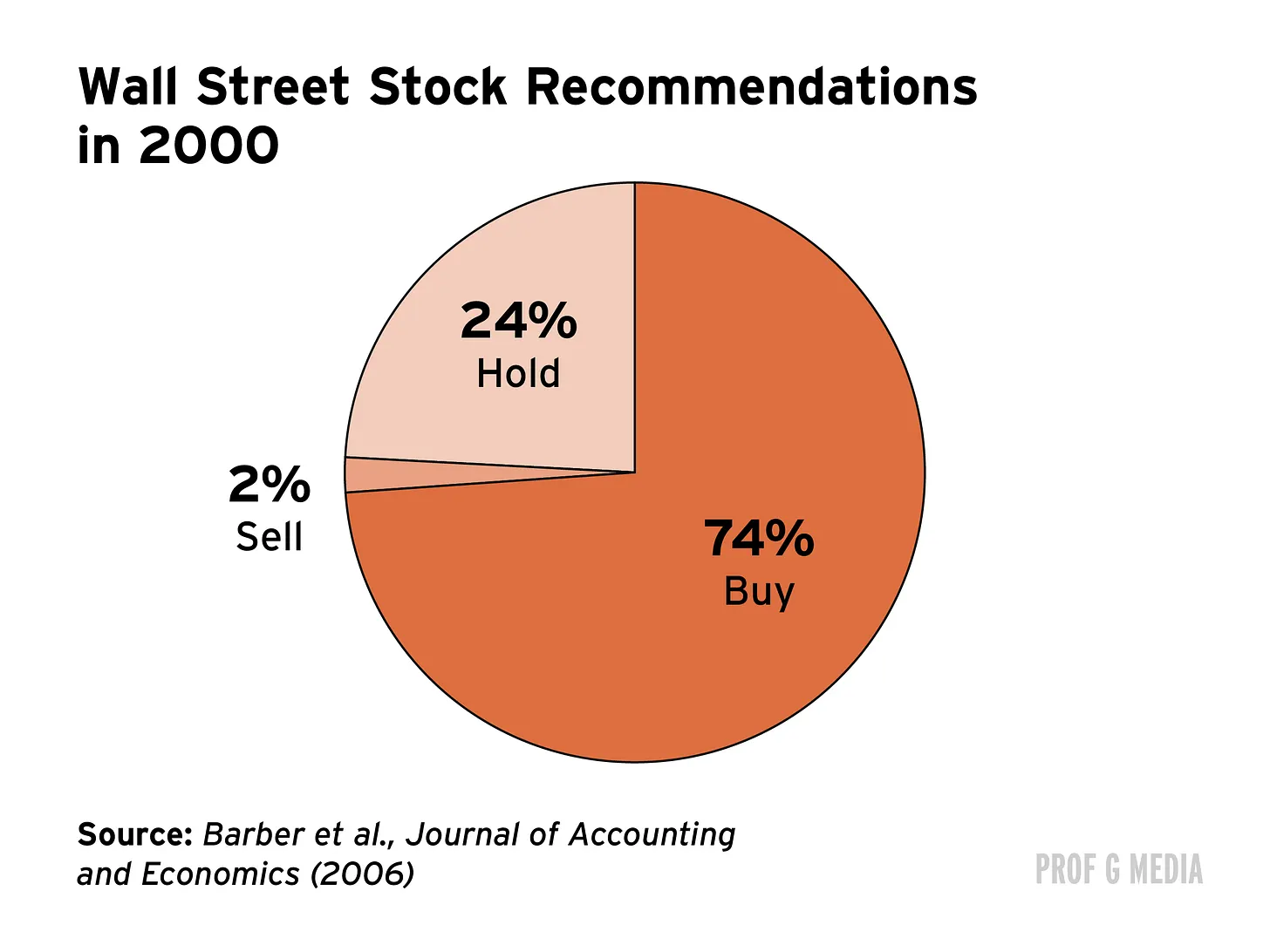
Blodget was just a representative figure, but not an isolated case. At Solomon Smith Barney, another analyst who publicly rated a company as "Buy" privately called the company a "pig." An analyst at Lehman Brothers admitted in an email that "ratings and target prices don't mean much anyway," and retail investors might be misled. "This is the essence of my profession," he wrote. This was an epidemic: by 2000, three-quarters of stocks were rated Buy, and only 2% were rated Sell. What happened later, I don't need to say much.
Why do Wall Street analysts recommend stocks they know are junk? One word: incentive mechanisms. Since IPOs and equity financing are important revenue sources for investment banks, analysts are incentivized to publish flattering research to win deals and earn fees. In 2002, an employee at Merrill Lynch complained to a colleague, summarizing this conflict of interest well: "John and Mary Smith are losing their retirement savings just because we don't want to make [investment banking clients] unhappy."
After the bubble burst, the SEC realized something had to be done. So in 2003, they came up with the "Global Research Analyst Settlement." The goal was to eliminate the conflict of interest caused by investment banking and stock research analysts being on the same team. So, they completely separated the two departments: equity research was no longer allowed to speak with investment banking (unless compliance personnel were present), and the compensation of the two teams was also independent of each other. This way, investment banking could continue doing its own thing (winning deals), and analysts could publish unbiased research.
Why am I saying this?
Last week, major Wall Street investment banks released stock research on SpaceX, with absurdly high target prices. Before discussing, remember that SpaceX is now valued at $1.8 trillion. Revenue in 2025 was only $19 billion, this valuation is at least $1 trillion too high. (I explained why here.) Okay, now let's see what Wall Street "believes."
JPMorgan believes SpaceX is worth $2.9 trillion. 58% higher than the current valuation. Their view is that SpaceX's "potential impact on humanity" is "greater than any company they have ever seen." Deutsche Bank says the company is worth even more: $3.3 trillion. In their view, this rocket manufacturer represents the "peak of civilization's ambitions." Morgan Stanley's number is higher: $3.9 trillion. Morgan Stanley says SpaceX is the "ultimate frontier" of AI. But the truly absurd target price comes from the less well-known investment bank Raymond James, whose chief analyst says SpaceX is worth—wait for it—$10.4 trillion. This would make SpaceX worth more than Microsoft, Amazon, Meta, Tesla, and Berkshire Hathaway... combined.
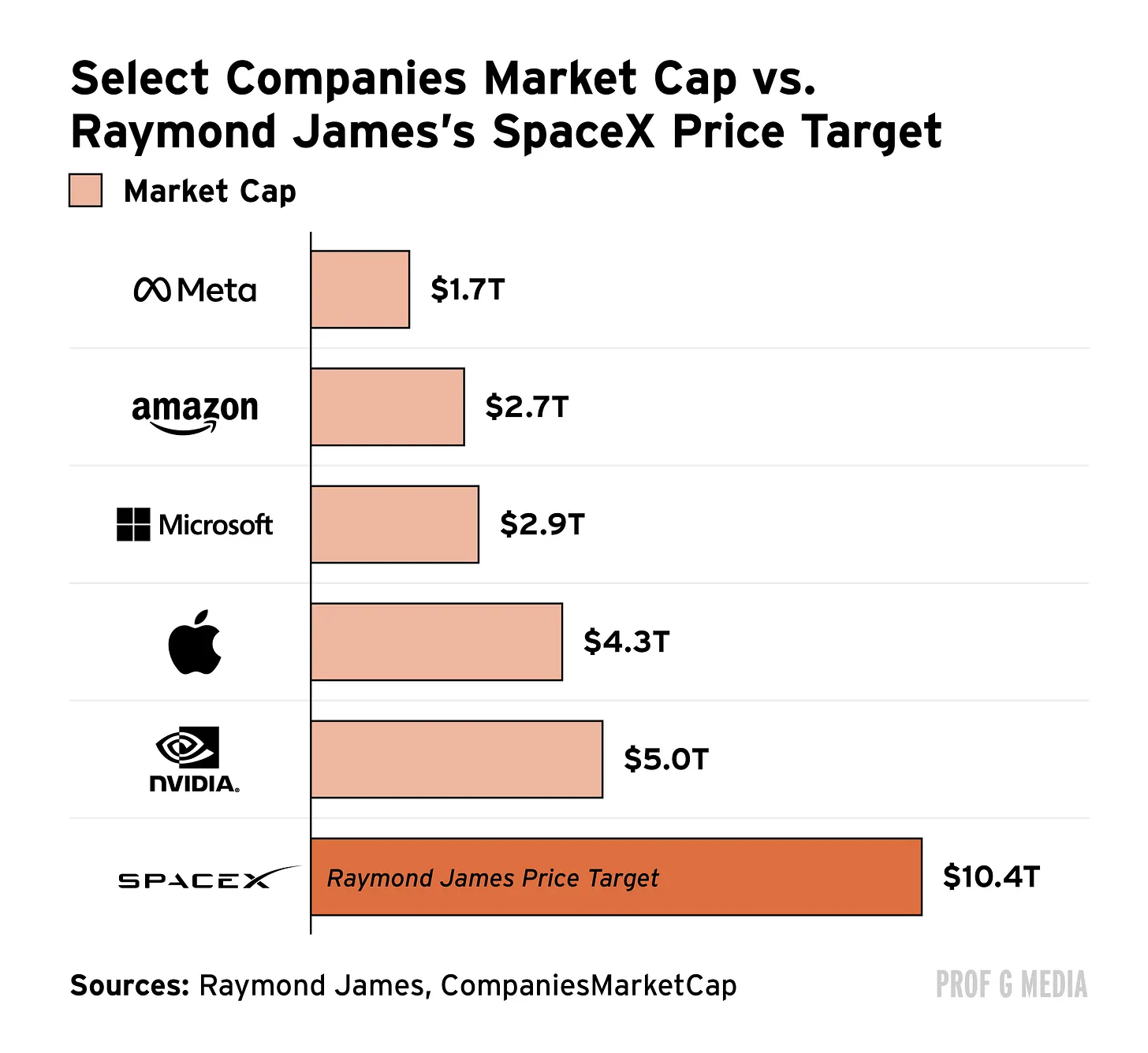
I have only one question: WTF? I had to read the Raymond James report a second time, just to confirm I wasn't hallucinating. (I wasn't.) Their "model" predicts SpaceX's revenue will grow from $19 billion to over $5 trillion by 2035. (This is nearly one-fifth of US GDP.) It is said that 94% of this revenue will come from AI, meaning the company's AI business must become 23 times larger than NVIDIA, despite currently being 67 times smaller than NVIDIA. Like I said a few weeks ago: pass me that crack pipe.
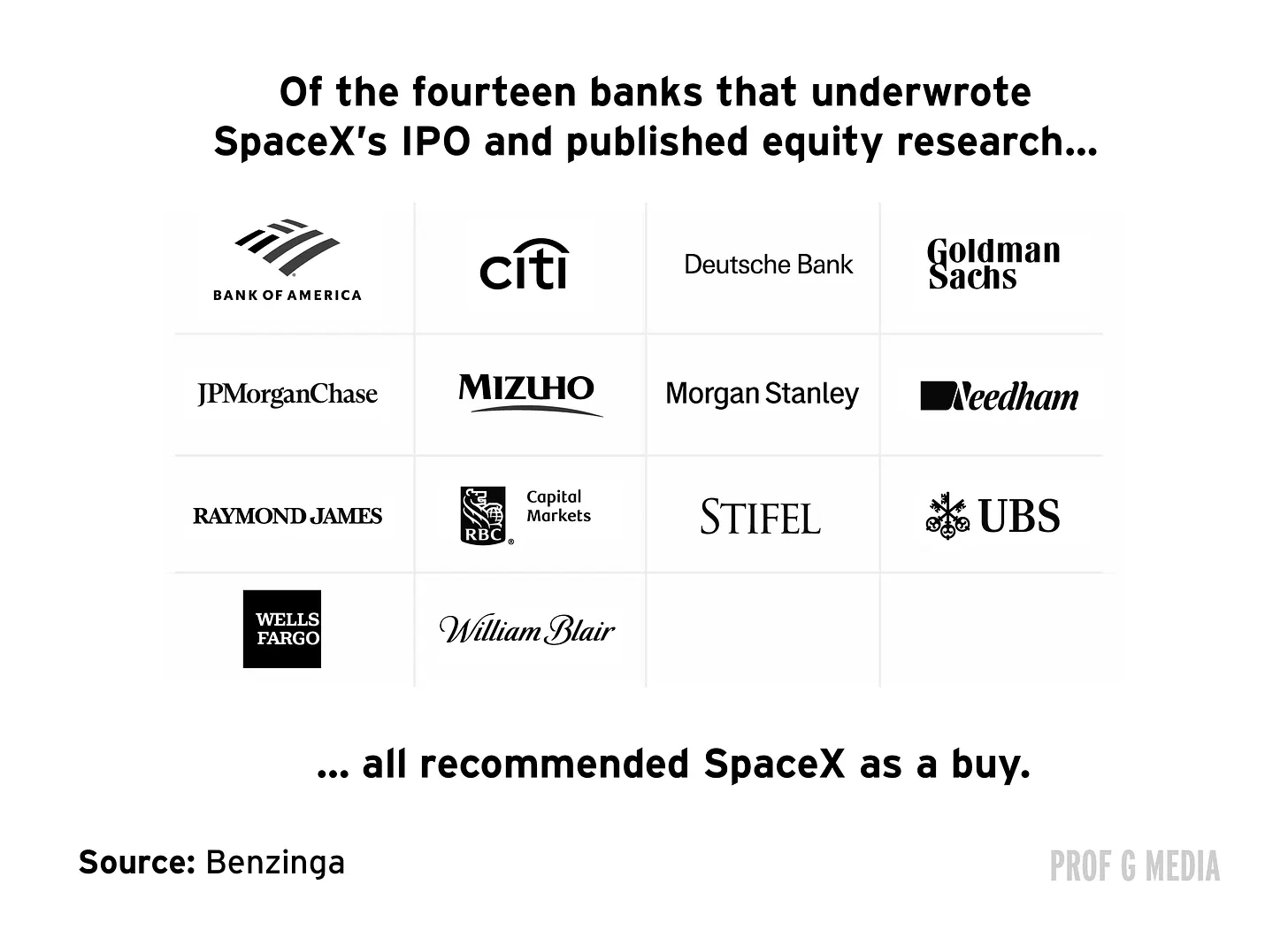
These target prices are too absurd—absurd to the point of being inexplicable. Until you realize one thing connecting them: they were all released by banks underwriting the SpaceX IPO. Yes, Raymond James, Morgan Stanley, JPMorgan... all participated. In fact, not a single bank underwriting the SpaceX listing failed to rate the stock as Buy.
I know what you're thinking: if the IPO has already happened and the banks have already collected fees, what is the incentive to publish flattering research now? Answer: more fees. SpaceX has already launched follow-up debt financing, and it is estimated that the company will have to raise $235 billion over the next four years to cover costs. This means tens of billions in future investment banking revenue. There are also rumors that SpaceX will seek to merge with Tesla, which will lead to (spoiler warning) more fees. In short, Wall Street's most profitable business now is not trading or lending... but making Elon Musk like you.
Opening the Floodgates
But wait. Wasn't the 2003 "Global Research Analyst Settlement" specifically designed to prevent banks from talking nonsense in research for fees? You are right. At least, until seven months ago when it was... terminated.
Yes. On December 5, 2025, the SEC formally abolished the law inspired by Blodget back then. According to the agency, the GRAS rules are now useless because they have been "largely superseded by" other rules. They are referring to FINRA Rule 2241, a law that technically addresses conflict of interest issues but does almost nothing in comparison. As former SEC Chairman Arthur Levitt wrote in his article titled "SEC May Let Wall Street Analysts Corrupt Again": "Do not be fooled by the promise of this separation provided by other regulations... This is the natural pattern of regulatory surrender."
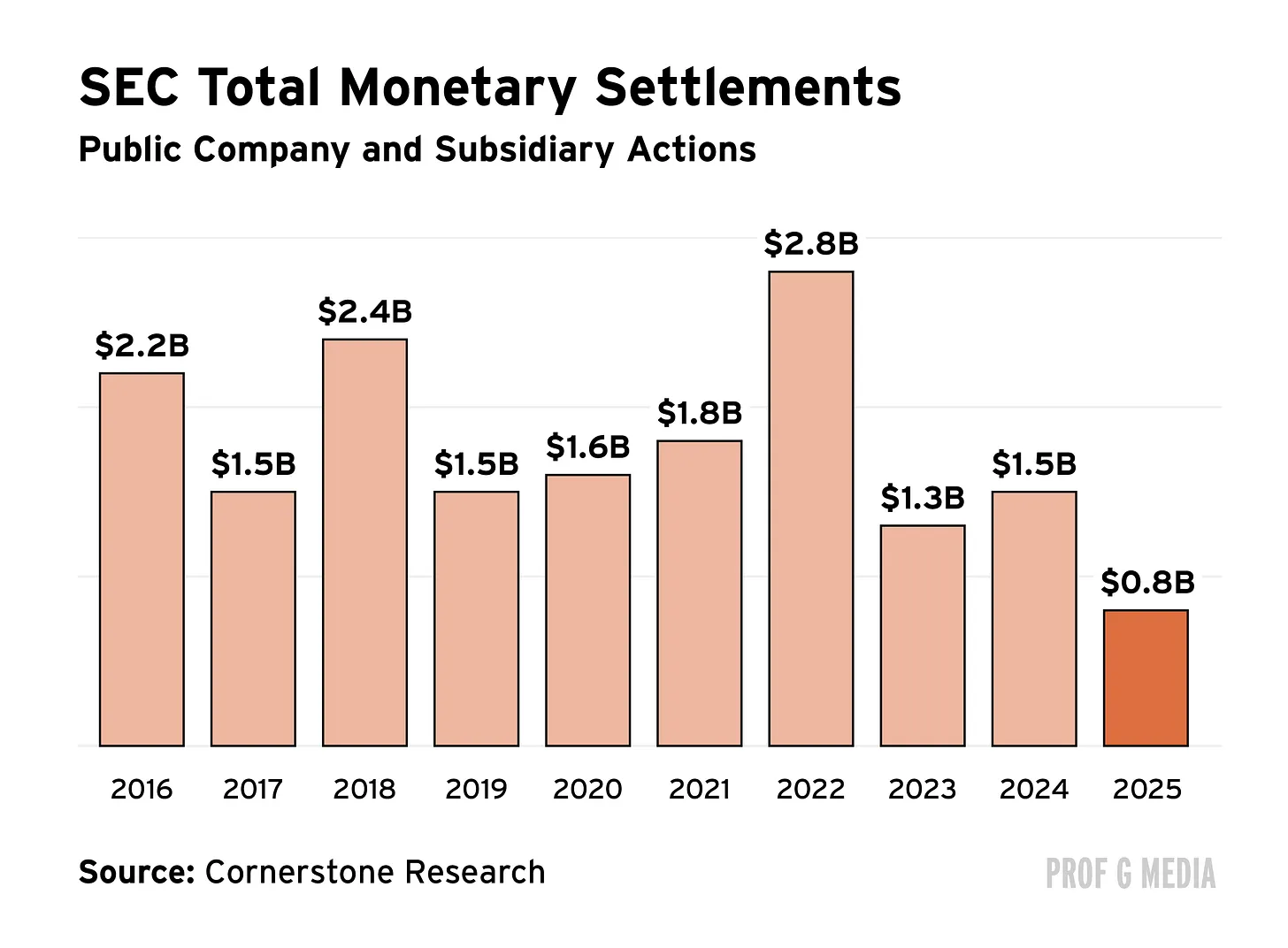
If it weren't for the fact that the SEC is indeed being torn apart, I would be inclined to say Arthur Levitt is crying wolf. Under Trump, the agency has lost one-fifth of its staff. Last year, it took only 56 enforcement actions against listed companies—down 30% from the previous year, the lowest in any transition year in a decade. Four months ago, its enforcement head Margaret Ryan mysteriously resigned after attempting (but failing) to investigate Trump family insider trading. It is obvious that the SEC no longer exists to protect investors, but for white-collar crime.
Here to Stay
If flattery was equivalent to a rocket launcher for deals in the dot-com bubble era, today it is a nuclear weapon. Speaking well of powerful people can now win you million-dollar deals, unprecedented legislation, and even cabinet positions. Tim Cook didn't give the president that gold trophy for the president—it was for the shareholders. In 2026, few things pay off higher than being a sycophant, and any executive who doesn't realize this has not fulfilled their fiduciary duty. In other words, who wouldn't hype SpaceX?
Of course, the trouble lies with retail investors. SpaceX has already fallen more than 30% from its high, and anyone who bought after the IPO is now underwater. This fits the trend: studies show that IPOs recommended by underwriting bank analysts underperform and lose money on average. Lesson: If someone is paid to tell you to buy a stock, proceed with caution.
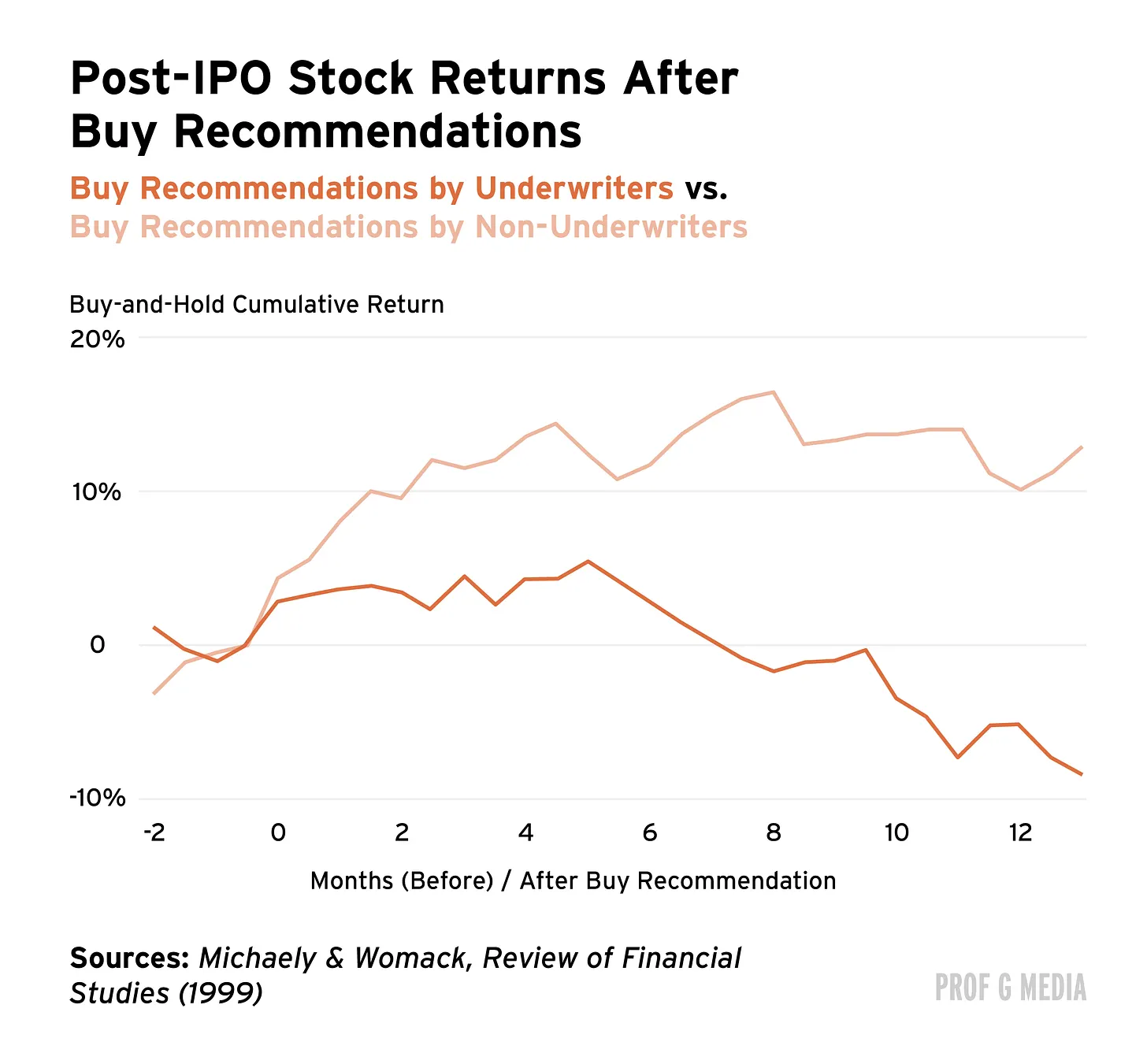
The fact is, SpaceX is a terrible investment at current prices. Morgan Stanley's stock research report implicitly admitted this, giving a "deliberately wide" price range, with a bull case target price of $600 and a bear case target price of... $75. Translated: "We fucking have no idea."
People wonder why so many Americans hate Wall Street. This is the reason. This doesn't mean analysts are bad—it just means the incentive mechanisms are bad. In Charlie Munger's words: "Show me the incentive and I will show you the outcome."
The solution is simple: fix the incentive mechanisms. Either restore the "Global Research Analyst Settlement" or find another way to eliminate conflicts of interest. This shouldn't be that hard, but it might be difficult for this administration because it would undermine the corrupt culture they have worked so hard to build. So if you expect things to change, listen to this analyst's advice: don't hope.
Join TechFlow official community to stay tuned
Telegram:https://t.me/TechFlowDaily
X (Twitter):https://x.com/TechFlowPost
X (Twitter) EN:https://x.com/BlockFlow_News