SpaceX’s IPO Sends On-Chain U.S. Stocks Back to Reality
TechFlow Selected TechFlow Selected
SpaceX’s IPO Sends On-Chain U.S. Stocks Back to Reality
When a cryptocurrency exchange turns U.S. stock market access into a single button, users should most concern themselves with whether real underlying assets back that button, who is responsible for delivery, and whom to contact when exiting.
 Navigating Web3 tides with focused insights
By Liu Honglin
On June 12, SpaceX went public on the Nasdaq at an offering price of $135 per share, raising approximately $75 billion—dubbed the largest IPO in history. Under the standard script, this should have been a celebration for Elon Musk, Wall Street, underwriters, and tech-stock investors.
But as the saying goes, “One man’s joy is another’s sorrow.” This time, the most anxious group was undoubtedly crypto enthusiasts.
In the days leading up to the IPO, numerous crypto exchanges and platforms began promoting slogans like “Participate in the SpaceX IPO on-chain” and “Subscribe to tokenized SpaceX shares using stablecoins.” Users were invited to use USDT or USDC to participate in the SpaceX stock subscription. Yet on IPO day, what followed was a string of apologies—and no shares available…
According to The Wall Street Journal, tokenization platforms such as xStocks had previously received over $1 billion in demand for SpaceX-related products—but major exchanges responded that they had not received any allocation from their partners and could only issue refunds to pre-ordering users.
This situation sounds abstract—but it’s very real.
Users thought they were subscribing on-chain, but in reality, they may have merely deposited funds into a centralized entry point, waiting for another centralized partner to secure allocations—whether or not those allocations materialized was entirely left to chance. Suddenly, concepts like “on-chain U.S. equities,” “Real World Assets (RWA),” and “tokenized U.S. stocks” shifted from grand narratives of financial innovation to a far more basic question: Did you actually purchase shares—or just a symbol?
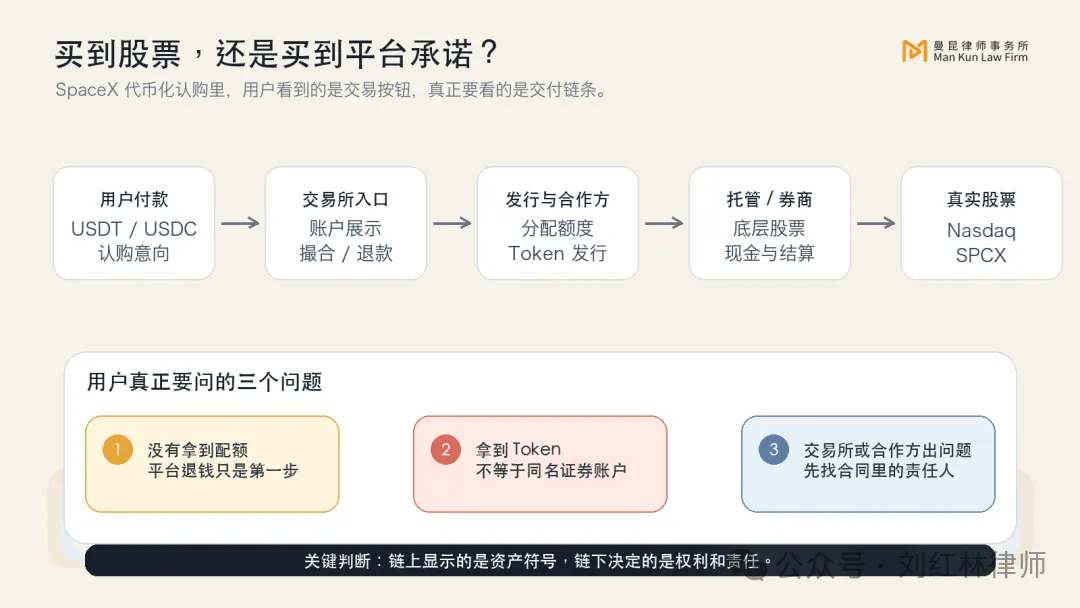
The asset and liability chain behind on-chain U.S. equities
Are You Really Buying Real Shares?
Many people’s first reaction is: “Since the platform refunded money, isn’t that fine? At least there was no rug pull, nor did they force-feed users worthless tokens.”
Refunding money is certainly better than not refunding. A reputable platform’s minimum responsible action upon failing to secure allocations is to cancel orders, return funds, and clearly explain why. But what truly warrants attention isn’t whether refunds occurred this time—it’s why a product marketed as “participating in the world’s largest IPO on-chain” failed at the most critical delivery stage: its underlying provider simply didn’t receive any allocation.
In traditional IPOs, users submit subscription requests through brokers like Robinhood, Fidelity, Schwab, or SoFi—and even then, allocation isn’t guaranteed. Not receiving shares is normal; hot IPOs are routinely subdivided among institutions, underwriters, large clients, and retail channels. But if you do receive an allocation, you get actual Nasdaq-listed SPCX shares, with registration, clearing, custody, client asset protection, and dispute resolution all operating within the conventional securities framework.
On-chain access doesn’t work that way.
Take xStocks’ publicly disclosed documentation as an example: it describes its product as “tokenized stocks or ETF representations,” claiming each xStock is backed 1:1 by the corresponding underlying asset. It sounds like stock ownership—but Kraken’s risk disclosures are more direct: xStocks holders do not own the underlying shares or equity in the company; they have no voting rights, dividend rights, or legal claim to company assets in the event of liquidation. What users obtain is economic exposure to the underlying stock’s performance—not direct shareholder status. xStocks’ official legal documentation classifies it as a debt instrument tracking underlying performance—not direct equity.
Many users draw parallels between such products and brokerage accounts offered by Futu, Tiger Brokers, or Interactive Brokers: “When I buy U.S. stocks via their apps, don’t I also go through brokers, custodians, and clearinghouses? Why be extra cautious about on-chain U.S. equities?”
This analogy holds partially. Modern securities markets have never involved holding physical stock certificates at home—the entire system relies on brokers, clearinghouses, custodians, registrars, market makers, and regulators. What ordinary users see is merely numbers inside an app.
The difference lies in the legal infrastructure supporting those “numbers” in traditional brokerage systems: relatively mature account registration, segregated client assets, underlying custody arrangements, and regulatory redress pathways. For instance, when you buy U.S. equities through a licensed broker, your assets might flow through institutions like Interactive Brokers, with relatively clear legal relationships among account registration, securities custody, and client identity. Broker failure is still problematic—but at least you can trace claims through your securities account, client records, custody logs, and regulatory procedures.
The trouble with on-chain tokenized U.S. equities is that they often package “rights held within a securities account” as “asset-like ownership in a wallet.” Users assume that once assets appear in their wallets, they hold genuine ownership. Yet in many structures, what resides in the wallet isn’t shares registered directly in the user’s name—but rather a financial instrument created by an issuer, backed by certain underlying assets, and transferable on secondary markets.
Controlling the token does not equal controlling the underlying shares.
If the platform operates smoothly, underlying assets remain fully collateralized, market makers quote prices normally, and redemption mechanisms function properly, this distinction remains invisible during routine trading. Users see prices track SpaceX, Tesla, or NVIDIA—and naturally treat these tokens as “on-chain stocks.”
But problems expose the gap immediately.
What happens if exchange–issuer partnerships collapse? If disputes arise between issuers and custodians? If the underlying broker fails to deliver? If secondary-market liquidity dries up? If regulators require service suspension in certain jurisdictions? If you hold shares in a traditional securities account, issues may be complex—but resolution paths remain relatively clear. If instead you hold tokens issued under offshore structures, you often must first determine: Who exactly is your creditor? Which document governs your rights? And in which jurisdiction can you enforce them?
This is the most overlooked aspect of on-chain U.S. equities: They make trading appear simpler—but dramatically complicate rights relationships.
You’re not buying shares directly registered in your name—you’re relying on a trust chain composed of exchanges, issuers, custodians, brokers, and redemption arrangements. The on-chain token is merely the visible tip; the true determinant of whether you recover your funds lies in the entire off-chain, centralized infrastructure behind it.
The “Amateur Hour” Isn’t About Technology
The crypto world loves talking about “decentralization”—yet on-chain U.S. equities drag everyone right back into centralized trust models.
We’ve long joked that crypto’s biggest paradox is people trading supposedly decentralized assets on centralized exchanges. Now, tokenized U.S. equities take it one step further: Users trade “on-chain U.S. stocks” on centralized exchanges, using centralized stablecoins, subscribing to tokens issued by centralized entities, backed by assets held by centralized custodians—and facilitated by centralized platforms handling matching and refunds.
This isn’t DeFi’s triumph. It’s a tacit, high-stakes stress test—blending traditional finance, crypto exchanges, offshore issuance structures, and on-chain narratives.
Tokenized U.S. equities represent a definite trend—especially given growing demand from non-U.S. users, crypto-native users, and those requiring 24/7 trading. Stocks, bonds, funds, Treasuries, receivables, and private equity fund interests could all benefit from on-chain methods to improve transfer efficiency, reduce cross-border operational costs, and enhance settlement experiences.
Yet trend ≠ reliability. Tokenizing assets doesn’t automatically tokenize rights. Truly mature tokenized securities must resolve underlying asset integrity, investor identity verification, rights registration, redemption mechanics, disclosure transparency, suitability assessments, anti-money laundering compliance, and dispute resolution. Many exchanges today prioritize only the most marketable features: big company names, stock tickers, stablecoin subscriptions, 24/7 trading, and low barriers to entry. Those less glamorous, foundational tasks—users typically remember only when things go wrong.
So the “amateur hour” isn’t about technology.
For ordinary users, attorney Liu Honglin advises: Unless you thoroughly understand how equity tokenization works, avoid jumping in solely to chase popular offerings.
First, clarify precisely what you’re purchasing: Is it an internal ledger record maintained by the exchange? A token issued by a third-party issuer? A tracking certificate? Or shares genuinely registered in your own-name securities account? Some platforms act only as matching gateways; others handle custody; some serve purely as secondary markets; others involve layered structures—issuers, brokers, custodian banks, market makers, and redemption agents.
Second, scrutinize your exit path. Whether you can sell depends not just on your willingness—but also on whether the platform continues offering trading services, whether secondary-market liquidity exists, whether the issuer supports redemptions, and whether your identity satisfies KYC and geographic restrictions. In this context, not all wallet holders can automatically redeem directly with the issuer.
Third, exercise extreme caution regarding “equity tokenization” or “on-chain U.S. equity subscriptions” promoted to mainland Chinese users. Within mainland China’s regulatory context, marketing foreign securities, derivatives, or high-risk financial products to unspecified public audiences carries significant compliance sensitivities. While overseas platforms may claim they don’t serve certain regions, community groups and affiliates aggressively acquire Chinese-speaking users—ultimately placing risk on the last users to grasp the rules.
If you insist on monitoring such products, focus exclusively on top-tier platforms with proven track records, comprehensive disclosures, and robust risk-control and compliance frameworks. Don’t rush into obscure exchanges based solely on trending topics, glossy return charts, low fees, or referral codes from Telegram groups. You may think you’re buying Musk’s stock, NVIDIA’s stock, or Tesla’s stock—only to discover you’ve purchased nothing more than a symbol bearing a stock’s name.
The Wind Keeps Blowing
The SpaceX IPO fiasco’s most important lesson isn’t whether a particular platform secured allocations—or whether certain users missed out on gains.
Rather, it functions as a stress test: When crypto exchanges turn U.S. equity access into a single button, users should care foremost about what lies behind that button—whether real assets exist, who bears delivery responsibility, and who to contact upon exit.
Over the next few years, tokenized U.S. equities will almost certainly continue evolving. Nasdaq, Kraken, Robinhood, Coinbase, Backed, wallets, and exchanges alike will keep exploring—on-chain U.S. equities deserve attention and may eventually become vital market infrastructure.
But at this stage, ordinary users shouldn’t yet treat them as equivalent to U.S. equities held in Futu or Interactive Brokers accounts. First confirm: Did you receive actual shares—or merely a string of symbols inside an exchange account?
Join TechFlow official community to stay tuned
Telegram:https://t.me/TechFlowDaily
X (Twitter):https://x.com/TechFlowPost
X (Twitter) EN:https://x.com/BlockFlow_News