SpaceX Rewrites a Century-Old IPO Process with a Single IPO
TechFlow Selected TechFlow Selected
SpaceX Rewrites a Century-Old IPO Process with a Single IPO
Prediction markets and perpetual contracts have taken a slice of the investment banking pie.
 Navigating Web3 tides with focused insights
By Prathik Desai
Translated by Luffy, Foresight News
An initial public offering (IPO) is a pivotal rite in capitalist financial systems. Company executives embark on roadshows lasting several weeks, pitching their business plans to fund managers at major asset management firms to secure institutional investment. Investment banks act as underwriters—aggregating market subscription demand, evaluating company valuations, finalizing issue prices, and allocating shares. On the listing day, the ceremonial bell-ringing marks the formal transition from private to public company. Thereafter, buy and sell orders in the secondary market continuously interact, completing price discovery within hours—or even days—of market opening.
The traditional IPO process—roadshow, pricing, and listing—has persisted for decades primarily because private companies’ true operational data remains inaccessible to outsiders, leaving investors reliant on investment banks for valuation. Historically, all enterprises were required to fully execute this process before listing on an exchange.
Yet SpaceX’s recent U.S. listing charted a radically different path. Before investment banks completed valuation assessments or launched roadshows, Elon Musk unilaterally set the issue price.
In conventional IPOs, price discovery, investor sourcing, and share settlement—the three core functions—are bundled and delegated to investment banks, which charge a bundled service fee. In contrast, SpaceX decoupled these three functions entirely, assigning each to distinct, independent channels. Well before investment banks officially commenced listing preparations, the market had already established a fair valuation for the company—and numerous investors had already queued up for subscriptions.
This article dissects how SpaceX has redefined corporate listings—and how investment banks’ roles are evolving in this new listing environment.
Origins of Investment Bank Underwriting Fees
Investment banks charge issuers underwriting fees. For nearly a century, such fees have typically been calculated as a percentage of total capital raised.
A full underwriting process includes organizing global roadshows; collecting institutional and retail investor subscription indications across various price ranges; determining a market-acceptable issue price; and ensuring smooth share delivery. Under a firm-commitment underwriting model, the investment bank purchases all issued shares outright and then distributes them to subscribing investors.
Price discovery, distribution/allocation, and share settlement have long been bundled together—a structural constraint imposed by early-market infrastructure. Investment banks were uniquely positioned to command comprehensive market intelligence, making them best suited to gauge demand. They gained early access to complete financial statements and strategic roadmaps, enabling precise valuation modeling. Their vast, diversified client base and cross-sector partnerships allowed efficient allocation to top-tier institutions and retail investors alike. Moreover, their mature clearing and settlement systems ensured seamless share delivery.
As a result, issuers had no alternative but to purchase this bundled service—and pay the associated fee.
The “modular IPO,” however, has shattered this monopoly. Prior to investment banks initiating formal listing preparations, publicly accessible venues—including perpetual futures exchanges, prediction markets, and the “pre-IPO” secondary market—had already revealed authentic market demand. Companies can now negotiate underwriting fees autonomously and select the most efficient service provider for each discrete step of the listing process.
U.S. mid-sized IPO underwriting fees average roughly 7% of gross proceeds, while larger deals command significantly lower rates. Alibaba’s $25 billion IPO in 2014 carried a mere 1.2% fee. SpaceX’s current underwriting fee stands at just 0.67%. That this historically largest IPO secured such a low rate likely stems from multiple factors—one key driver being the modularization of the listing process and the consequent dilution of traditional investment banking functions.
Price Discovery: Investment Banks Lose Pricing Power
From its earliest preparation stages, SpaceX broke with conventional IPO protocol. Traditionally, investment banks define a price range and gradually test market acceptance before locking in the final issue price. By contrast, Musk announced a fixed issue price of $135 per share—leaving investors with only two options: subscribe or decline.
SpaceX could bypass investment bank-led pricing because, weeks before listing, the market had already organically priced the company.
Three types of open markets delivered distinct valuation signals for SpaceX:
- “Pre-IPO” secondary markets Hiive and Forge: Employees and early investors trade private shares; intra-platform trading consistently settled near $150—close to the first-day opening price;
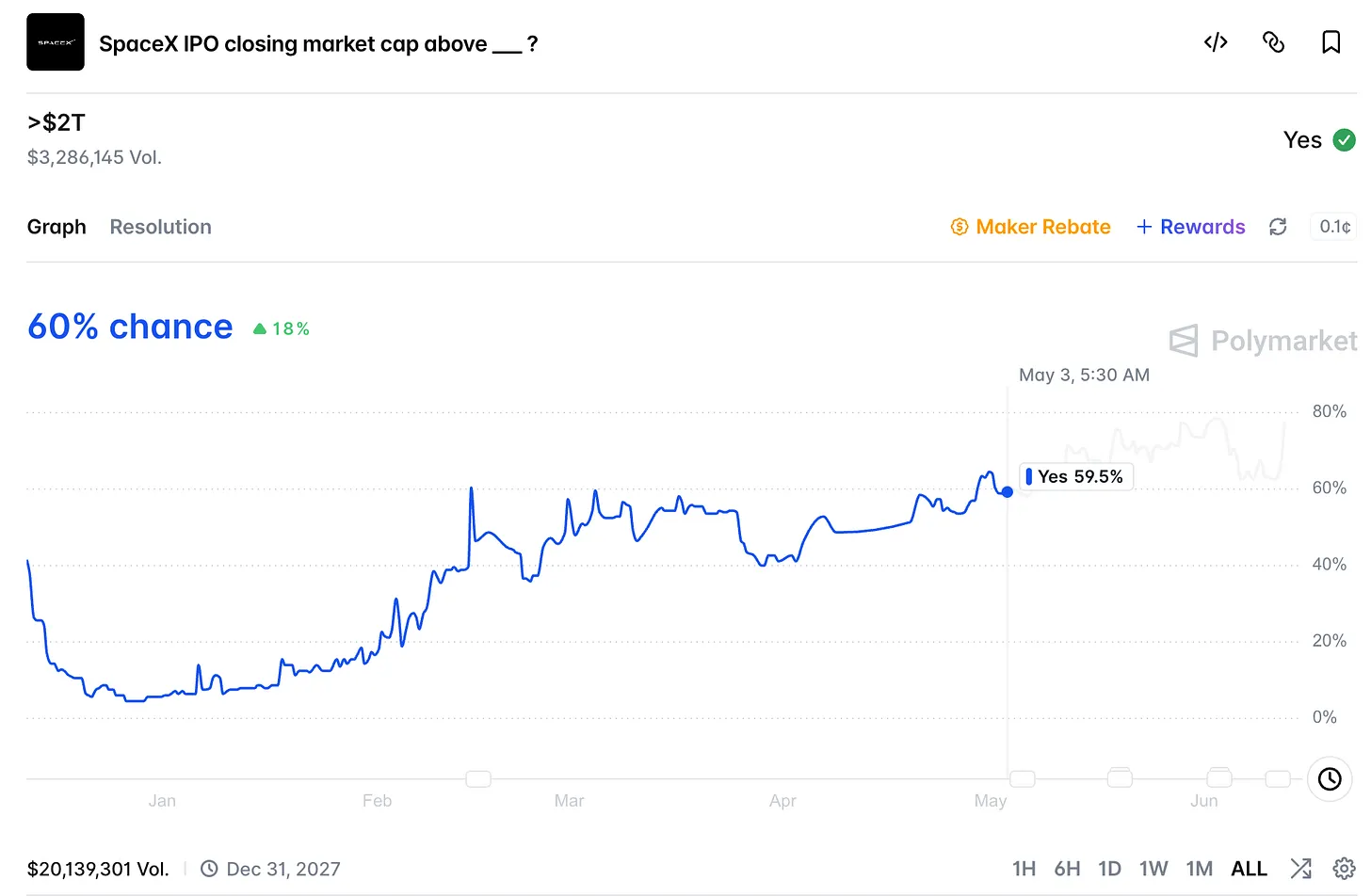
- Prediction market Polymarket: Users bet on the first-day closing price; the highest-volume bets implied a valuation exceeding $2 trillion; on Friday, June 12—the official listing date—SpaceX closed at ~$161, a 20% rise over the issue price, pushing its total market cap to $2.1 trillion;
- Perpetual futures platform Hyperliquid: Offers 24/7 trading of synthetic perpetual contracts tied to SpaceX, providing real-time reflection of market expectations for its equity valuation.
Prior to official listing, these pre-IPO perpetual contracts lacked actual underlying shares—they functioned essentially as leveraged wagers on the first-day stock price. On Hyperliquid, SpaceX-related contracts dominated open interest. During the listing-day pre-market session, the contract traded between $174–$185—representing a 30%–35% premium over the $135 issue price—while the actual stock peaked at $176 intraday. Once the stock officially listed on the exchange, the perpetual contract price rapidly converged toward the $150 opening price.
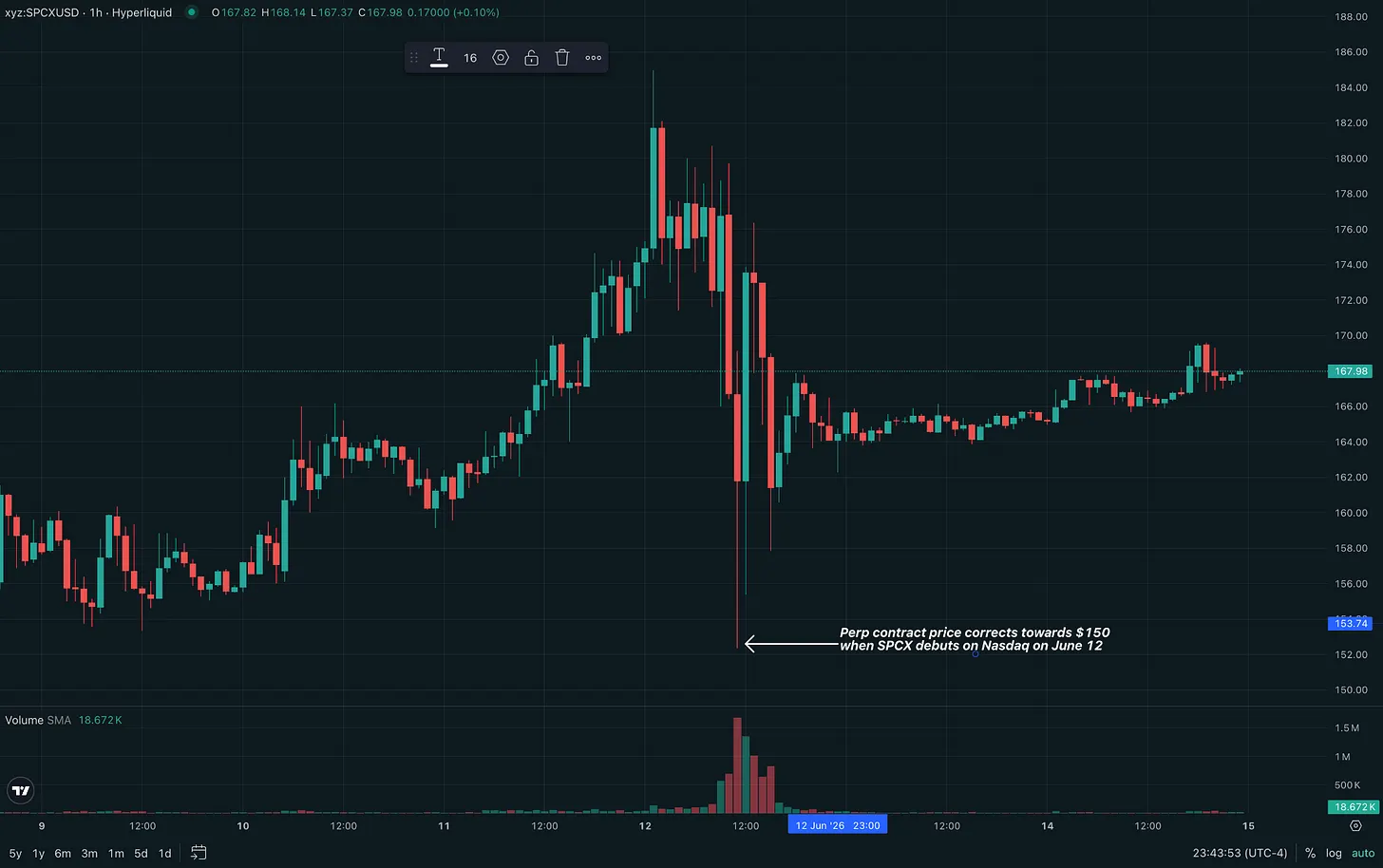
Is this merely coincidence? Precedent already confirms the reliability of these novel pricing mechanisms. Weeks earlier, chipmaker Cerebras’ IPO saw Hyperliquid’s corresponding perpetual contract price deviate by just 1.3% from Nasdaq’s actual opening price—with near-zero spread immediately after listing. At that time, Cerebras hadn’t even finalized its issue price, yet the market had already anticipated the opening level.
By leveraging diverse public trading venues, SpaceX circumvented investment banks’ first core responsibility: price discovery.
Share Settlement: Tokenization Exposes Underlying Custodial Vulnerabilities
After investment banks finalize pricing, their second core function is distributing shares and matching investors. Let’s temporarily skip distribution and instead dissect their third function: share allocation and settlement.
On SpaceX’s listing day, trading occurred across multiple platforms—operating entirely differently from traditional IPOs. Backpack on Solana issued tokens; U.S.-regulated institution Kraken launched corresponding products; Ondo issued tracking tokens; Hyperliquid listed synthetic perpetuals—all referencing SPCX as the underlying asset. Centralized exchanges including Bitget, Bybit, and Binance also opened IPO subscription channels.
Listing day yielded starkly divergent outcomes across platforms.
Products granting direct ownership of physical shares—or interfacing with custodial brokers holding real shares—opened on schedule, with prices perfectly aligned to the underlying stock. Backpack’s Solana token was backed 1:1 by real shares held in custody by its broker; Kraken’s U.S. offering interfaced with Payward Securities to deliver shares; Ondo issued daily custodial attestations guaranteeing full backing; Hyperliquid’s perpetuals require no physical shares—their price automatically syncs post-listing.
Binance, Bybit, and Bitget ran tokenized subscription campaigns, with xStocks pledging full backing by real shares. Yet none secured sufficient allocated shares—forcing full refunds. Binance alone refunded $557 million.
The root cause lies not in blockchain technology itself—compliant custodians successfully completed settlements. SpaceX’s oversubscription reached 3.5–4× its $75 billion fundraising target. Centralized exchanges relied on third-party intermediaries for share allocation, resulting in failed deliveries—and thus full refunds.
When price discovery becomes fully transparent and freely accessible, pricing ceases to be a scarce, high-value component of the IPO process. Industry competition now pivots on whether providers can reliably deliver fully backed shares.
Share settlement challenges are not new. Wall Street faced a similar crisis sixty years ago—and built supporting infrastructure to resolve it permanently.
In the late 1960s, surging U.S. equity trading volumes overwhelmed back-office operations. Since shares were paper certificates, every transaction required locating, verifying, and physically delivering documents—burying back offices under mountains of paperwork. Exchanges even closed every Wednesday solely to clear backlog. The industry ultimately solved this by eliminating paper certificates altogether.
The Depository Trust Company (DTC) was founded in 1968 and reorganized in 1973. All paper shares were consolidated into centralized depositories, with ownership transferred solely via book-entry records. Holding all assets with a trusted third party eliminated settlement risk—enabling custodians to guarantee sellers hold sufficient shares and buyers complete transfers seamlessly.
This remains the core problem custodial infrastructure must solve: Does the seller genuinely hold the underlying asset? Can it be transferred?
Tokenization faces identical risks. Tokens may launch early—but underlying shares might not yet reside in compliant custody. If tokens are backed by fully custodied shares held by a regulated broker, settlement is assured. But if tokens launch before underlying shares are secured, redemption promises collapse. This 2026 incident arose precisely because platforms issued tokens without securing corresponding physical shares.
Future IPOs will pivot less on price discovery—and more on verifying the existence and transferability of underlying assets.
What Irreplaceable Value Do Investment Banks Still Offer?
A full review of this new listing process reveals all three traditional functions now dispersed across external channels.
Primary-market price discovery is no longer investment-bank-exclusive. Weeks—or even months—before listing, pre-IPO secondary markets, prediction markets, and perpetual platforms continuously publish transparent valuations. By the time SpaceX locked in its issue price, multiple channels had already converged on a fair market value.
Trading venues are no longer monolithic. While SpaceX listed on Nasdaq, parallel on-chain trading channels opened simultaneously. Blockchain enables 7×24 trading—rendering secondary-market liquidity no longer dependent on a single legacy exchange.
The critical bottleneck for share settlement is custodial licensing. Historically, investment banks held exclusive control—leveraging depository institutions to guarantee settlement. Today, any licensed, compliant custodian can perform this function.
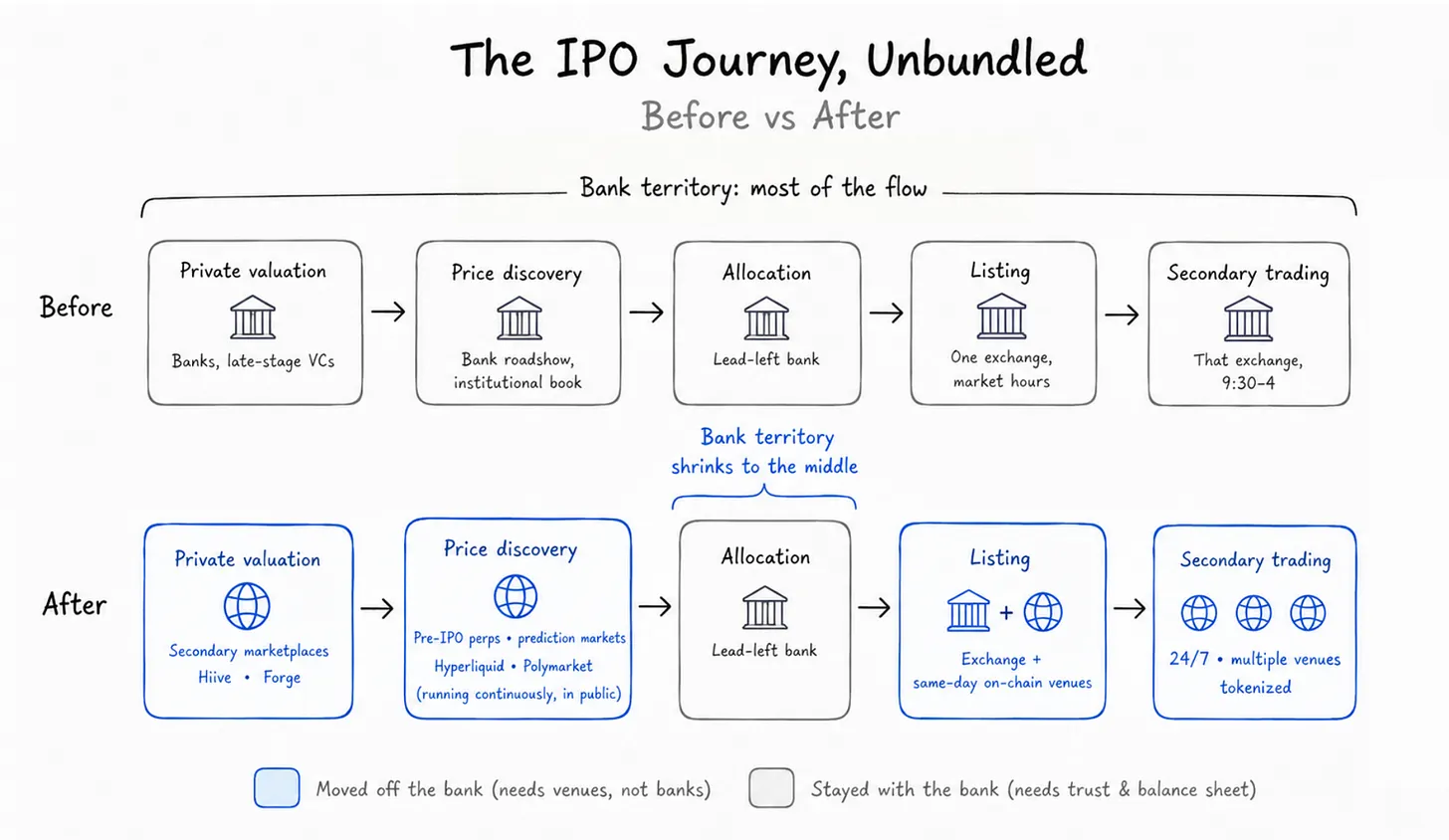
So what truly remains for investment banks to address? Currently, they retain only four hard-to-replace intermediary functions.
First, credit endorsement. The lead underwriter’s name on the prospectus serves as a formal credit guarantee—providing conservative institutional investors with crucial safety assurance. This decades-built industry reputation cannot be replicated by on-chain token platforms. Investment banks monetize this reputational capital through service fees. SpaceX paid $500 million in total underwriting fees—$100 million each to Goldman Sachs and Morgan Stanley—even though both firms played virtually no role in pricing.
Second, allocation authority. Lead underwriters retain discretionary control over most share allocations—selecting which investors qualify for subscriptions.
Third, risk assumption. SpaceX adopted a firm-commitment underwriting model: investment banks contractually agreed to purchase all issued shares upfront, then distribute them externally. Should market demand collapse and subscriptions fall short, unsold shares remain the banks’ liability—absolving SpaceX of loss. On-chain platforms lack capacity to absorb such massive downside risk.
Fourth, market stabilization. During volatile early trading, lead underwriters can activate “green shoe” mechanisms—overselling shares initially, then repurchasing them in the secondary market to dampen extreme price swings. Post-listing stabilization for SpaceX was handled by Morgan Stanley. This capability demands substantial balance-sheet capacity and professional market-making teams—currently available only at investment banks.
Beyond these four functions, every other step in the end-to-end listing process has been absorbed by newer channels—offering lower costs, extended trading hours, and full transparency.
Blockchain-based pricing channels have already validated their worth—delivering continuous, around-the-clock valuation estimates for pre-IPO companies, far outperforming traditional investment banks in efficiency. SpaceX’s massive oversubscription and near-19% first-day gain represent textbook IPO performance—strongly affirming the efficacy of these new pricing tools.
The traditional IPO model has been fully unbundled—each function now assigned to the most efficient channel available. Similar functional specialization is unfolding across industries. As noted in the prior article “Reconstructing Primary-Market Valuation,” markets no longer wait for investment banks to assign valuations to private companies. Investment banks—once monopolists over pricing and settlement—can no longer generate outsized fees from these standardized, commoditized services in the new listing ecosystem.
Will Investment Banks’ IPO Revenue Collapse Entirely?
No. SpaceX’s 0.67% underwriting fee is not the primary revenue source for investment banks.
Based on first-day gains, SpaceX’s $75 billion raise generated ~$14 billion in single-day paper profits. Investors capturing this upside were predominantly existing clients of underwriting banks. While banks cannot directly trade IPO shares themselves, they allocate coveted IPO allocations to clients—earning substantial trading commissions in return.
That’s why nearly twenty investment banks fiercely competed for underwriting roles despite the 0.67% fee. Underwriting fees have become secondary income; allocation rights, client-derived trading commissions, and long-term wealth management relationships constitute the true battleground for winning IPO mandates.
Investment banks’ profit logic is evolving—from standardized, replicable pricing services toward scarce resources: access to IPO share allocations.
Join TechFlow official community to stay tuned
Telegram:https://t.me/TechFlowDaily
X (Twitter):https://x.com/TechFlowPost
X (Twitter) EN:https://x.com/BlockFlow_News