SpaceX IPO Is Coming: Will Musk’s Wallet Gain Another $220 Billion?
TechFlow Selected TechFlow Selected
SpaceX IPO Is Coming: Will Musk’s Wallet Gain Another $220 Billion?
The real controversy lies in the $135 price—does it offer a sufficient margin of safety?
 Navigating Web3 tides with focused insights
Author: Biteye
Currently, SpaceX’s IPO price has preliminarily been set at $135 per share, with a planned fundraising target of approximately $75 billion—implying a fully diluted valuation of roughly $1.77 trillion. This would secure SpaceX the title of the largest IPO in capital markets history.
If this scale materializes, Elon Musk’s personal wealth would surge by over $220 billion, potentially propelling him to become the world’s first trillionaire.
Yet, to wear the crown, one must bear its weight. SpaceX’s IPO has drawn intense attention—not only because it may become the largest IPO ever, but also because market participants are already fiercely debating its valuation.
Is SpaceX truly worth $1.77 trillion? Staring at an extra $220 billion in his wallet, can Musk sleep soundly?
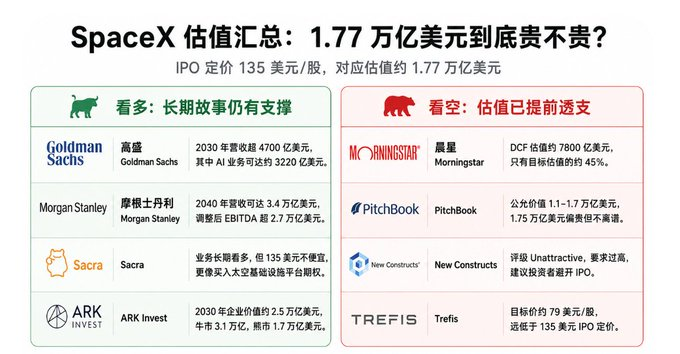
Bull Case: Underwriters Tell a Long-Term Story Leveraging Starlink + Launch Services + AI
Bulls argue that betting on SpaceX is not merely about backing a rocket company—it’s about securing early access to the future space infrastructure ecosystem.
The $1.77 trillion valuation may seem lofty, but if Starlink, low-cost launch services, and AI-related businesses continue delivering as expected, the $135 IPO price could be justified by a compelling long-term narrative.
1. Goldman Sachs @GoldmanSachs|X Followers: 1.132 million|XHunt Rank: 12,015|A global top-tier investment bank and one of SpaceX’s core IPO underwriters.
Core Viewpoint: SpaceX’s valuation cannot be assessed solely through the lens of traditional aerospace companies; Starlink and future AI-related businesses must be integrated into a long-term growth model.
Goldman Sachs projects SpaceX’s revenue will reach ~$160 billion in 2028 and exceed $470 billion by 2030.
Among these, the AI division represents the most aggressive component. Goldman Sachs estimates SpaceX’s AI-related revenue could reach ~$322 billion by 2030.
2. Morgan Stanley @MorganStanley|X Followers: 742,000|XHunt Rank: 32,049|A global top-tier investment bank and one of SpaceX’s core IPO underwriters.
Core Viewpoint: SpaceX’s long-term value stems from compound growth across “space + AI,” implying a far higher revenue ceiling than traditional aerospace firms.
Morgan Stanley likewise forecasts SpaceX’s 2028 revenue at ~$160 billion.
Its longer-term projections are even more ambitious: by 2040, Morgan Stanley expects SpaceX’s revenue to reach $3.4 trillion, with adjusted EBITDA exceeding $2.7 trillion.
If you’re buying access to the next decade-plus of space infrastructure, $135 is arguably undervalued—but realization will take considerable time.
3. Sacra|An independent research firm specializing in pre-IPO tech companies, focused on deep-dive company analysis and valuation breakdowns.
Core Viewpoint: Bullish on long-term business prospects, but $135 is not undervalued—it’s more akin to purchasing an option on SpaceX’s transition from a rocket company into a comprehensive space infrastructure platform.
Sacra estimates SpaceX’s 2025 revenue at ~$18.7 billion, of which Starlink contributes $11.4 billion—making it the company’s most critical profit center.
It highlights SpaceX’s key advantage: vertical integration—designing and manufacturing rockets in-house, conducting launches autonomously, deploying satellites independently, and controlling both end-user terminals and ground networks—thereby establishing cost advantages difficult for competitors to replicate.
If valuing only current Starlink and launch operations, $135 is not cheap. However, if one believes SpaceX will evolve beyond aerospace into a broad-based platform spanning satellite internet, low-cost launch, and other space infrastructure domains, the price becomes more palatable.
4. ARK Invest @ARKInvest|X Followers: 816,000|XHunt Rank: 1,637|An innovation-focused investment firm founded by “Woodie” Cathie Wood, long committed to disruptive technology assets.
Core Viewpoint: While SpaceX’s $1.77 trillion valuation is high, it is not entirely unsupported when viewed against its long-term potential through 2030.
ARK Invest’s open-source SpaceX valuation model estimates the company’s enterprise value at ~$2.5 trillion by 2030. Under its model, bull-case and bear-case scenarios yield values of ~$3.1 trillion and ~$1.7 trillion, respectively.
ARK’s core thesis is that SpaceX’s value extends well beyond launch services—to Starlink’s global satellite internet network, low-cost launch capability, and future space infrastructure ventures.
According to ARK’s projections, the $135 IPO offering price still offers some upside potential.
Bear Case: Independent Analysts Argue IPO Valuation Is Already Severely Overextended
Bears do not dispute SpaceX’s status as the world’s most unique commercial space asset, nor do they deny Starlink’s long-term value.
However, they contend that the $1.77 trillion IPO valuation has already priced in too much future growth—especially given the substantial uncertainty surrounding AI-related businesses.
1. Morningstar @MorningstarInc|X Followers: 238,000|XHunt Rank: 98,209|A globally renowned independent investment research firm widely known for fundamental analysis and DCF modeling.
Core Viewpoint: SpaceX is a strong company, but its IPO valuation is clearly excessive.
Using a DCF model, Morningstar assigns SpaceX a fair value of ~$780 billion—only ~45% of the $1.77 trillion IPO target valuation.
In Morningstar’s segmented valuation, SpaceX’s core launch business plus Starlink are valued at ~$611 billion, while xAI/AI-related businesses carry a probability-weighted valuation of ~$170 billion.
Morningstar also flags two risks: Elon Musk is SpaceX’s irreplaceable linchpin, meaning the valuation embeds a clear “Musk premium.” Post-IPO, expiration of lock-up periods could trigger selling pressure from early shareholders and employees.
Morningstar views $135 as clearly overpriced and unsuitable for rushed subscription—better entry points may emerge post-IPO.
2. PitchBook @PitchBook|X Followers: 48,000|XHunt Rank: 49,174|A global data platform covering private equity, venture capital, and private companies, offering extensive valuation and financing insights.
Core Viewpoint: A ~$1.5 trillion valuation is acceptable; $1.75 trillion is expensive—but not wholly irrational.
Applying a Sum-of-the-Parts model, PitchBook estimates SpaceX’s fair value range at ~$1.1–1.7 trillion, focusing primarily on launch operations and Starlink without full reliance on the xAI narrative.
The $135 price sits near or slightly above PitchBook’s upper valuation bound—not cheap, yet not entirely unreasonable if Starship and Starlink deliver as anticipated over the long term.
3. New Constructs @NewConstructs|X Followers: 5,675|XHunt Rank: –|An independent equity research firm emphasizing financial quality, valuation risk, and reverse DCF analysis.
Core Viewpoint: At a $1.75 trillion valuation, SpaceX is unworthy of participation; investors should avoid the IPO.
New Constructs rates SpaceX “Unattractive.” It argues that the $1.75 trillion valuation implies unrealistically high future growth and profitability targets—SpaceX would need to become one of the highest-revenue and highest-profit companies in the U.S. equity market just to justify the price.
Key concerns include inadequate internal accounting controls, virtually no voting rights for public investors, heavy use of IPO proceeds to repay debt, misleading non-GAAP metrics, and related-party transaction risks.
To sustain a $1.75 trillion valuation, SpaceX’s revenue may need to reach $1.1 trillion by 2035—implying an average annual growth rate of ~50% over the next decade. Fortune notes such growth has virtually no historical precedent.
New Constructs’ conclusion is stark: the risk-return profile is unattractive—participation in the IPO is not recommended.
4. Trefis @Trefis|X Followers: 2,661|XHunt Rank: –|An independent U.S. equity valuation platform deriving target prices via business-segment modeling.
Core Viewpoint: SpaceX is an exceptionally rare company—but the $135 offering price is clearly excessive.
Trefis acknowledges SpaceX’s long-term advantages in commercial space, Starlink satellite internet, and low-cost launch—but stresses those strengths don’t absolve investors from price discipline.
Trefis assigns SpaceX a target price of ~$79 per share—far below the $135 IPO price.
Final Thoughts
Both bulls and bears broadly agree that SpaceX ranks among the world’s most unique commercial space companies.
The real point of contention remains whether the $135 price offers any margin of safety.
Bulls see $135 as a bet on Starlink, low-cost launch, AI, and the long-term space infrastructure story.
Bears counter that $135 has already priced in all expectations.
Currently, the IPO subscription multiple for $SPCX has reached 4x—indicating strong investor enthusiasm despite the valuation debate.
So here’s the question: Will you participate in the $SPCX IPO? And do you think Musk’s $220 billion windfall is well-deserved—or keeping him up at night?
Join TechFlow official community to stay tuned
Telegram:https://t.me/TechFlowDaily
X (Twitter):https://x.com/TechFlowPost
X (Twitter) EN:https://x.com/BlockFlow_News
 @BiteyeCN