Want to chase SpaceX? Data shows that among 30 high-profile U.S. IPOs, most dropped by half within their first year.
TechFlow Selected TechFlow Selected
Want to chase SpaceX? Data shows that among 30 high-profile U.S. IPOs, most dropped by half within their first year.
History does not guarantee repetition, but a 50% decline in the first year has been the norm for this game over the past fourteen years.
 Navigating Web3 tides with focused insights
Author: Kuli, TideFlow Research
Introduction: SpaceX is scheduled to price its IPO after market close on June 11 and begin trading on the Nasdaq under the ticker symbol SPCX on June 12. The offering price is set at $135 per share, valuing the company at approximately $1.75 trillion and raising $75 billion—the largest IPO in history.
Yet data from Motley Fool on 30 high-profile tech IPOs shows that median returns at both 6 and 12 months post-IPO stand at -9%. The median maximum drawdown in the first year is 54%, with no company escaping it. Morningstar’s fair value estimate stands at only about $780 billion—less than half the IPO valuation.
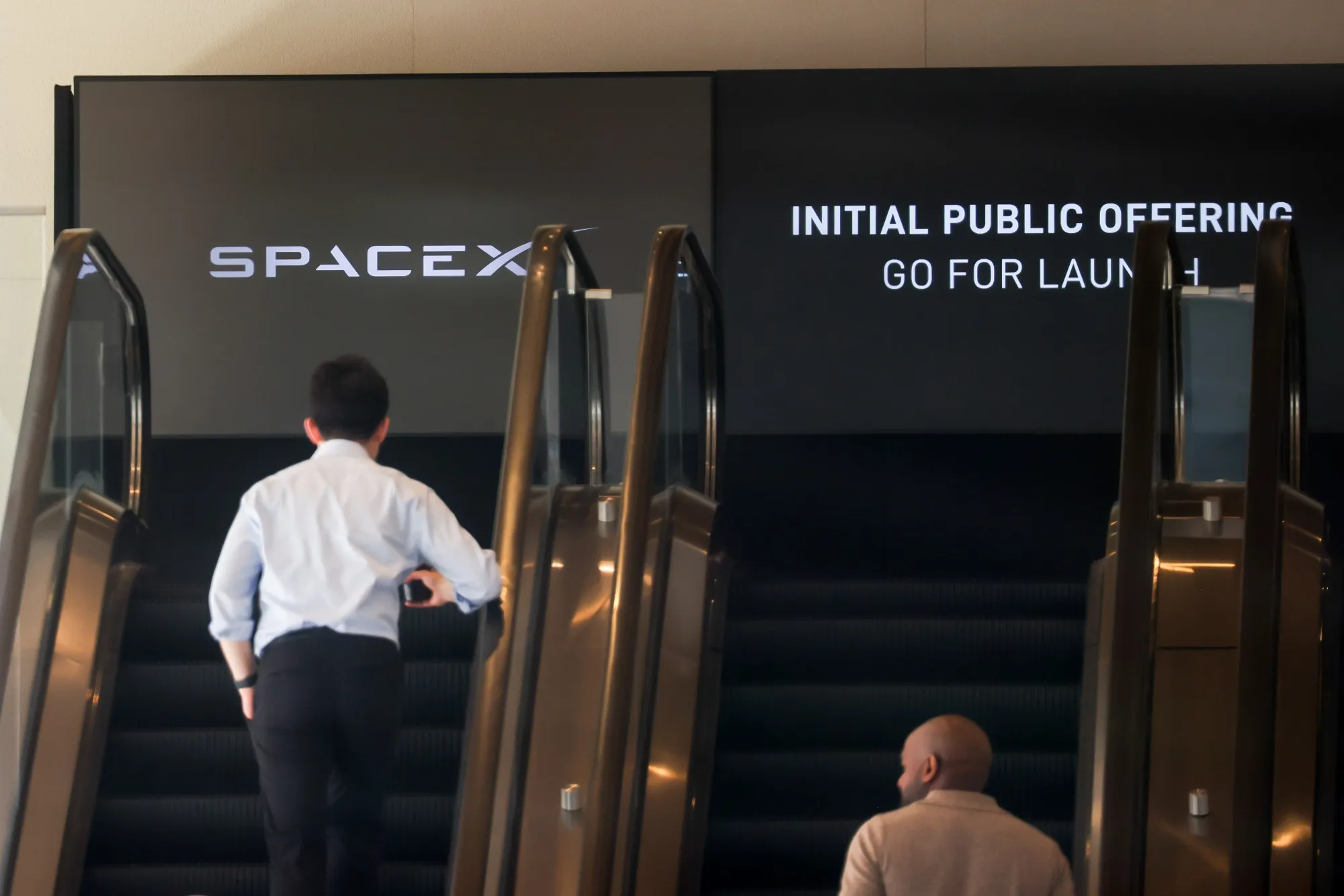
This Friday (June 12), SpaceX will list on the Nasdaq under the ticker SPCX. According to a Reuters report dated June 3, the offering price has been set at $135 per share, with approximately 556 million shares offered, raising $75 billion and implying a valuation of roughly $1.75 trillion (some sources cite $1.77 trillion based on post-offering fully diluted shares). Whichever metric is used, this will be the largest IPO ever in equity markets. A syndicate of 21 investment banks, led by Goldman Sachs, is underwriting the deal, and final pricing will be announced after U.S. market close on June 11.
The hype is undeniable. In its S-1 filing, SpaceX states it has identified “the largest addressable total market in human history,” quantified at $28.5 trillion. Retail investor allocation is set at 30% of the float—about three times the typical level for large IPOs.
The question is: For ordinary investors rushing in on day one, historical data paints a grim picture.
Median Performance: Small Gains Early, Then Broad Losses by Month Six
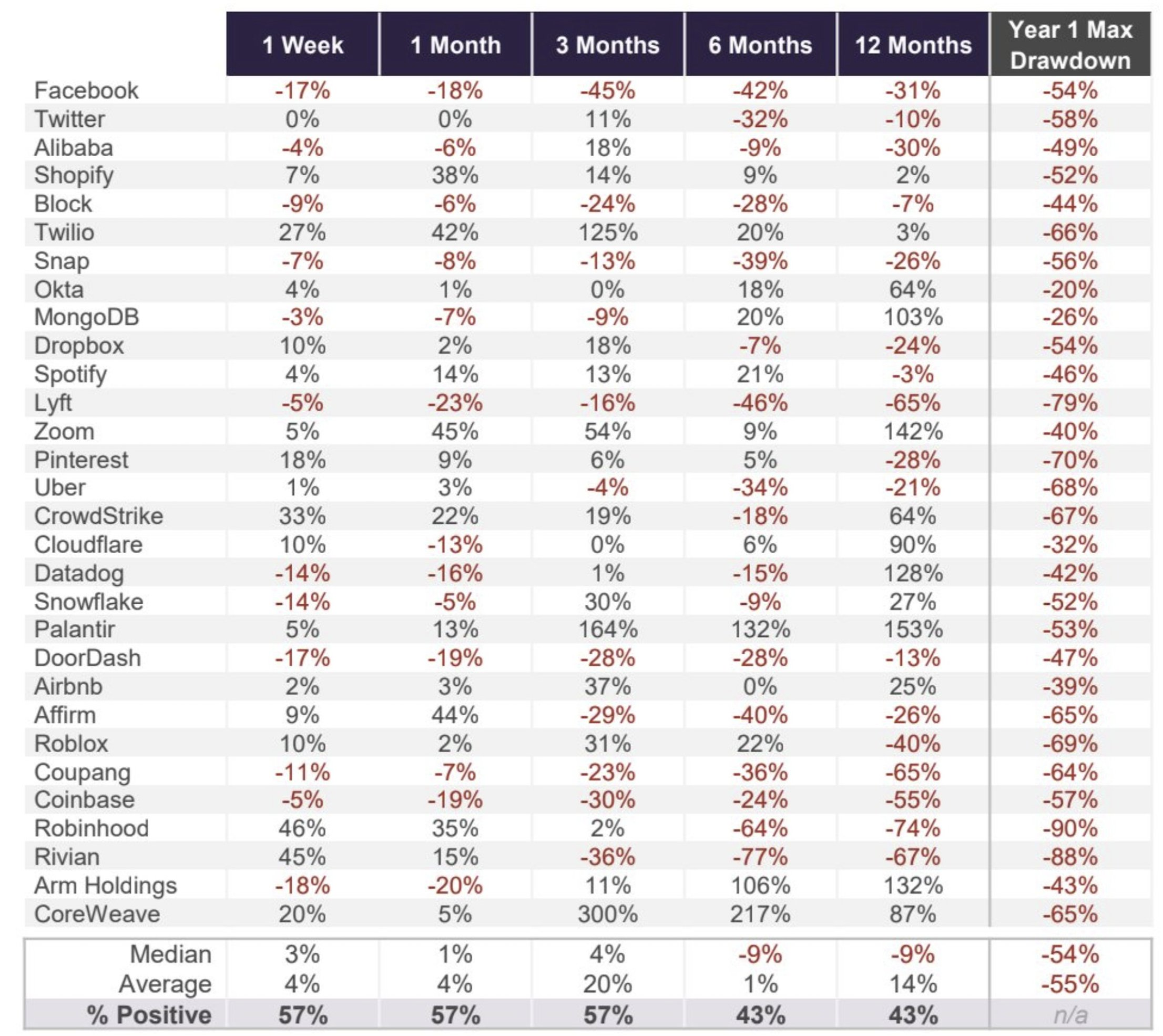
In an article published on June 9, Motley Fool analyst Ryan Vanzo analyzed post-IPO performance of 30 high-profile tech companies since 2012—including Facebook, Twitter, Coinbase, Robinhood, Rivian, Arm, and CoreWeave.
The median performance curve tells a clear story: median returns are +3% after one week, +1% after one month, and +4% after three months—still acceptable. But by six months, the median turns negative at -9%; at 12 months, it remains at -9%. The share of companies delivering positive returns also collapses: holding steady at 57% over the first three months, it drops to just 43% at both the six- and twelve-month marks. In other words, most momentum buyers lose money if they hold for a full year.
Individual stock outcomes vary dramatically. CoreWeave surged 300% in its first three months; Palantir rose 164%; Zoom gained 142% over 12 months. But downside cases are equally concentrated: Lyft fell 65% over 12 months; Robinhood dropped 74%; Rivian fell 67%; Coupang declined 65%. Star power and post-IPO returns show no consistent correlation.
Median First-Year Maximum Drawdown: 54%—Robinhood and Coinbase Both Fell Over 50%
Even more striking than returns are the drawdown figures. Across the 30 companies, the median first-year maximum drawdown was 54%, with an average of 55%. Even Okta—the least volatile—saw a 20% drawdown. Not a single company escaped meaningful losses.
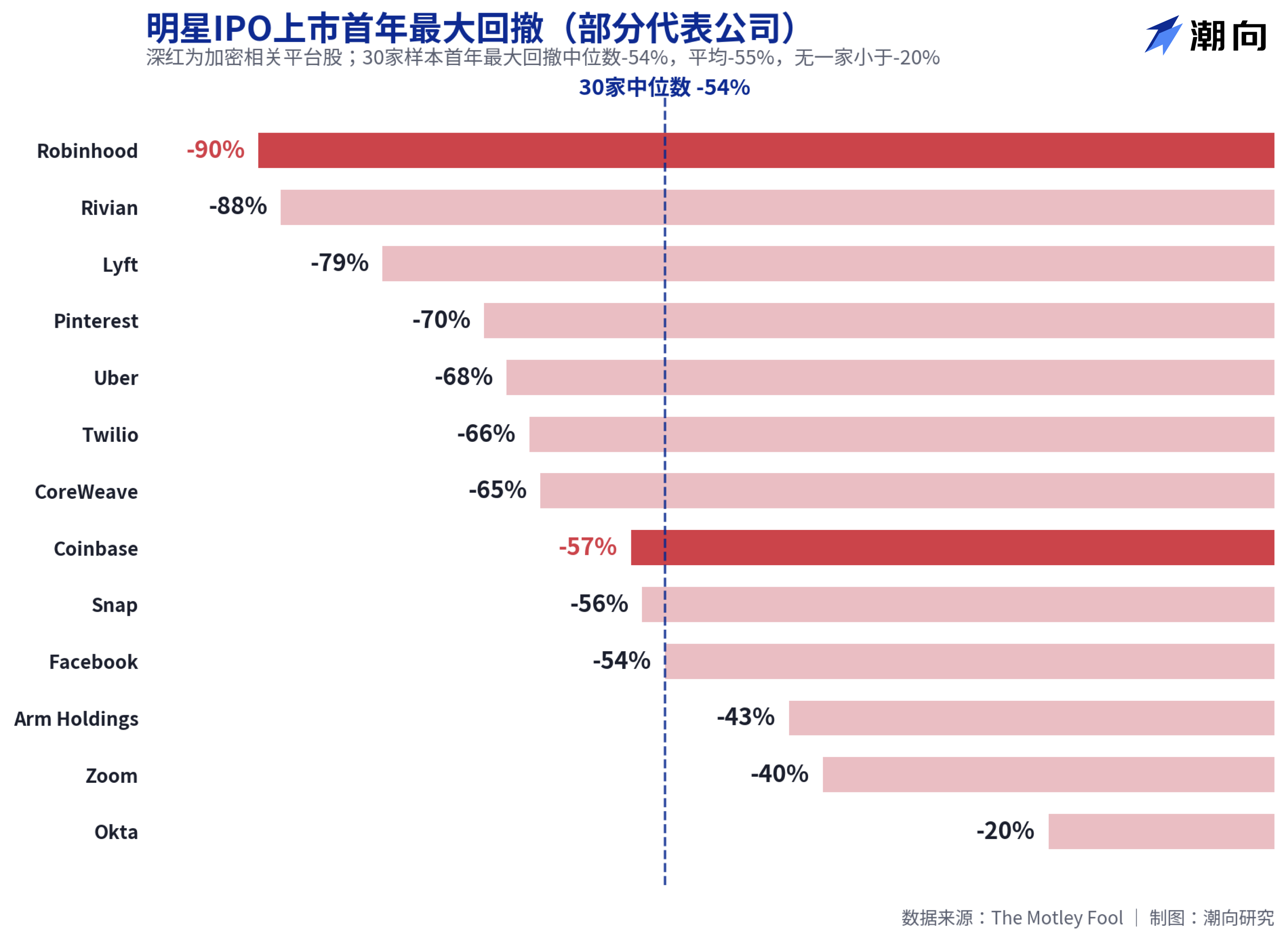
Two platforms familiar to crypto users sit squarely in the worst-performing group. Robinhood recorded a 90% maximum drawdown in its first year—the worst among the 30—while Coinbase fell 57%. Even later-proven winners were no exception: CoreWeave suffered a 65% drawdown; Palantir, 53%; Meta (then Facebook), 54%. These figures point to a simple conclusion: even if you pick the right company, buying at the IPO price almost guarantees an initial paper loss approaching 50%.
Academic research paints a similar picture. Jay Ritter, Director of the University of Florida’s IPO Project, tracked 1,479 IPOs between 2012 and 2021. Average first-day returns were a lofty 23.6%, but average cumulative returns over the subsequent three years totaled only 10.6%. The Wall Street Journal, citing Ritter’s data, notes that investors who bought and held for three years after the IPO underperformed a market-cap-weighted index by roughly 21%. The first-day euphoria largely exhausts future upside.
SpaceX’s Numbers: $18.7 Billion in Revenue Supports a $1.75 Trillion Valuation
Turning back to SpaceX itself, valuation concerns are even more concrete than historical patterns.
According to financial data cited by The Motley Fool, SpaceX generated $18.7 billion in revenue in 2025—a 33% increase year-on-year—but posted a net loss of $4.9 billion, reversing a $790 million profit in 2024. Per S-1 data compiled by BitMEX, SpaceX incurred a staggering $4.28 billion net loss in Q1 2026 alone, bringing its cumulative net loss to $41.3 billion. Its AI business—incorporating xAI—burns approximately $2.5 billion per quarter. At the $1.75 trillion valuation, its price-to-sales ratio exceeds 90x.
Morningstar’s stance is the most direct. Its analysts label SpaceX “severely overvalued,” advising long-term investors to wait for better entry points post-IPO and assigning a fair value estimate of roughly $780 billion—less than half the IPO valuation. For context: SpaceX’s December 2025 private tender offer implied a valuation of ~$800 billion; within six months, the IPO price implies more than double that figure.
Bullish arguments exist as well. SpaceX holds over 80% of the U.S. launch market share; Starlink has surpassed 12 million subscribers and is already profitable—providing the foundational support for this valuation. Vanzo himself expects strong first-day performance but cautions that, given the valuation and historical precedent, share price struggles over the next 12 months would be unsurprising.
For those preparing to place orders this Friday, the data from these 30 companies is worth at least a glance: history doesn’t guarantee repetition—but a first-year drop of roughly 50% has been the norm for the past 14 years.

Join TechFlow official community to stay tuned
Telegram:https://t.me/TechFlowDaily
X (Twitter):https://x.com/TechFlowPost
X (Twitter) EN:https://x.com/BlockFlow_News
 @chaoxiangooo