US Stocks On-Chain: A Tripartite Division, Which of the Three Models is Closer to the Ultimate Form?
TechFlow Selected TechFlow Selected
US Stocks On-Chain: A Tripartite Division, Which of the Three Models is Closer to the Ultimate Form?
A Comparative Review of Ondo Stocks, Bitget rToken, and Binance bStocks.
 Navigating Web3 tides with focused insights
Author: Liao Liao
In 2026, the opening bell on Wall Street lost its effect for the first time. Over the past century, the trading floor of the New York Stock Exchange determined when global capital woke up and when it slept, with weekends and holidays being strict times off. This year, this boundary began to loosen: the on-chain world gained the ability to handle real order flows from Nasdaq and the NYSE for the first time, and for stocks, the oldest form of financial asset, a 7×24 operational model emerged.
This major change owes much to the intensive breakthroughs in the tokenized US stock sector since 2026. MiCA's compliance framework gradually landed in Europe, the draft of the US CLARITY Act provided clearer legislative references for digital asset classification, and multiple top exchanges and fintech platforms successively increased investment in stock tokenization product lines.
The leader of tokenized stocks in Europe and the US, Ondo Global Markets, pushed its asset scale to the billion-dollar level within a few months and simultaneously advanced the Securities and Exchange Commission (SEC) registration process; Bitget's rToken can directly connect to Nasdaq and the NYSE, and through unified trading accounts, margin applications, and high-frequency reserve audits, transform US stocks into tradable, collateralizable, and reusable crypto-native assets; Binance also launched bStocks in June, expanding rapidly relying on the native traffic of the largest exchange.
Although exchange tokenized stock products mostly use similar expressions such as "24/7 trading" and "1:1 backing," there are significant differences in their liquidity sources, trading mechanisms, capital usage, and underlying risk structures.
To gain a deeper understanding, Odaily Planet Daily reporters will conduct a horizontal comparison from four dimensions: liquidity sources, trading hour availability, capital efficiency and composability, and compliance licenses and custody transparency, and combine market scale and order book data to analyze the real differences between the three product models.
Evaluation Dimension Settings
The horizontal comparison dimensions adopted in this article include:
- Liquidity Sources and Price Pegging Mechanisms
- Trading Hours and Availability
- Capital Efficiency and Composability
- Compliance Licenses and Asset Custody Transparency
The four dimensions correspond to what investors care about most: whether the price reflects the actual US stock price, whether trading can be done at any time, whether funds can be used efficiently, and whether the underlying stock assets truly exist and are verifiable. At the end, we will introduce the ranking of existing different product trading volume scales as a reference.
Dimension One: Liquidity Source Comparison
The price pegging mechanism is the core structural difference of tokenized stock products, and is also the key to determining whether there is a "de-pegging" risk, directly relating to whether traders can enter and exit at real prices at critical moments.
Ondo Global Markets adopts an "Inherited Liquidity" mode, maintaining the token price close to the underlying stock through real-time minting and redemption mechanisms superimposed with arbitrageur behavior; this design allows the token to circulate flexibly on-chain while staying as close as possible to the target stock price. rToken directly routes spot orders to the NASDAQ and NYSE order books connected by licensed brokers during US stock trading hours, writes transaction results back to the exchange spot order records in real time, synchronizes price and liquidity completely with the underlying stock market, and is the only product among the three to achieve direct connection to exchange-level order books. Binance bStocks' pricing method is to peg the target stock price through oracle data pushes; relying on Binance's own user base and update mechanism, it can quickly cover a large number of targets with a lower threshold, providing users with a real-time price tracking experience.
The three have different focuses on liquidity pegging, and respectively represent exchange direct connection matching, minting redemption arbitrage, and oracle tracking, these three currently mainstream technical paths in the industry.
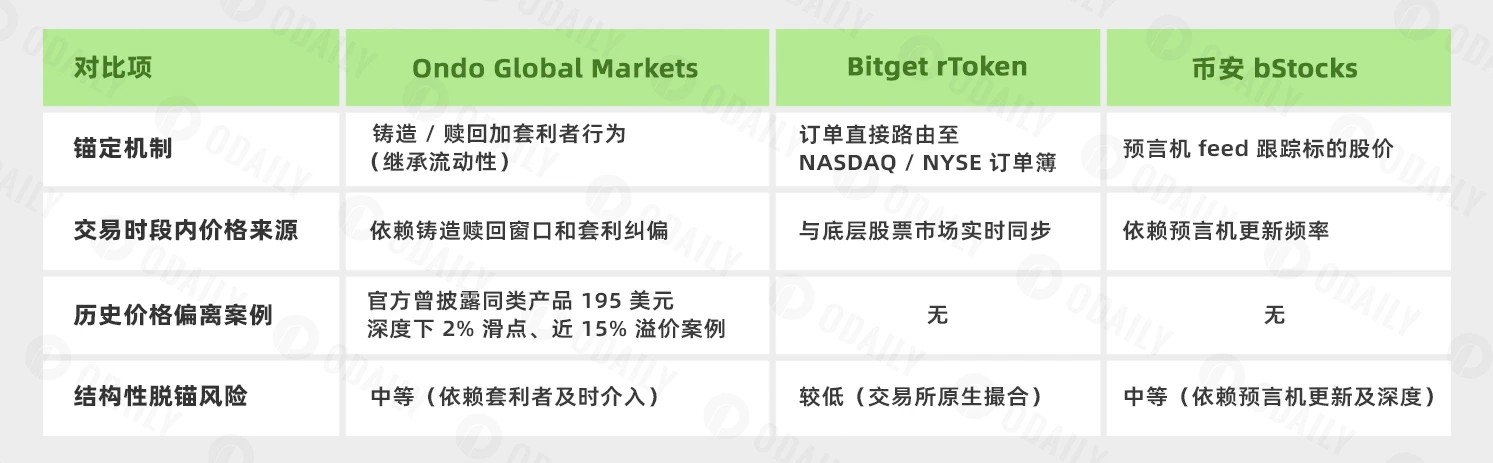
The liquidity pegging mechanisms of the three are not structurally equivalent, and also adapt to different usage scenarios respectively. Ondo's minting redemption mode is more suitable for users accustomed to on-chain native operations and willing to bear a certain arbitrage correction lag, and is also more suitable for arbitrage users; bStocks' oracle tracking threshold is lower, suitable for ordinary users pursuing convenience and wide coverage of targets; rToken's trading direct connection order book mode, from a design logic perspective, is closer to real prices, especially has advantages in price consistency during regular US stock trading hours, suitable for traders with high price requirements and pursuing low slippage.
At the same time, we also conducted a test on actual order book data. Taking Circle (CRCL) tokenized stock as an example, the quotes and depth of the three platforms at the same point in time show respective strengths and weaknesses:
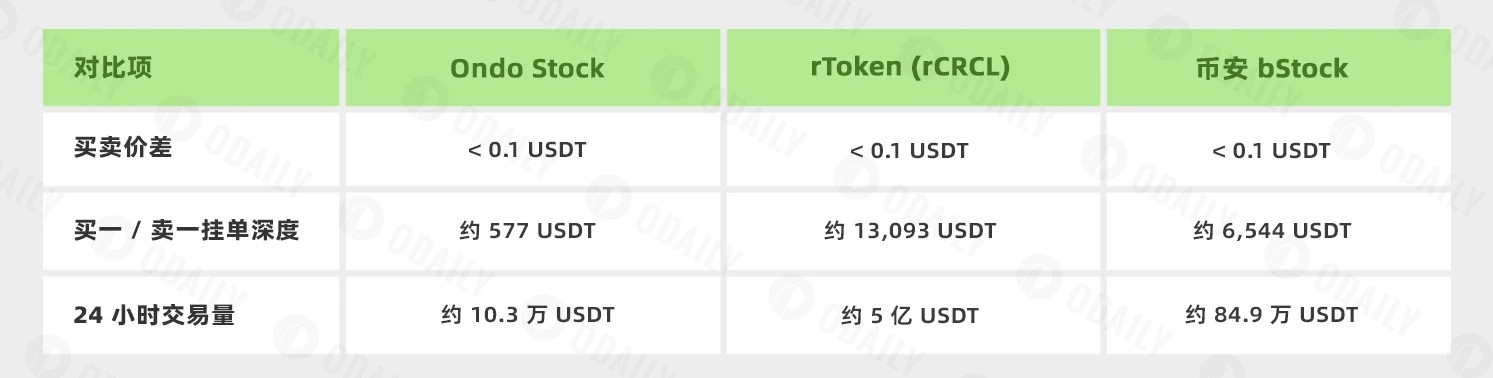
In this set of data, all three maintained relatively narrow spreads. However, in terms of order book depth and 24-hour trading volume, rToken's performance is more prominent; its mode of accessing the stock exchange native order book has significant advantages in order carrying capacity and market activity.
Dimension Two: Trading Hours and Availability
In terms of all-weather trading capabilities, all three products publicly promote support for 24/7 user trading, but there are significant differences in specific mechanisms.
Ondo Global Markets' minting and redemption windows are 24 hours, five days a week; on-chain transfers themselves are not time-limited, providing users with flexible asset circulation capabilities, while price discovery relies on the open status of the minting redemption windows. rToken covers US stock regular trading, pre-market, intra-day, after-hours, and night session periods; some hot targets further support true 24/7 trading; during market closure, Bitget provides internal liquidity to maintain price discovery, achieving a seamless connection from regular periods to market closure periods. Binance bStocks also focuses on all-weather liquidity, near-instant settlement, and zero conversion fees; relying on the exchange's native user base allows more targets to be conveniently traded at any time.
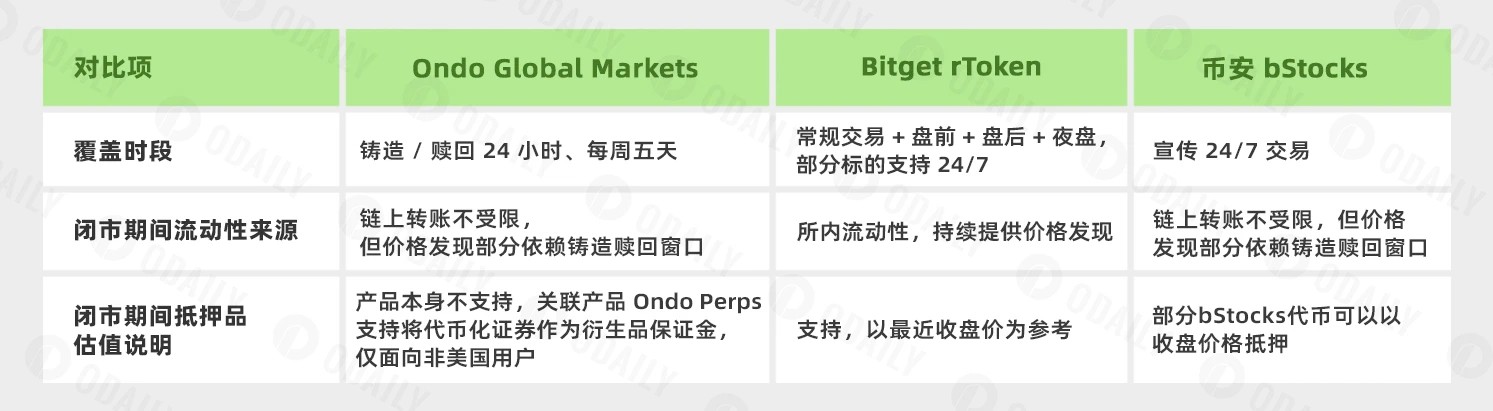
All three take all-weather availability as a core capability, and have established corresponding mechanisms for trading and price volatility risks during US stock market closure periods; the overall product experience and risk management frameworks are relatively complete. In terms of pure 24/7 level availability, Ondo is slightly inferior in coverage time, therefore Bitget rToken and bStocks will be more suitable for daily users.
Dimension Three: Capital Efficiency and Composability
Capital efficiency is a core consideration for institutions and professional traders when choosing tokenized stock products, specifically reflected in whether such assets can be used as margin or collateral, and whether they can be flexibly allocated between different accounts and strategies; this is also where the gap in actual usage value between products is widened. Although this part is far from traditional small-capital retail investors, it is a core consideration for professional traders and institutions themselves when choosing to configure crypto asset US stock exposure.
Odaily Planet Daily's evaluation results are as follows:
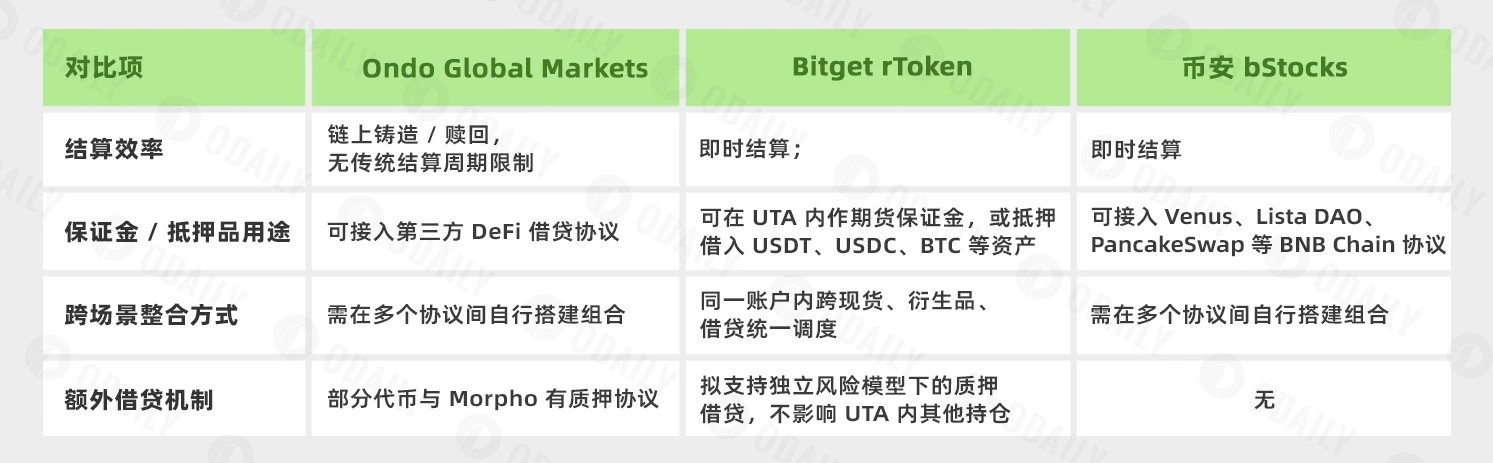
From a design perspective, the capital efficiency functions of the three are significantly different: Ondo and bStocks lean more towards "on-chain DeFi composability," relying on third-party protocol ecosystems, requiring users to bear the friction of cross-protocol operations and additional smart contract risk exposure; rToken takes the "in-exchange institutional-level unified margin account" route, directly integrating stock positions into derivatives, lending, and other scenarios, completing multi-asset coordination within the same account system. If pursuing on-chain DeFi functions more, Ondo and bStocks are more suitable; if starting from the actual needs of professional and institutional traders for capital efficiency, rToken's integration and convenience are more prominent, and it is also closer to institutional requirements for risk control controllability.
Dimension Four: Compliance Licenses and Custody Transparency
While trading on-chain, whether the underlying US stock assets truly exist and can be independently verified is the foundation for tokenized stock products to establish trust. In terms of credit endorsement in this aspect, how do the various products perform?
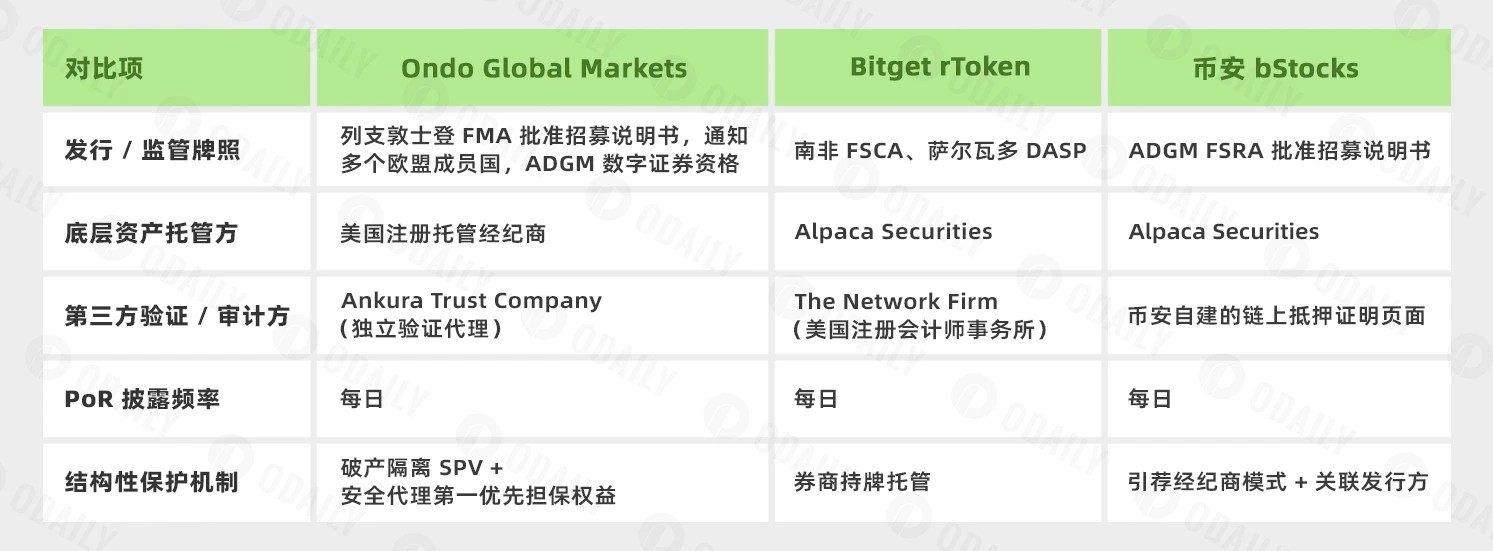
All three adopt an asset protection mechanism combining regulated custody and third-party independent verification, and have established relatively complete frameworks in terms of compliance, transparency, and underlying asset credibility. It can be seen that after experiencing several rounds of market cycles in the crypto market, in terms of underlying asset protection, the major players in the crypto-stock sector have made maximized protections. The differences between the three are more reflected in specific arrangements such as audit frequency, information disclosure granularity, and third-party verification entities, but for users, the perceptual experience difference is not significant.
Conclusion: Three Companies Adapt to Investors with Different Needs, but Each Has Advantages and Challenges
Combining the four dimensions and market rankings, the three paths respectively respond to different needs in the tokenized stock sector.
Ondo Global Markets, relying on its inherited liquidity mode and compliance layout covering multiple jurisdictions, is more suitable for institutions that value regulatory frameworks and open on-chain applications and users with high compliance needs in Europe and the US; Binance bStocks relies on exchange native traffic and on-chain ecosystem integration, and is more convenient in terms of trading entry, self-custody, and on-chain circulation, more suitable for investors who have deeply used the BNB ecosystem and are familiar with on-chain operations; Bitget rToken, relying on diverse product functions, is more suitable for high-frequency traders and institutional clients, who are more sensitive to liquidity, capital efficiency, and cross-scenario asset allocation.
From a longer-term industry perspective, the common challenges faced by tokenized stocks are more worthy of attention than the differences between various products. Whether cross-border finance is compliant, whether real market demand can keep up, and whether precise pricing can be achieved during market closure periods still await further industry resolution. As regulatory boundaries gradually become clear and underlying liquidity continues to deepen, different paths will learn from each other in competition, promoting this market from early experiments to maturity. The boundary once drawn by Wall Street is being slowly rewritten by every transaction on-chain.
Join TechFlow official community to stay tuned
Telegram:https://t.me/TechFlowDaily
X (Twitter):https://x.com/TechFlowPost
X (Twitter) EN:https://x.com/BlockFlow_News
 Odaily