Even pickaxe sellers need to borrow money to buy pickaxes: The U.S. AI stock sector lost over $1 trillion in value in one week, and the market has begun pricing AI’s “bill”
TechFlow Selected TechFlow Selected
Even pickaxe sellers need to borrow money to buy pickaxes: The U.S. AI stock sector lost over $1 trillion in value in one week, and the market has begun pricing AI’s “bill”
Increasing amounts of money are being borrowed in increasingly complex ways for this AI infrastructure race.
 Navigating Web3 tides with focused insights
Author: Ada, TechFlow
Over the past week, U.S. AI-related stocks painted a strange picture: records fell one after another—and shares were sold off in rapid succession.
On June 1, Alphabet—holding $100 billion in cash—announced one of the largest equity financings in its history. On June 3 after market close, Broadcom delivered its strongest quarterly results ever—but its stock crashed the next day. On June 5, the Nasdaq Composite plunged 4%—its worst single-day drop since the tariff turmoil of April 2025—as the semiconductor sector lost roughly $1 trillion in market value in one day. On June 10 after market close, Oracle reported record-breaking revenue and backlog—but its share price tumbled anyway. On June 11, SpaceX—the largest IPO in history—entered its pricing phase. The financial figures themselves were sound; what raised concern was how those numbers were achieved: ever more capital, borrowed through increasingly complex structures, is flooding into the AI infrastructure race. Once markets began scrutinizing this financing math, even record-setting results couldn’t prop up valuations.
The Same Script: Break Records First—Then Get Hammered
Broadcom set the precedent. According to its earnings report and multiple media outlets, in its second fiscal quarter ended May 3, Broadcom posted $22.219 billion in revenue—a 48% year-on-year increase—and $10.8 billion in AI chip revenue—a 143% rise. Earnings per share (EPS) also exceeded Wall Street expectations. Yet investors focused on just one gap: management’s guidance for next quarter’s AI chip revenue stood at $16 billion—below analyst forecasts. CEO Hock Tan declined to raise the full-year AI revenue target and noted Google may diversify its chip supply chain. The next day, Broadcom’s stock dropped nearly 15%, wiping out almost $280 billion in market value—the largest single-day market cap decline in Wall Street history.
A week later, Oracle followed suit. Per its earnings report and CNBC coverage, in its fourth fiscal quarter ended May 31, Oracle reported $19.2 billion in revenue—up 21% YoY—and $5.8 billion in cloud infrastructure revenue—up 93% YoY. Adjusted EPS hit $2.11, surpassing the consensus estimate of $1.95. Its backlog—measured as Remaining Performance Obligations (RPO)—reached $638 billion, a staggering 363% YoY surge and far above the $595.7 billion analysts had expected. Still, the stock rejected the news, plunging nearly 9% after hours.
Sandwiched between these two earnings reports came the broad-based selloff on June 5. As reported by TheStreet and CNBC, the Nasdaq Composite fell 4%—its worst day since April 2025’s tariff shock—triggered by Broadcom’s cautious outlook for AI chip demand. AMD and Intel led the semiconductor sector lower.
Notably, June 5’s plunge wasn’t purely “AI skepticism.” That day, U.S. nonfarm payrolls rose by 172,000—well above expectations—pushing up rate expectations and triggering a rotation from high-valuation growth stocks into defensive sectors like healthcare and consumer staples. Given their sky-high valuations, AI stocks bore the brunt. In other words, macro-driven rate concerns and sector rotation formed one driver; doubts over AI capital expenditures formed another—compounding rather than replacing each other.
What’s Getting Hammered Isn’t the Income Statement—It’s the Cash Flow Statement
Putting these three episodes together reveals a shared pattern: while income statements still trumpet “record highs,” markets have shifted focus to cash flow and balance sheets. Valuation is pivoting—from “how much did you earn?” to “how much more must you burn—and borrow—to earn it?”
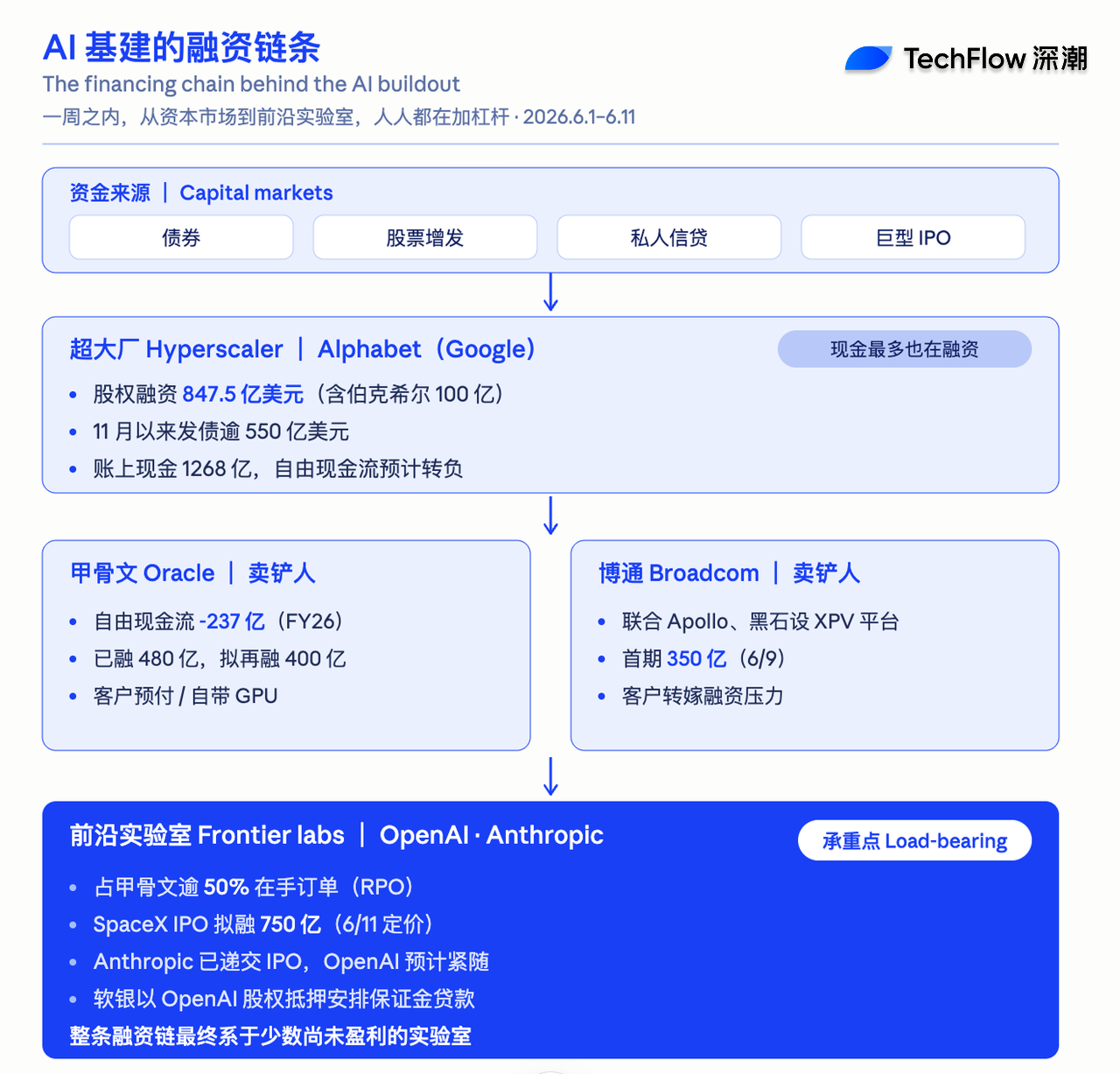
Oracle offers the clearest illustration. According to its earnings report, FY2026 operating cash flow hit a record $32 billion—a 54% YoY increase—but free cash flow turned negative at -$23.7 billion. It has already raised $43 billion in debt and $5 billion in equity this fiscal year. What truly rattled sentiment, however, was its forward-looking commentary. As reported by CNBC, Oracle plans to raise approximately $40 billion more in FY2027—via a mix of debt and equity. A company that just raised nearly $50 billion and posted negative free cash flow, then announces another $40 billion funding round, forces investors to price the latter—not the former—even when both appear side-by-side.
Broadcom’s logic is similar, but plays out differently. As reported by Barron’s, Broadcom lowered its third-quarter gross margin guidance from 77% to 74%, citing rising sales of lower-margin AI chips. Add to that its retreat from selling full-system solutions to selling only chips—and customers demanding chip leasing arrangements to shift financing pressure onto Broadcom—and markets see a business with explosive growth but deteriorating margins and worsening capital intensity.
Goldman Sachs provided a framework for this shift. Per its research note, investor tolerance for rising capital expenditures hinges on profitability strength and the visibility of AI monetization. The same report notes Alphabet’s stock rose after raising profit guidance, while Meta’s fell after holding guidance steady. Markets no longer reward “growth” uniformly—they now distinguish winners from losers based on “monetization viability.”
The Financing Chain Has Become the Main Character: Even the Cash-Richest Players Are Borrowing
If income statements are the façade, the financing chain is this week’s true protagonist. From top to bottom, nearly every link in the AI infrastructure value chain is leveraging up—or diluting equity—to fund the same AI buildout.
The most compelling example is Alphabet. Per its SEC filing, on June 1 it announced an $80 billion equity offering, which was increased and priced at $84.75 billion on June 2—including a $10 billion private placement from Berkshire Hathaway. The anomaly? Alphabet doesn’t need the money. Multiple reports indicate it held $126.8 billion in cash as of March 2026, with annual operating cash flow of $174 billion—and has issued over $55 billion in new debt since November. Even so, Melius Research estimates Google’s free cash flow will turn negative in coming years. Investor Dan Niles summed it up: capital isn’t infinite—and Google, possessing “the strongest AI tech stack across the entire industry,” still needs massive external funding. That alone signals the sheer intensity of this investment cycle.
Downstream, every link repeats the pattern. Cloud startup Oracle runs negative free cash flow, funds itself via dual debt-and-equity raises, and pressures customers to prepay GPU purchases or bring their own GPUs to reduce its upfront infrastructure spending. Chip enabler Broadcom, on June 9, partnered with Apollo and Blackstone to launch the AI XPV Platform—with an initial $35 billion fund targeting over 20 gigawatts of compute capacity by 2028, serving frontier labs including Anthropic and OpenAI. At the chain’s end, labs deploy even more aggressive tools: earlier reports revealed SoftBank pledged OpenAI equity as collateral for margin loans; now SpaceX is racing toward a $75 billion Nasdaq IPO, Anthropic has filed confidentially for its listing, and OpenAI is expected to follow closely.
The total scale of investment is ballooning rapidly. CreditSights estimates hyperscalers’ combined 2026 capex at ~$750 billion—a ~67% increase over 2025. Goldman Sachs’ alternative estimate puts hyperscaler 2026 capex at $51.8 billion—up from $31.4 billion at the start of the year. Whichever figure you use, the direction is unambiguous: spending is accelerating, while the portion fundable by operating cash flow is shrinking—forcing greater reliance on capital markets to fill the gap.
The Chain’s Load-Bearing Point Rests on a Handful of Unprofitable Labs
Leverage itself isn’t alarming—what matters is who ultimately bears it. Tracing the financing chain to its end reveals extreme concentration.
Oracle’s $638 billion RPO may look impregnable—but per Bank of America, over 50% stems from OpenAI alone. Oracle also disclosed that recent RPO growth has come overwhelmingly from large AI contracts where clients either prepay GPU purchases or procure GPUs themselves and hand them over to Oracle. Similarly, Broadcom’s six major custom-chip customers are concentrated among Google, Meta, Anthropic, and OpenAI. In short, from hyperscaler fundraising, to chipmaker orders, to private credit and insurance capital inflows—the entire chain’s ultimate payer converges on a tiny cohort of unprofitable, fundraising-dependent frontier labs: OpenAI, Anthropic, and others.
The record revenue is real. The $638 billion RPO is real. But the payer base behind those orders is highly concentrated—and those payers themselves rely on fundraising to stay alive. Markets are now re-examining the chain’s leverage structure. This week, markets didn’t deny AI growth—they simply began demanding transparency on who pays the bill, and how. SpaceX’s pricing after market close on June 11—and its June 12 Nasdaq debut at $135 per share, implying a ~$1.77 trillion valuation—will be the next stress test for this financing chain.
Join TechFlow official community to stay tuned
Telegram:https://t.me/TechFlowDaily
X (Twitter):https://x.com/TechFlowPost
X (Twitter) EN:https://x.com/BlockFlow_News
 深潮TechFlow