The more advanced AI becomes, the more expensive real girlfriends become.
TechFlow Selected TechFlow Selected
The more advanced AI becomes, the more expensive real girlfriends become.
The most sought-after computing power in Silicon Valley is carbon-based human companionship.
 Navigating Web3 tides with focused insights
Author: Kuli, TechFlow
AI has truly driven down the cost of many things to cabbage-like levels over the past two years—writing code, designing graphics, editing videos—all now boil down to typing a few words into a text box.
Yet in San Francisco—the epicenter of AI-driven wealth creation—a particular service is quietly defying this trend, its prices climbing steadily, unrecorded by any official inflation index.
According to a June 7 Forbes cover story, a woman using the pseudonym Meida Marek was once an entry-level employee in finance. As she told Forbes, her career pivot began when she realized AI would inevitably threaten her own job.
After much deliberation, she decided not to wait—and instead turned to monetizing the very people building AI. Today, she commands $3,500 per hour and is booked months in advance.
Her business? High-end companionship. A full “girlfriend experience”—dating, conversation, attending events together—is offered on her personal website, with transparent, upfront pricing.
The concept itself isn’t new. What’s unprecedented is the price tag.
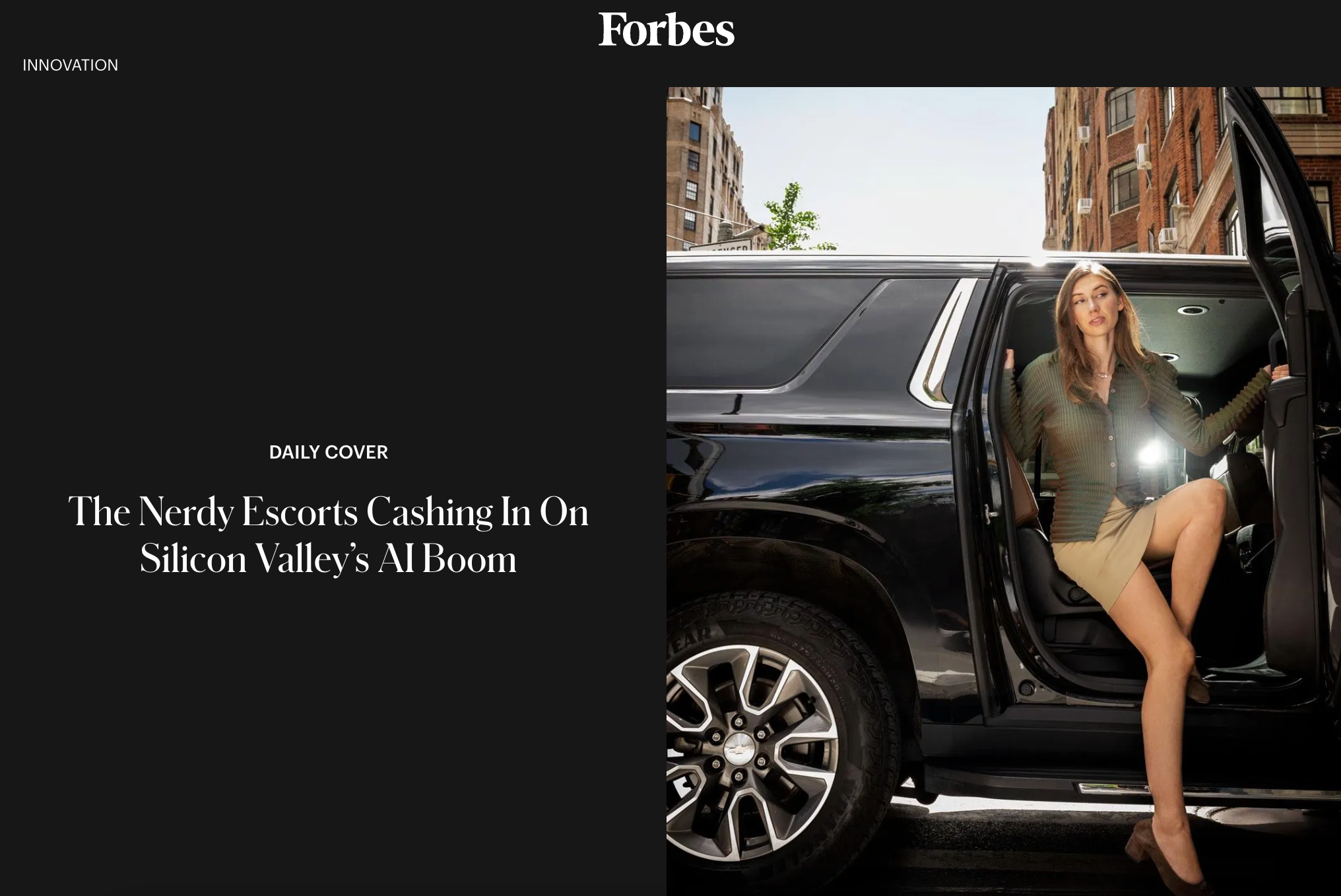
Practitioners interviewed by Forbes say that five years ago, hourly rates exceeding $1,000 were rare even among top-tier providers. Today, $1,000 no longer appears on elite practitioners’ rate cards—$3,000 is merely the entry point, and even then, waiting lists are long.
This wage surge would warrant an emergency Fed meeting in any conventional industry.
Nvidia’s stock has minted millionaires en masse; AI startup employees routinely cash out for sums equaling a decade’s salary elsewhere—these stories have circulated for two years. But where that money flows *after* it lands in their pockets has remained largely unexamined—until now.
This Forbes report pulls back the curtain on one such channel—and those navigating it earn more respectably than most AI-themed startups riding the hype wave.
So who exactly are the people booking up $3,500-per-hour slots months in advance?
“No Dating Until Series B”
A self-deprecating slogan has swept Silicon Valley lately: “Single until Series B.”
As reported by Forbes, the phrase originated as an inside joke among founders, but quickly spread—now emblazoned on T-shirts and caps.

Jokes gain traction because they ring true. In this worldview, dating is a deferrable item—ranked below product development, fundraising, and hiring, to be addressed only after hitting certain company milestones.
Engineers at major Chinese tech firms need no translation for this reality.
And those putting romance on hold are seeing their wealth accumulate at an unprecedented pace. Last October, OpenAI ran an internal stock sale: over 600 employees participated, each averaging ~$11 million in proceeds, according to Business Insider and other U.S. outlets. Similar windfalls have rolled through the Bay Area every few months over the past two years.
More money. Less time. Social needs squeezed into calendar slivers.
For them, dating apps represent another poorly optimized problem—matching, small talk, scheduling coordination, ghosting—each step laden with friction costs. Worse still, even if a date happens, odds are high the other person can’t meaningfully engage on topics that truly fascinate them.
So the market offers a solution: pay for certainty.
Another practitioner cited by Forbes charges $23,000 for a full day, $30,000 for a weekend—yet still maintains a waiting list.
For someone who just cashed out $10 million, the math is simple. The hard part? Securing availability.
Forbes also highlights an unexpected yet logical detail: for many clients, the core service isn’t physical companionship—it’s conversation.
Talking about technology, the future, staying up till dawn—certain unspoken elements become mere garnish. Some clients spend evenings listening to real human voices precisely because their daytime job is teaching AI how to speak.
This nuance fundamentally reshapes the entire pricing logic.
If conversation is the primary offering, then pricing hinges on a new variable: what you can talk about—and how deeply.
Market rates for beauty and appearance have held relatively steady for centuries—but no one has ever priced conversational depth.
So in San Francisco, what kind of conversation commands the highest premium?
The “Smart Premium”
One practitioner interviewed by Forbes put it plainly: “The highest fees aren’t charged by the prettiest girls—but by those who are both beautiful *and* brilliant.”
How do they monetize intelligence? They’ve developed a complete playbook.
X (formerly Twitter) serves as their main acquisition channel. They regularly post AI-related content—industry updates, technical takes. One practitioner described the funnel to Forbes:
“Some Nvidia engineer will pop up saying, ‘Wait—you actually know what a GPU is?! Oh my god.’ And just like that, the deal’s done.”
Other industries call this content marketing. Targeted, high-conversion, near-zero customer acquisition cost—growth teams at countless startups dream of these metrics.
And yes, the dinner-table conversations really are technical—not performative window dressing. As Forbes notes, gifts from clients include AI-generated art—and hardware specifically configured to run open-source models at home…
Flowers and handbags belong to the last era. Today’s Silicon Valley elite express affection with compute power.
These gifts reveal something subtler still: when a client gifts you hardware capable of running open-source models, it signals that the paid conversations they’re having with you involve topics they’re genuinely obsessed with—yet rarely find space to explore.
That gets to the heart of this business.
For these AI-era elites, wealth is an asset in the dating market—but their interests are a liability. Try discussing models, GPUs, or longevity research with a typical date, and their eyes glaze over within three minutes… forcing him to “translate himself” into something socially digestible—just to finish dinner.
Over time, “not having to translate yourself” becomes something money can’t buy.
And why does that demand command astronomical prices? Look to supply. The dating market has never lacked beauty—or even beauty with transparent pricing. What’s scarce is beauty paired with the ability to meaningfully engage on large language models and other cutting-edge tech topics. That niche’s supply is, for all practical purposes, zero.
Premiums don’t reward effort—they reward scarcity.
Hence, this companionship business flips conventional knowledge economics. In standard education, students pay teachers to lecture. Here, the person most fluent in technology pays for a companion who can *understand* his lectures.
Practitioners in the Forbes piece call this strategy “nerd-first”: establish common ground first, *then* transact.
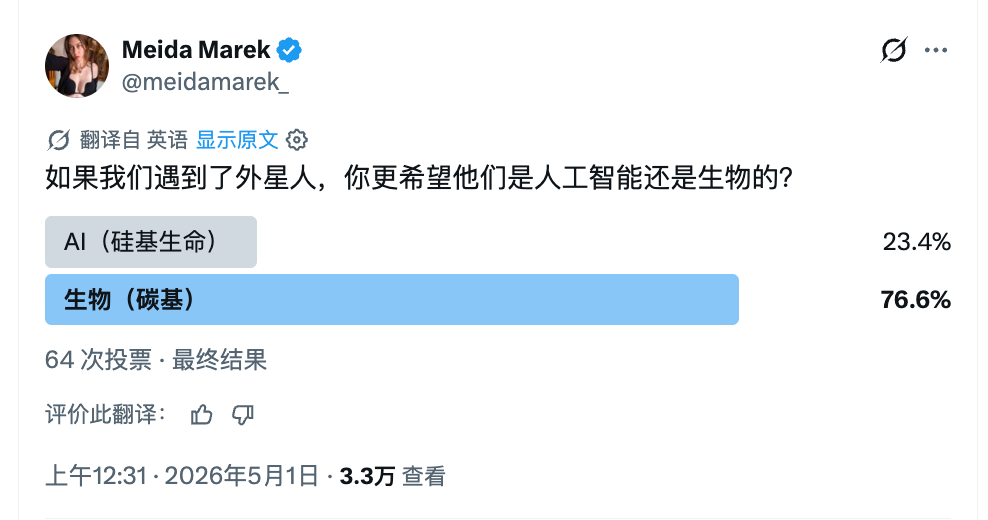
Meida—the former finance professional—exemplifies this approach on her social media profile.
Scroll her feed: few selfies. Instead, her timeline features polls and questions. On May 1, she asked followers: “If we encountered aliens, would you prefer they be AI-based or biological?” Her options: “Silicon-based life” and “Carbon-based life.”
Voters chose carbon-based. Her tech-nerd clients may well be voting with their wallets—for shared intellectual curiosity.
Silicon Cheaper, Carbon Pricier
Companionship is a timeless business rooted in human nature.
On the silicon side, prices are clear: AI companion apps like Replika charge ~$20/month—available 24/7, endlessly accommodating, always agreeable. With LLMs locked in a price war, that number will only fall further.
On the carbon side, the high-end companionship discussed here reaches a ceiling of $6,000/hour. Per U.S. Census Bureau data, that single hour approaches the monthly income of an average American household—and yet, slots remain booked solid.
In Forbes’ original interviews, one practitioner—who holds a master’s degree—cut straight to the point: “AI is turning authentic human connection into a luxury good.”
Coming from her, that statement carries unusual weight—because her clients are precisely the world’s foremost AI experts. Insiders spot scarcity first—and insiders hoard it first.
This logic has already been validated by capital markets this year.
In February, Wall Street embraced the term “HALO”—for “Heavy Asset, Low Obsolescence Risk”—describing companies immune to AI disruption. Funds fled software stocks and flooded into McDonald’s and Walmart.
This companionship business follows the same logic—beauty edition—and without quarterly earnings reports.
The last time San Francisco saw this dynamic was in 1849: gold rush prospectors flooded in, mines eventually emptied, and most left broke. Yet the winners’ list included few miners—one was Levi Strauss, who made pants for them.
Every wave of wealth re-prices everything around it. This time, it may be pricing humanity itself.
The AI story isn’t over. Tech’s gold continues flowing outward. But one thing is certain: every cent silicon-based companionship drops in price, carbon-based companionship rises by a corresponding amount.
Join TechFlow official community to stay tuned
Telegram:https://t.me/TechFlowDaily
X (Twitter):https://x.com/TechFlowPost
X (Twitter) EN:https://x.com/BlockFlow_News
 深潮TechFlow