Retail Investor Bonuses Fade, Prediction Markets Enter AI Arms Race
TechFlow Selected TechFlow Selected
Retail Investor Bonuses Fade, Prediction Markets Enter AI Arms Race
July Fed rate decision night, a "quant shadow war" over pricing power.
 Navigating Web3 tides with focused insights
By: Gino Matos
Compiled by: Saoirse, Foresight News
From July 28 to 29, the Federal Reserve will hold a meeting to finalize the new interest rate decision. Traders will use bonds, foreign exchange, cryptocurrencies, and event contracts settled directly based on the central bank's decision results to bet on price movements brought by the decision.
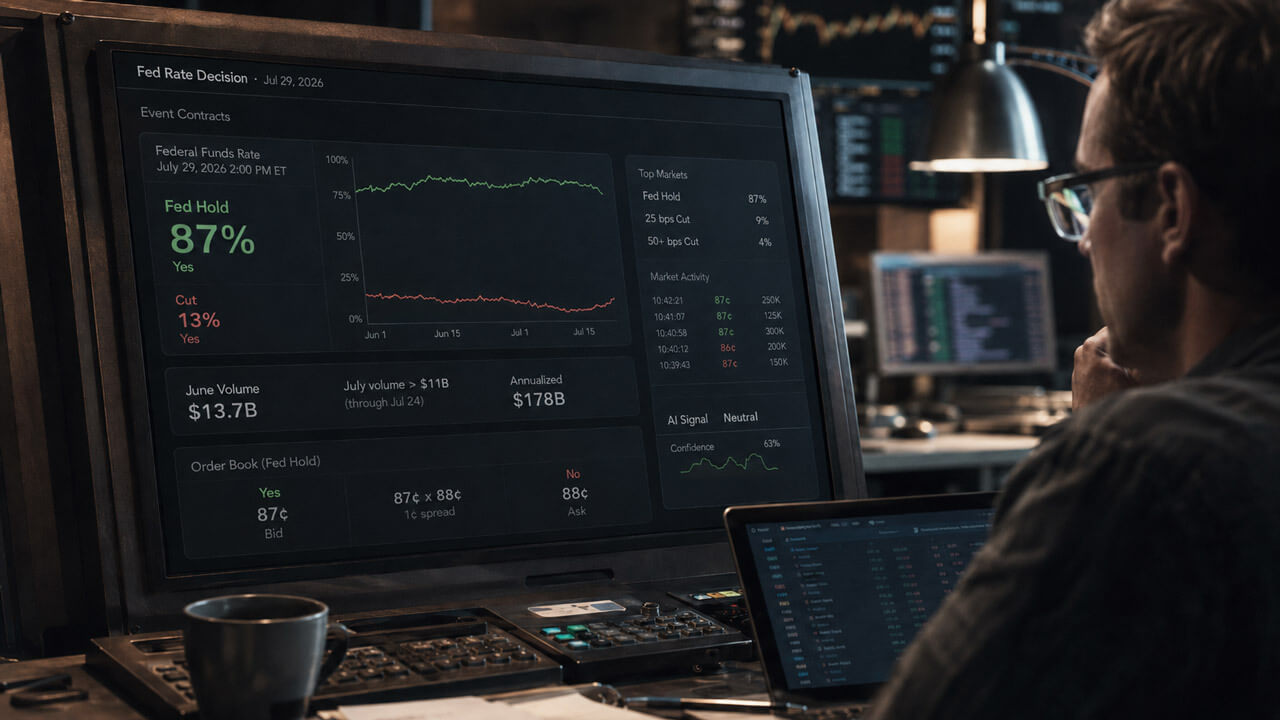
Reuters conducted a survey of 104 economists on July 21, and all respondents expected the Federal Reserve to maintain the interest rate range at 3.50%–3.75%. The probability of betting on this result in Kalshi's July contracts reached 87%, with relevant contract trading volume at approximately 29.7 million USD, while the market still needs counterparties to quote prices for the remaining 13% probability.
Nowadays, such counterparties include market makers, quantitative institutions, asset management proprietary trading teams, and AI agents. These programs monitor prices around the clock, compare similar contracts across platforms, and continuously update event occurrence probabilities.
Various institutions are testing event contracts, and brokers are continuously introducing liquidity providers. Asset management proprietary trading firms are beginning to use settled contracts as a benchmark for screening traders — whether the trader is a human or an algorithm, as long as they can price uncertainty more accurately than the market crowd, they will be closely focused on.
The superposition of multiple forces can thicken the order book and accelerate price discovery, but trading advantages will also concentrate towards institutions with the fastest infrastructure.
The total monthly trading volume of the two major platforms, Kalshi and Polymarket, touched a peak of 13.7 billion USD in June, and July trading volume has now exceeded 11 billion USD. Data proves that the prediction market trading scale has reached the level of professional institutions.
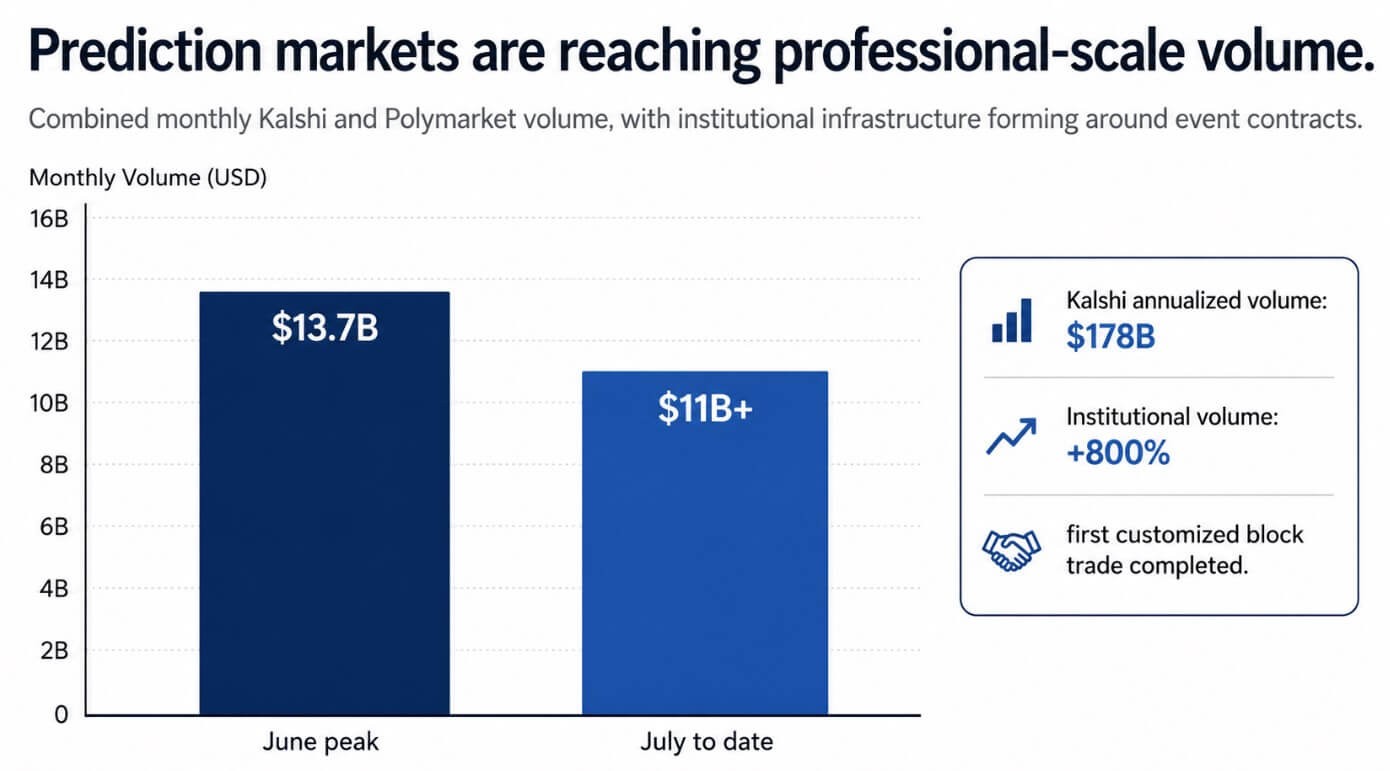
The chart shows that Kalshi and Polymarket monthly trading volume hit a high of 13.7 billion USD in June, among which Kalshi's annualized trading volume reached 178 billion USD
Kalshi stated that within six months, the platform's annualized trading volume grew more than twofold to 178 billion USD, institutional trading volume increased by up to 800%, and the platform completed its first customized block trade.
Clear Street, Marex, and Jump Trading have all built access channels in line with this growth trend: Clear Street helps institutional clients connect to Kalshi; Marex connects both Kalshi and Polymarket platforms simultaneously; Jump Trading assists institutions in directly participating in event market trading. In addition, AQR, Susquehanna, and OKX have successively posted recruitment information for professional trading positions in prediction markets.
Corporate finance departments are also testing such contracts to hedge exposures brought by tariff risks and regulatory policies. However, the premise for such hedging demand to hold is that there are counterparties in the market capable of continuously and large-scale undertaking opposite position quotes.
To build a well-functioning market, the supply side needs to be willing to quote two-way prices, compare similar contracts across platforms, and immediately correct pricing when significant deviations appear.
Measuring Trading Advantage
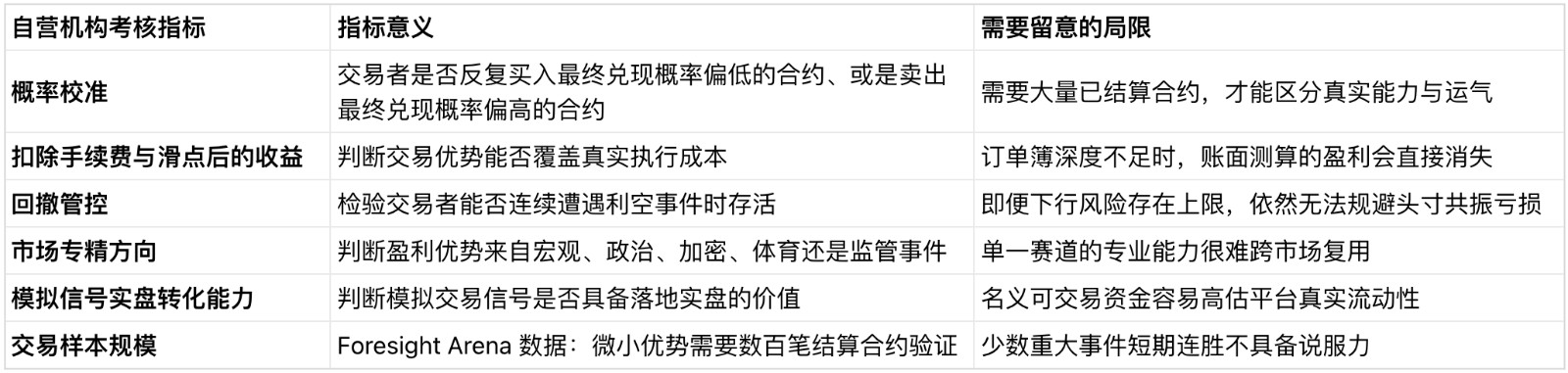
Louis Régis, founder of on-chain proprietary trading company Propr and former Credit Suisse quantitative trader, proposed: Compared to traditional financial markets, event contracts have stricter screening criteria for traders. Such contracts can clearly reflect traders' judgment capabilities, while risk boundaries are clear and controllable.
A contract is ultimately settled based on a clear outcome, allowing capital providers to intuitively judge: whether traders can continuously provide probability pricing superior to market consensus. Relying on event contracts to identify trading capability is far purer than simply looking at directional trading profit and loss records — ordinary profit and loss are easily interfered by factors such as market trends and margin fluctuations.
Foresight Arena benchmark calculations show: To confirm a stable trading advantage of 2 percentage points with reasonable statistical confidence, approximately 350 settled binary prediction contracts are needed; if verifying an advantage of 1 percentage point, the required sample size is approximately four times the former.
Relying solely on a few Federal Reserve decision or election-related contracts to achieve short-term profits is likely just selecting favorable trading targets, position correlation coincidences, or simply betting on accidental events, and does not represent long-term capability.
Propr plans to expand this evaluation system to Polymarket. Traders and AI agents who pass the assessment can obtain a trading quota of up to 100,000 USD per single account, with a combined limit of 300,000 USD for multiple accounts, and the profit sharing ratio can reach 80%.
The company treats every trade as a valid signal; part of the signals are copied to the live trading platform as A Book positions, and the rest run simulations internally within the system, classified into B Book. Regardless of the method, traders will receive profit and loss accounting based on equal standards.
Currently, Propr only deploys approximately 5% of trading signals to the real trading market, with remaining signals kept in internal simulation. Louis Régis stated that adopting this model is to accumulate sufficient data and prudently allocate proprietary capital. Whether A Book or B Book, returns are ultimately settled on-chain in USDC.
Challenges at the Execution Level
Louis Régis believes that prediction markets are naturally suited for AI agents: each contract structure is standardized, prices are observable in real-time, and settlement is completed based on fixed rules.
Agents can continuously monitor the market and update pricing every minute. Louis Régis stated that a standardized market environment combined with uninterrupted repricing capability can theoretically form a solid trading advantage.
Prediction Arena conducted benchmark tests: six cutting-edge AI models were each allocated 10,000 USD in funds to trade autonomously on Kalshi and Polymarket between January 12 and March 9. The results showed that model loss margins on Kalshi ranged between 16%–30.8%; on Polymarket, the average loss margin was smaller, but still recorded negative returns, with an average drawdown of 1.1%. Another research paper pointed out: To convert prediction accuracy into stable profits, one must pair it with reasonable betting strategies while having sufficient liquidity to support strategy implementation.
Prediction markets can become an excellent testing ground to test whether AI trading models can convert prediction views into profitable trades.
Future Market Evolution Prospects
In an optimistic scenario, funded traders, market makers, and AI agents will bring sufficient live trading capital, narrow bid-ask spreads, thicken the order book, and bring closer the price levels between Kalshi and Polymarket.
A research paper in January 2026 analyzed similar contracts on Polymarket, Kalshi, PredictIt, and Robinhood platforms. The study found that when liquidity and trading activity are at high levels, Polymarket often dominates price discovery, and large-scale one-way order flows will determine which platform adjusts prices first. More live trading capital entering the market is expected to further expand the leading advantage of top platforms on more contracts and narrow the price differences between major platforms.
In a pessimistic scenario, trading advantages will concentrate in the hands of a few institutions possessing top-tier infrastructure. Ordinary retail traders continuously lose to better-informed counterparties; when the market finds it difficult to price events, liquidity will shrink rapidly.
Louis Régis stated: "I am confident in the direction of development, but cannot predict the final scale." Even if a proprietary trading firm expands rapidly, compared to a market where monthly trading volume has already reached tens of billions of USD, the trading volume a single institution can provide remains very limited.
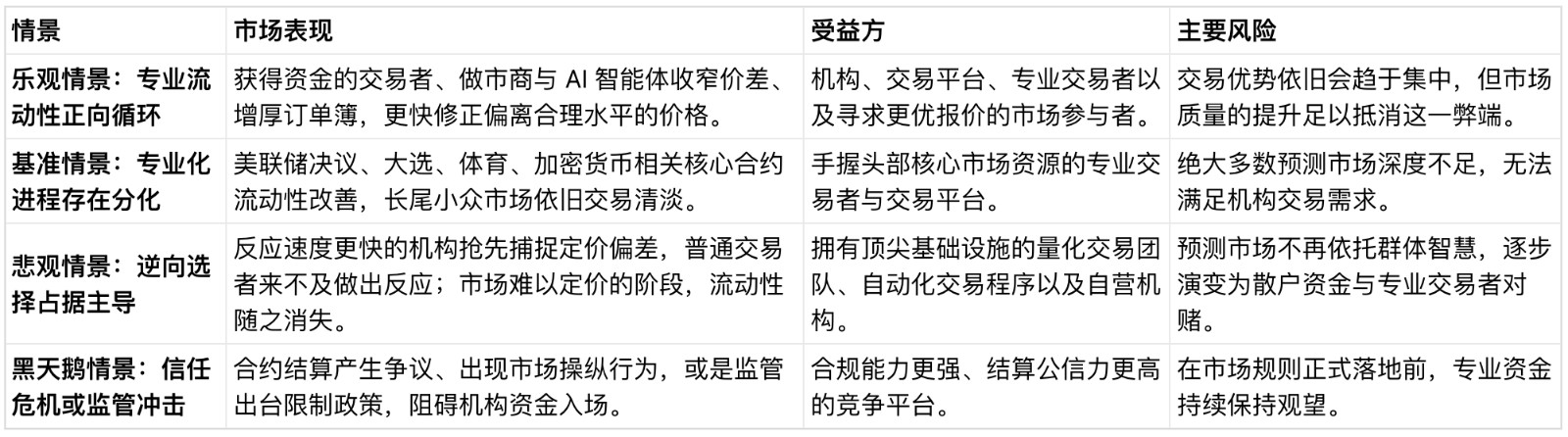
The market has already bet in advance on the expectation that the Federal Reserve will maintain interest rates unchanged from July 28 to 29; before the official statement is released, the mainstream expectation is basically set. The real betting exists in the tail range, that is, the probability interval deviating from this consensus; and when CPI, GDP, and non-farm employment data are released, all contracts will welcome a window of concentrated repricing.
The U.S. Bureau of Economic Analysis will release the preliminary GDP estimate on July 30, and the July employment report will be announced on August 7. Every round of data release will stage the same competition: whoever can first predict data surprises, or fastest correct outdated pricing, will master the trading order flow.
Being able to continuously and accurately price such data market movements is the key for a trader or a model to obtain live trading capital support from proprietary trading firms.
Join TechFlow official community to stay tuned
Telegram:https://t.me/TechFlowDaily
X (Twitter):https://x.com/TechFlowPost
X (Twitter) EN:https://x.com/BlockFlow_News
 @CryptoSlate