U.S. Stock Market Trend: Dow Jones Plunges Below 50,000 Points; Oracle’s Strongest-Ever Earnings Report Fails to Save It
TechFlow Selected TechFlow Selected
U.S. Stock Market Trend: Dow Jones Plunges Below 50,000 Points; Oracle’s Strongest-Ever Earnings Report Fails to Save It
The next test comes on Thursday: the PPI data and market digestion of Oracle’s management guidance for fiscal year 2027.
 Navigating Web3 tides with focused insights
Author: TideFlow Research

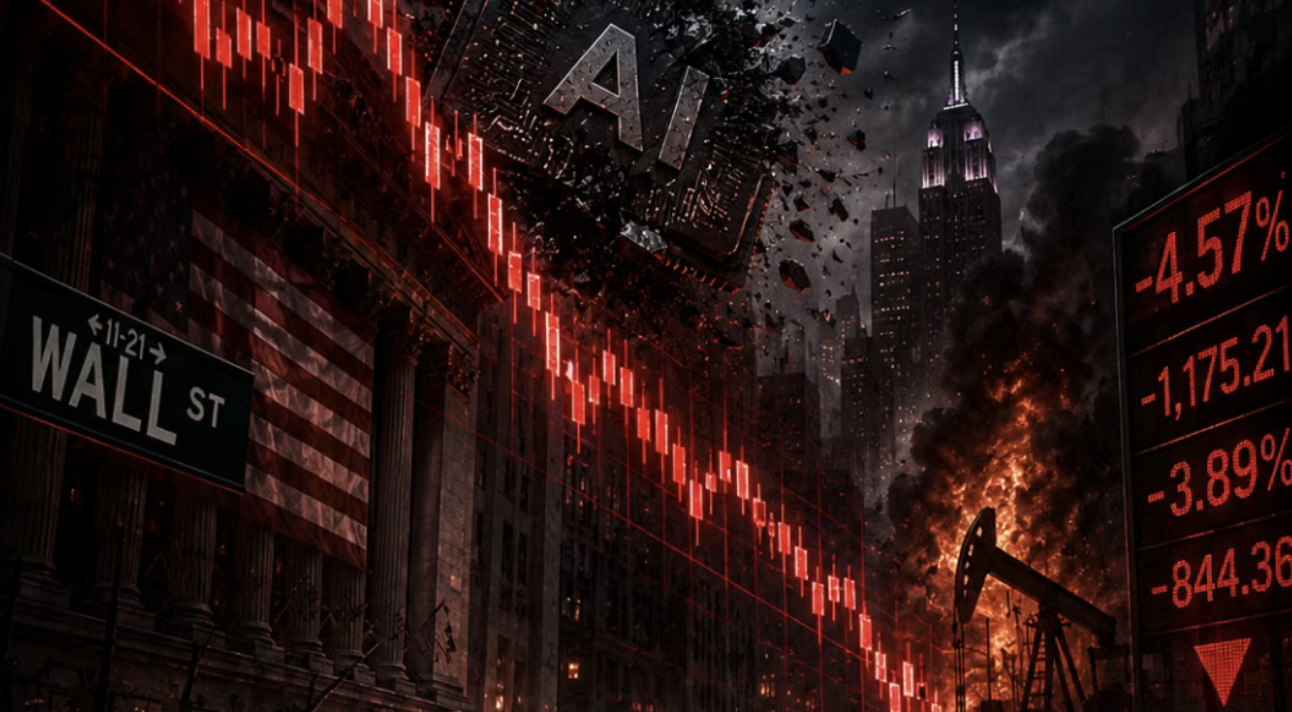
On Wednesday (June 10 Eastern Time), Wall Street faced a dual assault: one front was inflation rebounding to 4.2%, the other was escalating U.S.-Iran tensions. By market close, all three major indices settled near their intraday lows.
The Dow Jones Industrial Average plunged 953.33 points (–1.87%) to 49,918.78, breaching the psychological 50,000 threshold. Recall that on June 4, the Dow had hit an all-time high; within just one week, the blue-chip “safe haven” narrative had unraveled entirely. The S&P 500 fell 1.62% to 7,266.99, while the Nasdaq Composite dropped 1.98% to 25,169.50—down roughly 7% from its record high of 27,086.81 on June 1. The Russell 2000 Index declined only 1.10%, making it the best-performing major index that day.
The VIX Volatility Index surged 11.83% in a single day to 22.22, reclaiming the 20 “warning line.”
Inflation and War: A New Chapter of an Old Script
May’s CPI report released Wednesday morning showed year-on-year inflation at 4.2%—a three-year high—and month-on-month growth of 0.5%. While the headline number was unattractive, it aligned with market expectations. Moreover, core CPI rose only 0.2% month-on-month—below consensus forecasts. Treasury markets told the full story: the 10-year U.S. Treasury yield briefly touched 4.55% before retreating to 4.52%, essentially unchanged. In short, the CPI print alone could not trigger such a sharp selloff.
What truly ignited the sell-off was afternoon geopolitical news. After Iran shot down a U.S. Army Apache helicopter, U.S. forces launched “defensive strikes” Tuesday night. Iran responded by attacking U.S. military facilities across Gulf states—including Bahrain, Jordan, and Kuwait. On Truth Social, former President Trump declared Iran had “delayed negotiations for too long and must now pay the price,” adding that the U.S. would “strike them very hard.” Upon the news breaking, sector after sector flipped from green to red: industrials fell over 3%, while technology and materials each dropped more than 2%.
WTI crude oil settled up 2.07% to $90.03 per barrel; Brent rose 1.8% to $93.10. Oil prices and inflation feed each other—a combination markets dread most. Interest-rate futures now fully price in a 25-basis-point rate hike by December. For U.S. equities in 2026, the Federal Reserve is discussing “rate hikes,” not “rate cuts.” This is the true valuation-level Sword of Damocles.
AI Titans Line Up to Raise Capital
If macroeconomic headwinds formed the background score, this week’s dominant theme on U.S. equity markets was something else: the AI arms race has burned through so much cash that shareholders are now footing the bill.
Super Micro Computer (SMCI) collapsed 27.98% to $29.27 on Wednesday—the worst single-day decline in its history. The catalyst? The company announced plans to raise up to $7 billion, including a $5 billion underwritten public offering and a $2 billion at-the-market (ATM) equity issuance, to fund component purchases required to fulfill customer orders. A company building AI servers found itself needing to dilute nearly one-third of its market capitalization just to finance order fulfillment—a calculation the market made instantly.
The Philadelphia Semiconductor Index suffered broad-based losses: Broadcom fell 5.12%, TSMC dropped 4.44%, NVIDIA slid 3.73%, Micron declined 4.70%, and Tesla lost 3.80%. Apple bucked the trend with a modest 0.35% gain—its rationale straightforward: among the “Magnificent Seven,” it carries the lightest capital expenditure burden.
After-hours, the real protagonist emerged. Oracle delivered an almost flawless Q4 earnings report: revenue of $19.2 billion (+21% YoY), beating estimates; non-GAAP EPS of $2.11, topping the $1.97 consensus; and remaining performance obligations (RPO) surged $85 billion quarter-on-quarter—from $55.3 billion to $63.8 billion. Yet its stock plunged over 7% after hours.
The reasons lay hidden in three other numbers: cloud revenue missed expectations; fiscal year 2026 free cash flow is projected at negative $23.7 billion; and the company announced plans to raise ~$40 billion via a mix of equity and debt to fund data center construction. Just two months ago, Oracle had laid off 30,000 employees.
Tying this week’s threads together: Alphabet seeking $85 billion in financing; Super Micro raising $7 billion; Oracle borrowing another $40 billion. The AI narrative is shifting—from “How large are the orders?” to “Where will the money come from?” Markets once cheered every dollar of RPO; now they’re asking about the payback period for every dollar of capex. Oracle’s $63.8 billion order book sitting alongside negative $23.7 billion cash flow—that’s the entire contradiction defining AI trading in June 2026.
Where Did the Money Go?
This selloff wasn’t indiscriminate. Coca-Cola and TJX Companies both hit all-time highs Wednesday; Morgan Stanley even named Coca-Cola its top pick in the consumer staples sector that day. Investors sold AI hardware stocks and bought beverage and discount apparel companies—the flight to safety was stark, almost brutal. The Russell 2000’s minimal decline reinforces this point: small-cap stocks never meaningfully participated in the AI frenzy, so they bear the lightest correction burden today.
The selling pressure also rippled across Asia: South Korea’s KOSPI plunged 4.5%, led by Samsung Electronics and SK Hynix; Japan’s Nikkei 225 fell 1.9%, with SoftBank Group down 8.3%. Deleveraging across the AI supply chain is global.
In TideFlow Research’s view, this downturn reflects a confluence of two cycles—the “AI credit cycle” and the “geopolitical inflation cycle”—rather than a single-event shock. The former determines whether capital markets will continue funding tech firms’ capex; the latter dictates the direction of the risk-free rate. Both deteriorated simultaneously this week—the fundamental reason behind the Nasdaq’s persistent bleeding since June 5.
Still, let’s hear the counterargument: Core CPI’s month-on-month increase stood at just 0.2%; energy-driven inflation hasn’t yet materially filtered into service prices; Oracle’s cloud infrastructure revenue grew 93% year-on-year—demand remains robust; historically, risk assets recover within weeks following Middle East conflict escalations. If Thursday’s PPI report comes in mild and any de-escalation signal emerges from Iran, an oversold rebound could materialize at any moment.
Yet one shift is structural: AI giants have moved from “building data centers with profits” to “building data centers with equity and debt.” That step, once taken, is hard to reverse. As financing markets begin pricing in risk premiums for AI capex, valuation anchors shift.
The next test arrives Thursday: the PPI release—and how markets digest Oracle’s management guidance for fiscal year 2027. Order books or cash flows—which will Wall Street ultimately believe?
Join TechFlow official community to stay tuned
Telegram:https://t.me/TechFlowDaily
X (Twitter):https://x.com/TechFlowPost
X (Twitter) EN:https://x.com/BlockFlow_News
 @BlockFlow_News