Dissecting the U.S. Quantum Computing Sector: Among IonQ, Rigetti, and D-Wave—Three Stocks to Watch—Which One Deserves Your Bet?
TechFlow Selected TechFlow Selected
Dissecting the U.S. Quantum Computing Sector: Among IonQ, Rigetti, and D-Wave—Three Stocks to Watch—Which One Deserves Your Bet?
There are two relatively safer approaches: betting on tech giants and allocating a small position to quantum-themed ETFs.
 Navigating Web3 tides with focused insights
Compiled & Translated by TechFlow
Host: Nico
Podcast Source: Nico Frontier Alpha
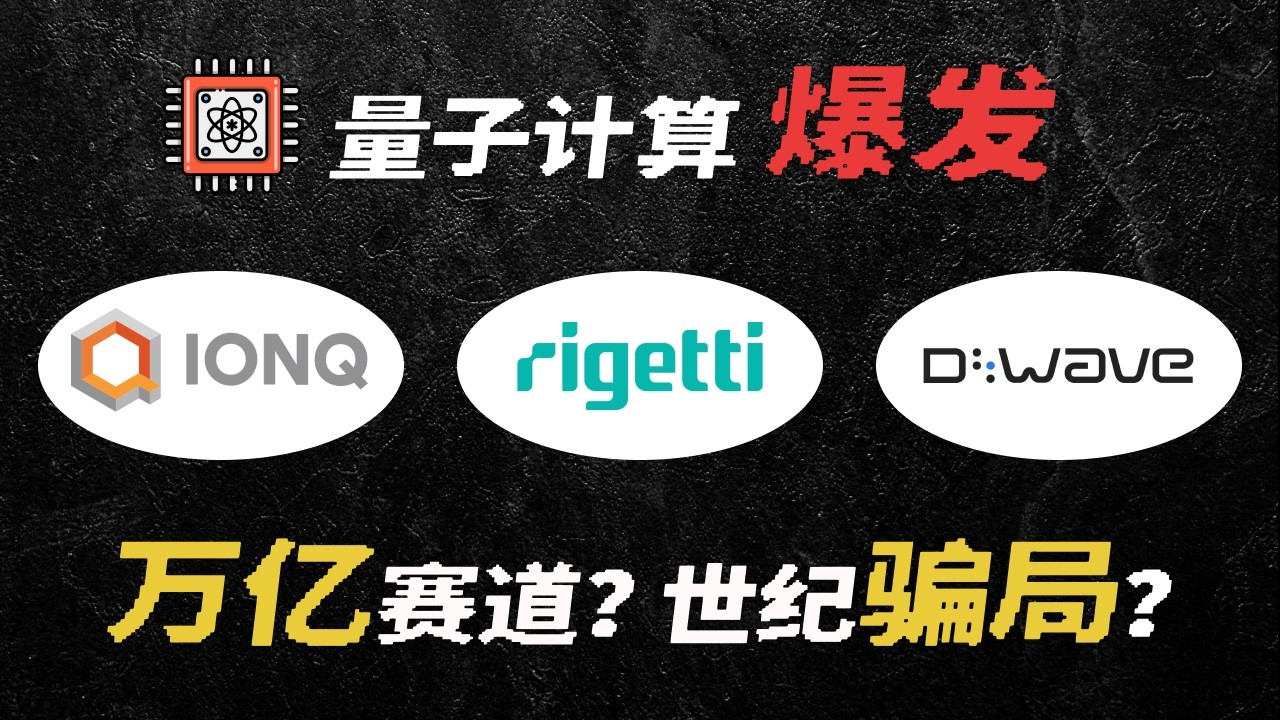
Original Title: Quantum Computing Boom: A Trillion-Dollar Market or a Century-Long Scam? IonQ, Rigetti, D-Wave—Who’s Overpromising, and Who Represents the Real Future? A Comprehensive 10,000-Word Breakdown of the Quantum Computing Sector
Air Date: May 29, 2026
Key Takeaways
This episode provides a systematic breakdown of quantum computing—from its foundational principles and technical approaches to commercialization progress and investment frameworks. Nico argues that quantum computing is not an empty scam; its long-term market potential lies in high-value applications such as drug discovery, cryptography, financial modeling, materials science, and logistics optimization. Yet it remains on the cusp of commercialization, with widespread real-world deployment likely still 3–7 years away. The episode compares the technical approaches, financial conditions, business models, and valuation risks of three U.S.-listed quantum-computing companies—IonQ, Rigetti, and D-Wave—and also discusses the roles played by tech giants including Google, IBM, Microsoft, Amazon, and NVIDIA within the quantum ecosystem. For investors, the current stage offers both the long-term imagination reminiscent of early AI—and simultaneously carries high risks of bubble deflation and valuation corrections.
Highlights of Key Insights
Why Quantum Computing Has Reemerged as a National Strategic Priority
- “China and the U.S. have almost simultaneously elevated quantum computing to top national priority status.”
- “Quantum computing theoretically can break nearly all encryption protecting today’s internet communications—including banking transactions, military communications, and diplomatic cables. Whoever masters this capability first will gain strategic initiative in future cyberspace.”
- “U.S.-listed quantum computing firms are not ordinary small-cap tech stocks—they are strategic ‘chess pieces’ in a national technology race.”
The True Capability Boundaries of Quantum Computing
- “Quantum speedup does not come from faster individual operations—but rather from exponentially reducing the number of required operations.”
- “Classical computers are highly efficient machines executing precise instructions; quantum computers are exploratory tools searching for answers across near-infinite possibilities.”
- “Quantum computing is not universally applicable—it only delivers value in problems where the number of possible answers explodes exponentially with problem size and where finding the optimal solution is essential.”
Why Commercialization Has Been Delayed So Long
- “The fundamental reason quantum computing has yet to be commercialized is not that qubits cannot be built—but that qubits are too error-prone to perform any practically valuable computation.”
- “Quantum error correction aims to encode many unreliable physical qubits into a single highly reliable logical qubit.”
- “Stability, scale (number of qubits), and speed form an ‘impossibility triangle’ in quantum computing—six competing technical approaches each represent distinct trade-offs among these three dimensions.”
Differences Among the Three Quantum-Computing Stocks
- “IonQ boasts the strongest financials, most advanced commercialization progress, and highest-quality customer base—but at the cost of an extremely rich valuation, with market expectations already pricing in significant future upside.”
- “Rigetti offers the highest risk-reward profile: smallest revenue, most inflated valuation—but if technological catalysts materialize, its stock could deliver outsized upside.”
- “D-Wave occupies the most distinctive position: its quantum annealing approach already serves real customers and solves real problems—but its dual-platform transition (annealing + universal QC) remains a key execution risk.”
Symbiotic Relationship Between Giants and Startups
- “What makes today’s quantum landscape unique is that no single technical approach has yet converged—nobody knows whether superconducting, trapped-ion, annealing, photonic, neutral-atom, or silicon-spin qubits will ultimately prevail.”
- “Startups aren’t necessarily competing head-on with giants; often they supply components or services to them. If a startup gains leadership in a given technical path, giants are more likely to partner with or acquire it.”
- “NVIDIA doesn’t build quantum computers—it builds the connective layer between quantum and classical computing. Regardless of which hardware architecture wins, quantum computers will need to work alongside GPUs, and NVIDIA is building that infrastructure.”
Investment Framework and Risks
- “Quantum computing today closely resembles AI between 2018 and 2020: foundational technologies are accelerating rapidly, governments and tech giants are investing early—but the inflection point for broad commercial adoption hasn’t arrived yet.”
- “Before that inflection point arrives, the quantum sector will likely undergo another round of bubble deflation.”
- “Currently, two relatively prudent investment approaches exist. First, gain quantum exposure indirectly through established tech giants already deeply invested in quantum—such as Google, IBM, Microsoft, NVIDIA, or Amazon. Second, allocate modest capital to quantum-focused ETFs. One option is WQTM—the purest non-leveraged quantum ETF in the U.S. market, officially designed to invest in hardware, software, and infrastructure companies across the quantum computing ecosystem.”
Quantum Computing Emerges as a New Frontline in U.S.–China Tech Competition
Nico:
Quantum computing—a concept that sounds almost sci-fi—has recently reignited public interest and reappeared prominently in headlines. Just last week, former U.S. President Donald Trump signed off on $2 billion in federal funding allocated to nine American quantum computing firms, with the U.S. federal government taking minority equity stakes in each. This marks the most direct and consequential U.S. government industrial support for quantum computing in recent years—and signals formal inclusion of quantum computing into America’s next-generation technology strategy.
Across the Pacific, China has enshrined quantum technology in its 15th Five-Year Plan, placing it alongside embodied AI and controlled nuclear fusion as core pillars of future industry development. In Q1 2026 alone, domestic quantum-sector fundraising reached over RMB 2 billion—approaching or possibly exceeding the full-year 2025 total.China and the U.S.—the world’s two superpowers—have almost simultaneously elevated quantum computing to national strategic priority status.
This raises urgent questions: Where exactly does quantum computing stand in 2026? Could it become the next global industrial revolution—following AI—or is it merely another wave of hype-driven speculation? Among the three leading U.S.-listed quantum stocks—IonQ, Rigetti, and D-Wave—who is overpromising, and who truly represents the future?
In this episode, we’ll unpack the entire quantum computing landscape—from underlying technical architectures and publicly listed companies to investment frameworks—in under 45 minutes. By the end, you’ll understand what quantum computing really is, what it can and cannot do, which technical paths hold promise, which companies deserve attention, and how to allocate to this nascent sector based on your personal risk tolerance.
Before diving into technical concepts, let’s examine the broader geopolitical context driving both nations’ quantum investments. Over a week ago, the Trump administration tapped funds from the CHIPS Act to inject $2 billion into nine U.S. quantum computing firms. The dollar amount itself isn’t the most important detail—the critical point is that the U.S. federal government directly acquired minority equity stakes in all nine companies, effectively stepping into the quantum computing arena as a shareholder.The White House Office of Science and Technology Policy has quietly elevated quantum computing to the same national-strategy priority level as AI, and multiple major U.S. financial media outlets report that a dedicated presidential executive order on quantum computing is currently being drafted.
The political signal behind these moves is unambiguous: The U.S. refuses to miss another infrastructure-level technological revolution. Looking back historically, U.S. companies were the primary beneficiaries of every major global tech revolution—PCs, the internet, mobile internet, and now AI. The U.S. built the foundational infrastructure first, validated the “0-to-1” path, and then others followed. The Trump administration’s move is essentially about locking in U.S. dominance across the quantum value chain before it’s too late.
From a national security perspective, quantum computing has one especially sensitive application: It theoretically can break nearly all encryption securing today’s internet—including bank transfers, military communications, and diplomatic cables.Whomever masters this capability first gains decisive advantage in future cyberspace. That’s what truly alarms U.S. policymakers.
Turning to China, the logic is identical. Whether reflected in the 15th Five-Year Plan or rising quantum-sector fundraising volumes, China’s ambitions in this emerging domain are unmistakable. While the U.S.–China quantum competition lacks the intensity of the AI large-model race, it is already simmering beneath the surface—and may evolve into the largest geopolitical tech contest of the next 5–10 years.
Understanding this macro backdrop helps explain why U.S.-listed quantum computing firms—having surged dozens of times over the past few years—are not just typical small-cap tech stocks, but rather strategic ‘pawns’ placed in a national-level technology race.
What Is Quantum Computing? From Bits, Superposition, Entanglement, to Interference
Nico:
If we jump straight into quantum concepts, many listeners may get lost—so let’s begin with something familiar. Whether you’re scrolling videos on your phone or writing documents on your laptop, what’s happening underneath is computation. Every image, video, or text you see originates from binary code—strings of 0s and 1s processed by computers into outputs humans can interpret.
For decades, our central goal has been increasing how quickly computers process those 0s and 1s. The dominant method has been shrinking transistors on chips—packing more transistors onto the same area to boost processing speed. But this path is nearing its physical limit. The most advanced chip processes have reached 2 nanometers—approaching the scale of individual atoms. At that scale, classical physics breaks down—and no conventional engineering fix can overcome it.
Beyond hardware ceilings, the binary bit itself imposes fundamental limits. No matter how fast the chip runs, a single bit can only ever be 0 or 1 at any given moment. To evaluate one quadrillion possibilities, you’d need to test each individually.For certain problems, the number of possibilities explodes exponentially with problem size. For example, a delivery driver delivering 100 packages faces roughly 10158 possible routes—a number vastly greater than the total number of atoms in the observable universe. Even today’s fastest supercomputers couldn’t compute all options before Earth’s demise.
Quantum computing was conceived precisely to overcome this limitation. Its underlying logic diverges completely from classical computing. While classical bits are either 0 or 1, quantum computers operate using quantum bits—or qubits. A qubit can exist simultaneously as both 0 and 1—a property called quantum superposition. This sounds counterintuitive: a coin is either heads or tails; a light switch is either on or off. In daily life, we never observe anything existing in two mutually exclusive states at once.
Yet in the microscopic world, individual particles naturally obey quantum mechanical rules. Electrons, photons, and atoms genuinely exist in multiple states simultaneously—an experimentally verified physical fact. We don’t perceive this in everyday life because macroscopic objects consist of astronomical numbers of particles. When vast numbers of particles interact with each other and their environment, superposition becomes extremely fragile and collapses almost instantly—making the macroscopic world appear definitively deterministic.
Quantum computing aims to preserve and harness microscopic superposition for computation. Why does superposition accelerate computation? A classical computer searching among one quadrillion possibilities must test each sequentially—no amount of chip speed changes that. Quantum superposition breaks this constraint. Fifty qubits in superposition collectively represent one quadrillion possible states—and crucially, all those states coexist simultaneously. Performing a single operation on those 50 qubits acts on all one quadrillion states at once—equivalent to one quadrillion classical operations.
But superposition alone isn’t enough. If 50 qubits existed independently in superposition without correlation, we couldn’t coordinate their behavior. That brings us to the second essential concept: quantum entanglement. Two qubits in superposition yield random measurement outcomes individually—but when entangled, their outcomes exhibit absolute correlation.
For instance, imagine two entangled qubits—one in Beijing, one in New York. Measuring the Beijing qubit and obtaining 0 means the New York qubit must be 1—even without checking. Conversely, measuring 1 in Beijing guarantees 0 in New York. Individually random, yet perfectly complementary when considered together. This correlation requires no signal transmission and holds instantaneously regardless of distance—an effect repeatedly confirmed in landmark experiments.
In quantum computing, entanglement transforms independent qubits into an inseparable collective system. Without entanglement, ten qubits remain ten isolated states; with entanglement, they behave as one unified entity—altering one affects all others. This enables coordinated manipulation of the entire system, guiding all qubits toward the correct answer.
So how do we extract the correct answer? This is quantum computing’s most elegant aspect. While in superposition, each state carries a weight—effectively its probability amplitude. Initially, all weights are uniform, so reading the result yields the correct answer no better than random guessing. Quantum algorithms carefully adjust these weights via a sequence of precisely designed operations.
This adjustment leverages quantum interference—a wave phenomenon: drop two stones into calm water, and overlapping wave crests amplify height while crest–trough overlap cancels out. Quantum interference similarly amplifies amplitudes pointing toward the correct answer and suppresses those pointing toward wrong answers. Each quantum operation incrementally increases the probability of the right answer and decreases probabilities of incorrect ones. After sufficient iterations, the correct answer’s probability approaches 100%—and upon measurement, the superposition collapses into a definite 0 or 1, yielding the final result.
“Collapse” sounds arcane, but simply means: at the moment of measurement, the qubit transitions from simultaneous 0-and-1 superposition to a definite 0 or 1. Why observation causes collapse remains incompletely explained by modern physics—but for practical quantum computing purposes, we only need to accept this rule.
To summarize: superposition grants quantum computers parallel processing across all possibilities; entanglement enables coordination among those possibilities; interference drives convergence from uncertainty to certainty. All three mechanisms are indispensable.
Let’s walk through a complete example: Imagine searching among one million locks for the sole one that fits your key. A classical computer tries keys one-by-one—lucky guesses succeed instantly; worst-case requires nearly one million attempts. A quantum computer first places qubits in superposition covering all one million locks; then entangles them into a coordinated system; then applies quantum interference—each operation slightly strengthens the signal of the correct lock while weakening others. After ~1,000 operations, measurement collapses the superposition directly revealing the correct lock.
A classical computer might require hundreds of thousands of trials; a quantum computer needs only ~1,000.Quantum acceleration arises not from faster individual operations—but from exponentially fewer operations required. Crucially, quantum computers deliver this advantage only for specific problem types.
What Quantum Computing Can—and Cannot—Do
Nico:
Let’s start with a direction impacting everyone: drug discovery. Whether a new drug molecule works in the human body ultimately depends on the quantum-mechanical state of its electrons. Simulating those electron states classically causes computational complexity to explode exponentially with molecular complexity. Simple molecules remain tractable—but moderately complex ones overwhelm even the world’s largest supercomputers. That’s why average drug-development timelines remain stuck above 10 years, with costs soaring into the billions of dollars.
If quantum computers someday accurately simulate protein folding and intermolecular interactions, drug development cycles could shrink from over a decade to mere years—or even months. Global pharmaceutical leaders—including Pfizer, AstraZeneca, and Merck—are already partnering with quantum computing firms on such explorations.
A second direction is cryptography—the most widely known quantum capability and the one causing greatest concern among governments. Today’s entire internet relies on RSA encryption. RSA’s security rests on the fact that cracking a 2048-bit key would take today’s fastest supercomputers billions of years. Quantum computers differ fundamentally: a sufficiently large universal quantum computer running Shor’s algorithm could break such a key in hours to days.
This implies that once such quantum computers arrive, massive security vulnerabilities could emerge across finance and defense sectors. Precisely because of this threat, a new market—quantum-safe cryptography—is emerging. Governments and enterprises worldwide must migrate existing systems to quantum-resistant encryption standards *before* quantum computers mature. That migration process itself represents a massive market opportunity.
A third direction is financial modeling. Portfolio optimization, risk pricing, derivatives valuation, and fraud detection—all core financial tasks—fundamentally involve finding optimal solutions amid vast possibility spaces—precisely the combinatorial optimization problems where quantum computing excels. Wall Street stalwarts—including JPMorgan Chase, Goldman Sachs, and HSBC—have quietly assembled internal quantum teams and actively tested quantum algorithms over recent years.
Another everyday-relevant direction is logistics and supply-chain optimization. How should a courier plan routes to deliver 100 packages in minimum time? With 100 locations, possible routes number ~10158—exceeding the number of atoms in the observable universe. Scale this to global supply chains involving tens of thousands of warehouses and hundreds of thousands of transport routes—with real-time variables like inventory, weather, and traffic—and quantum computing’s potential for large-scale optimization becomes immense.
However,quantum computing is not universally applicable. Tasks like web browsing, document editing, video streaming, or messaging involve clear, sequential logic—not exhaustive searches across vast possibility spaces—where classical computers vastly outperform quantum ones. Similarly, database queries, file storage, and large-scale data I/O are bottlenecked by input/output speeds and storage architecture—not quantum-appropriate. Real-time control systems—including autonomous vehicles and industrial robots—demand deterministic response times, whereas quantum outputs are probabilistic and require extreme physical environments—making integration impossible.
Here’s a simple rule of thumb: If a problem has clearly defined steps and doesn’t require searching vast possibility spaces, classical computing is superior. Ifthe number of candidate solutions explodes exponentially with problem size—and you need the optimal solution among them—quantum computing becomes relevant. Classical computers are efficient executors of explicit instructions; quantum computers are exploratory tools searching for answers across near-infinite possibilities. They are complementary—not competitive.
That said, quantum computing’s ideal problem domains align precisely with the world’s highest-value industries: drug discovery, financial modeling, cryptography, materials science, and logistics optimization. Collectively, these opportunities suggest a multi-trillion-dollar long-term market. Yet all these applications remain confined to laboratories today.
Where Commercialization Stalls: Error Rates, Quantum Error Correction, and the Impossibility Triangle
Nico:
Why has quantum computing remained uncommercialized despite decades of discussion? What’s the critical bottleneck?
As noted earlier, microscopic superposition is extraordinarily fragile. Temperature fluctuations, electromagnetic noise—even stray air molecules colliding with qubits—cause superposition to collapse, forcing qubits into definite 0 or 1 states. Once collapsed, computations fail. In practice, no physical qubit implementation can fully eliminate environmental interference—no engineering solution achieves perfect noise isolation.
Thus, current quantum computers exhibit non-zero error rates per operation—ranging from ~0.1% to several percent. Though seemingly low, real-world quantum algorithms require thousands or millions of operations.If each step carries a 1% error probability, after 1,000 steps, the final result is almost certainly incorrect. This is the fundamental reason quantum computing remains uncommercialized—not because we can’t build qubits, but because existing qubits are too error-prone to perform any practically useful computation.
The industry consensus is that quantum error correction (QEC) is unavoidable. Its premise is encoding many unreliable physical qubits into a single highly reliable logical qubit. Consider this analogy: Suppose you need to transmit critical information to a friend—but the messenger is unreliable and often misstates it. If 100 people simultaneously relay the same message, even if a few err, your friend hears the correct version from the majority and reconstructs the truth.
Quantum error correction performs a similar function—using many physical qubits to cross-check and detect/correct errors. But the cost is enormous. Current estimates suggest building one robust logical qubit requires ~1,000–10,000 physical qubits. If your algorithm demands 1,000 logical qubits for commercial utility, you’d need a quantum computer with 1–10 million physical qubits. Today’s most advanced machines possess only 100–several thousand physical qubits—a gap spanning multiple orders of magnitude.
At this point, quantum computing’s core bottleneck is clear: it must simultaneously achieve three objectives:qubits stable enough to maintain low error rates; qubits numerous enough to scale to the million-qubit range; and qubit manipulation fast enough to complete computations before superposition collapses. Stability, scale, and speed are all indispensable.
Yet in physical reality, these goals conflict deeply. Enhancing stability demands extreme isolation—making manipulation harder and scaling more difficult. Increasing qubit count raises system complexity, introduces more noise sources, and degrades stability. Accelerating manipulation reduces precision and increases error likelihood. No physical system can optimize all three dimensions simultaneously—this is the “impossibility triangle.”
The six competing technical approaches discussed next represent distinct trade-offs across these three dimensions.
Six Technical Approaches: Superconducting, Trapped-Ion, Annealing, Photonic, Neutral-Atom, and Silicon-Spin Qubits
Nico:
First, superconducting qubits—the most mature and widely researched approach. Among stability, scale, and speed, superconducting prioritizes speed. It cools tiny circuits of special metals to ~−273°C—near absolute zero—where metals enter a superconducting state with zero resistance. Critically, electrical currents in such circuits can flow clockwise and counterclockwise simultaneously—creating superposition—controlled precisely via microwave pulses.
Superconducting qubits execute quantum operations in tens of nanoseconds—the fastest among all six approaches. Manufacturing also leverages existing semiconductor infrastructure, sharing equipment and processes with classical chip fabrication. The trade-off is poor stability: superposition lasts only tens to hundreds of microseconds—requiring all computation within ultra-short windows. Physical layout constraints also limit direct interaction between arbitrary qubit pairs.
Second, trapped-ion qubits—a fundamentally different approach prioritizing stability. It uses electromagnetic fields in vacuum to trap individual charged ions, suspending them free from all contact, then employs lasers to precisely place ions into superposition. Because it manipulates single atoms—nature’s most stable entities—superposition persists for seconds—orders of magnitude longer than superconducting. Moreover, any two ions can interact directly, unrestricted by physical layout.
The trade-off is slower operation: each step takes microseconds to tens of microseconds—two to three orders of magnitude slower than superconducting. Scaling to hundreds or thousands of ions within a single trap also presents formidable engineering challenges. IonQ—the U.S.-listed trapped-ion leader—represents this path.
Third, quantum annealing abandons universality for practical utility. Rather than building a general-purpose machine capable of running any quantum algorithm, it focuses exclusively on optimization problems. Borrowing from metallurgy, annealing heats metal to high temperatures then slowly cools it, allowing atoms to settle into lowest-energy configurations. Quantum annealing similarly lets quantum systems evolve under quantum effects to find lowest-energy states—which correspond to optimal solutions for optimization problems.
By avoiding universal quantum gate operations, engineering requirements relax significantly—enabling much larger qubit counts. D-Wave’s latest Advantage2 system boasts over 4,400 qubits—far exceeding any universal quantum computer. Real enterprise clients already use annealing for logistics scheduling and portfolio optimization. Its limitations are equally clear: it cannot run Shor’s algorithm (for cryptanalysis) or Grover’s algorithm (for generic search)—its applicability remains confined to optimization. Should universal quantum computers mature, annealing’s market space could shrink. D-Wave is currently the sole publicly traded company pursuing this path.
Fourth, photonic qubits adopt a unique angle—using photons (light particles) as qubits. Photons offer inherent advantages: they barely interact with external environments. A photon traveling through air experiences negligible thermal or electromagnetic interference—meaning photonic systems can operate at room temperature without complex cryogenic infrastructure. Photons also propagate natively through optical fiber—perfectly compatible with existing telecom infrastructure.
Photons’ main disadvantage: they largely ignore each other when colliding—making precise two-qubit interactions (like entanglement generation) extremely difficult. Engineering two photons to influence each other at exact moments and precise configurations remains a formidable technical challenge.
Fifth, neutral-atom qubits—a rising star over the past 1–2 years—bet heavily on scalability. It uses laser tweezers to trap individual neutral atoms. Imagine lasers as microscopic tweezers—each holding one atom arranged into orderly 2D or even 3D arrays, with each atom serving as a qubit. To entangle two atoms, one is excited to a special high-energy “Rydberg” state—inducing strong interactions with neighboring atoms.
This path’s greatest appeal is theoretical scalability—from hundreds to thousands or even tens of thousands of qubits. Among all six approaches, neutral atoms may offer the strongest expansion potential. Its limitation is immaturity: starting later than superconducting and trapped-ion, many engineering hurdles remain unresolved.
Finally, silicon-spin qubits fabricate qubits directly on conventional silicon chips. Electrons in silicon possess intrinsic quantum “spin”—capable of superposition between up/down states—ideal for qubits. Its biggest allure is manufacturing compatibility: leveraging decades of existing semiconductor foundry expertise and infrastructure. If quantum qubits can be mass-produced in the same fabs as classical chips, long-term scalability and cost advantages may surpass all other approaches.
Yet today, silicon-spin lags furthest behind: single-qubit quality and controllable qubit counts trail both superconducting and trapped-ion approaches.
Comparing all six approaches reveals a consistent pattern: each approach’s strength is another’s weakness. None dominates across all dimensions. This is quantum computing’s current reality: whoever first achieves usable levels of stability, scale, and speed unlocks fault-tolerant quantum computing. Crossing that threshold triggers rapid commercialization—because demand is already primed. The U.S. CHIPS Act’s $2 billion quantum allocation spread across all six approaches reflects universal uncertainty about which path will win. The smartest strategy is to bet on all of them.
This profound uncertainty constitutes both the greatest risk—and greatest opportunity—in quantum investing.
Industry Stage and Timeline: How Far Is Quantum Computing From Commercialization?
Nico:
Where does quantum computing stand today—and when will it finally generate revenue?
The quantum computing industry unfolds across three major phases. We currently inhabit Phase 1: NISQ (“Noisy Intermediate-Scale Quantum”). Simply put, qubit counts have reached hundreds or thousands—but each qubit remains noisy and error-prone. These machines enable technical demonstrations and solve niche problems—but fall short of true commercial viability.
Phase 2—the Early Fault-Tolerant Era—also called the Logical Qubit Era—follows next. As discussed, current error rates necessitate quantum error correction. When error rates drop sufficiently for stable execution of complex algorithms, the industry crosses into Phase 2—the watershed between demonstration and initial real-world deployment.
Only after clearing this hurdle does Phase 3 arrive: Large-Scale Universal Fault-Tolerant Quantum Computing—the commercial era. So when will fault tolerance arrive?
IBM’s roadmap is currently the most concrete—detailing annual milestones. It plans to launch “Starling,” a quantum computer with 200 logical qubits capable of executing 100 million quantum gates, in 2029. By 2033, IBM targets 2,000 logical qubits.
Google’s Willow chip achieved a landmark breakthrough in late 2024: demonstrating that increasing qubit count *reduces* overall error rate—a feat previously unattainable over 30 years. Historically, adding qubits amplified errors; this breakthrough proves—physically—that error correction is viable.
Beyond these two giants, trapped-ion firm Quantinuum also targets 2030. Authoritative research firm Gartner forecasts quantum computing will threaten current encryption systems by 2029. Across diverse institutions and companies, timelines converge tightly around 2029–2033.
In other words,from today’s vantage point, genuine commercial quantum computing remains at least 3–7 years away. This timeline echoes AI’s trajectory: between 2018–2020, GPT-2’s release revealed Transformer architecture’s potential—prompting heavy investment by OpenAI, DeepMind, and others—yet most investors and the public still dismissed AI as hype. Subsequently, the AI sector underwent major corrections before ChatGPT’s 2022 emergence ignited full-scale explosion.
Quantum computing likely stands today where AI stood in 2018–2020—on the cusp of ChatGPT-like breakout. A major correction and cleansing phase may still lie ahead before true liftoff.
IonQ, Rigetti, D-Wave: Which Quantum Stock Is Closest to the Future?
Nico:
Having surveyed the quantum computing landscape, let’s examine its three flagship public companies: IonQ, Rigetti, and D-Wave.
First, IonQ—pursuing trapped-ion technology—is the largest, most commercially advanced of the three. IonQ’s revenue stems from three streams: First, cloud access—customers rent IonQ’s machines remotely via Amazon, Microsoft, or Google cloud platforms, paying per usage (analogous to renting cloud servers). Financial institutions—including JPMorgan Chase and Goldman Sachs—use IonQ’s machines for portfolio optimization and risk modeling.
Second, direct hardware sales—large, irregular contracts. Third, government R&D contracts. IonQ secured a $54.5 million contract from the U.S. Air Force Research Lab and partnered with the Department of Energy on space-based quantum applications. This stream provides multi-year stable cash flow—and crucially, official validation.
Within IonQ’s revenue mix, ~60% now comes from commercial clients—not solely reliant on government orders. Its products reach over 30 countries—up from single digits a year ago. Clients include the U.S. Department of Defense, Air Force Research Lab, Amazon, AstraZeneca, and NVIDIA. Total orders and remaining performance obligations surged 554% YoY—indicating substantial backlog awaiting revenue recognition.
Financially,IonQ generated $130 million in revenue last year—up 202% YoY—making it the first publicly traded quantum company to exceed $100 million annually. Q1 2026 revenue hit $64.7 million—up 755% YoY and 30% above Wall Street expectations. Full-year guidance was raised to $260–270 million.
IonQ’s financial health is strongest among the three—holding $3.1 billion in cash, equivalents, and investments. However, note that IonQ reported $800 million in net income in Q1 2026—suggesting quantum computing is suddenly profitable. In reality, this figure stems almost entirely from accounting revaluations of warrant instruments—a paper gain, not real cash. Excluding such one-time items, IonQ remains unprofitable. Its own full-year guidance projects an operating loss of $310–330 million. IonQ remains a cash-burning quantum startup—but with $3.1 billion in cash, it can sustain operations for many years.
Technically, IonQ has notable recent progress. Regarding qubit count, its flagship commercial system “Tempo” features 100 physical qubits. Yet IonQ avoids emphasizing raw qubit numbers—preferring “algorithmic qubits”: Tempo delivers 64 algorithmic qubits, reflecting trapped-ion qubits’ high fidelity and full connectivity (any pair can interact directly)—yielding higher effective computational power per qubit than competitors.
Another key advance is EQC (Electronic Quantum Control). Traditional trapped-ion systems use lasers to manipulate ions—a scaling bottleneck. IonQ’s EQC replaces lasers with precise electronic signals integrated directly onto standard semiconductor chips—enabling fabrication in existing chip foundries, improving scalability and lowering costs.
An interesting footnote: IonQ did not receive CHIPS Act funding among the nine recipients. Many investors initially interpreted this as lack of government endorsement. But the opposite is likely true: IonQ’s $3.1 billion war chest renders it financially self-sufficient. Government funds target startups needing lifelines—and possessing uniquely promising technical paths. IonQ’s exclusion underscores its financial independence.
IonQ’s core risk is valuation. With a market cap >$20 billion and 2026 revenue guidance implying a forward P/S ratio near 100x, it exemplifies the quantum sector’s premium pricing. Market sentiment has priced in years of hypergrowth—making IonQ vulnerable to sharp corrections if quarterly results disappoint or commercialization timelines slip.
Next,Rigetti—pursuing superconducting qubits—generates revenue similarly to IonQ but with different emphasis. It also monetizes via cloud access, hardware sales, and government contracts—but its current revenue engine centers on private deployments: customers buy entire quantum computers for on-premises installation—not cloud rentals.
Revenue-wise, Rigetti is the smallest of the three. Full-year 2025 revenue totaled $7.1 million—down 34% YoY. Yet Q1 2026 reversed course—reaching $4.4 million, up ~200% YoY. Financially, it holds $569 million in cash, zero debt, and reported $16.2 million in operating cash outflow in Q1. At this burn rate, cash runway extends ~8–9 years. Though far less cash than IonQ, Rigetti’s smaller team and product scope enable slower burn.
Technically, Rigetti has made meaningful progress. In April 2026, it launched Cepheus—the highest-qubit-count system to date—at 108 qubits. Its architecture is distinctive: instead of one monolithic chip, it combines twelve 9-qubit “chiplets”—a modular approach potentially easing scalability. If successful, this could become Rigetti’s key technical differentiator.
However, Cepheus’ initial two-qubit gate fidelity stood at 99.1%—short of IonQ’s 99.9%. Rigetti targets 99.5% by late 2026. It already achieves 99.7% on smaller 9-qubit modules—but fidelity degrades as qubit count rises—a classic superconducting challenge. Next, Rigetti plans Lyra—a 336-qubit chip aiming to demonstrate quantum advantage—proving quantum computers can outperform classical counterparts on a specific problem.
Rigetti’s core risk mirrors IonQ’s: $7+ million in annual revenue supporting a multi-billion-dollar market cap implies a 2025 P/S ratio exceeding 1,000x—extremely aggressive. Any shortfall in product, business, or sector progress could trigger severe short-term price drops.
Finally,D-Wave—the oldest of the three (founded in 1999)—pursues quantum annealing exclusively, skipping universal quantum computing to focus on optimization-specific machines. Its Advantage2 system boasts >4,400 qubits—the highest count among all quantum machines.
Its primary revenue comes from Leap Cloud Platform—customers access annealing machines on-demand, paying per usage. D-Wave also sells full systems and offers professional services—translating clients’ business challenges into quantum-optimizable formats.
D-Wave’s client roster exceeds 100 real enterprises—including Mastercard, Volkswagen, Lockheed Martin, Deloitte, and Siemens Healthineers. Crucially, these aren’t experimental users—they deploy D-Wave for production use cases: employee scheduling, portfolio optimization, logistics routing, factory dispatch, and even grocery-chain operations. D-Wave has co-developed >250 real-world applications. This distinguishes it sharply: IonQ and Rigetti primarily serve research labs; D-Wave solves tangible operational problems—thanks to annealing’s practicality, which doesn’t await fault-tolerant quantum computing.
Additionally, D-Wave’s biggest recent strategic shift is acquiring Quantum Circuits for $550 million—entering universal quantum computing. D-Wave now pursues a dual-platform strategy—annealing + universal QC—to address prior limitations.
Financially, D-Wave’s 2025 revenue reached $24.6 million—up 179% YoY. Q1 2026 revenue fell 81% YoY to $2.9 million—but this reflects a $12.6 million one-time system sale in Q1 2025. More telling metrics are order-related: Q1 2026 saw record $33.4 million in new orders—up ~2,000% YoY; backlog reached $42.4 million—up 563% YoY—including a $20 million system purchase from Florida Atlantic University and a $10 million quantum computing services contract from a major enterprise.
Financially, D-Wave holds $588 million in cash—supporting ~4 years of operations. Beyond valuation risk, its dual-platform transition poses execution risk: annealing’s commercial model is proven, with real customers and revenue; universal QC remains nascent—competing against Google, IBM, and Rigetti, who’ve invested deeply in superconducting QC for years.
Comparing all three reveals stark contrasts. IonQ offers strongest financials, most advanced commercialization, highest-tier clients—with $3.1B cash, 755% revenue growth, and $470M backlog—but trades at extreme valuations, pricing in abundant optimism.Rigetti offers highest reward potential—smallest revenue, most inflated valuation—but possesses technical breakthroughs (Lyra chip and narrow quantum advantage) as imminent catalysts. If delivered, upside could be explosive; delays would trigger steep downside. D-Wave occupies the most unique position: annealing delivers real-world adoption today, with surging order momentum—its key question is whether dual-platform execution succeeds.
Valuing Quantum Stocks: Not Traditional Metrics—But Milestone Options
Nico:
Building on these three companies, let’s discuss valuation. For cutting-edge, hype-fueled sectors lacking broad commercialization, traditional valuation methods largely fail. Most firms burn cash with minimal revenues—how should investors value such quantum stocks?
First, assess the total addressable market (TAM)—long-term revenue potential. Quantum computing’s TAM spans hundreds of billions to trillions of dollars. Stock prices reflect investor expectations about each company’s future market share—the slice of that pie they’ll capture.
A second framework treats quantum stocks as “milestone options.” Each qubit-count milestone, error-rate improvement, or product launch triggers market repricing. Additionally, government or corporate partnerships confer “validation premiums.” CHIPS Act funding equals official certification—providing a U.S. government safety net, lowering perceived risk, and elevating the sector’s overall risk appetite.
After reviewing these three firms, we must also consider quantum computing’s true incumbents: Google, IBM, Microsoft, Amazon, and NVIDIA.
Google leads the superconducting path with its 105-qubit Willow chip. Willow’s breakthrough—demonstrating lower overall error rates with more qubits—was unprecedented in 30 years. This physically validates the error-correction path—the most critical hurdle toward practical quantum computing.
IBM’s roadmap is exceptionally clear: targeting 200 logical qubits by 2029 and 2,000 by 2033. IBM recently cut the physical qubits needed per logical qubit by 90%—dramatically lowering the commercialization barrier. In the CHIPS Act, IBM received $1 billion—the largest single allocation—to build a quantum foundry. IBM aims to become the “TSMC of quantum”—manufacturing quantum chips for the entire industry.
Microsoft pursues the most distinctive—and riskiest—path: topological qubits. Theoretically, this approach promises best stability and lowest error-correction overhead—but Microsoft has built only eight qubits, remains far from practical utility, and faces ongoing academic skepticism about its experimental results. Yet Microsoft maintains contingency plans—integrating IonQ and Quantinuum hardware via Azure Cloud, ensuring quantum cloud revenue regardless of its own path’s success.
Amazon follows similarly—AWS offers quantum cloud services. Finally,NVIDIA doesn’t build quantum computers—it builds the bridge between quantum and classical computing. Its CUDA-Q platform enables GPU–quantum computer collaboration and it has invested in multiple quantum startups.NVIDIA’s strategy is clear: regardless of which hardware architecture wins, quantum computers will require GPU integration—and NVIDIA is building the connective infrastructure—the foundational layer.
Can Startups Survive Amidst Giant Tech Companies?
Nico:
Amidst these tech giants, do startups retain viable opportunities? I believe their prospects remain strong.
A unique feature of today’s quantum landscape is that no single technical path has converged. Nobody knows whether superconducting, trapped-ion, annealing, photonic, neutral-atom, or silicon-spin qubits will ultimately dominate. This gives startups a window to establish local leadership on specific paths. IonQ leads in trapped-ion; Rigetti pioneers superconducting chiplet architecture; D-Wave owns annealing with virtually no competition.
Giant advantages are obvious: capital, talent, and resources—and many pursue the same paths as startups. For survival, quantum startups must partner with tech giants. IonQ’s machines are available on Amazon AWS and Microsoft Azure; Rigetti’s systems follow suit.This means startups aren’t competing with giants—they’re supplying them. If a startup emerges as a leader on a given path, giants are more likely to partner or acquire than compete.
Finally, my personal view on quantum investing: quantum remains in an early-stage phase—strikingly similar to AI in 2018–2020. Foundational technologies are accelerating; governments and tech giants are positioning early—but the broad commercial inflection point hasn’t arrived.I expect another round of bubble deflation before that inflection point—and thus hold no quantum positions currently.
Investment Framework: Prudent Entry Points and ETF Selection
Nico:
I see two relatively prudent investment approaches today.
First, gain quantum exposure indirectly via tech giants already deeply invested in quantum—Google, IBM, Microsoft, NVIDIA, or Amazon. Quantum initiatives constitute only minor portions of their overall businesses—so even if quantum progress stalls, their stock prices won’t materially suffer.
Second, allocate modest capital to quantum-focused ETFs. Since we cannot predict which company will ultimately win, ETFs provide diversified exposure. Two options exist. QTUM—the largest and most liquid quantum ETF—launched in 2018 and now manages >$5 billion. However, it’s not a pure quantum fund—it blends quantum computing, machine learning, AI, and semiconductors. Pure quantum names like IonQ, D-Wave, and Rigetti each hold <1% weight.
WQTM is the purest non-leveraged quantum ETF in the U.S. market, officially mandated to invest in hardware, software, and infrastructure companies across the quantum computing ecosystem. Its high purity makes it suitable as a satellite allocation for quantum exposure.
Returning to our opening question: quantum computing is undeniably a real, high-potential technology—projected to reach trillion-dollar scale—not a century-long scam. Over the next 5–7 years, quantum computing may enter mass commercialization—and we stand precisely at the dawn of its breakthrough era.
Yet short-term volatility and uncertainty remain extremely high. Before investing, carefully weigh the underlying risks and rewards.
Join TechFlow official community to stay tuned
Telegram:https://t.me/TechFlowDaily
X (Twitter):https://x.com/TechFlowPost
X (Twitter) EN:https://x.com/BlockFlow_News
 深潮TechFlow