When NVIDIA on Bitget Begins Paying Dividends, U.S. Stocks Enter the “Reality” Moment
TechFlow Selected TechFlow Selected
When NVIDIA on Bitget Begins Paying Dividends, U.S. Stocks Enter the “Reality” Moment
Choosing the difficult path is not about enjoying suffering—it’s because the easy path won’t take them where they want to go.
 Navigating Web3 tides with focused insights
Author: David, TechFlow Research
Tokenized U.S. equities represent one of the fastest-growing—and most heavily criticized—segments in the crypto industry over the past two years.
What are people criticizing? Calling it a shell.
For example, you spend 100 USDT to buy a token named NVDA, believing you’ve acquired a fractional share of NVIDIA stock. In reality, what you likely hold is merely a price-tracking shadow—backed by no actual shares, paying no dividends, and conferring none of the rights inherent to equity ownership.
Yet this much-maligned segment has become the dominant trend in today’s crypto industry.
And among exchanges operating in this space, one stands out with a set of numbers that are hard to ignore.
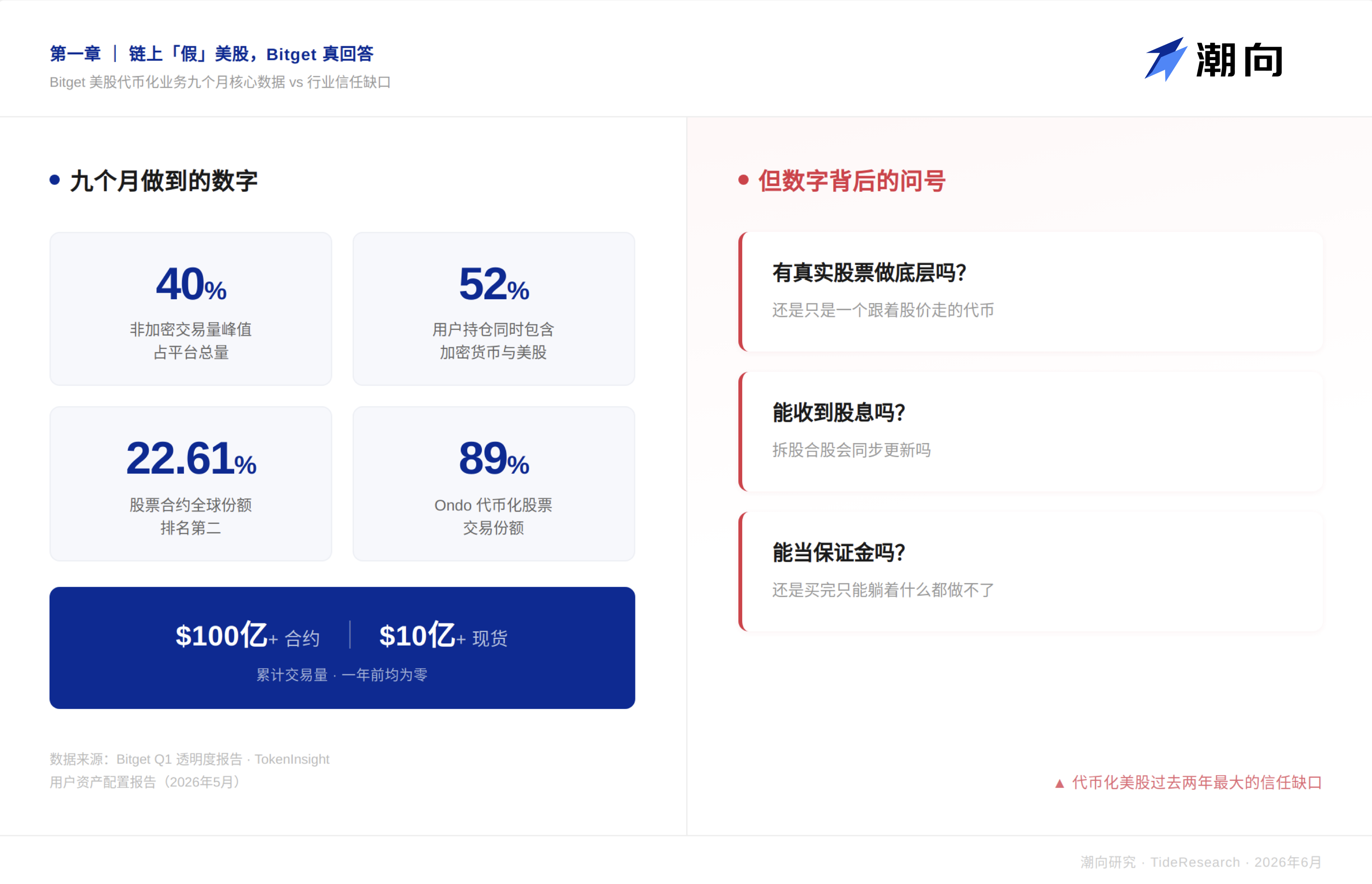
According to Bitget’s Q1 2026 Transparency Report, peak trading volume for non-crypto assets now accounts for 40% of the platform’s total volume. Stocks, gold, and forex—assets traditionally found only in brokerage apps—are now being traded significantly on crypto exchanges.
TokenInsight’s Q1 2026 derivatives market report offers another data point: Bitget ranks second globally for stock perpetual contracts, holding a 22.61% market share.
Additionally, among tokenized stocks issued by Ondo, Bitget captures approximately 89% of trading volume. Cumulative stock futures volume has surpassed $10 billion, while spot volume exceeds $1 billion.
Now consider the user side.
Per Bitget’s May 2026 User Asset Allocation Report, 52% of users now hold both cryptocurrencies and U.S. equities in their portfolios. Half of all users no longer trade crypto exclusively—their accounts now hold assets from two distinct financial worlds.
All these figures stood at zero just one year ago.
The numbers are certainly impressive, and demand is undeniably real. Yet beneath them lies a sharper question—one our observation reveals:
What exactly do you own when you purchase these on-chain U.S. equities? Or have you spent real money to acquire nothing more than an elegantly rendered price shadow?
Bitget spent nine months answering precisely that question.
Borrowing Stones from Other Mountains to Polish U.S. Equities
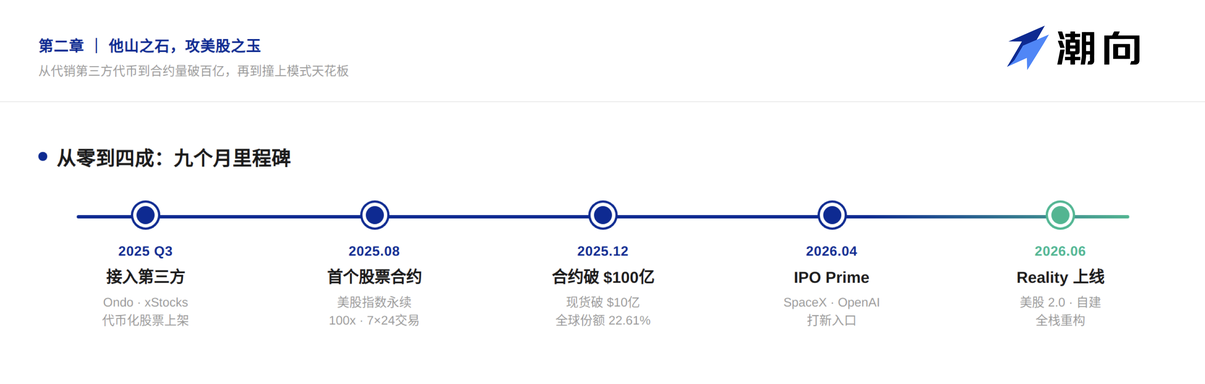
In Q3 last year, Bitget began listing U.S. equities using a “borrowing stones from other mountains” approach.
It integrated third-party-issued tokenized stocks—Ondo and xStocks—and handled listing and order matching. Simultaneously, it launched the industry’s first U.S. equity index perpetual contract, offering up to 100x leverage and 24/7 trading.
This model ran for several months. By end-December, contract volume reached $10 billion—a highly respectable scale. Demand was clearly there: users genuinely wanted access to U.S. equities via crypto exchanges. But the underlying products themselves had serious flaws.
“Borrowing stones from other mountains” may polish jade—but if the stones are too coarse, the result remains rough. As volume scaled, so did the problems.
For instance, you search for NVIDIA, buy $100 worth of on-chain NVDA tokens, and see price tracking Nasdaq closely. Then what?
First, liquidity feels DEX-grade: even moderately sized orders suffer visibly high slippage. Second, regarding shareholder rights—if NVIDIA pays quarterly dividends, you receive zero. During stock splits, your position may take days to update.
With on-chain U.S. equities, users typically acquire only the price—nothing else follows.
These three issues aren’t unique to Bitget; they’re endemic across the entire tokenized U.S. equities sector. Third-party issuers control both the underlying assets and product logic. The exchange functions merely as a shelf—depth, dividends, and asset usability are entirely outside its control.
The ceiling of a reseller model is simply the ceiling of someone else’s product.
Faced with this, Bitget and other exchanges had two paths forward: continue patching infrastructure built by others—or build their own vessel. Bitget chose the heavier path.
Self-Refinement: When Stocks on Bitget Start Paying Dividends

Recently, NVIDIA announced raising its quarterly dividend from $0.01 to $0.25 per share, with the next payout scheduled for June 26. If you hold rNVDA on Bitget, your account may soon receive a cash dividend converted into USDT—and your cost basis will update automatically.
In the tokenized U.S. equities space, this marks perhaps the first instance of “true equity.” And because these rights exist, it signals a fundamental evolution in the underlying architecture of on-chain U.S. equities on Bitget.
In June this year, Bitget launched a platform called Reality. Its name translates literally to “reality”—a deliberate declaration in a sector saturated with shadow equity assets:
When tokenized stocks become mainstream, the prefix “tokenized” will fade away. They’ll simply be called “stocks,” while today’s conventionally traded equities will instead bear the qualifier “traditional stocks.”
This may sound futuristic—but Reality aims to make it real.
The platform’s operation is straightforward: it no longer sources tokens from Ondo or xStocks. Instead, Reality itself issues tokenized U.S. equities. Issuance is handled by Reality; custody is entrusted to licensed broker-dealer Alpaca; and independent audits are conducted by The Network Firm—each party fulfilling a distinct, specialized role.
The platform’s stock tokens are branded rTokens. Any U.S. equity ticker you now purchase on Bitget appears prefixed with “r.”

How does rToken differ in experience from the third-party tokens issued six months ago?
The most immediate difference is transparency about whether real assets back your holdings. In the 1.0 era of tokenized equities, the custodial chain was essentially a black box for users—you couldn’t verify whether your NVDA token represented actual NVIDIA shares.
Reality opens that chain fully. Each rToken—a tokenized U.S. equity—is mapped directly to underlying real-world assets.
For example, when you buy $100 worth of rNVDA on Bitget, Reality purchases the corresponding quantity of actual NVIDIA shares on U.S. markets through Alpaca, depositing them into Alpaca’s custodial account. You buy X—Reality buys X. It’s a strict 1:1 match.
Public records show Alpaca is a U.S.-licensed self-clearing broker-dealer registered with the Financial Industry Regulatory Authority (FINRA) and protected by the Securities Investor Protection Corporation (SIPC).
SIPC is a federal investor insurance mechanism: even if the broker-dealer fails, securities held in custodial accounts are covered up to $500,000. Alpaca is currently one of the most widely used custodians in the tokenized securities space—also serving Binance, Ondo, and xStocks.
Independent audits are conducted by The Network Firm, which publishes CPA-level reports confirming reserve ratios exceeding 100%. Bitget also maintains an on-chain reserve proof dashboard updated in real time—open for anyone to view.
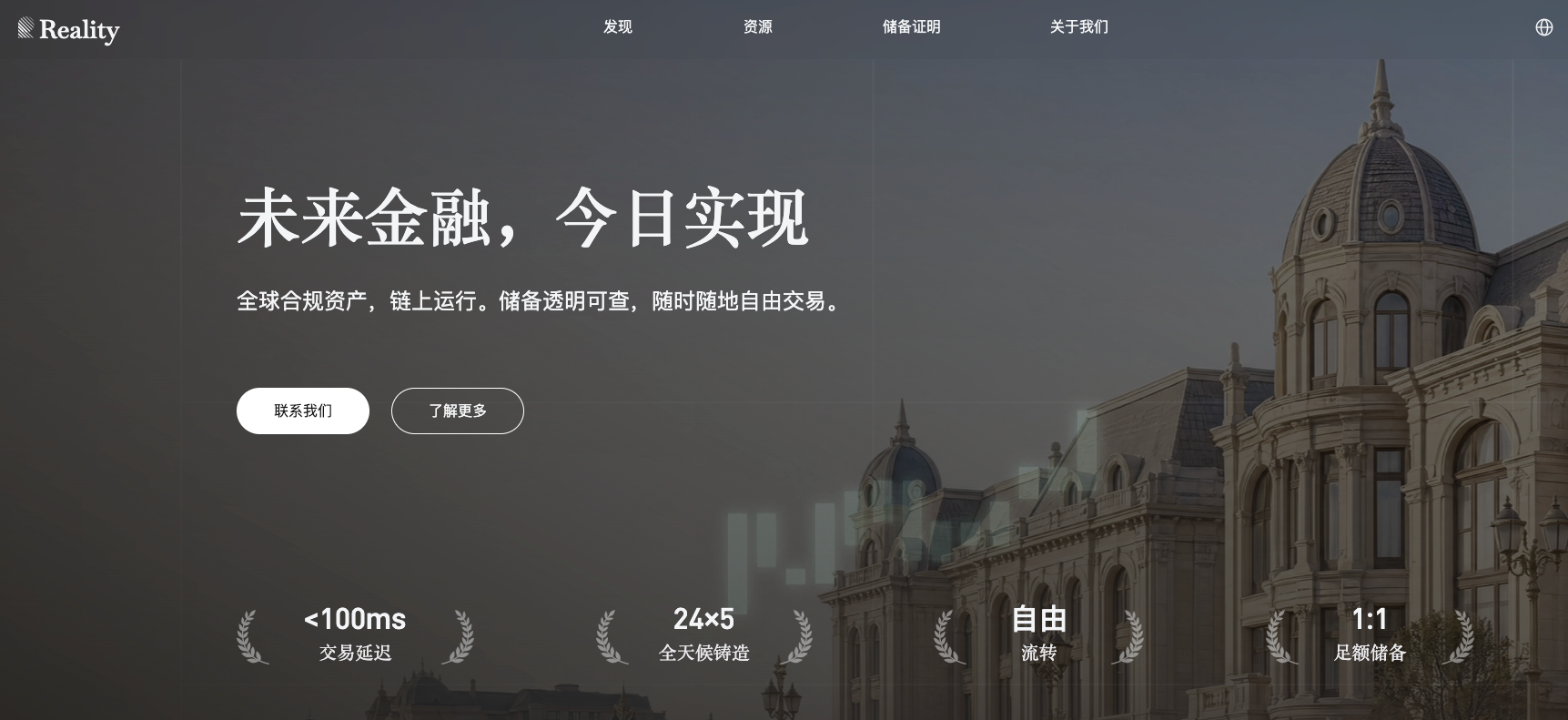
You now own an asset—and know it’s genuine. That’s the tangible shift in user experience.
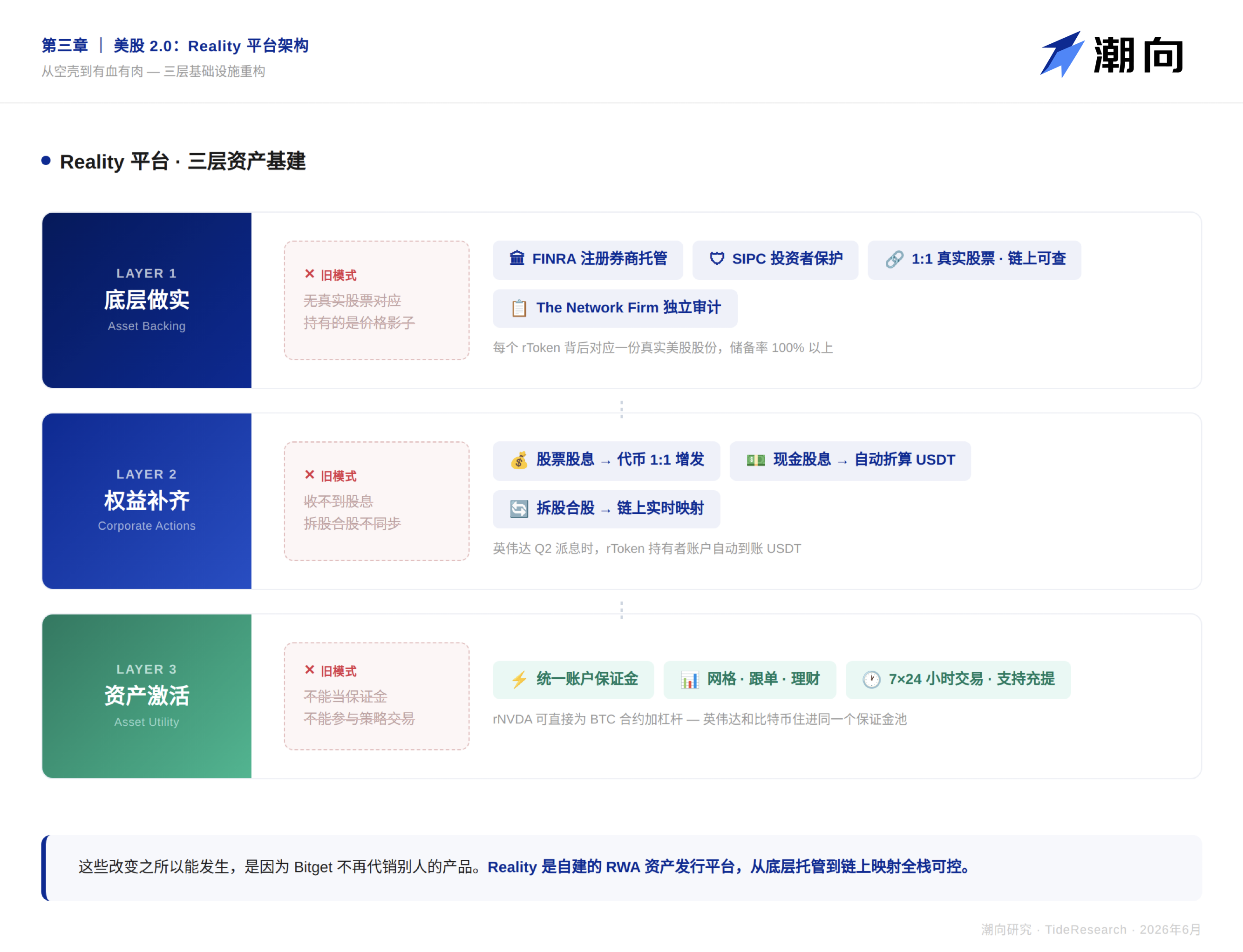
Following this perception deeper reveals Reality’s architectural philosophy. Bitget rebuilt tokenized U.S. equities across three layers:
The first layer is grounding the foundation. Alpaca custody, 1:1 purchasing, and on-chain reserve proofs address the most basic trust question: “Is there something real behind what I bought?”
The second layer is completing shareholder rights. Stock dividends are distributed 1:1 as new tokens; cash dividends are converted to USDT and credited directly; stock splits and consolidations are reflected on-chain in real time. For the past two years, buying tokenized NVIDIA elsewhere meant watching real shareholders collect dividends each quarter while your account remained unchanged. This time, rToken holders get their turn.
The third layer is activating assets.
rTokens integrate seamlessly into Bitget’s unified account system—your rNVDA can serve directly as margin. You can use your NVIDIA position to open a BTC futures contract, leveraging a U.S. equity to hedge or speculate on crypto. In traditional brokerage systems, cross-asset margin is reserved for institutions—and previously unthinkable in on-chain equities. Now, any ordinary Bitget user can achieve similar functionality.
So what’s the cost of acquiring these stocks now?
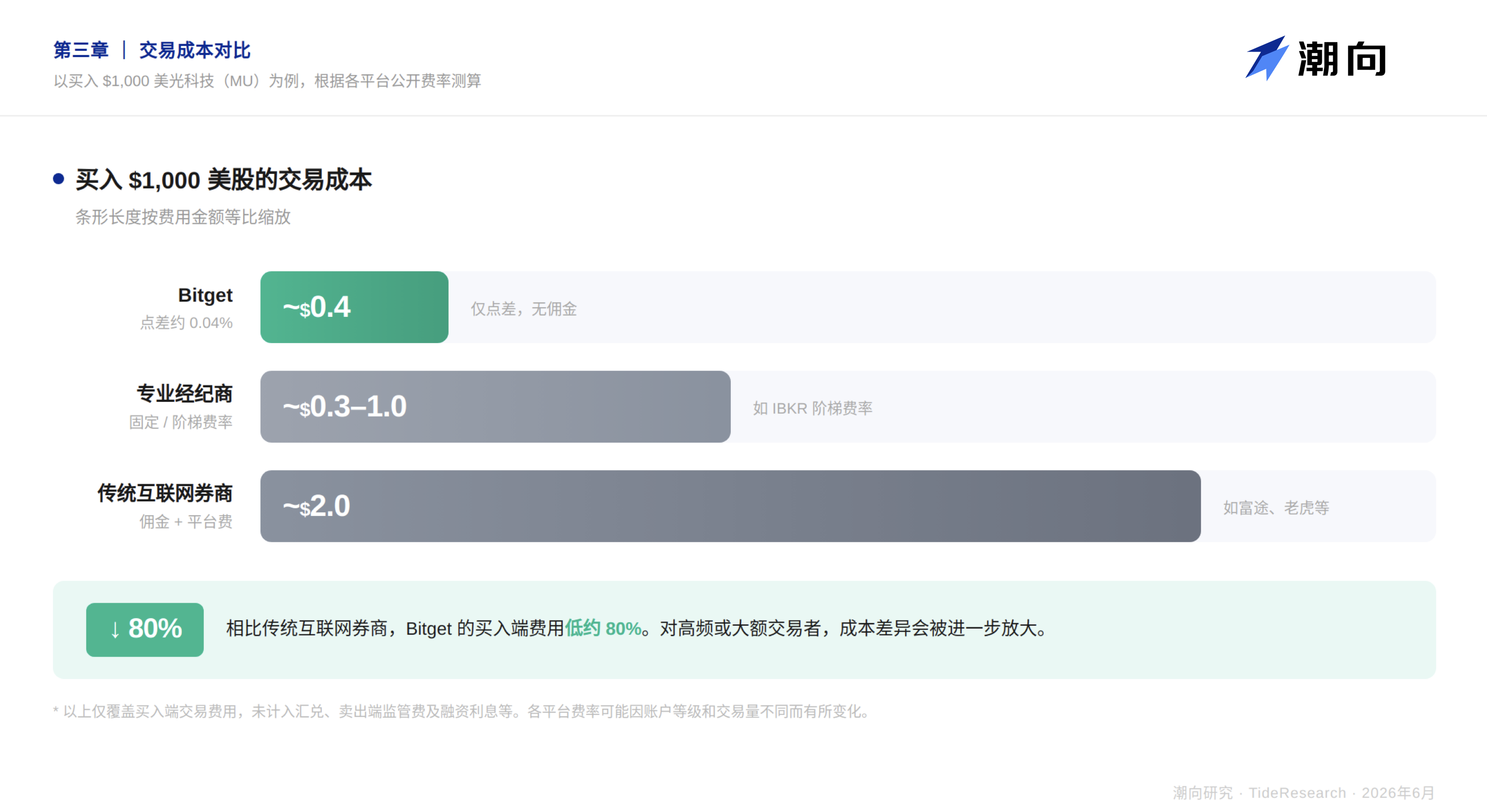
Based on publicly disclosed fee structures across platforms, purchasing $1,000 worth of U.S. equities costs roughly $0.40 on Bitget—versus ~$2.00 on typical internet-based brokers.
Viewed together, these three layers mark a qualitative leap for tokenized U.S. equities on Bitget: from a mere price-tracking shadow token to a financial instrument backed by real custody, complete shareholder rights, and seamless interoperability with crypto assets.
Two years ago, neither brokers nor exchanges could deliver this.
Some may ask: If the goal is U.S. equities access, why not choose the simpler path—integrating directly with a broker’s API and building just a frontend?
Bitget chose the opposite: rather than becoming dependent on traditional finance, it rebuilt the entire value chain using crypto-native and on-chain methods. Reality controls the full stack—from custody to distribution to on-chain mapping. rTokens are natively on-chain assets: they can be deposited, withdrawn, and composably combined—capabilities impossible under a broker-integration model.
At this point, the author recalls a famous line from the Chinese drama *The Knockout*: “The bigger the waves, the more valuable the fish.”
But catching more fish amid sudden market turbulence requires a reliable vessel. Renting someone else’s boat works—but building your own means setting your own waterline.
This ambition—unstated in Bitget’s official communications but unmistakable—is likely what drives the Reality platform.
And clearly, Bitget intends to load far more than just U.S. equities onto this vessel.
More Than U.S. Equities: The Emergence of a Full-Spectrum Exchange
With the vessel built, the first cargo loaded extends well beyond public company stocks.
In April this year, Bitget launched IPO Prime—a product enabling retail users to invest in pre-IPO companies. The first offering featured SpaceX: priced at $650 per unit, with a total pool of ~$61 million. Demand surged to $177 million from 14,435 participants.
The second round featured OpenAI: priced at $725 per unit, with a $21 million pool—drawing $120 million in subscriptions from 5,448 participants, nearly six times oversubscribed.
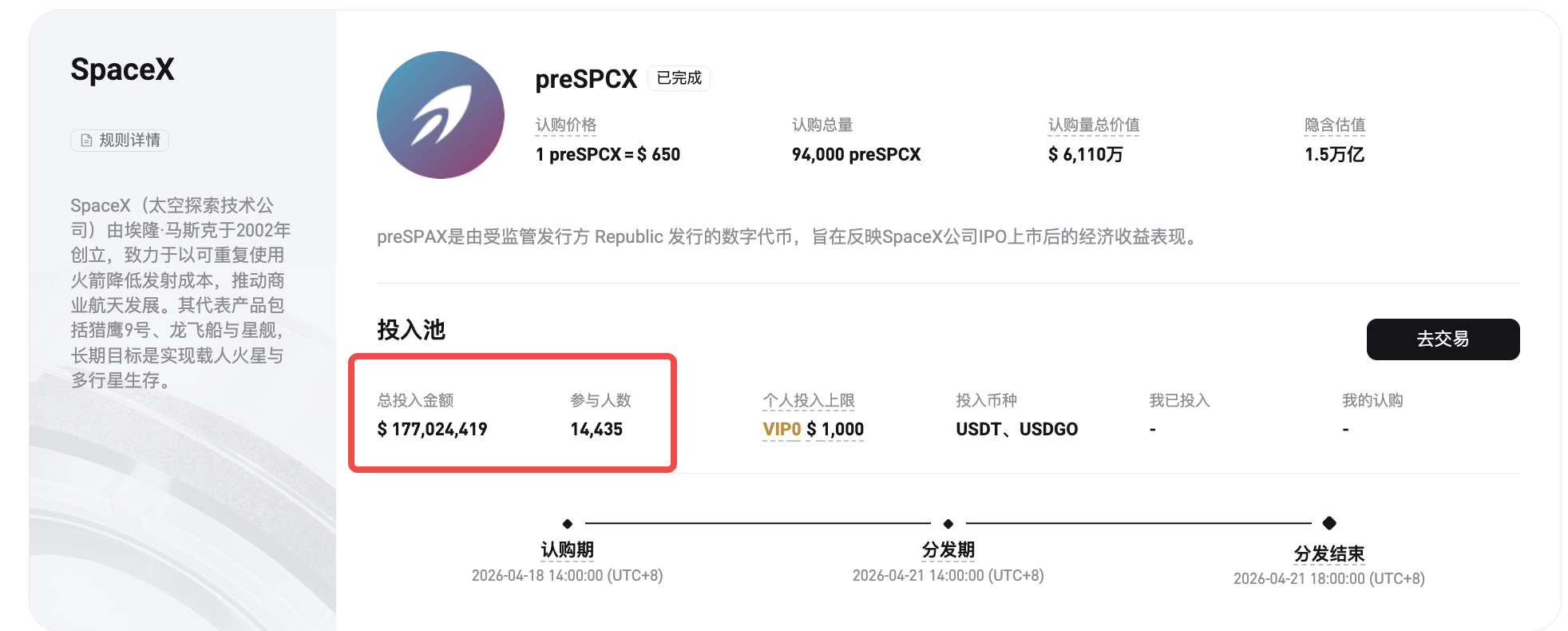
Combined, the two rounds attracted nearly $300 million in subscriptions from close to 20,000 users.
Both companies share a key trait: in traditional finance, ordinary investors have zero channels to gain equity exposure before their IPOs. IPO Prime operates via SPVs structured in partnership with Republic—and anchors each unit to real equity.
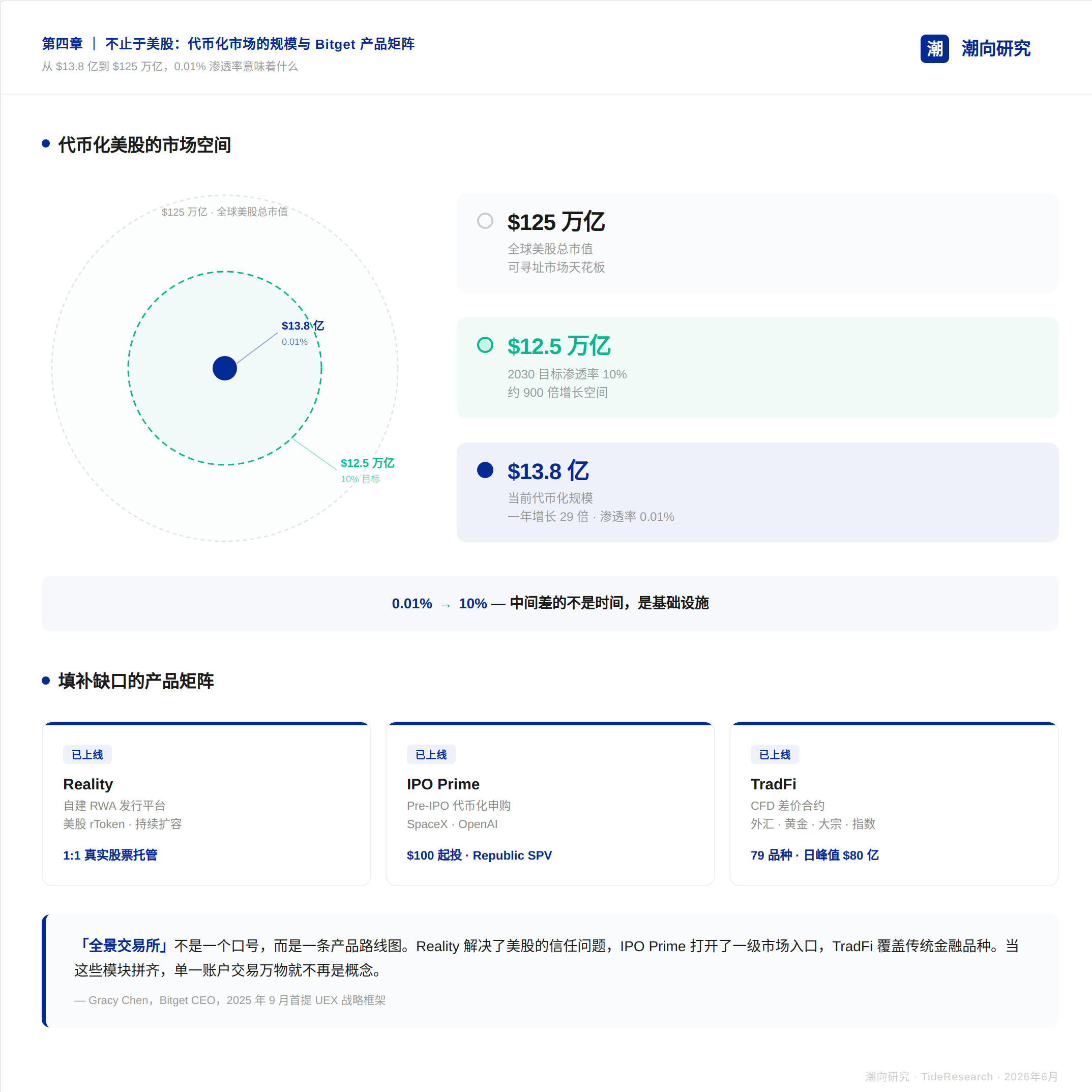
Beyond pre-IPO offerings, Bitget launched TradFi last December—a USDT-denominated CFD product covering 79 instruments, including forex, gold, commodities, and indices. Its peak daily trading volume exceeded $8 billion.
Adding Reality’s continuously expanding roster of U.S. equity rTokens, the range of assets accessible within a single Bitget account now vastly exceeds the conventional definition of a “crypto exchange.”
Internally, Bitget refers to this vision as UEX—the “Universal Exchange.”
CEO Gracy Chen first publicly introduced the concept in September last year, stating the goal plainly: enable access to crypto, U.S. equities, gold, ETFs, forex, and other globally优质 assets—all through a single account.
To support this framework, the team is scaling rapidly.
Public records indicate Bitget has recently hired a wave of hybrid talent—professionals combining deep traditional finance expertise with internet-scale growth experience. New hires include alumni from Futu, LongBridge, Robinhood, and eToro, with cross-market experience spanning the U.S., Hong Kong, Singapore, Australia—and ongoing collaboration with traditional financial institutions like Nasdaq.
Judging by hiring patterns, this isn’t a crypto exchange playing catch-up—it’s a new species assembling its skeleton.
What’s particularly interesting is Bitget’s attitude toward this endeavor. There exists a lighter path to U.S. equity trading: integrate a broker’s API, wrap it in a frontend, and call it done—users can buy and sell, and that’s sufficient.
Many platforms take exactly this route. Bitget deliberately chose the heaviest path—building its own issuance platform, designing its own custodial infrastructure, ensuring rTokens are fully on-chain—depositable, withdrawable, and composable.
Why?
From a product standpoint, Bitget’s stance is already clear. Broker-integration models remain fundamentally frontends for traditional finance—stocks reside inside the broker’s system, cannot be deposited on-chain, cannot be withdrawn to wallets, and certainly cannot be used as margin for BTC futures.
Reality’s rTokens are native on-chain assets—capable of far more than any broker-integration solution. Choosing the heavy path isn’t about enjoying hardship—it’s because the light path can’t reach where Bitget wants to go.
The author believes this decision reflects a broader conviction: blockchain and crypto, if limited to token issuance and speculation, have no sustainable future. Their true potential lies in reshaping financial product experiences and distribution mechanisms.
Reality is the first concrete manifestation of that conviction. Three years ago, such a claim might have drawn skepticism—but today, looking at the product’s architecture, it sounds less like hype and more like fact.
How far this path ultimately leads remains too early to judge.
But one thing is certain: Bitget is no longer the crypto-only exchange it was a year ago.
From reselling to building in-house, from U.S. equities to pre-IPO to forex and gold, from a cryptocurrency trading platform to a universal gateway for all asset classes—each step along this journey adds a new deck to the vessel Bitget built itself.
The ship has launched. Now we watch how far it sails.
This article is based on official Bitget product documentation and publicly available market information. All referenced features and data reflect the latest version of the Bitget platform. TechFlow Research independently verified product descriptions but makes no representations or warranties regarding platform operations or asset security.
Tokenized stocks are emerging financial products. Custody frameworks, audit standards, and regulatory compliance for underlying assets remain under active development. Regulatory stances vary significantly across jurisdictions; investors must conduct their own risk assessments.
Markets involve risk; decisions must be made independently.
Data Sources: Bitget Q1 2026 Transparency Report · Bitget User Asset Allocation Report (May 2026) · TokenInsight Q1 Derivatives Market Report · The Network Firm Audit Reports · Publicly Disclosed Fee Structures Across Platforms
TechFlow Research · June 2026
Join TechFlow official community to stay tuned
Telegram:https://t.me/TechFlowDaily
X (Twitter):https://x.com/TechFlowPost
X (Twitter) EN:https://x.com/BlockFlow_News
 @chaoxiangooo