Taiwan’s Node in the AI Industry Chain: Nine Taiwanese Stocks Favored by “New Stock God” Serenity
TechFlow Selected TechFlow Selected
Taiwan’s Node in the AI Industry Chain: Nine Taiwanese Stocks Favored by “New Stock God” Serenity
“The AI industry chain in Taiwan’s stock market is not experiencing a bubble; the real risk does not lie across the Taiwan Strait, but rather in the capital expenditures of hyperscale cloud service providers.”
 Navigating Web3 tides with focused insights
Author: Ada, TechFlow
The recently viral “new stock god” Serenity on X has publicly shared his systematic view of Taiwan’s AI industrial chain. He highlighted nine Taiwan-listed stocks covering three core themes: CPO (co-packaged optics), ASIC (application-specific integrated circuits), and compound semiconductors—with CPO designated as “the largest industry theme for the next phase.” Goldman Sachs forecasts that the global optical TAM will explode from $15 billion in 2026 to $15.4 billion in 2028, with CPO’s share surging from $164 million to $9.1 billion. Serenity explicitly stated: There is no bubble in Taiwan’s AI industrial chain; the real risk lies not in cross-strait tensions but in capital expenditures (capex) by hyperscale cloud providers.
TSMC’s COUPE Platform Enters Mass Production in 2026—Five Taiwan Stocks Covering Five Key Links
The hard timeline anchoring Serenity’s CPO thesis is TSMC’s COUPE (Compact Universal Photonic Engine) platform entering mass production in 2026.
According to TrendForce’s April 1 report citing Hou Shang-Yu, Director of TSMC’s Advanced Packaging Integration Division, speaking at SEMICON Taiwan, COUPE leverages SoIC technology to achieve heterogeneous integration of electronic ICs and photonic ICs—and is scheduled to enter mass production in 2026. Hou also identified three major bottlenecks hindering CPO scale-up: wafer-level testing, fiber array unit (FAU) integration, and high-speed optical packaging assembly. The five Taiwan-listed stocks Serenity named correspond precisely to these three bottlenecks and their supporting ecosystem.
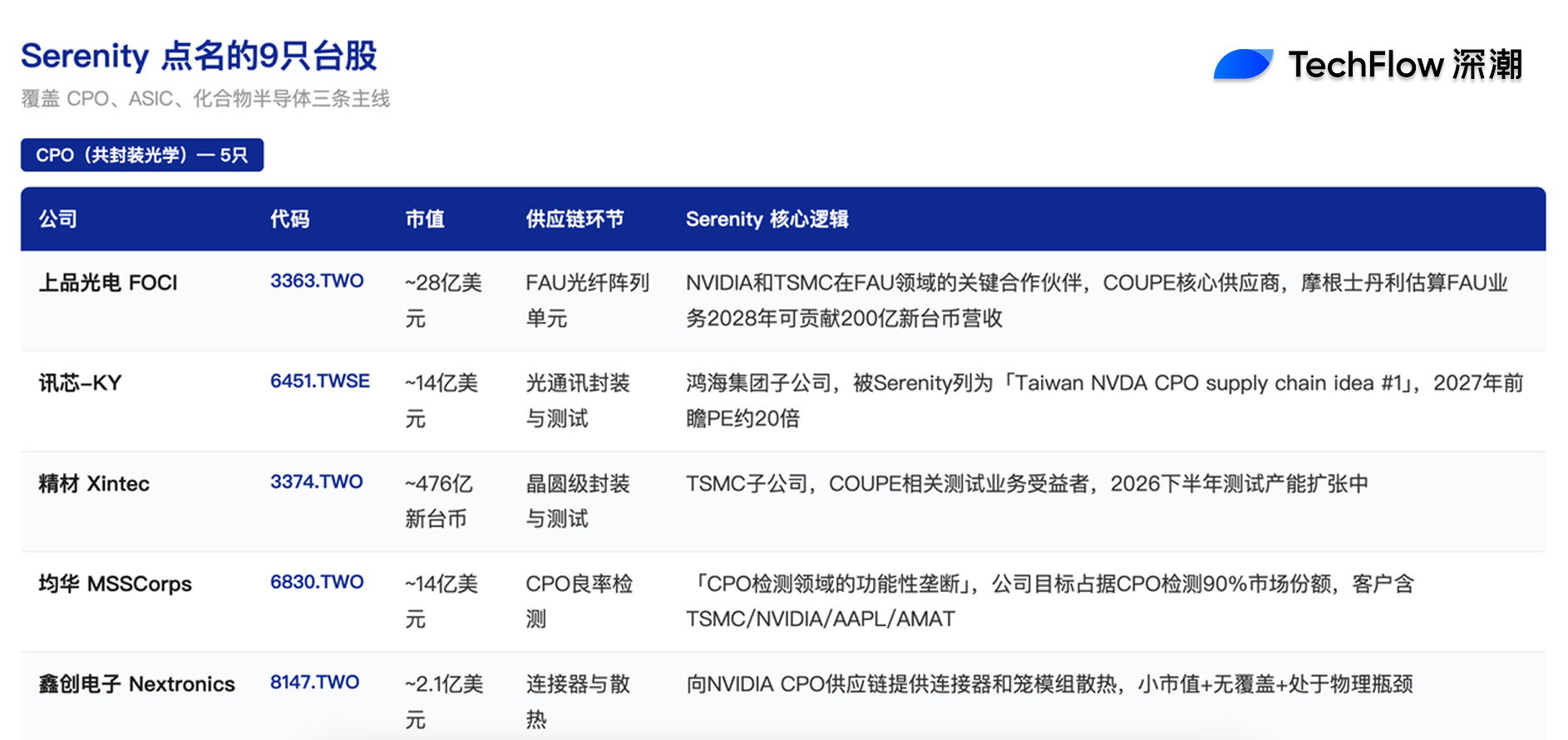
The first is FOCI (Shangpin Optoelectronics, 3363.TWO), with a market cap of approximately $2.8 billion. FOCI is a key partner of NVIDIA and TSMC in the FAU domain and a core supplier within the COUPE architecture. On X, Serenity remarked that FOCI’s current $2.8 billion market cap “has yet to fully reflect its strategic position in the supply chain.” Morgan Stanley estimates FOCI’s FAU business alone could generate ~NT$20 billion in revenue by 2028—nearly zero today. As early as March, Hunterbrook Media and Citrini Research confirmed a “fingerprint-level” alignment among FOCI, Himax, and TSMC across four patents related to 22-channel FAUs—constituting the strongest external evidence that FOCI has entered COUPE’s core supply chain.
The second is Shunsin Technology (6451.TWSE), with a market cap of ~$1.4 billion. Shunsin is Foxconn Group’s subsidiary specializing in optical communication packaging and testing. Serenity once labeled Shunsin on X as “Taiwan NVDA CPO supply chain idea #1,” explaining: “Foxconn is NVIDIA’s ODM—akin to Celestial being taken public ‘for free’ by MRVL.” His personal estimate values Shunsin at a forward P/E of ~20x for 2027.
The third is Xintec (3374.TWO), with a market cap of ~NT$47.6 billion. Xintec is TSMC’s wafer-level packaging and testing subsidiary, chaired by CH Chen, and specializes in wafer-level chip-scale packaging (WLCSP) and wafer testing. According to DIGITIMES’ May 29, 2026 report, Xintec is preparing capacity expansion for its testing business in H2 2026. In recent interviews, Serenity categorized Xintec as a “COUPE-related testing business beneficiary.”
The fourth is MSSCorps (6830.TWO), with a market cap of ~$1.4 billion. Serenity explicitly announced on X that he had initiated a long position in MSSCorps, delivering a strong assessment: “This appears to be a functional monopoly in CPO inspection. The market may mistakenly conflate it with material/failure-analysis oligopolists like MA-tek and iST.” He then cited MSSCorps’ own statement—“Our goal is to capture 90% of the CPO inspection market”—as corroboration. MSSCorps’ client list includes TSMC, NVIDIA, AAPL, and AMAT. Among the three CPO bottlenecks identified by TSMC, “wafer-level testing” is the exact link where MSSCorps has secured direct positioning.
The fifth is Nextronics (8147.TWO), with a market cap of ~$210 million. Serenity built his position in Nextronics because it supplies NVIDIA’s CPO supply chain with “CPO connectors and Cage Thermal Modules.” Nextronics is the smallest-cap stock among the five CPO names—a profile consistent with Serenity’s established stock-picking framework: “small-cap + uncovered + physically constrained.”
Ordered by supply-chain function, the five Taiwan-listed stocks are roughly: FAU integration (FOCI), optical communication packaging & testing (Shunsin-KY, Xintec), yield inspection (MSSCorps), and connectors & thermal management (Nextronics). Collectively, their downstream customers are overwhelmingly concentrated at just two companies: NVIDIA and TSMC.
Three Taiwanese ASIC Foundries Aligned with Three Hyperscalers’ In-House Chips
Beyond NVIDIA GPUs, the sustained ramp-up of in-house ASICs developed by hyperscalers—including AWS Trainium, Google TPU, and Microsoft Maia—forms Serenity’s second thematic pillar for Taiwan-listed stocks.
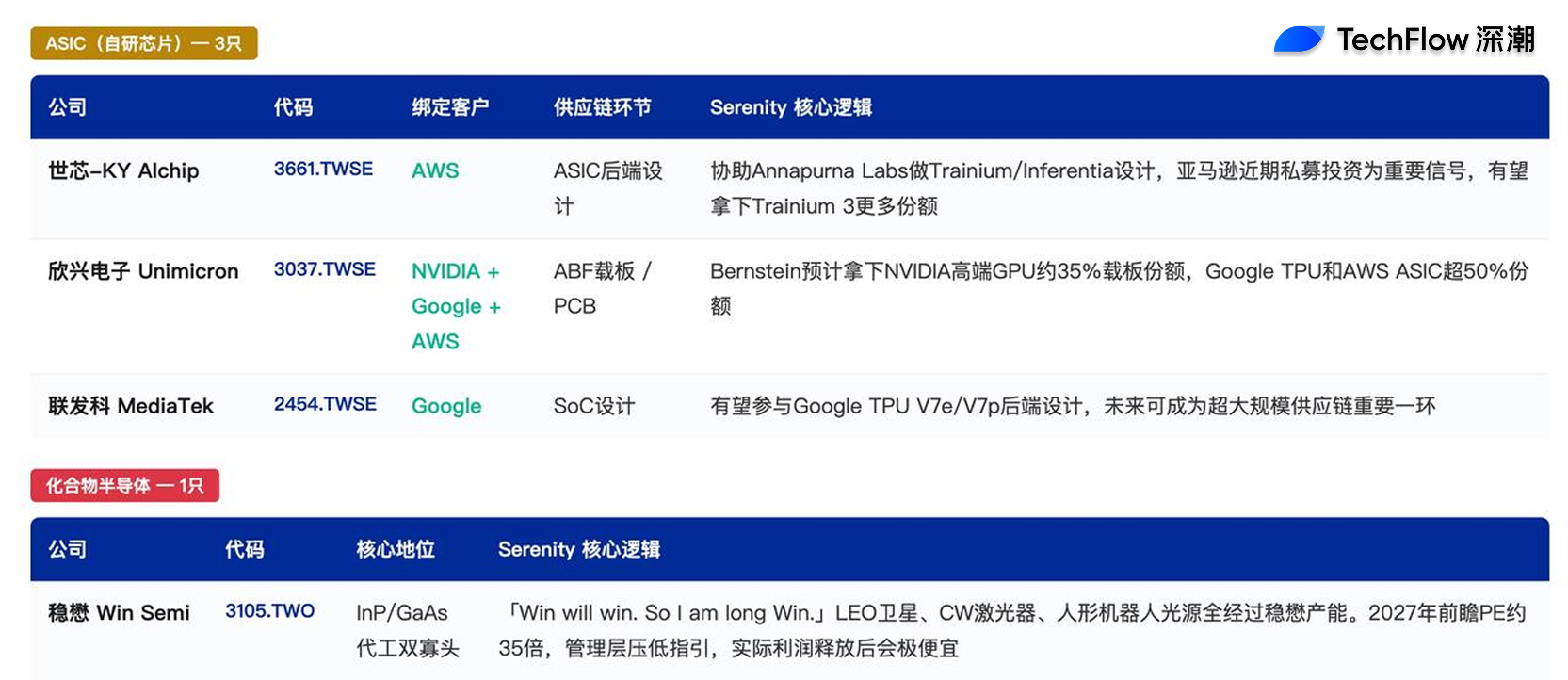
Alchip (3661.TWSE) is the most representative name on this axis. Founded in 2003 and headquartered in Taipei, Alchip specializes in advanced CMOS ASIC design and manufacturing. Per Global Tech Research’s supply-chain data compilation, Alchip primarily supports Amazon’s Annapurna Labs in backend design for AWS Trainium and Inferentia series chips, with active projects including Trainium 1 and Inferentia 2. Serenity recently noted that Alchip stands to gain greater design-share traction on AWS Trainium 3—especially following Amazon’s recent private investment in Alchip, widely interpreted by the market as a significant signal. Alchip’s collaboration with Ayar Labs in the CPO space further signals potential expansion of its addressable market.
Unimicron (3037.TWSE) enters the ASIC value chain via ABF substrates and PCBs. According to Gotrade News’ May 4 citation of Bernstein’s research report, Unimicron is expected to secure ~35% of NVIDIA’s high-end GPU ABF substrate share, and over 50% of ABF substrate share for ASIC chips such as Google TPU and AWS Trainium. Bernstein ranks TSMC and Unimicron as “the two most representative Taiwan-listed stocks in Asia’s AI capex cycle.” Unimicron posted 8% sequential revenue growth and an 18% gross margin in Q1 2026.
MediaTek (2454.TWSE)’s collaboration with Google TPU has been widely reported in the market. Global Tech Research analysis suggests MediaTek may participate in backend design support for upcoming Google TPU V7e/V7p. Serenity recently observed that while this positive catalyst has already been partially priced into the stock, MediaTek’s future ASIC business growth remains worthy of continued attention. Over the coming years, MediaTek could become an extremely critical node in U.S.-based hyperscalers’ large-scale supply chains.
These three Taiwan-based firms collectively anchor themselves across three distinct dimensions—design services, substrate packaging, and SoC design—securing direct exposure to the core development cycles of hyperscalers’ in-house chips.
Win Semiconductor: The Undervalued InP/GaAs Dual Oligopoly
Serenity’s most resolute and unambiguous holding among Taiwan-listed stocks is Win Semiconductor (3105.TWO).
Win Semi is one of the world’s leading compound semiconductor foundries—and forms, alongside GlobalFoundries, the dual oligopoly in InP (indium phosphide) and GaAs (gallium arsenide) foundry services. Market perception of Win Semi traditionally centers on its ties to SpaceX Starlink and Broadcom (AVGO).
Serenity’s recent X post reads: “Win will win. So I am long Win.” His core thesis: Win Semi is one of only two dominant players in InP and GaAs foundry services—and will serve as the manufacturing backbone for emerging applications including SpaceX’s LEO (low-earth-orbit) Starlink satellites, continuous-wave (CW) lasers, and visual/radar light sources for humanoid robots.
His valuation target: a forward P/E of ~35x for 2027. While seemingly rich, he argues that “management deliberately guides earnings conservatively; once actual profits materialize, the P/E will appear extremely cheap.” Win Semi’s role in helping silicon photonics companies scale laser production is, in Serenity’s view, the company’s future core growth engine—a segment still underpriced by the market.
InP is the same layer where AXTI—the “Strait of Hormuz”-style stock Serenity first bought in U.S. equities—operates. Serenity likens InP substrates to “oil for the AI optical communications era.” Win Semi occupies the downstream foundry node along this critical supply chain.
Segments Serenity Did Not Mention—but Are Essential to the Full Picture: Upstream Materials, Energy, and Liquid Cooling
The nine Taiwan-listed stocks Serenity named concentrate on midstream CPO and ASIC segments. Yet for a complete view of Taiwan’s AI industrial chain, upstream materials and downstream energy/liquid cooling sectors are equally indispensable. Although Serenity did not directly cover these areas in public remarks, they remain non-negotiable for holistic understanding.
On the upstream materials front, TSMC (2330.TWSE) itself sits at the center of the entire picture. Bernstein forecasts TSMC’s 2026 earnings growth at ~40%, with a 2027–2028 CAGR of ~20%; the company has set its 2026 capex guidance at the high end of $52–56 billion. As the amplifier and gatekeeper of AI capex transmission upstream, TSMC’s capex trajectory directly determines order timing for all downstream Taiwan-listed stocks—from packaging and testing, to substrates, inspection, and connectors.
On the energy and liquid-cooling front, Taiwan’s AI data centers face real electricity-supply pressure. Per Reccessary’s December 2025 report citing Yi Xu-Quan, Director of System Planning at Taipower, critical global grid equipment—including transformers and gas turbines—is in short supply. Gas turbine delivery lead times have stretched from 2–3 years to 7–8 years, with prices doubling—“grid construction simply cannot keep pace.” This supply-side bottleneck has created structural opportunities for three key Taiwan-listed stocks.
First, Delta Electronics (2308.TWSE), the leader in power management and integrated liquid-cooling solutions, has penetrated both the white zone (IT compute) and gray zone (power & cooling) of AI data centers. Second, AVC (3017.TWSE), the global leader in thermal solutions, offers full-stack capabilities spanning cold-plate and immersion liquid cooling. Third, Auras Technology (3324.TWSE), focused on liquid-cooling module manufacturing, is a Tier-1 supplier to NVIDIA. Goldman Sachs forecasts global server cooling market size to grow by 111%, 77%, and 26% in 2025–2027 respectively, reaching $17.6 billion in 2027—a growth curve synchronized with CPO’s trajectory within the AI capex cycle.
The Real Risk Is Not Cross-Strait Tensions—But Hyperscaler Capex
Serenity’s overall risk assessment for Taiwan’s AI industrial chain diverges sharply from mainstream market narratives.
He recently stated that Taiwan’s AI supply chain currently exhibits no bubble—many Taiwan firms trade at valuations lower than their NASDAQ peers—and geopolitical risks are overblown, given Taiwan’s irreplaceable role in the global tech supply chain: “No country would choose zero-sum, large-scale supply-chain disruption.” Looking 7–10 years ahead, the U.S. is indeed building domestic capacity through firms like Intel—but no major systemic risk looms over the next 2–3 years.
Instead, he identifies hyperscalers’ capex as the true risk to monitor. Sustained investment by Microsoft, Amazon, Google, Meta, and Oracle powers the current AI boom: “So long as these firms continue expanding AI infrastructure, Taiwan’s supply chain will benefit; however, if hyperscalers begin cutting capex, Taiwan’s AI supply chain may face substantial valuation adjustments.”
Early signs of this “stress test” are now emerging.
A marginal shift worth tracking has just surfaced. On June 3, Broadcom reported Q2 FY2026 results, guiding Q3 FY2026 AI chip revenue at $16 billion—$1.2 billion below the LSEG-aggregated sell-side consensus of $17.2 billion. Broadcom CEO Hock Tan maintained the full-year AI semiconductor revenue guidance of $56 billion without raising it. The market interpreted the lack of an upward revision negatively: On June 5, the Philadelphia Semiconductor Index (SOX) plunged 10.26%—its largest single-day drop since March 2020; South Korea’s KOSPI fell 5.54% the same day, then dropped another 8.37% at open on June 8, triggering a circuit breaker.
Yet critical reference points remain unchanged—for now. TSMC’s 2026 capex remains anchored at the high end of $52–56 billion, with no substantive downward revision. Hyperscalers’ own capex guidance likewise remains on an upward revision path. Whether Serenity’s “real risk” has truly been triggered hinges on capex guidance updates from Microsoft, Amazon, Google, Meta, and Oracle in their Q2 and Q3 2026 earnings reports—the foundational premise of Serenity’s Taiwan stock list, and the most critical marginal variable to track over the coming quarter.
Join TechFlow official community to stay tuned
Telegram:https://t.me/TechFlowDaily
X (Twitter):https://x.com/TechFlowPost
X (Twitter) EN:https://x.com/BlockFlow_News
 深潮TechFlow