AI Compute Assetization Wave: Axe Compute May Become the Most Undervalued GPU Compute Entry Point in the US Stock Market
TechFlow Selected TechFlow Selected
AI Compute Assetization Wave: Axe Compute May Become the Most Undervalued GPU Compute Entry Point in the US Stock Market
AI is no longer merely one of the themes, but has become the absolute main thread of global capital markets.
 Navigating Web3 tides with focused insights
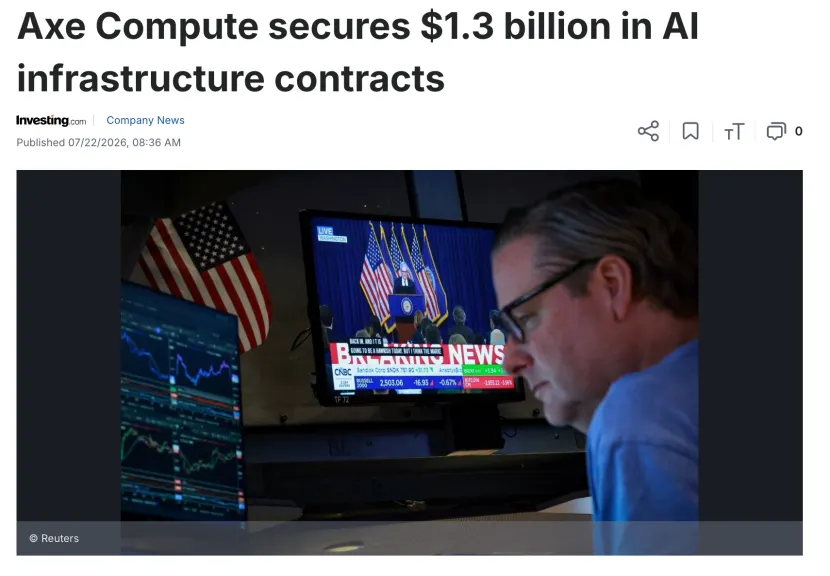
From late 2025 to the first half of 2026, as other sectors (some high-valuation growth, cyclical, pure narrative themes) fade, while AI Capex continues to exceed expectations and semiconductor and data center-related stocks significantly outperform, market consensus truly forms — — "AI is no longer just one of the themes, but has become the absolute main thread of the global capital market". With research into undervalued AI companies in the US stock market, Axe Compute has become a company we are focusing on this year. Recently, the announcement on July 22 added a $1.3 billion AI computing power contract, greatly strengthening our confidence in investing in Axe. If the contract can be implemented in an orderly manner and data can be truly converted and reflected in the financial reports in the future, we believe "Axe Compute, this company with a current market cap of less than $100 million, may become the most undervalued GPU Compute entry point in the US stock market"
I. A Splendid Transformation from Biopharmaceuticals to AI Computing Power
Before the name change in December 2025, the predecessor of Axe Compute was Predictive Oncology Inc. (NASDAQ: POAI), a typical US stock micro-cap biopharmaceutical company. As a typical "small-cap biotech stock", POAI had mediocre performance during the pharmaceutical stage: revenue remained at the level of hundreds of thousands of dollars for a long time, continued losses, market cap hovered in the tens of millions of dollars range for years, and capital market attention was extremely low.
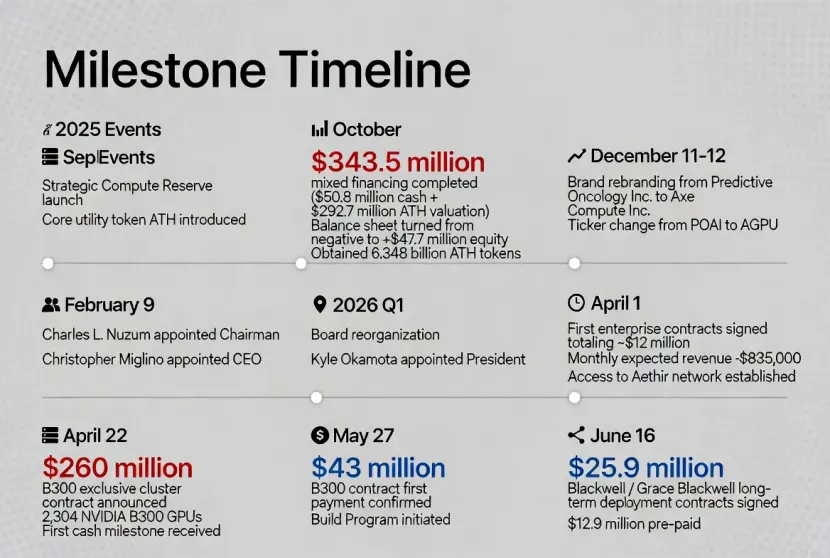
In September 2025, the company suddenly launched Strategic Compute Reserve, clearly taking Aethir's native utility token (ATH) as the core, continuing the Crypto Treasury strategy narrative, implying that the company will turn to AI narrative and computing power business.
In October 2025, it completed two simultaneous PIPE financings, totaling $343.5 million in cash, financed in a mixed way with $50.8 million in cash + ATH with a nominal value of $292.7 million. Through this financing, the company's balance sheet turned from negative equity to a positive $47.7 million gain, obtaining 634.8 million ATH, formally forming a deep binding between the company and the Aethir network, deriving a capital operation mode of AI computing power narrative + treasury company superposition, and since then the company has entered the observation horizon.
On December 11–12, 2025, the company rebranded, company name from Predictive Oncology Inc. → Axe Compute Inc., Ticker from POAI → AGPU, continuing to trade on Nasdaq.
At the end of the first quarter of 2026, Axe Compute officially began operating as a new cloud service provider, and the crypto project Aethir affiliate may become the largest shareholder, conveying a comprehensive transformation signal to the financial market:
On February 9, Charles L. Nuzum served as Chairman, Christopher Miglino (previously involved in ATH transaction structure design) officially became CEO, board restructuring was completed in March, and Kyle Okamoto (former Aethir CTO/GM) became President.
On April 1, the company completed enterprise-level commercial access to the Aethir distributed GPU network (400,000+ GPU containers, 200+ locations, 93 countries), signing the first batch of enterprise contracts of about $12 million. The contracts were mainly for the Immediate Access Program, contributing about $835,000/month expected revenue, payment method was prepayment + monthly prepayment, and has begun to contribute a small amount of compute revenue (Q1 actual recognition about $7,000)
On April 22, 2026, disclosed a $260 million B300 exclusive cluster contract (Build Program first order), contract core terms: 36-month take-or-pay agreement, delivery of 2,304 NVIDIA B300 GPUs + AI high-speed storage (US Tier-3 data center, 4.8 MW exclusive power). Structured deposit + prepayment + monthly prepayment, after going online in Q3 2026, quarterly revenue about $21 million.
May 27, 2026: Confirmed receipt of $43 million B300 contract first payment, this is the first real contract cash milestone, confirming that the Build model has started as planned, hardware procurement and deployment are progressing.
June 16, 2026: Landed a $25.9 million Blackwell / Grace Blackwell long-term deployment contract (12 months + 24 months, renewable), of which $12.9 million has been prepaid.
July 22, 2026: Announced an additional $1.3 billion AI infrastructure customer contract, these agreements are based on five-year contracts, with options to renew, requiring a large prepayment in the early stage, and including terms for continuous GPU upgrades as new generations of GPUs are launched. Revenue is expected to begin generating at the end of Q4 2026, prepayments will be paid in Q3 2026, at which time Annual Recurring Revenue (ARR) will exceed $384 million, this $1.3 billion large order should become the starting point for the whole market to truly re-understand Axe.
II. Multiple AI Computing Power Solutions, Highly Elastic "CoreWeave": Axe Business Model Breakdown
Axe Compute Inc. is a technology company focusing on providing high-performance computing infrastructure for artificial intelligence (AI) workloads. By obtaining large-scale GPU capacity from hardware manufacturers and infrastructure suppliers, and then deploying it to enterprise customers through long-term service agreements; service scope includes hardware procurement, data center hosting, network, storage and financing. Axe also retained the oncology drug research and development solution business, but it is currently not the company's main business.
1. Axe's business is divided into two product lines:
(1) Immediate Access Program
For customers who need to go online quickly and scale elastically. Relying on the existing GPU inventory of the Aethir distributed network, deployment can be completed in as fast as 48 hours, covering more than 200 global nodes. Suitable for inference, fine-tuning, small and medium-scale training and other scenarios, paying monthly according to reserved capacity.
(2) Build Program / AI Factory
For ultra-large-scale, long-cycle exclusive computing power requirements. Axe is responsible for overall architecture design, data center site selection and power negotiation, hardware financing arrangements, and final enterprise-level SLA (Service Level Agreement) operations, "Design-Deploy-Own-Operate".
The $260 million three-year large order landed in April 2026 is a landmark case of this model. The company plans to purchase a dedicated cluster composed of 2,304 NVIDIA B300 graphics cards and AI-dedicated high-speed storage infrastructure from a Tier-3 data center facility in the United States, supported by 4.8 megawatts of exclusive redundant power. The customer specifies the deployment location and service standards, and the deployment work is scheduled to be completed in the third quarter of 2026. Adopting a structured payment arrangement, the first installment of $43 million has been received. During the 36-month service period, the company will recognize about $21 million in revenue per quarter.
In June 2026, the company signed another $25.9 million Blackwell and Grace Blackwell long-term deployment contract, covering two scenarios: inference infrastructure and simulation platforms. $12.9 million has been received in the form of prepayment.
In July 2026, the company's Build business line again won a total of over $1.3 billion in five-year AI infrastructure long-term contracts in the United States and Europe, significantly exceeding the annual signing target of $1 billion. Project prepayments will arrive in Q3 2026, and continuous revenue will be officially recognized from the end of Q4 2026. After all clusters are landed and operate stably, the corresponding Annual Recurring Revenue will exceed $384 million. Company management stated that current market demand is strong, relevant revenue will be included in 2027 Annual Recurring Revenue, continuously opening up medium and long-term growth space.
2. To re-understand Axe's Build computing power business, the best comparison object is CoreWeave, one is the concentrated training leader, the other is a new global hybrid computing power force:
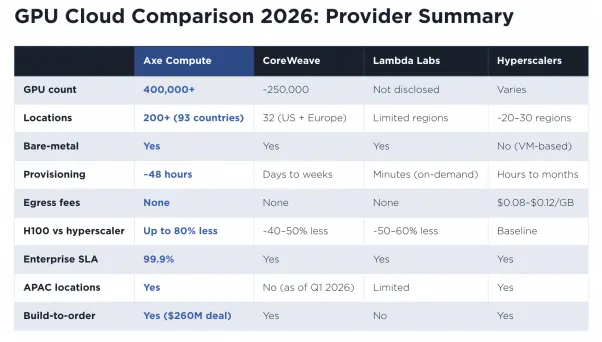
CoreWeave follows a heavy-asset, centralized, deep-cultivation training scenario route, operating a total of 49 large AI data centers in North America and Europe, owning about 250,000 high-end GPUs, relying on InfiniBand high-speed interconnection network and Kubernetes native orchestration to create single-data-center ten-thousand-card-level training clusters. The extreme performance of ultra-large-scale distributed training is suitable for hundred-billion-parameter training of top AI laboratories such as OpenAI, Meta, and Microsoft. Listed on Nasdaq in March 2025, received an additional $2 billion strategic investment from NVIDIA in January 2026, and has become a benchmark enterprise for dedicated AI computing power cloud (Neo-Cloud). However, since all data centers are concentrated in North America and Europe, the 80~150 milliseconds network latency brought by intercontinental transmission, coupled with data residency compliance requirements of various countries, has kept CoreWeave out of a large number of regional markets such as Asia-Pacific, Middle East, and Latin America.
Axe Compute follows a hybrid mode, distributed, global coverage route. On one hand, relying on the Aethir distributed computing power network to integrate global third-party data center resources, deploying more than 200 computing nodes in 93 countries, providing computing power access to a total of more than 435,000 GPUs. On the other hand, it is vigorously expanding the asset-centric new cloud business worth $1 billion+. This enables it to enter the large-scale customized computing power market, serving all types of GPU buyers and artificial intelligence companies.
3. Financial Analysis:
Axe Compute First Quarter Financial Results Ended March 31, 2026
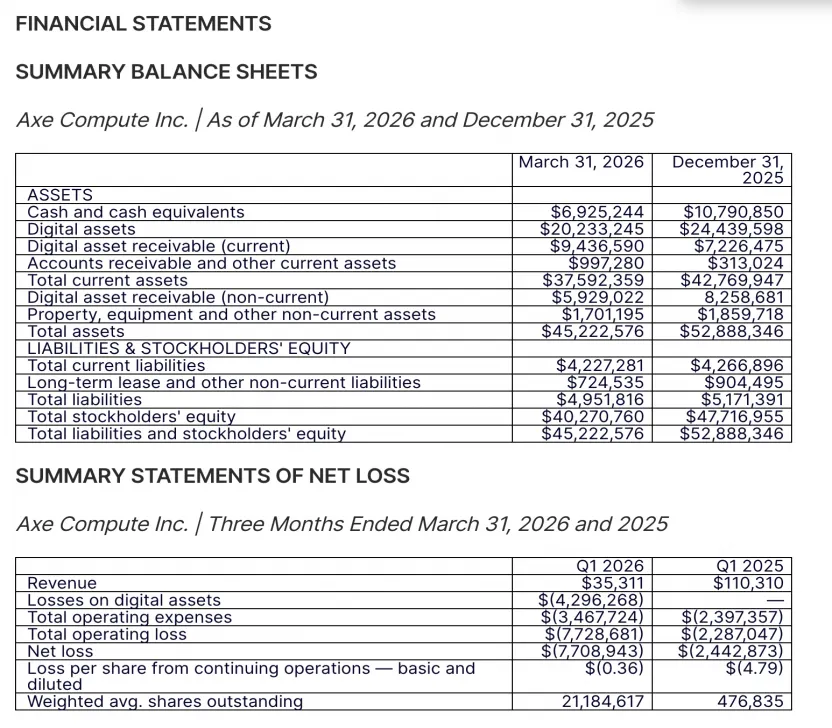
As of March 31, 2026, the company held $6.9 million in cash and cash equivalents, $20.2 million in ATH digital asset holdings (about 2.83 billion tokens), and $9.4 million in current digital asset receivables, totaling a liquidity pool of about $36.5 million. Management believes this is sufficient to support the company's operations through fiscal 2026 and beyond.
Revenue for the first quarter of 2026 was $35,000, while for the first quarter of 2025 it was $110,000. Sales in the first quarter of 2026 mainly came from the traditional drug discovery services department, and the computing services department contributed only $7,000. According to the company's disclosure, the $43 million B300 large order first payment has arrived in May, and another $25.9 million Blackwell series long-term contract was added in June, neither of which has been converted into income statement revenue yet.
Once the $260 million exclusive cluster goes online in the third quarter, about $21 million in computing power revenue can be recognized in a single quarter, equivalent to 600 times the total revenue of the first quarter. Assuming the $1.3 billion order goes online in the fourth quarter, quarterly revenue can increase by another $65 million to $86 million at that time, quarter-over-quarter growth exceeding 400%. The company is standing at the explosion critical point of leaping from hundred-thousand-level quarterly revenue to hundred-million-level quarterly revenue. The current market pricing still does not fully reflect the certainty of this step-like revenue jump.
Net loss for the first quarter of 2026 was $7.7 million. The net loss includes a $4.3 million non-cash mark-to-market loss on the company's ATH digital asset holdings. As of March 31, 2026, accounts receivable were $659,000, while as of December 31, 2025, it was $32,000. Accounts receivable and contract liabilities both increased significantly this quarter, reflecting monthly prepayments that Compute Services customers need to pay after projects go online at the end of the first quarter.
Axe Compute CEO Christopher Miglino stated: "Our goal this year is to sign contracts worth $1 billion. The closure of the July contract has made us far exceed this goal... We believe signing contracts worth $2 billion this year is not out of reach, which will help increase next year's Annual Recurring Revenue (ARR)." Combining his public statements in the first half of the year, Axe Compute currently has potential business orders exceeding $4 billion, has signed contracts worth $1 billion+, and targets signing a total of $3 billion in contracts this year.
4. Valuation Analysis:
Model 1: FY2026E Forward Price-to-Sales Ratio (Forward P/S)
Annual Revenue Estimation
The following are confirmed orders officially released. Based on these contracts, the confirmed revenue for FY2026 can be calculated to be about $125 million.
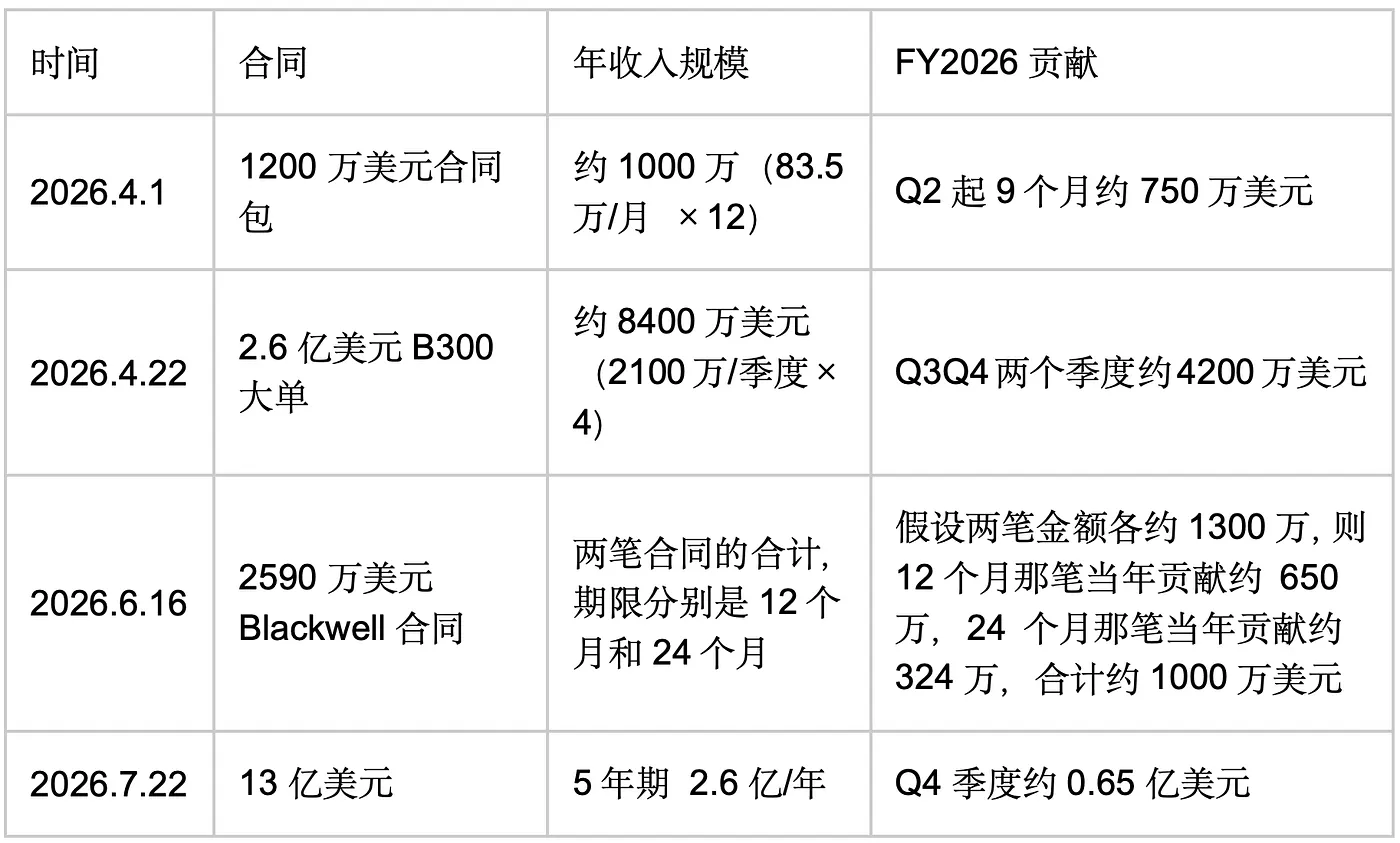
3 Wall Street analysts predict AGPU's 2026 revenue average to be $163,935,524, among which the lowest forecast value for AGPU revenue is $157,505,455, and the highest forecast value is $168,752,872. In 2027, this value reaches $254,372,663, the lowest revenue forecast is $244,405,017, and the highest revenue forecast is $261,853,600. Currently, we conservatively predict confirmed revenue to be about $125 million.
CoreWeave Forward PS is about 3.88x, Axe Compute 2026 actual confirmed revenue is about $125 million, total share capital 11.385 million, current price $6.85.
Axe Market Cap = $125 million × 3.88 = $485 million
Corresponding Stock Price: $485 million ÷ 11.385 million shares ≈ $42.60/share
Relative Current Price Increase Multiple: 42.60 ÷ 6.85 ≈ 6.21x
Model 2: P/ARR (Forward Scenario Calculation)
P/ARR (Annual Recurring Revenue) The ratio of total market capitalization to Annual Recurring Revenue is a common steady-state valuation indicator in the computing power infrastructure industry, adapted to business models centered on multi-year locked computing power contracts, and can better reflect the intrinsic value of enterprise long-term stable cash flow. This time referring to industry leader CoreWeave July 2026 P/ARR valuation center about 2.4x, as a fair pricing benchmark for mature computing power service providers.
As of now, the company's total outstanding Build business long-term orders forward steady-state Annual Recurring Revenue (ARR) can reach $384 million.
Axe Forward Reasonable Total Market Cap = $384 million × 2.4 = $921.6 million
Corresponding Target Stock Price = $921.6 million ÷ 11.385 million shares ≈ $80.94/share
Relative Current Price Upside Space: 80.94 ÷ 6.85 ≈ 11.8x
Comprehensive calculation results, Axe stock price has 6–11x upside space, current market value is seriously undervalued. The above calculations did not set valuation discounts for the differences in business volume and development maturity between the two companies, and the actual reasonable valuation center may have room for downward adjustment.
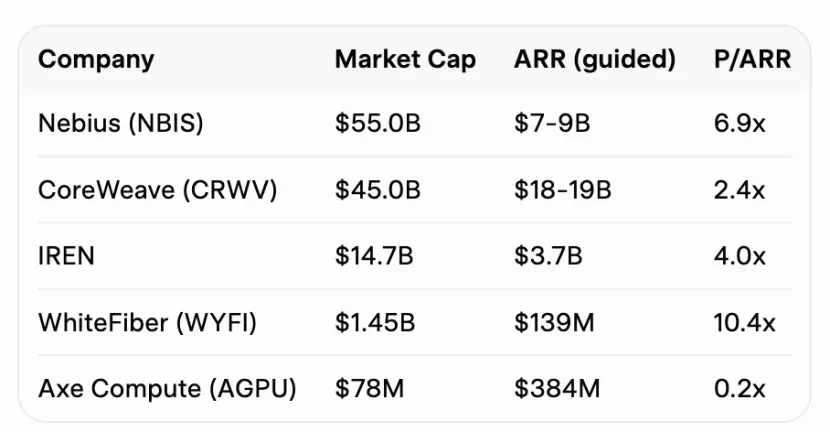
From a horizontal comparison with peers, AGPU's current market pricing has a significant mismatch with its business scale and growth potential. As of now, the company's market cap is only about $80 million, while based on landed long-term contracts, its guided ARR has reached $384 million, corresponding to a P/ARR of only 0.2x. In contrast, peers Nebius, CoreWeave, IREN and WhiteFiber have P/S on ARR of 6.9x, 2.4x, 4.0x and 10.4x respectively. Even considering AGPU is still in the early commercialization stage and revenue recognition rhythm has not been fully released, its valuation level is still far below the industry average. As the B300 exclusive cluster and subsequent contracts over $1 billion level continue to contribute revenue in the second half of 2026, the company's ARR is expected to be realized quickly next year, and the current extremely low valuation multiple provides investors with significant safety margin and elastic space.
III. AI x Crypto Capital Model Design: "Compute + Treasury" Dual-Wheel Drive Model
In addition to the Compute business with amazing expected data, AGPU also has a flywheel model with huge imagination space, namely the ATH Treasury strategy. Different from treasury companies that simply hoard BTC and ETH, ATH is placed within a corporate entity where related business generates positive cash flow. Compute orders directly drive ATH demand and settlement, Treasury appreciation feeds back into Compute expansion, the two are cause and effect, synergistic resonance, forming a self-reinforcing positive flywheel.
1. What are ATH and Aethir?
The Aethir network is a Decentralized Physical Infrastructure Network developed by the Panama Foundation company DCI Foundation (referred to as "DCI"). The Aethir network aggregates enterprise-level GPUs contributed by independent data centers, enterprises and other hardware owners into a global distributed network. The network is designed to provide instant GPU computing resources for artificial intelligence training and inference, cloud gaming and other virtualized computing workloads, and in many cases, its price is lower than centralized cloud providers. In the network, three roles jointly ensure the availability, applicability and quality of computing resources: "Containers", which are the containers that actually execute the computation; "Checkers", used to test and monitor containers to verify their integrity and performance; and "Indexers", used to match computing resource users with suitable containers. Buyers of computing resources use the network's computing resources.
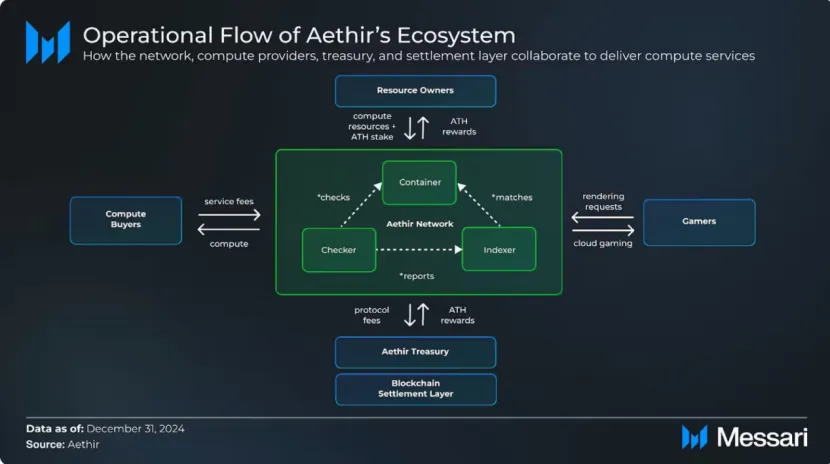
ATH, as a proxy unit of GPU computing power, is the transaction medium and incentive unit for Aethir network participants. To become a computing resource provider, network participants need to obtain ATH and stake it as collateral to contribute GPU resources and qualify for processing computing requests. After computing resources are delivered and verified, ATH flows from computing resource users to resource providers as payment and reward. Resource providers obtain ATH through "Proof-of-Capacity" rewards (used to maintain availability and readiness) and "Proof-of-Delivery" rewards (used to complete workloads) as well as service fees paid by computing resource users. Service providers can re-stake, hold, lend or sell the received ATH. Aethir's treasury is responsible for managing protocol fees and ATH allocated to protocol development, while the blockchain settlement layer is responsible for recording transactions and facilitating the transfer of ATH.
2. Capital Design of Axe and ATH
The capital architecture of ATH Treasury is not simply "buying and hoarding coins", but through a two-layer design, deeply binding Axe Compute's business entity with the Aethir (ATH) ecosystem, forming a trinity closed loop of business-capital-token. The core advantage of this design is: every landing of a Compute order will convert into incremental demand and value capture for ATH in the future, rather than like traditional treasury companies, relying only on external market liquidity and sentiment.
(1) Axe's Access Business is Conducted on the Aethir Network
The Access mode (Immediate Access) is the core of AGPU's asset-light expansion, and its underlying layer completely relies on the Aethir distributed GPU network (400,000+ GPU containers, 200+ locations, 93 countries coverage). After industry customers place orders through AGPU's Access platform, computing tasks directly enter the Aethir network for execution. Every call of an order will consume or stake ATH, forming real demand.
Every Access Order = Directly 拉动 ATH Demand + Generate Positive Cash Flow (Prepaid Revenue). This design makes AGPU's Access business a "Natural Demand Engine for ATH". Linking business growth with ATH price — — the more orders, the more ATH consumption/staking, the stronger the price support.
(2) Axe's Treasury Strategy: Holding ATH and Forming Strategic Reserves
AGPU's Treasury strategy belongs to an upgraded version of BTC/ETH treasuries. MicroStrategy and other companies passively hold BTC as "Digital Gold", returns rely on external Bitcoin halving and market cycles, lacking endogenous cash flow support. AGPU's ATH is "installed" into a Compute business entity that can generate positive cash flow. ATH is not only a reserve, the Aethir network uses ATH staking and settlement, Axe's Access business runs on it, naturally forming a closed loop.
3. How the Positive Flywheel of AGPU and ATH Works
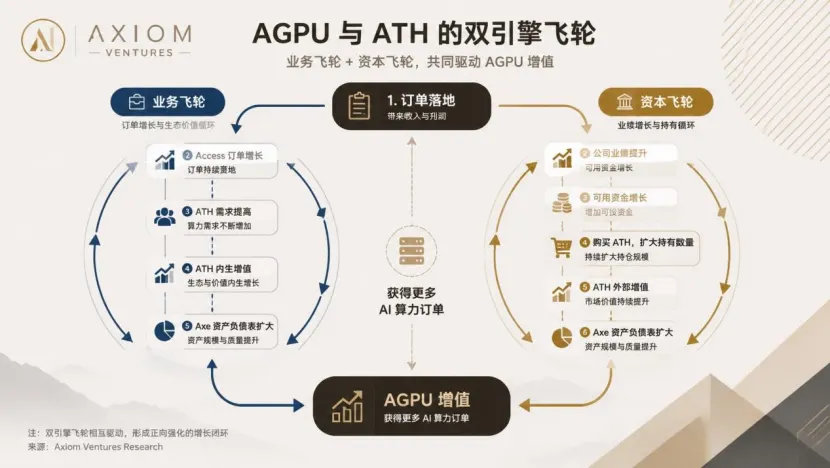
(1) Business Flywheel of AGPU and ATH: "Order-Demand-Appreciation" Cycle Driven by Access Mode
Order Landing, access order growth — ATH demand increases — ATH endogenous appreciation — Axe balance sheet expands — AGPU appreciates — Obtain more AI computing power orders
(2) Capital Flywheel of AGPU and ATH: "Performance-Capital-Increase Holding" Cycle Driven by Treasury Appreciation
Order Landing — Company performance improves, available funds grow — Purchase ATH, expand ATH holding quantity — ATH external appreciation — Axe balance sheet expands — AGPU appreciates — Obtain more AI computing power orders
The business flywheel provides endogenous demand and cash flow (Access orders directly feed ATH demand). The capital flywheel provides leveraged appreciation and asset expansion (Treasury increase holding amplifies ATH price effect), forming two deeply nested drive models — — Performance and ATH price jointly drive AGPU price increase and performance expansion. This model may become a new paradigm for the "AI x Crypto" capital model.
IV. Potential Risk Variables for Axe
Axe Compute (AGPU)'s story has huge imagination space, current market pricing does not reflect optimistic expectations for future contract landing and ATH reserve value. However, just like any high-elastic growth target, the story leads financial realization, valuation is more based on future GPU contract delivery and ATH price performance, rather than confirmed revenue and profit. Historical revenue is still at an extremely low base, real conversion of large orders and financial report verification still need time. The following are main risk variables, investors need to evaluate prudently.
1. Contract Execution and Delivery Risk
Build Program is the key for AGPU to transform from asset-light Access to semi-asset-heavy customized clusters. The $260 million B300 exclusive cluster (quarterly about $21 million revenue after going online in Q3 2026) and subsequent $1.3 billion global customer contracts have been signed. But hardware procurement, data center coordination, power deployment and enterprise-level SLA landing still have execution risks. If unable to go online on time or customer acceptance is delayed, revenue recognition will be postponed, cash flow and market confidence may be affected.
2. Revenue Conversion and Financial Report Verification Risk
2026 Q1 revenue was only $35,000 (Compute service contribution was minimal), and nearly $1.6 billion in signed orders have not yet been converted into revenue on a large scale. Wall Street analysts' 2026 revenue average expectation is about $164 million, but these predictions include second half conversion assumptions. If order landing is slower than expected, actual revenue may be significantly lower than consensus. Non-cash ATH mark-to-market losses will continue to fluctuate, increases in accounts receivable and contract liabilities also reflect potential bad debt risks under the prepaid model.
3. Macro, Market Valuation Risk
If AI Capex is lowered due to economic slowdown or technology iteration, order demand may be affected; GPU supply, energy costs and data center compliance requirements tightening may all push up execution costs. Forward P/S and P/ARR calculations are all based on the assumption that financial data can be realized, actual reasonable valuation center may have discounts due to volume and maturity differences, current high elasticity also means amplified volatility.
Overall, Axe Compute's story leads financial realization, revenue recognition rhythm and next quarter or half-year financial reports will be key verification windows. The above risk variables are not exhaustive, investors should conduct their own due diligence, fully understand related risks, and make independent decisions based on their own risk tolerance.
Overall summary: AGPU completed a splendid transformation from traditional biotechnology to AI GPU Compute entry point in less than a year, business model covers asset-light "Access Mode" + large-scale cluster construction and leasing "Build Mode" hybrid AI computing power solution, and achieved amazing $1.6 billion order contract data. Superimposing the "Compute + Treasury" dual-wheel drive model, combining business model, asset reserves and valuation unpriced comprehensive judgment, relative to current stock price, AGPU has 6–11x growth space, it is a high-elastic target worthy of key attention in the wave of AI computing power assetization.
Join TechFlow official community to stay tuned
Telegram:https://t.me/TechFlowDaily
X (Twitter):https://x.com/TechFlowPost
X (Twitter) EN:https://x.com/BlockFlow_News
 @Axiom_Invest_