On-chain US stocks become the main narrative of the cycle, ONDO up 30% in three weeks—what catalyst are funds speculating on?
TechFlow Selected TechFlow Selected
On-chain US stocks become the main narrative of the cycle, ONDO up 30% in three weeks—what catalyst are funds speculating on?
Market Watch, A Comprehensive Overview of $ONDO's Latest Catalysts.
 Navigating Web3 tides with focused insights
Author: Curry, TechFlow
When the market is down, seeing who is still rising might be an indicator of which projects are still making moves.
Bitcoin has been grinding around $63,000 for nearly a month, while most altcoins are lying on the ground unnoticed. The crypto market in the first half of this year has basically been in one state: after the meme retreat, money and attention are looking for the next destination.
Memes on Robinhood account for part of it, but there is currently a trend of dwindling activity; RWA is another high-conviction battlefield.
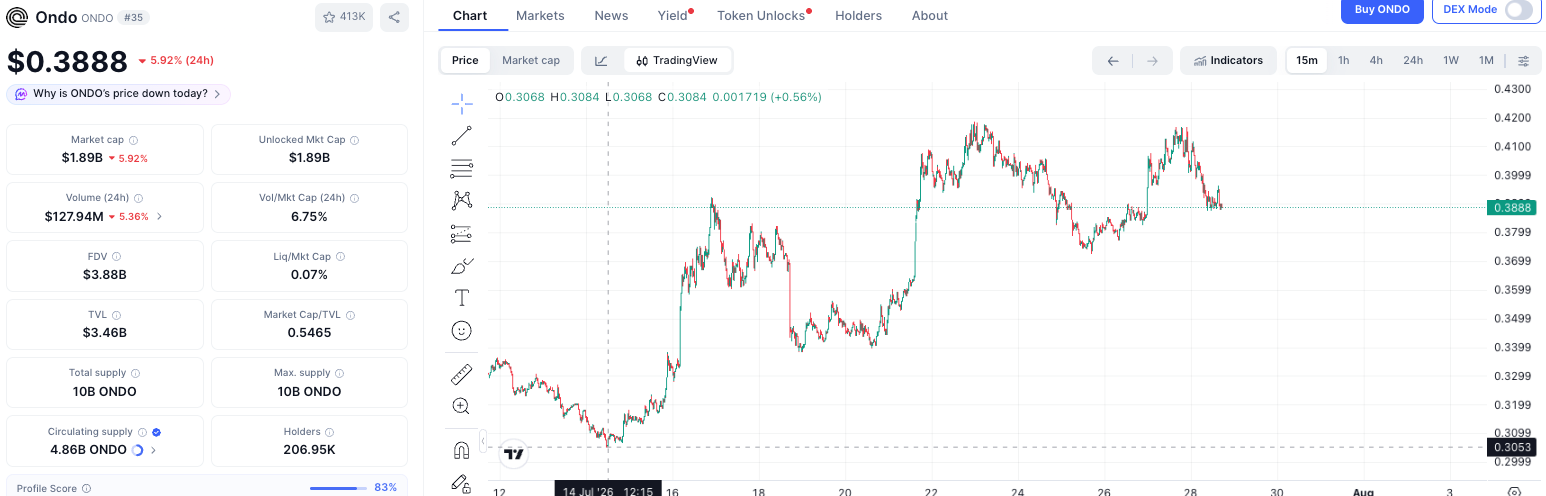
For example, the ONDO token was at $0.31 in early July and is now near $0.40, rising nearly 30% in three weeks. This could of course be market makers pumping or market cap management. But what's more interesting is that ONDO's rise is happening within a larger context.
On Hyperliquid, trading volume for tokenized stocks and commodities reached $25.1 billion in the third week of July. According to Startup Fortune, this exceeded the trading volume of crypto assets on the platform for the first time.
Trade[XYZ] has listed on-chain contracts for SpaceX and the latest ChangXin Memory. Tokenized stocks now account for 23 of the top 30 assets on Hyperliquid. Binance is also following suit, capturing 56% of the CEX market share for RWA perpetual contracts. Even the SEC is discussing opening an "innovation exemption" loophole for tokenized stock trading.
In other words, trading US stocks on-chain is clearly the main narrative of this crypto cycle. And Ondo happens to be the one making the most frequent moves on this narrative recently.
Many of those US stock contracts on Hyperliquid are supplied by Ondo underneath
ONDO rising 30% this round, if you only see "another RWA concept coin rose" then you lose. Ondo's position at this table is different from Hyperliquid and Binance.
Hyperliquid and Binance are fighting for trading volume.
trade[XYZ] achieved 79% of the open interest in the RWA perpetual track, and Binance's RWA perpetual trading volume accumulated to $450 billion in the first quarter.
To use an imperfect analogy, they are running restaurants, while Ondo is supplying the ingredients.
For those tokenized stock contracts listed on trade[XYZ], a large part of the underlying assets come from Ondo Global Markets. According to AInvest, the on-chain tokenized stocks accessed by Hyperliquid via Felix Protocol in May this year also used tokens issued by Ondo.
According to RWA.xyz data, Ondo Global Markets' share in the tokenized stock issuance end exceeds 70%, with TVL exceeding $5 billion and cumulative trading volume exceeding $18 billion.
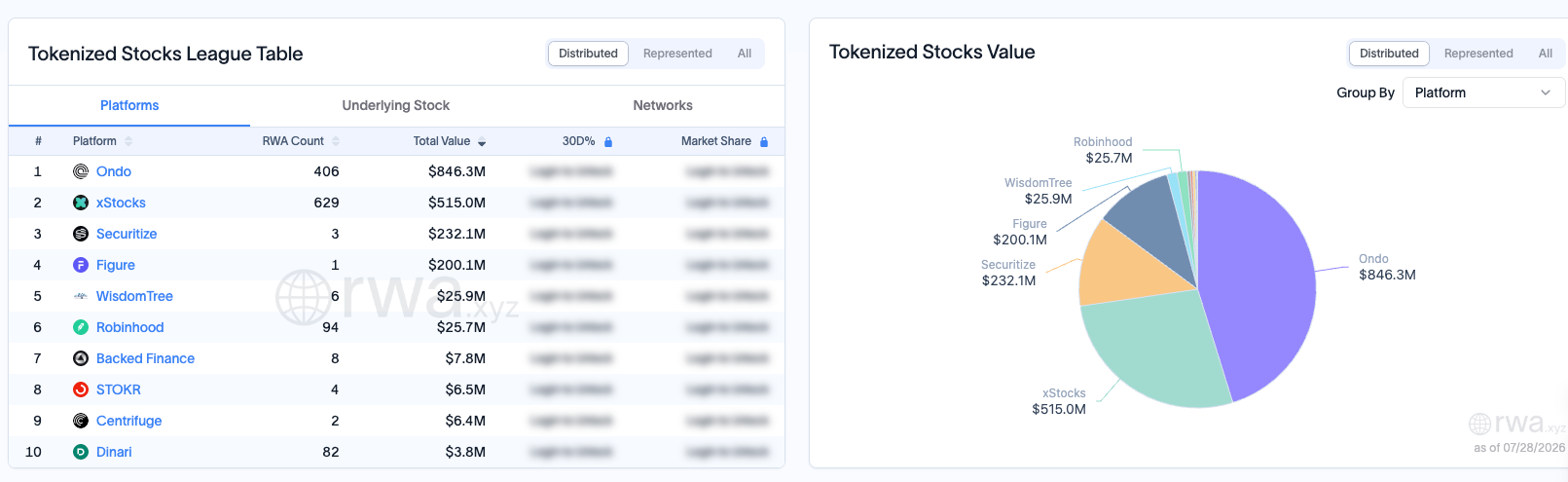
There are over 260 tokenized US stocks and ETFs on the platform, deployed on Ethereum, Solana, and BNB Chain, distributed through channels such as Binance, Bitget, MetaMask, and Blockchain.com.
When the DTCC news came out on July 15, ONDO rose 18% that day. For a legacy coin, the market reaction was so fierce, and the reason lies here.
DTCC is the settlement and clearing hub for US stock transactions; almost all US stock transactions eventually go through it. The on-chain US stock vouchers issued by Ondo through DTCC's tokenization service appear on the same participant list as BlackRock, J.P. Morgan, Goldman Sachs, and Nasdaq.
This is not news at the level of a "cooperation announcement"; this is news at the level of distribution channels.
When Ondo goes from supplier to opening its own store, Perps data analysis
After occupying 70% of the upstream share, Ondo is starting to eat downstream.
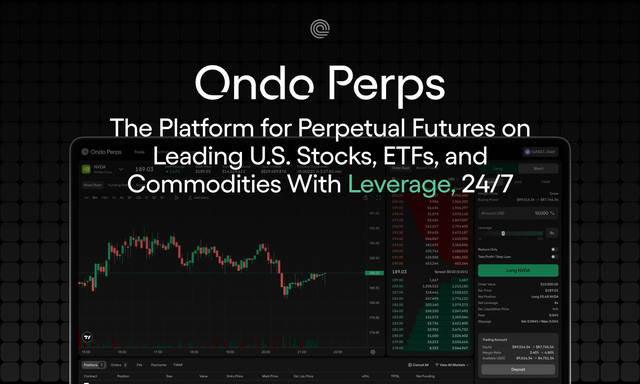
Ondo Perps, launched on July 7, equals Ondo opening its own trading platform. US stocks, ETFs, and commodity perpetual contracts, with up to 20x leverage.
This platform has a feature that others cannot currently achieve: using tokenized stocks issued by Ondo directly as margin. If you hold Apple or Nvidia tokens on-chain, you can use them directly to open positions.
On Hyperliquid or other perps platforms, you have to convert assets to USDC or USDT first to use as margin, because the trading platform and the asset issuer are two different parties. Ondo has combined issuance and trading, eliminating the friction in between.
According to the DefiLlama RWA Perps list, as of July 28, Ondo Perps 24-hour trading volume was $221 million, ranking fourth.
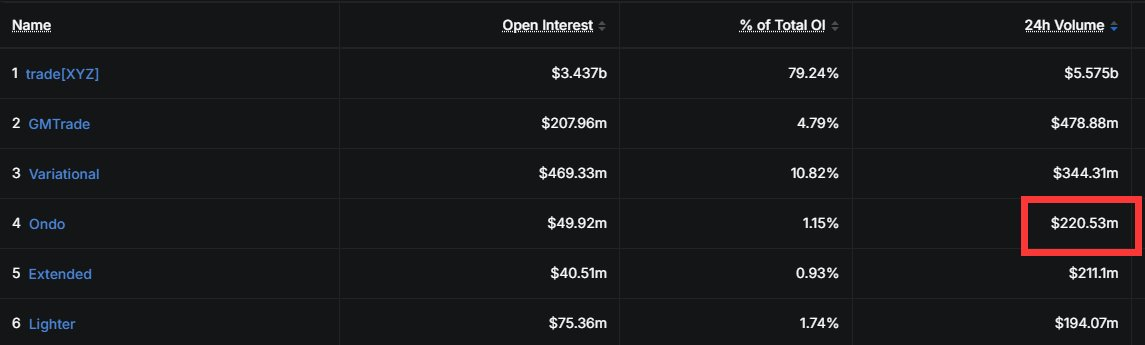
The growth rate is indeed fast, but open interest is only $49.92 million, accounting for 1.15% of the total market. Trading volume divided by open interest is 4.4 times, indicating that money comes in, turns over, and leaves on the same day, leaving overnight positions very thin.
For comparison, the same metric for trade[XYZ] is 1.6 times, with capital retention obviously thicker.
Comparing the $221 million daily trading data with Hyperliquid's $25.1 billion weekly trading volume, it is definitely a fraction. But Ondo Perps is not eating the same batch of users.
What it does is convert holders in its $5 billion+ asset pool into traders, earning trading fees from issuance fees. The play of this logic may not lie in whether daily trading volume can catch up with Hyperliquid; whether open interest can move up from $50 million is more critical. Trading volume can be boosted by market making and incentives, but overnight positions cannot be forced.
It is worth mentioning that the DefiLlama RWA Perps overall list and the Ondo Perps protocol page give two sets of numbers, differing by nearly three times (the protocol page shows 24-hour trading volume of $77.53 million, open interest $10.3 million). People following this line should lock in one caliber for vertical comparison; cross-caliber horizontal comparison is prone to failure.
Is the promised Ondo public chain not happening?
On July 27, Ondo released Ondo Network, replacing the Ondo Chain public chain plan that had been promoted for over a year.
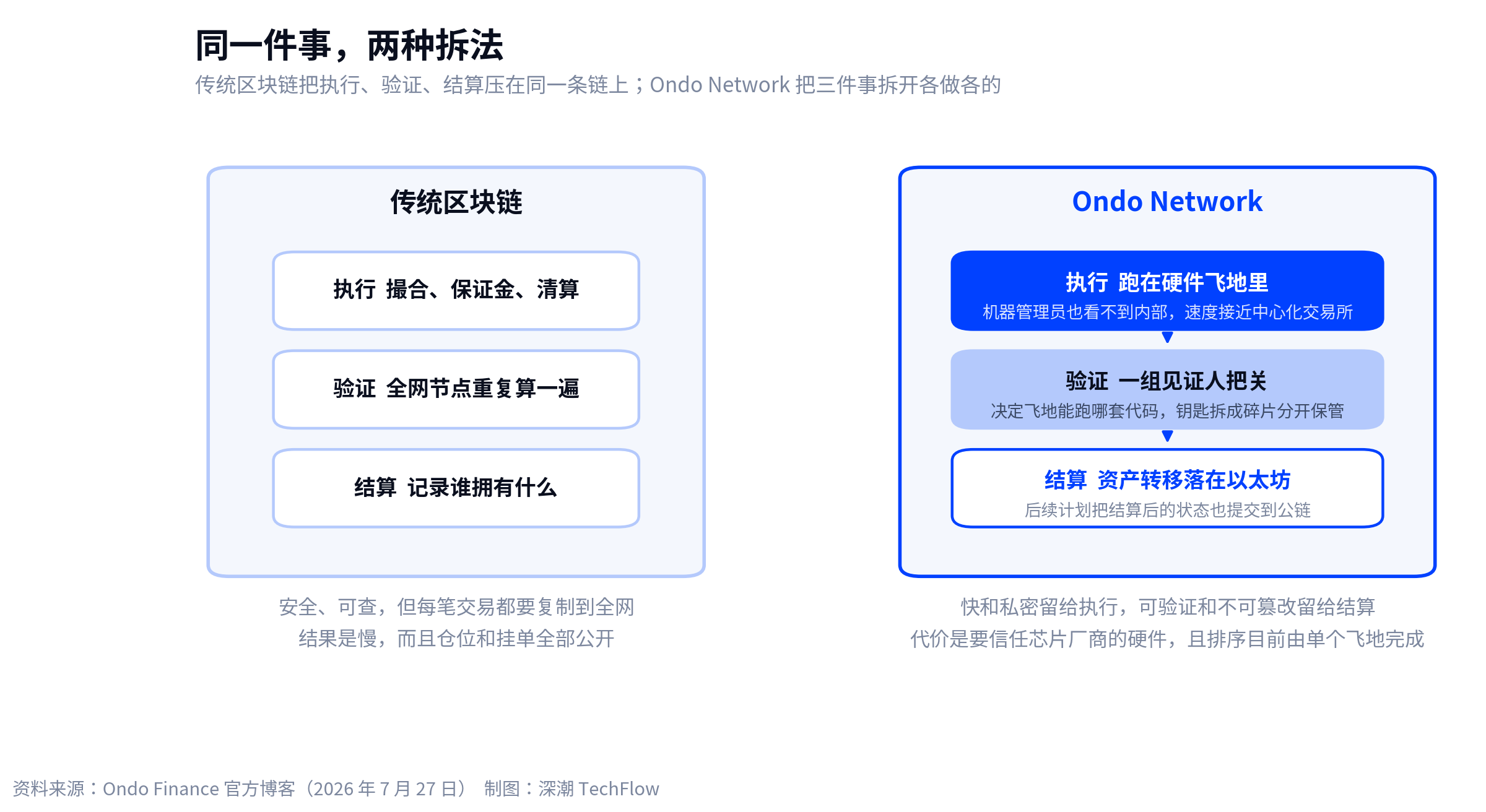
Simply put, Ondo now splits trading into two segments. Execution (matching, margin, clearing) runs in hardware enclaves, which is a closed space separated inside the chip; even server administrators cannot see what is running inside, with speed close to centralized exchanges. Settlement (who owns what) still goes through Ethereum. Ondo Perps runs on this architecture.
In my opinion, the choice not to build its own chain is more pragmatic than forcing a L1.
There have been enough lessons in the L1 track over the past two years. Building your own chain means accumulating liquidity and ecosystem from zero, while Ondo's assets are already deployed on several chains like Ethereum and Solana. Separating the execution layer allows it to travel light, with much less risk.
But the current architecture has two compromises that Ondo itself admits.
First, execution runs in a single enclave, not a distributed network; transaction verification is handed over to a group of independent operators called "witnesses," but the quantity, list, and identity are not public, which is somewhat centralized.
Second, the security of the enclave solution is anchored on the chip manufacturer. Ondo has not disclosed which manufacturer's which generation of chip hardware it is using, so the security of the chip itself must be questioned.
These technical details do not constitute buy/sell signals, but they mean that Ondo Network is currently closer to a "verifiable centralized execution layer," still some distance from the decentralized endgame described in the whitepaper.
However, for those who want to follow the ONDO token, what needs more concern is that the CEO said the ONDO token will assume incentive and governance roles in the future network decentralization, but the witness economic model and staking sharing methods are all written in "possible directions," with not a single one having a timetable.
What is the current rise of ONDO pricing in?
Breaking it down, 18% of the rise comes from the DTCC news, which is pricing in the upgrade of Ondo's distribution channels, specifically pricing in the identity of "being on the same list as BlackRock and Goldman."
Another approximately 10% comes from the SBI Group cooperation (Japan market entry) and the beta of the overall RWA sector rise.
The information released on July 27 about the architecture upgrade not doing L1 but doing the trading layer has very limited impact on token price changes.
So this hype signal is actually very clear: catalysts come more from the 70% share at the RWA issuance end and institutional distribution channels, not from the technical architecture.
From an investment perspective, ONDO's current price is $0.38, market cap is about $2 billion, down about 65% from the 52-week high of $1.13.
If you believe that trading US stocks on-chain will become a structural trend lasting several years (Hyperliquid's data that week at least shows the trend exists), then Ondo sitting on 70% share at the issuance end indeed has underlying logical support.
Ondo is indeed making big moves, and tokenized stocks are indeed the meta of this cycle, but constrained by the overall downturn of the crypto market, short-term catalysts are difficult to constitute long-term structural rises; it is more about short-term reactions to events and capital games.
Join TechFlow official community to stay tuned
Telegram:https://t.me/TechFlowDaily
X (Twitter):https://x.com/TechFlowPost
X (Twitter) EN:https://x.com/BlockFlow_News
 深潮TechFlow