Should You Buy SpaceX Stock on Its First Day of Trading? Four Strategies, Four Outcomes
TechFlow Selected TechFlow Selected
Should You Buy SpaceX Stock on Its First Day of Trading? Four Strategies, Four Outcomes
$1.75 Trillion: Buy Now or Wait?
 Navigating Web3 tides with focused insights
By Xiao Bing, TideFlow Research
On June 12, SpaceX will list on the Nasdaq at $135 per share under the ticker symbol SPCX, implying a valuation of $1.75 trillion. This will be the largest IPO in the history of global capital markets.
Fidelity, Robinhood, and Charles Schwab have all opened retail investor subscription windows, allocating 30% of shares to individual investors—with a minimum investment threshold as low as $2,000. In other words, virtually any U.S. brokerage account holder can participate.
This raises two immediate questions: Should you buy? And if so, when?
No one can provide a definitive answer. Yet, around this IPO, the market has already coalesced around several distinct strategic frameworks—each grounded in its own logic, assumptions, and historical precedents. Below, we unpack each in turn to help readers make decisions aligned with their personal risk tolerance.
Key Timing Milestones:
- June 11: IPO priced at $135/share
- June 12: Nasdaq listing (ticker: SPCX), with only 3% of shares freely tradable
- Early July: Fast-track inclusion window for the Nasdaq-100 Index (within 15 trading days post-listing)
- September: First quarterly report (Q2 2026), disclosing detailed losses from the AI division for the first time
- Following Q2 earnings: First lock-up expiration—certain insiders permitted to sell up to 20% of their holdings
- December: Broad lock-up expiration—early employees, VCs, and underwriters collectively unlock shares
- June 2027: Elon Musk’s 366-day lock-up expires
Four Strategies at a Glance:
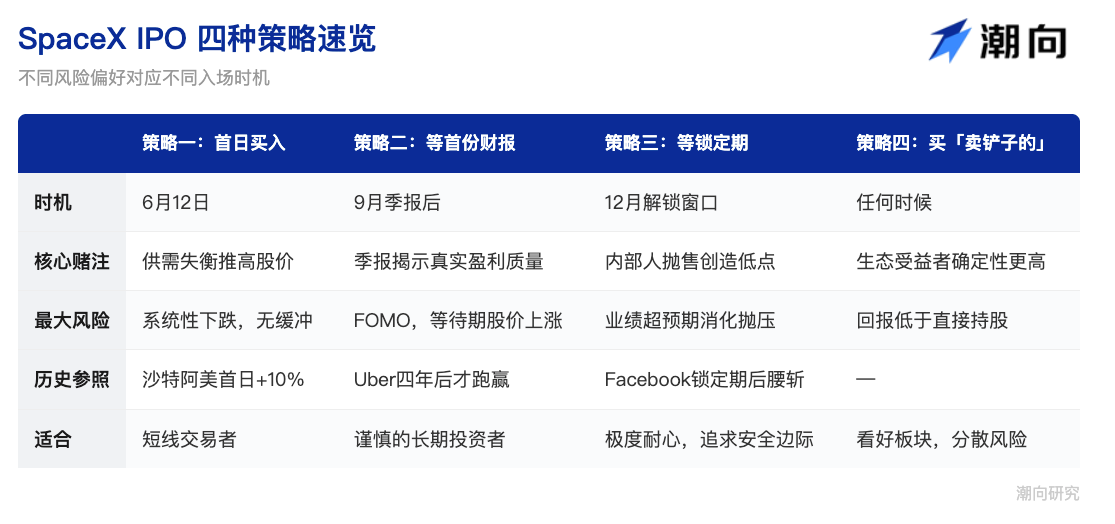
Strategy One: Buy on Day One—Bet on Short-Term Supply-Demand Imbalance
This is the most aggressive approach—its core bet is that initial stock supply will significantly lag demand.
Three structural factors support this view.
First, extremely limited float. SpaceX is issuing only ~3% of its shares in this offering; the vast majority remain held by insiders and early investors, subject to lock-up agreements. For a company valued at $1.75 trillion, just 3% free float means even modest buying interest could drive sharp price appreciation.
Second, the Nasdaq-100 fast-track inclusion mechanism. Per updated Nasdaq rules effective in 2024, SpaceX may be added to the Nasdaq-100 Index as soon as 15 trading days after listing—around early July. Once included, all passive funds and ETFs tracking the index will be compelled to buy shares, delivering a wave of highly predictable incremental capital. While Morningstar argues SpaceX is overvalued by 100%, it acknowledges this mechanism may prop up the stock in the near term.
Third, the syndicate of underwriters. Led by Goldman Sachs, Morgan Stanley, Bank of America, Citigroup, and JPMorgan Chase—and comprising 21 institutions total—the world’s top investment banks have both the incentive and capacity to stabilize the stock during the IPO’s initial phase.
Historical Reference: Saudi Aramco’s 2019 IPO priced at $25.60 and rose 10% on its first day—hitting the daily limit. However, Aramco listed solely on the domestic Tadawul exchange, where liquidity pales in comparison to the Nasdaq. SpaceX faces direct inflows from global capital.
Biggest Risk: If the broader market suffers a systemic decline during IPO week—triggered by geopolitical shocks or an unexpectedly hawkish Fed—even the strongest underwriting syndicate may fail to counteract selling pressure. Moreover, the fixed $135 pricing bypasses the traditional book-building process; should actual demand fall short of expectations, there is no price-adjustment buffer.
Strategy Two: Wait for the First Earnings Report—See Clearly Before Acting
SpaceX’s first quarterly report as a public company is expected in September 2026, covering Q2 2026 results.
The value of this report lies in its being the first disclosure—under full public-company standards—of detailed, quarterly loss figures for SpaceX’s AI business. The roadshow presentation offered only annual aggregate numbers; the quarterly report, however, requires segment-level breakdowns. Questions like “How much is xAI burning each quarter?”, “Is Starlink user growth continuing?”, and “What progress has Grok made with enterprise clients?” will all be answered here.
Simultaneously, this earnings release also marks the first lock-up expiration window. SpaceX employs an unconventional, tiered lock-up structure: certain insiders may sell up to 20% of their holdings immediately following the Q2 earnings release—far shorter than the standard 180-day lock-up period typical of most IPOs.
Historical Reference: Uber went public in May 2019 at $45 but closed its first day below the offer at $41.57. Its true bottom came in March 2020 ($13.71, pandemic lows) and again in June 2022 (~$20). Over the four years from IPO through May 2023, Uber underperformed the S&P 500 by 116 percentage points—but from May 2023 onward, it outperformed by 118 percentage points. Investors who waited for a more reasonable valuation ultimately achieved superior returns.
Suitable For: Those bullish on SpaceX’s long-term value but uneasy about the $1.75T valuation—and willing to wait three months for fuller information.
Biggest Risk: If the stock surges on Day One and continues rising after Nasdaq-100 inclusion, waiting translates into higher entry costs. FOMO is this strategy’s greatest adversary.
Strategy Three: Wait for Lock-Up Expirations—Buy the Dip Amid Insider Selling
This is the most patient strategy—its core bet is that a concentrated wave of insider selling will create a more attractive entry point.
SpaceX’s lock-up structure warrants close attention. Elon Musk’s lock-up lasts 366 days, expiring mid-June 2027. Other executives and early investors begin phased releases after the Q2 earnings report, with full unlocking scheduled by the Q2 2027 earnings release. The first major wave of concentrated unlocking is expected around December 2026.
BitMEX’s trading strategy analysis notes this timing may trigger “the largest single-day insider selling event in market history.” Early employees (many holding at near-zero cost basis), early VC investors, and underwriting banks may all become sellers simultaneously.
If AI-related losses continue expanding across Q2 and Q3 reports—and the narrative shifts from “AI tailwind” to “AI profit drag”—selling pressure will intensify further.
Historical Reference: Facebook priced its May 2012 IPO at $38. After lock-up expiry, its stock fell steadily to $17.55 in September 2012—a 54% drop from the offer price. Yet investors who bought at that low and held through today have earned over 30x returns. Lock-up-driven dips often represent the best long-term entry opportunities.
Suitable For: Those convinced SpaceX’s long-term value rests primarily on Starlink—and willing to wait 6–12 months for greater margin of safety.
Biggest Risk: If SpaceX delivers unexpectedly strong results during the waiting period—e.g., Starship achieving commercial operations, Starlink surpassing 15 million users, or the AI business turning profitable unexpectedly—the stock may rise well before lock-up expiry, rendering the anticipated dip unlikely. For high-quality companies, lock-up expiry doesn’t always trigger declines: Netflix and Amazon both rebounded swiftly post-lockup.
Strategy Four: Skip SPCX—Buy the “Pick-and-Shovel” Providers
Avoid direct participation in the SpaceX IPO altogether, instead investing in companies and instruments with clear, structural exposure to the SpaceX ecosystem.
Promising avenues include:
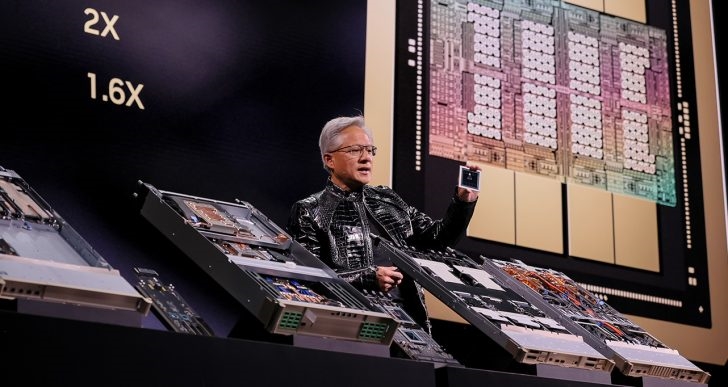
In hardware supply chains: SpaceX’s Colossus data centers use NVIDIA GB200 and GB300 chips; Starship’s avionics and Starlink terminals rely heavily on custom silicon. NVIDIA (NVDA) stands as the most direct upstream beneficiary; if the Terafab chip factory materializes, Intel (INTC) would also benefit.
Via ETF exposure: The Cambria ERShares Private Investments ETF (XOVR) holds a special-purpose vehicle (SPV) with SpaceX exposure. As of April 2026, reported SpaceX exposure exceeded 40% of XOVR’s total portfolio. Following SpaceX’s inclusion, the Nasdaq-100 ETF (QQQ) will also gain automatic exposure.
Suitable For: Those believing SpaceX’s listing will lift the entire space and AI infrastructure sector—but unwilling to bear concentrated risk tied to a single stock trading at a $1.75T valuation.
Biggest Risk: Indirect exposure may not match—or even exceed—the returns of direct ownership. If SpaceX surges post-listing, observers risk substantial opportunity cost.
TideFlow Commentary
None of these four strategies is inherently right or wrong. Their distinction lies in how investors weigh two variables: SpaceX’s long-term intrinsic value, and the time required for the market to digest its $1.75T valuation.
If you believe Starlink’s growth alone justifies a $600B+ valuation—and that the long-term optionality embedded in space-based computing truly merits $1 trillion—then buying and holding long term makes sense at any price. Conversely, if you believe the current 94x revenue multiple demands time to normalize—and that lock-up expirations and AI-loss disclosures represent foreseeable pressure points—then waiting for a better entry price is the more rational choice.
No one is obligated to decide on Day One of the largest IPO in history. SpaceX won’t vanish after June 12—it will keep launching rockets, and Starlink will keep adding users. The sole difference is that waiting grants investors more information—and greater margin of safety.
In capital markets, the cost of missing a rally is almost always far less than the cost of getting trapped at the wrong price.
Disclaimer: This article reflects only the analytical views of TideFlow Research and does not constitute investment advice. SpaceX (SPCX) has not yet commenced formal trading. All valuations, pricing, and timelines cited herein are based on publicly reported information and the S-1 filing, and remain subject to change. Investors should carefully read SpaceX’s SEC-filed prospectus, fully understand all associated risk factors, and make independent investment decisions based on their own financial circumstances and risk tolerance.
Join TechFlow official community to stay tuned
Telegram:https://t.me/TechFlowDaily
X (Twitter):https://x.com/TechFlowPost
X (Twitter) EN:https://x.com/BlockFlow_News
 @BlockFlow_News