An AI Read SpaceX’s IPO Prospectus and Wrote This Investment Memo in 12 Minutes
TechFlow Selected TechFlow Selected
An AI Read SpaceX’s IPO Prospectus and Wrote This Investment Memo in 12 Minutes
As AI agents gain the ability to pay for data themselves and make independent decisions about analytical pathways, the way Wall Street operates is being restructured.
 Navigating Web3 tides with focused insights
Author: Nick Prince
Compiled by TechFlow
TechFlow Intro: An AI agent autonomously completed work that would normally take an investment analyst team days: reading SpaceX’s 226MB S-1 filing, purchasing real-time market data on Base using USDC, and generating an Investment Committee memo—including multi-faceted analysis, valuation modeling, and a risk matrix—at a total cost of just $1.87. This is not a demo—it’s a real record of paid API calls. When AI agents can pay for data themselves and independently decide their analytical path, Wall Street’s operating model is being fundamentally restructured.
An AI agent read SpaceX’s 226MB S-1 filing—submitted Monday—bought real-time market data using USDC on Base, and generated this Investment Committee memo within 12 minutes. Total cost: six paid API calls, $1.87 in USDC, no API keys required.
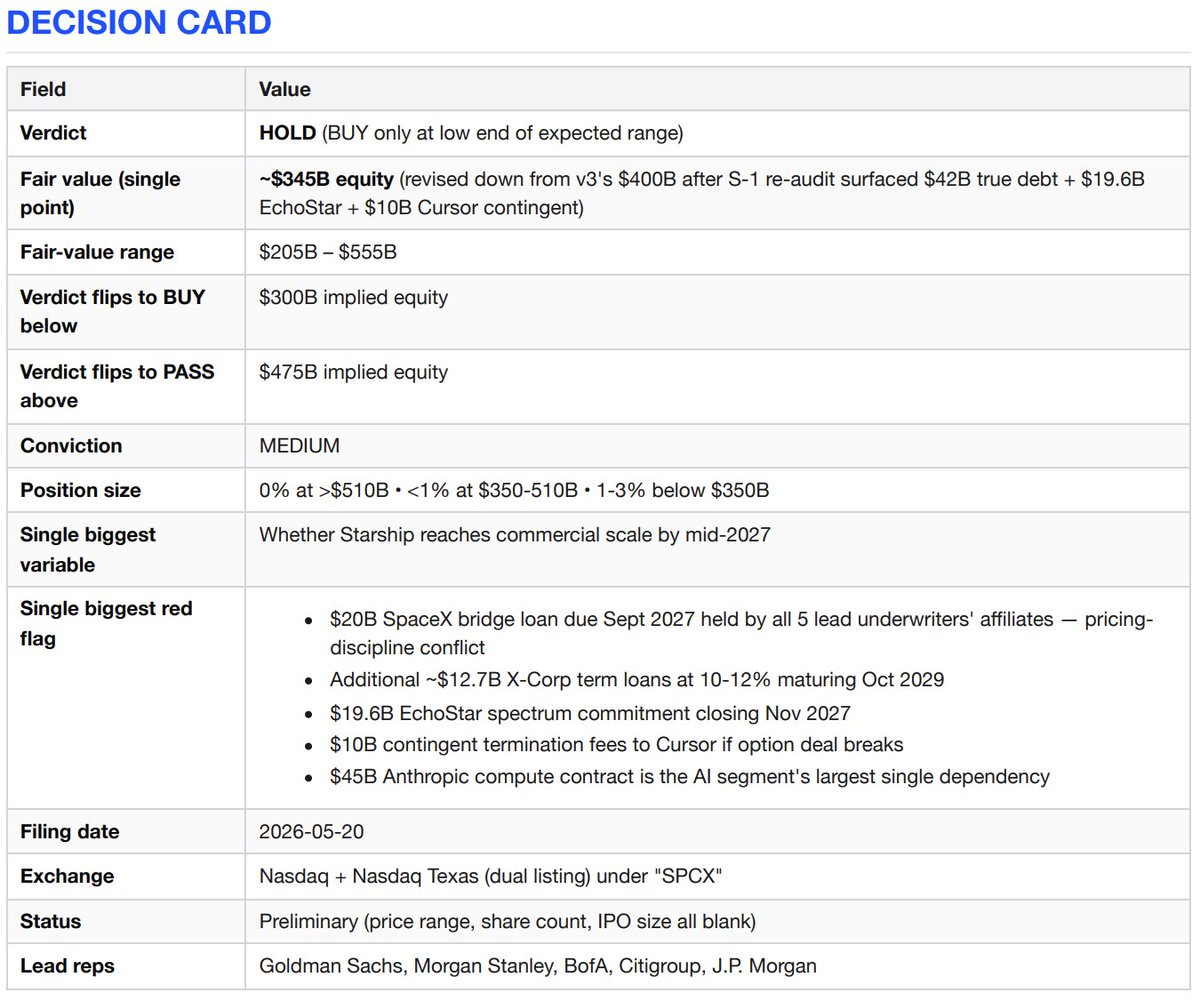
Decision Card (Conclusion = Hold)
Bull Case
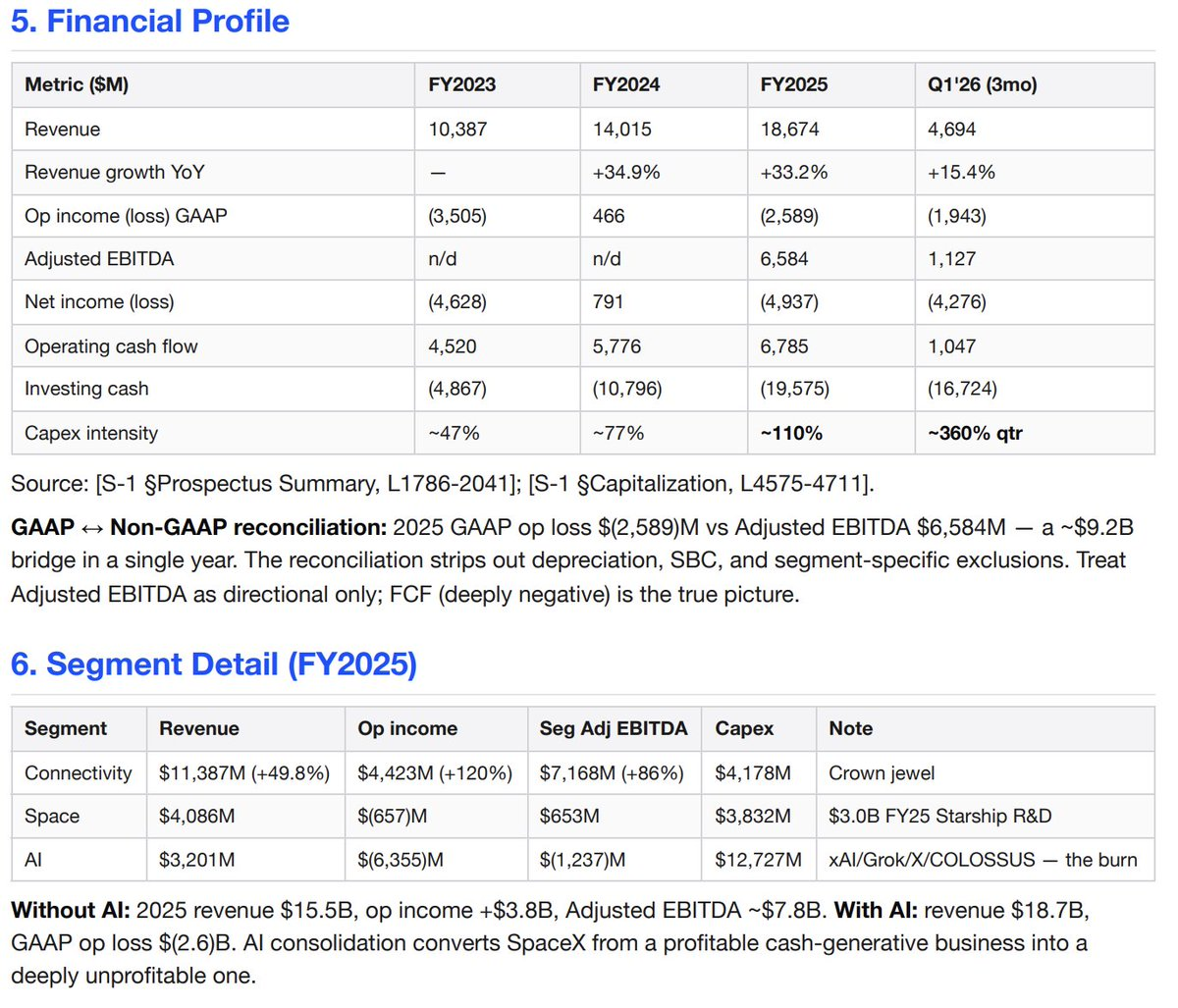
SpaceX operates three businesses competitors cannot replicate. First, near-monopoly access to commercial spaceflight—accounting for 80% of global mass launched to orbit since 2023, with Falcon mission success rates at 99% and reusable launch technology leading peers by a decade. Second, the world’s only deployed low-earth-orbit (LEO) broadband network—Starlink serves 10.3 million subscribers across 164 countries, up 49.8% year-on-year, with segment-adjusted EBITDA of $7.2 billion. Third, since its acquisition of xAI in February 2026, SpaceX has become the only vertically integrated AI lab extending down to the launch vehicle level—and plans to deploy orbital computing capacity. Under any reasonable valuation methodology, this is a generational asset.
Bear Case
The Connectivity business is real and profitable. But everything else either burns cash at an astonishing pace—the AI division posted $3.2B in revenue and $6.4B in operating losses in 2025—or hinges on Starship, which has completed 11 flight tests but has yet to deliver payloads to orbit. This IPO is partially a refinancing event. SpaceX borrowed $20B in bridge financing to acquire xAI, maturing in September 2027—and those bridge lenders are precisely the IPO underwriters. If the valuation exceeds $500B, you’re paying for unproven execution capability, corporate governance you have no right to scrutinize, and a refinancing transaction the underwriters must succeed at.
Investment Thesis
Starlink is an outstanding standalone business. Revenue in 2025: $11.4B (+49.8%), operating income: $4.4B (+120%), segment-adjusted EBITDA: $7.2B (+86%). Premium subscription service, with 10.3 million paying users.
The launch business is unique. Since 2023, SpaceX has accounted for over 80% of global mass launched to orbit, Falcon success rate exceeds 99%, and Falcon 9 first stages have flown up to 34 times.
Vertical integration is real and compoundable: rockets → satellites → spectrum (the EchoStar AWS-4/H-band transaction has received FCC approval) → AI compute (two COLOSSUS clusters totaling ~1GW).
Government dependence is a moat—not a risk. Primary U.S. national security launch provider: executed 11 of 12 National Security Space Launch missions in 2025, and all five NASA crewed and cargo flights.
Option value of orbital AI compute, planned for deployment in 2028. If Starship achieves even 50% of its targeted economics—i.e., a 99% reduction in launch costs—the addressable market expands by an order of magnitude.
Counterarguments
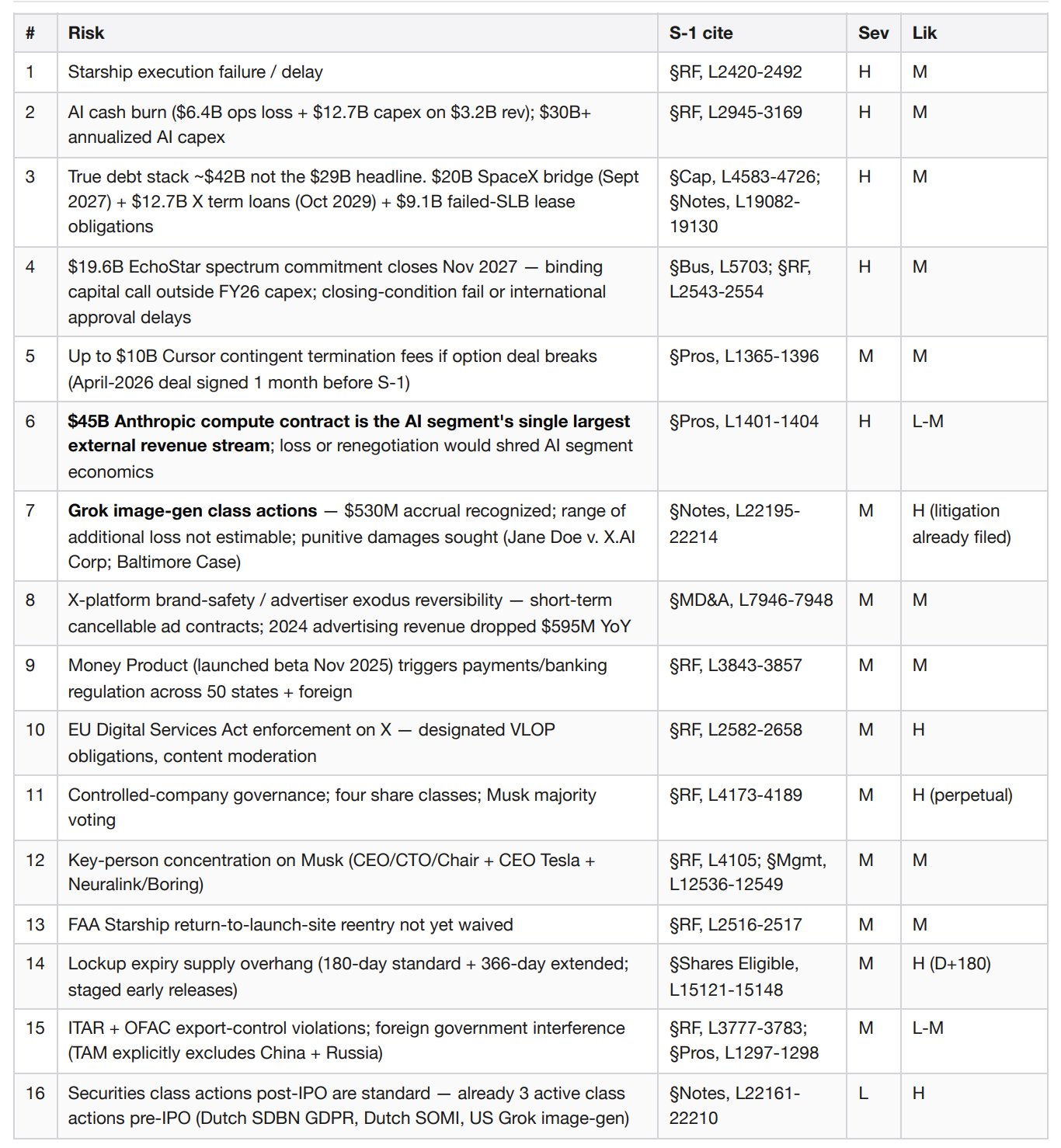
The AI division is a bottomless pit burning over $6B annually. In 2025: $3.2B revenue vs. $6.4B operating loss, segment-adjusted EBITDA negative $1.2B, capex $12.7B. Q1 2026 alone: $818M revenue vs. $2.5B operating loss, capex $7.7B. Annualized AI capex now exceeds $30B, while AI revenue remains only $3.2B.
Total debt is ~$42B—not the headline $29B figure. Composition: ~$20B SpaceX bridge loan (maturing September 2027), ~$6.7B X Corp B-1 term loan and ~$6B X Corp B-3 term loan (both maturing October 2029, effective interest rate 10–12%), plus ~$9.1B in “other financing,” including obligations arising from failed sale-leaseback arrangements for AI infrastructure. X-related loans alone generate ~$1.2–1.3B in annual interest expense, booked to the AI division.
The $19.6B EchoStar spectrum commitment closes in November 2027. Equity-plus-cash consideration secures 65MHz of U.S. spectrum and global mobile satellite services licenses. This is a binding capital commitment beyond the bridge loan and FY2026 capex.
The option agreement with Cursor could trigger up to $10B in termination fees. SpaceX signed a compute and option agreement with Anysphere (Cursor) in April 2026—one month before this S-1 filing—implying a Cursor valuation of $60B. Either party’s termination triggers a $1.5B termination fee plus $8.5B in deferred service fees, payable in cash or Class A stock.
The $45B Anthropic contract is the AI division’s largest single external revenue source. The cloud services agreement, signed in May 2026, commits Anthropic to $1.25B monthly payments through May 2029. SpaceX is selling COLOSSUS compute capacity to cutting-edge model companies that are also direct competitors—creating extreme counterparty concentration risk.
A $530M litigation reserve is recorded on the balance sheet for the Grok image-generation class-action lawsuits—Jane Doe v. X.AI Corp. (filed January 2026), Jane Doe 1 (March), and the Baltimore case (March). Plaintiffs seek compensatory, statutory, and punitive damages. The S-1 explicitly states that additional loss exposure cannot be reasonably estimated.
Q1 2026 revenue growth slowed to 15.4% ($4.69B vs. $4.07B YoY), below the full-year 2025 growth rate of 33.2%.
SpaceX will be a controlled company with four classes of equity. Musk retains majority voting power post-IPO. The company will rely on Nasdaq’s controlled-company exemption, waiving requirements for independent compensation and nominating committees.
Adjusted EBITDA masks ~$9B. Management’s headline 2025 number is $6.6B “adjusted EBITDA,” whereas GAAP operating loss was ($2.6B). Adjustments exclude depreciation, stock-based compensation, and division-specific exclusions.
Company Overview
SpaceX (Space Exploration Technologies Corp.; SEC CIK 0001181412) designs and operates reusable launch vehicles, the world’s largest LEO satellite constellation (~9,600 broadband satellites + ~650 direct-to-cell satellites), and—following its acquisition of xAI in February 2026—gigawatt-scale AI training infrastructure. Three reportable segments: Space, Connectivity (10.3M Starlink subscribers), and AI (Grok models, the X social platform with 550M monthly active users, and COLOSSUS/COLOSSUS II compute clusters). 2025 revenue: $18.7B; GAAP operating loss: ($2.6B); cash on hand: $15.85B against $29.1B in long-term debt listed on the capitalization schedule.
X (Social Platform) Is a Business Unit—Not a Footnote
The corporate chain merits re-tracing. SpaceX acquired xAI in February 2026. xAI acquired X Holdings in March 2025. X Holdings acquired Twitter in October 2022. Result: Twitter/X is now consolidated into SpaceX’s AI division—with its own balance-sheet line items, its own litigation, and its own debt structure.
Scale. Supported 1.3B accounts over the last 12 months, 550M monthly active users (up from 520M in December 2025), and 350M daily posts. Of these MAUs, 117M use Grok features—X is the model’s primary distribution channel. Money products (payments, banking, financial services) entered beta in November 2025 and are progressing toward full availability. X Ads Manager began phased rollout in April 2026.
Financial contribution. AI division revenue in 2023–2024 came almost entirely from X—advertising, X Premium subscriptions, and data licensing. In 2024 alone, ad revenue declined $595M due to “X losing advertising partners,” partially offset by $157M growth in X Premium subscription revenue and $90M growth in data licensing.
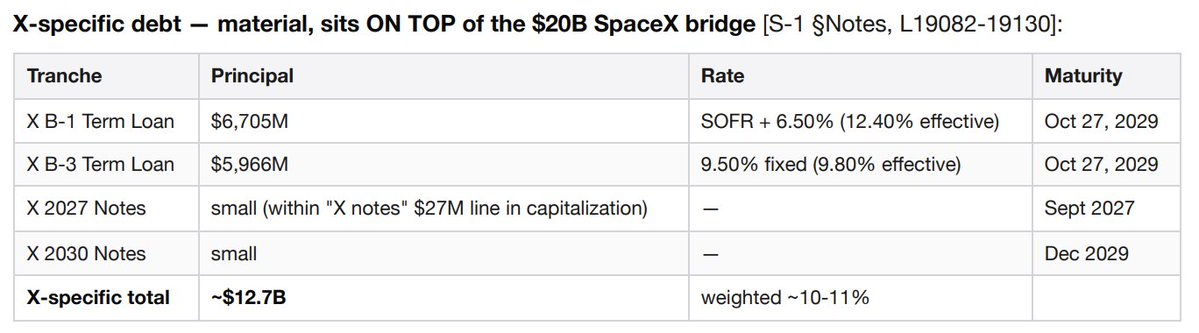
Adding the $20B SpaceX bridge loan (September 2027) and $9.1B “other financing” line item yields ~$42B in total long-term debt—not the $29B headline number on the capitalization schedule.
X-specific risks absent elsewhere in SpaceX’s business. Enforcement of the EU’s Digital Services Act (DSA) against Very Large Online Platforms (VLOPs). Advertiser brand-safety reversibility on short-term, cancelable contracts—2024’s mass exodus could recur within a single news cycle. Money products trigger payment/money transmission/banking regulation across all 50 U.S. states and every foreign jurisdiction. Reversals in content moderation policy could simultaneously trigger advertiser pauses and user migration.
Market Position—Real-Time Comparable Data
This comparison table was assembled in real time during analysis, sourcing bulk fundamental data for all five comparable companies via a $0.10 payment to Jintel’s GraphQL endpoint. No Bloomberg Terminal. No FactSet contract.
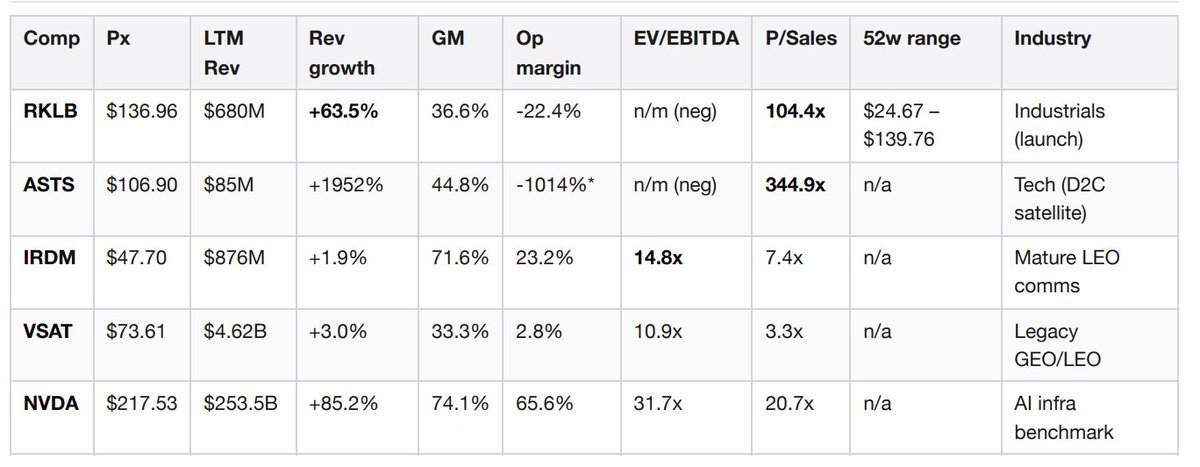
ASTS’ operating margin reflects pre-revenue scale-up investments. Source: Jintel entitiesByTickers via x402 on Base, retrieved 2026-05-22.
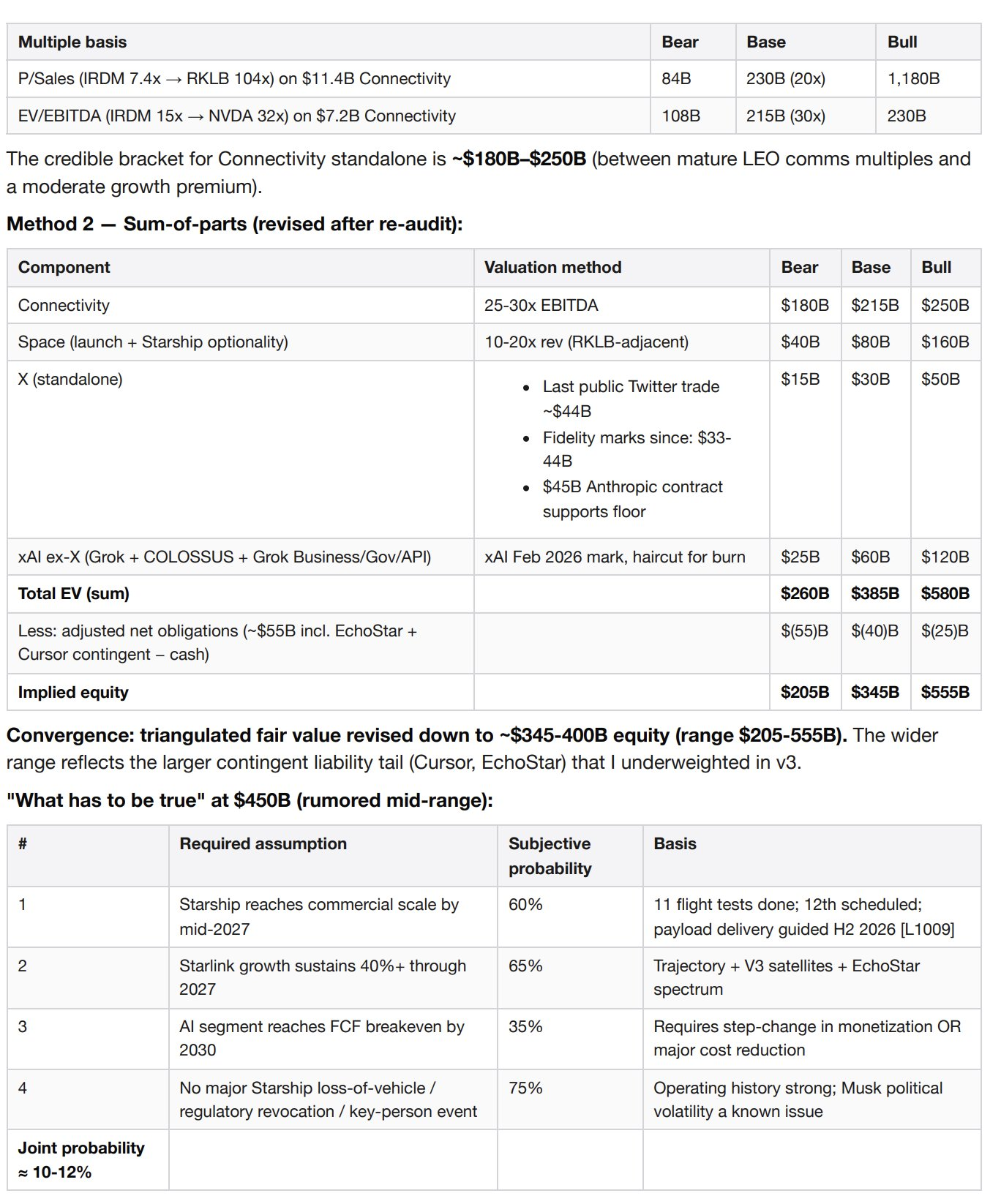
Interpreting the peer group. Rocket Lab’s 104x P/S multiple is the closest narrative proxy—investors pay high multiples for scalable reusable launch + LEO optionality, even with negative margins. SpaceX should command a higher multiple than RKLB—but mechanically applying 104x to SpaceX’s Connectivity-only $11.4B revenue implies $1.2T equity value, anchoring to nothing. AST SpaceMobile’s 345x P/S is purely pre-revenue narrative valuation, serving only as an upper-bound reference for direct-to-cell optionality. Iridium’s 7.4x sales and 14.8x EBITDA represent mature, profitable LEO communications—applying 7.4x to Starlink’s $11.4B yields an $84B standalone Starlink valuation (bear anchor). NVIDIA’s 31.7x EV/EBITDA corresponds to 85% revenue growth—the level the AI division must reach to merit fundamentals-based valuation. It hasn’t yet.
Notable signal. Rocket Lab filed its 424B5 prospectus supplement on May 20, 2026—the same day SpaceX released its S-1. RKLB’s secondary equity offering during the SpaceX news cycle signals management believes the IPO window is open—and competitive supply pressure is imminent.
Pending Major Transactions & Contingent Obligations
These four items are individually material—and mutually compounding. Two were signed within 60 days prior to this S-1 filing.
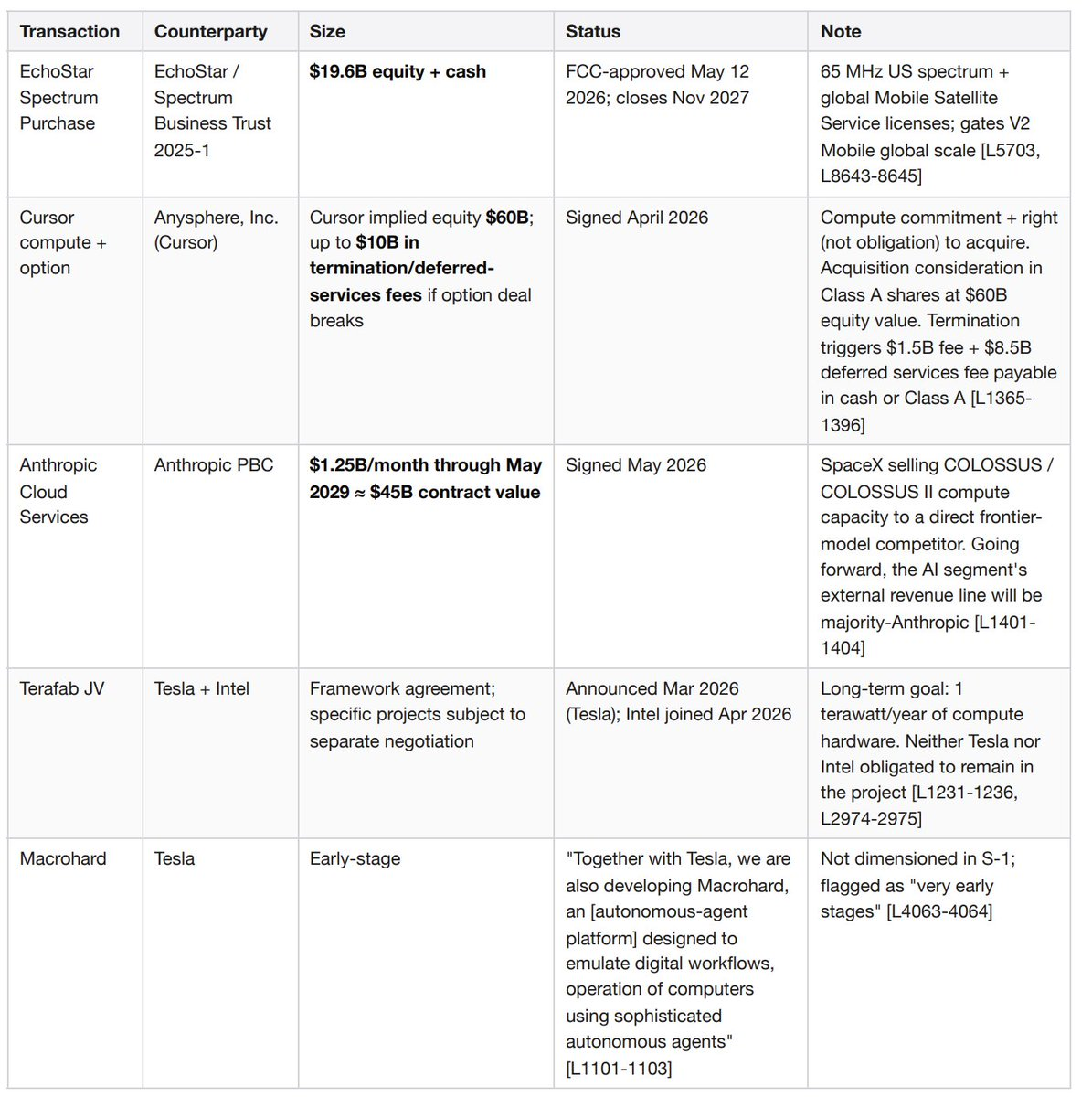
Why this matters for valuation. A clear “adjusted net obligation” view is: $42B total debt + $19.6B EchoStar commitment + up to $10B Cursor contingent liability − $15.85B cash on hand = ~$55B net obligation—before accounting for any IPO proceeds. That’s three to four times the simple number on the capitalization schedule, materially altering the bear case.
Valuation
Method 1—Based on standalone trading multiples for the Connectivity segment, as it is the only segment with positive standalone economics.
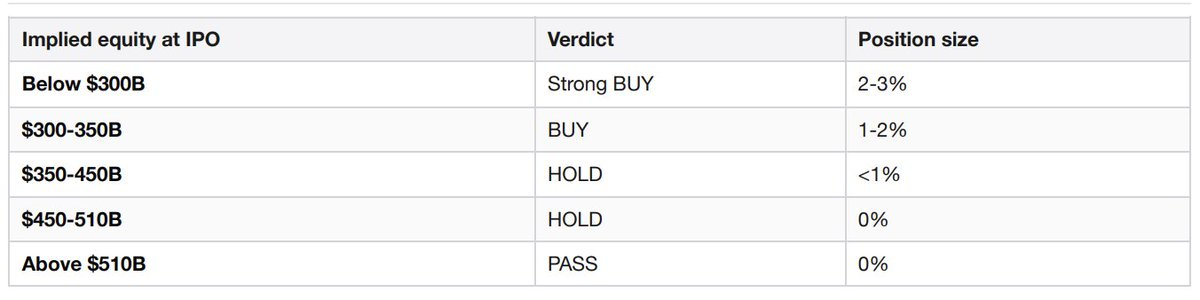
Position Size Ladder
Key Risks (Severity × Likelihood)
Underwriter Conflict of Interest
This point is buried deep in the underwriting section and rarely covered in news reports—but it is highly material. The five lead underwriters (Goldman Sachs, Morgan Stanley, Bank of America, Citigroup, JPMorgan Chase) plus five additional bookrunners (Barclays, Deutsche Bank, RBC, UBS, Wells Fargo) have affiliated entities that are lenders on the $20B SpaceX bridge loan—which this IPO is now priced to refinance. Morgan Stanley additionally served as advisor to SpaceX on its acquisition of xAI (funded by that very bridge loan). The syndicate has a direct financial incentive to maximize IPO proceeds. This should keep the Investment Committee vigilant on pricing discipline.
Related-Party Density
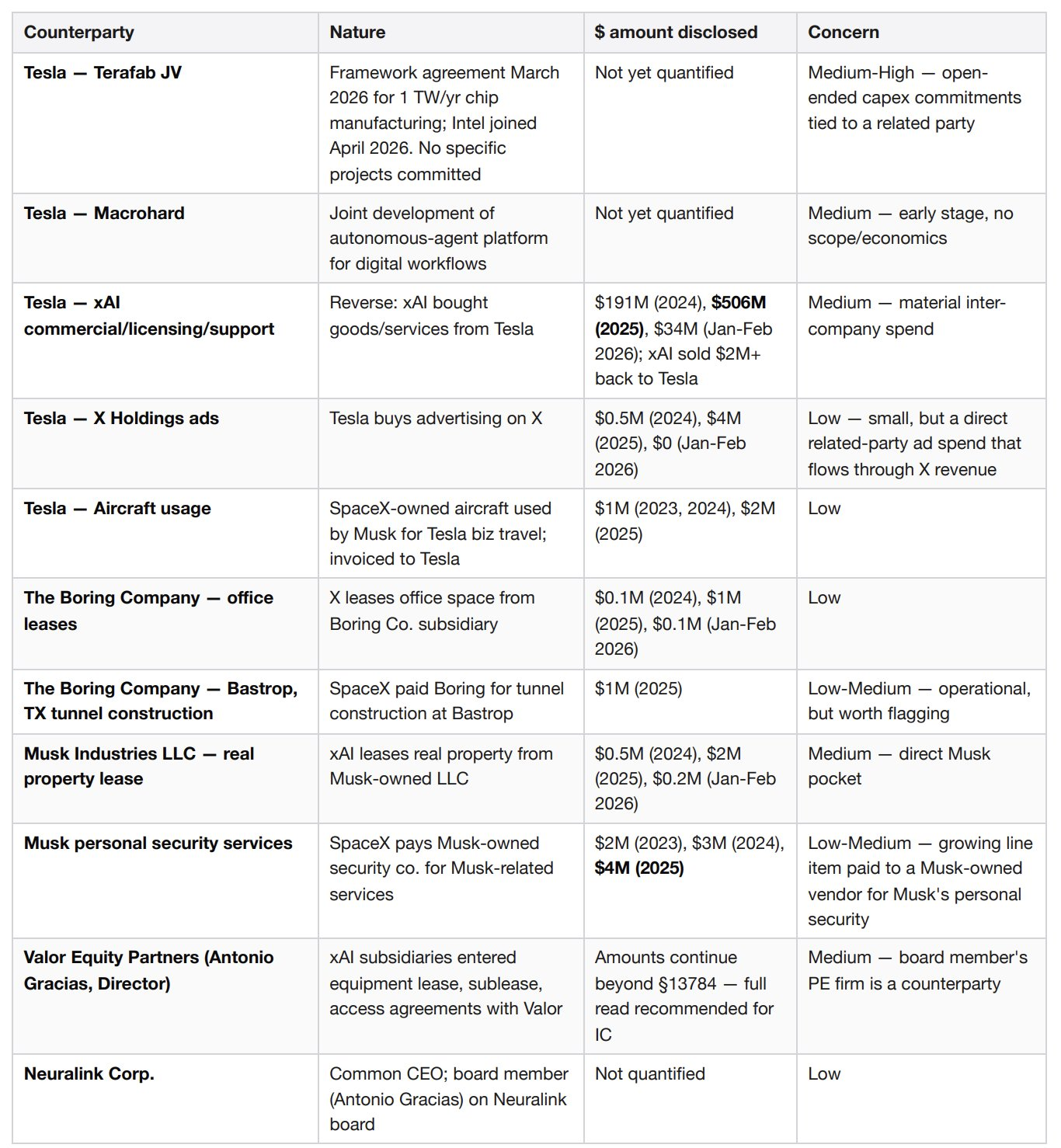
No single relationship appears alarming on its own. What is alarming is the density—Elon Musk’s network of controlled entities has at least nine distinct financial touchpoints with SpaceX. Public company governance committees typically review one or two such relationships. Here, there are ten times as many.
Decision Triggers
If the offering prices at an implied equity value of $350B or lower, Starship achieves commercial payload delivery in H2 2026 per guidance, and Q2 2026 Connectivity revenue growth exceeds 40% YoY, upgrade to Overweight.
If the offering prices above $510B, a Starship vehicle loss delays V3 satellite deployment beyond 2027, AI division cash burn accelerates to >$8B annualized operating loss in Q2–Q3 2026, or the FAA imposes a prolonged Starship grounding, downgrade to Avoid.
First 180 Days + Multi-Year Observation List
D+1: First-day pop benchmarked against comparable IPOs
D+30: First quarterly earnings (Q2 2026)—triggers early release of lockup tranches (20% immediate release; +10% additional if share price rises 30% above IPO price)
D+70, +90, +105, +120, +135: Phased early-release lockup tranches, each 7%
D+90: Quiet period ends; sell-side analysts initiate coverage
D+180: All standard lockup tranches expire
H2 2026: Starship delivers commercial payload per guidance
Q2–Q3 2026: Procedural milestones in Grok image-generation class actions (monitor whether $530M reserve increases)
April 2027: One-year anniversary of Cursor option agreement—watch for exercise or termination signals
September 2027: $20B SpaceX bridge loan matures (must be refinanced or repaid)
November 2027: $19.6B EchoStar spectrum transaction closes—global V2 mobile rollout contingent on this
May 2029: $45B Anthropic compute contract expires; renewal terms will define AI division economics for years ahead
October 2029: Combined $12.7B X Corp B-1 and B-3 term loans mature
Sources
SpaceX S-1, SEC File No. 0001628280-26-036936, filed 2026-05-20
Real-time comparable fundamentals via Jintel GraphQL entitiesByTickers, x402 on Base, retrieved 2026-05-22
Real-time SEC consolidated filings via x402helper /companies/profile for RKLB, IRDM, VSAT, retrieved 2026-05-22
Industry IPO context via Parallel Search, x402 on Base, retrieved 2026-05-22
Four Scenarios for the SpaceX IPO—Acadian Asset Management
Generated by the IPO Analysis Package on agentic.market. Six paid x402 calls. $1.87 USDC on Base. No API key. No registration. Pay-per-use.
A Bloomberg Terminal seat costs $24,000/year. This memo demonstrates what agents can now produce when they can pay for data themselves.
Join TechFlow official community to stay tuned
Telegram:https://t.me/TechFlowDaily
X (Twitter):https://x.com/TechFlowPost
X (Twitter) EN:https://x.com/BlockFlow_News
 @Nick_Prince12