Musk’s Net Worth Surpasses Bitcoin’s Market Cap: SpaceX’s Explosive Wealth Game
TechFlow Selected TechFlow Selected
Musk’s Net Worth Surpasses Bitcoin’s Market Cap: SpaceX’s Explosive Wealth Game
The largest speculative trade in the market is no longer necessarily a token, but rather a rocket company.
 Navigating Web3 tides with focused insights
Author: CryptoSlate
Translation & Editing: TechFlow
TechFlow Intro: Within one week of its IPO, SpaceX’s stock surged over 50%, lifting Elon Musk’s personal wealth to $1.32 trillion—surpassing Bitcoin’s $1.29 trillion market cap. This is not Bitcoin’s failure; rather, speculative capital is exiting the crypto market and flooding into SpaceX—a “$2 trillion meme stock.” Yet the company posted nearly $5 billion in losses in 2025, and its current valuation hinges entirely on Musk’s promise of $1 trillion in annual revenue by 2030. How long can this bet last?
According to the Bloomberg Billionaires Index, Musk’s net worth has risen to approximately $1.32 trillion as SpaceX’s share price breaches $200—exceeding Bitcoin’s ~$1.29 trillion market cap.
This milestone underscores how SpaceX’s explosive post-IPO rally has reshaped global wealth rankings and shifted the market’s focus in discussions around speculative risk.
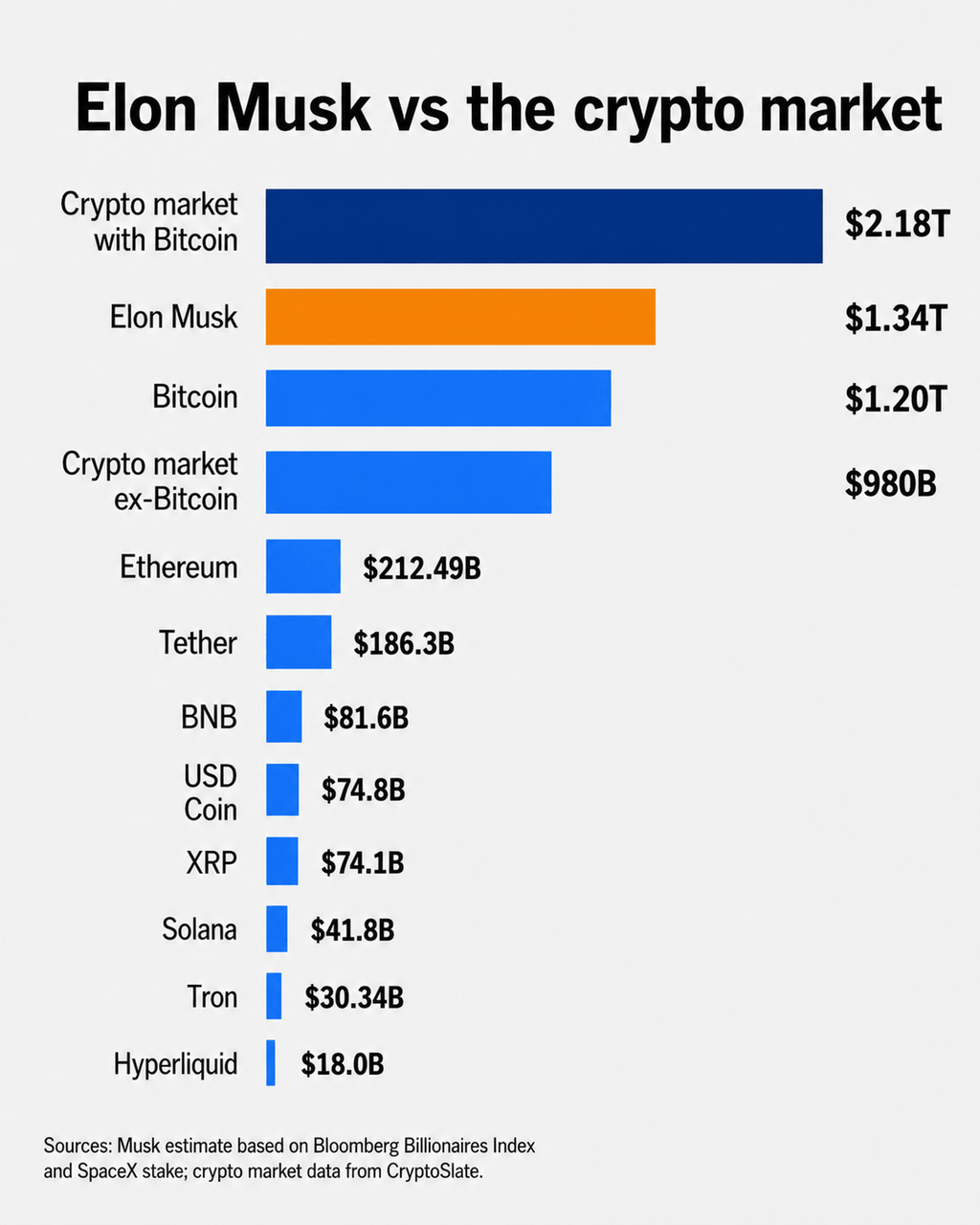
While this comparison is inherently imprecise, it vividly illustrates how SpaceX’s rapid ascent has captured global market attention—and propelled Musk’s wealth to unprecedented heights.
Bitcoin’s Pullback Makes the Comparison Possible
Bitcoin remains the largest digital asset by market cap—but its lead has narrowed amid a broader crypto market retreat from last year’s highs.
Per CryptoSlate data, total cryptocurrency market capitalization has fallen from a peak of ~$4.21 trillion to ~$2.23 trillion over the past year. Over the same period, Bitcoin dropped over 50% from its all-time high near $126,000 at end-2025, enduring months of selling pressure and weakening risk appetite.
This reversal followed a robust rally that began during Donald Trump’s 2024 presidential campaign and continued after his return to the White House. At that time, Bitcoin first breached $100,000 as investors reacted to expectations of industry-friendly appointments, regulatory proposals, and a more accommodating stance toward digital assets from Washington.
However, those gains have since faded this year: crypto exchange volumes have declined, leveraged positions have been liquidated, and capital has flowed back into large-cap tech stocks, private-market proxies, and newly listed growth companies.
Against this backdrop, Musk’s wealth milestone reflects less Bitcoin’s loss of benchmark status in crypto—and more SpaceX’s astonishing emergence as the new focal point for speculative capital.
Meanwhile, the contrast becomes even starker beyond Bitcoin alone: with total crypto market cap at ~$2.23 trillion—and Bitcoin accounting for ~$1.29 trillion—Musk’s estimated net worth now exceeds the combined value of all other digital assets.
SpaceX Becomes the Market’s New Crowded Trade
The direct catalyst behind Musk’s wealth surge is SpaceX, which trades on Nasdaq under the ticker SPCX.
The company priced its IPO at $135 per share and has since climbed over 50%, pushing its market cap to ~$2.7 trillion. That places SpaceX among the world’s most valuable publicly traded companies—surpassing Amazon and nearing Microsoft’s market cap.
This rally stems from a rare confluence of scarcity, brand power, and momentum. As previously reported by CryptoSlate, only a small fraction of SpaceX shares entered public trading, leaving investors scrambling for limited float in one of the most anticipated IPOs in years. This imbalance helped translate demand directly into price pressure.
At the same time, retail investors have been central to the stock’s rapid ascent.
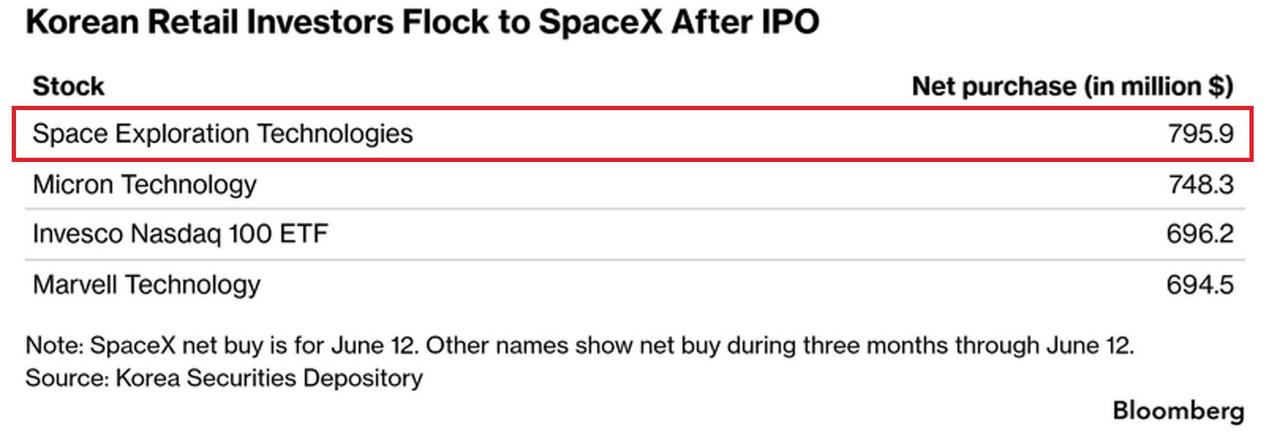
According to market flow data cited by Global Market Investor, South Korean retail investors purchased ~$795.9 million worth of SpaceX stock on its first trading day, June 12—making SPCX the most heavily bought U.S. stock by South Korean retail investors on a single day.
This purchase volume exceeded the net buying of several major U.S. tech stocks over three months. Per the same data, South Korean retail investors bought $748.3 million of Micron Technology, $696.2 million of the Nasdaq-100 ETF, and $694.5 million of Marvell Technology over the past three months.
Meanwhile, the frenzy around SPCX has also manifested in leveraged ETFs tied to the company—products that saw explosive trading volumes in their first days.
Eric Balchunas, Senior ETF Analyst at Bloomberg Intelligence, noted that the 2x-leveraged SpaceX ETF surpassed $3 billion in total trading volume—up from ~$1 billion the previous day.
One such product, ticker SPCH, recorded ~$1.3 billion in trading volume on its second day. Balchunas called this the highest second-day trading volume ever recorded for an ETF—surpassing the ~$500 million second-day volume of BlackRock’s spot Bitcoin ETF (IBIT).
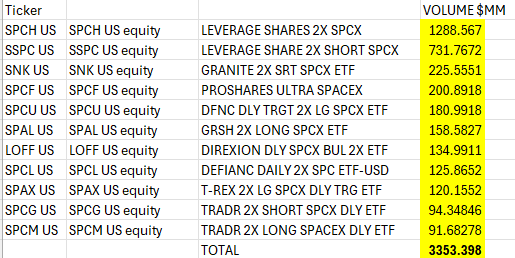
This demand is noteworthy because many of these products track the same underlying stock and offer similar leverage. It suggests investors aren’t merely seeking long-term exposure to SpaceX—many are using these funds to place short-term directional bets.
Ultimately, these figures confirm SpaceX is being treated as a global momentum trade—not as a traditional aerospace public company.
Investors who missed IPO allocations have rushed to buy shares in the open market, while others have turned to ETFs, options, and crypto derivatives to gain exposure to the same underlying theme.
Mounting Scrutiny Over SpaceX’s Valuation
The pace of the rally has intensified questions about whether SpaceX’s valuation has outstripped its business fundamentals.
Musk has stated SpaceX could generate $1 trillion in annual revenue by 2030—a target that has led investors to price the company not just as a rocket-and-satellite business, but as a broader technology ecosystem. Markets are assigning value not only to Starlink, AI, launch infrastructure, but also to Musk’s wider technological vision.
Current financial data shows the company is still spending aggressively to build that future. On $18.67 billion in 2025 revenue, SpaceX posted a $4.94 billion net loss. In Q1 2026 alone, it reported another $4.27 billion loss—reflecting heavy capital expenditures across Starlink, launch capacity, computing infrastructure, and AI initiatives.
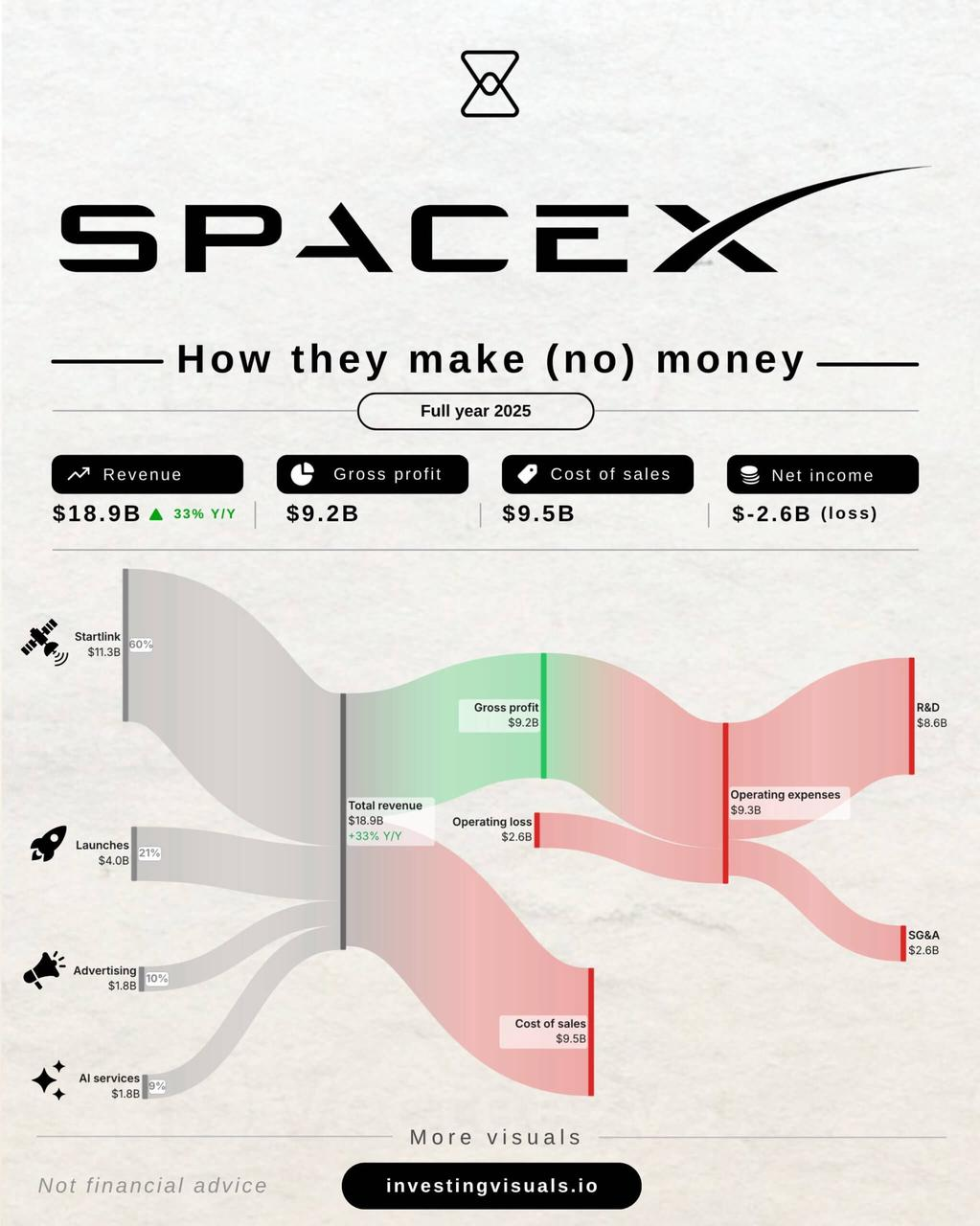
These losses have not halted the rally—but they widen the gap between SpaceX’s present reality and the price investors are paying for its future.
This is precisely where the Bitcoin comparison proves useful. Bitcoin’s market cap has always reflected what buyers are willing to pay for scarcity, network strength, and future monetary relevance. SpaceX is now being priced using a similarly forward-looking logic—albeit through the structure of a publicly traded company linked to Musk.
Currently, the public market is rewarding this narrative far more aggressively than the crypto market ever did.
While Musk’s wealth may not permanently exceed Bitcoin’s market cap—given potential SpaceX stock declines, Bitcoin rebounds, or sharp divergent moves in either direction—this milestone captures the current state of risk appetite: the market’s biggest speculative trade is no longer necessarily a token, but a rocket company.
Join TechFlow official community to stay tuned
Telegram:https://t.me/TechFlowDaily
X (Twitter):https://x.com/TechFlowPost
X (Twitter) EN:https://x.com/BlockFlow_News
 @CryptoSlate