
Crypto Morning Brief: Coinbase Announces Launch of Crypto and Stock Options Trading, as Well as Tokenized Stocks; U.S. Senate and House Reach Agreement to Ban CBDCs Until 2030
TechFlow Selected TechFlow Selected
Crypto Morning Brief: Coinbase Announces Launch of Crypto and Stock Options Trading, as Well as Tokenized Stocks; U.S. Senate and House Reach Agreement to Ban CBDCs Until 2030
China is accelerating the establishment of the World Artificial Intelligence Cooperation Organization.
 Navigating Web3 tides with focused insights
Author: TechFlow
Yesterday’s Market Highlights
Coinbase Announces Launch of Crypto and Stock Options Trading, Tokenized Stocks
According to The Block, Coinbase announced in its latest “System Update” that it will enable users to trade cryptocurrency and stock options—capabilities built upon its acquisition of Deribit. Simultaneously, Coinbase announced the launch of its first batch of 1:1 fully backed tokenized shares of U.S. publicly listed companies, with plans to support “every major U.S. stock, index, and ETF.” Additionally, Coinbase will unify liquidity pools across its U.S. and international operations into a single global pool and has received CFTC approval to launch perpetual-style futures contracts in the U.S., further solidifying its positioning as a “universal exchange.”
Zhipu Science & Technology’s Sci-Tech Innovation Board IPO Counseling Status Updated to “Counseling Verification”
Per disclosure on the China Securities Regulatory Commission (CSRC) website, Beijing Zhipu Huazhang Technology Co., Ltd.’s Sci-Tech Innovation Board IPO counseling status has been updated to “counseling verification,” with Guotai Junan Securities serving as the counseling institution.
Bipartisan Agreement Reached in U.S. Senate and House: Housing Bill Includes CBDC Ban Through 2030
According to The Block, leaders from the U.S. Senate and House jointly released an updated version of the “Pathway to 21st Century Housing Act,” confirming bipartisan agreement between both chambers. The bill’s core provisions focus on housing affordability reform—including expanding housing supply and curbing market monopolization by corporate landlords. Notably, an attached provision explicitly prohibits the Federal Reserve from issuing or creating a Central Bank Digital Currency (CBDC) or any “substantially similar” digital asset before December 31, 2030—a clause spearheaded by Republican members of the House.
The Trump administration maintains a consistent stance on this issue; Treasury Secretary Scott Bessent previously stated unequivocally that CBDCs are “not under consideration.” The bill will first undergo procedural voting in the Senate and is expected to be submitted to the House for deliberation after Congress resumes on June 23, followed by presidential signature.
Multiple Senators Urge Treasury Department to Clarify State-Level Stablecoin Certification Process Under GENIUS Act
According to CoinDesk, Senator Cynthia Lummis (R-WY), joined by several bipartisan senators, sent a letter to Treasury Secretary Scott Bessent, noting that the Treasury Department’s previously published stablecoin regulatory principles lack clarity on timelines and procedural requirements for state-level certification—leaving states uncertain about next steps. The letter requests that the Treasury issue written procedural guidance outlining application, review, and certification processes for state regulatory frameworks, while preserving sufficient flexibility to accommodate varying legislative paces across states.
Pro-Crypto Digital Bank Revolut Secures UAE Central Bank License, Enters Middle East Market
According to Bloomberg, pro-crypto digital bank Revolut announced it has obtained relevant licensing approvals from the Central Bank of the United Arab Emirates (UAE), marking the start of its expansion into the Middle East region.
The approved licenses include authorizations for stored value facilities and retail payment services. Revolut stated that, prior to official launch, it will prioritize building local technology infrastructure, establishing operational architecture, and deploying compliance capabilities.
RED (Xiaohongshu) Preparing for Hong Kong IPO, Target Valuation Exceeds $70 Billion
According to The Wall Street Journal, RED (Xiaohongshu), China’s lifestyle and video-sharing platform, plans to list in Hong Kong as early as year-end, with major investors seeking a valuation exceeding $70 billion. The company’s valuation in recent private secondary-market transactions has already surpassed $50 billion.
Founded in 2013 by Mao Wenchao and Qu Fang, RED began as a shopping guide app and has since evolved into one of China’s most influential social media platforms. It is projected to generate over $3 billion in net profit this year.
OpenAI vs. Anthropic Escalates: AI Regulation Debate Turns into Multi-Million-Dollar Electoral Contest
According to Fortune magazine, the political contest surrounding New York State Assemblymember Alex Bores’ campaign for a U.S. congressional seat has escalated into a direct confrontation between two major AI industry camps. OpenAI and Anthropic have each deployed multi-million- to tens-of-millions-of-dollar funding through affiliated political action committees (PACs) to back candidates with opposing stances on AI regulation.
Alex Bores’ previously proposed New York State “RAISE Act” is widely viewed as one of the nation’s strictest AI safety regulatory efforts, mandating AI firms disclose potential “catastrophic risks”—making it the focal point of current controversy. Notably, the PAC “Leading the Future,” backed by OpenAI-aligned investors and Silicon Valley capital, has spent over $7.6 million on advertising to block Bores’ election. Meanwhile, Anthropic-affiliated political networks and their investors have contributed over $10 million in support of his candidacy—elevating AI regulation from policy debate to real-world political battleground.
China Accelerates Establishment of World Artificial Intelligence Cooperation Organization
Per a press conference held by China’s State Council Information Office, China is accelerating preparations to establish the World Artificial Intelligence Cooperation Organization and welcomes participation from all parties to jointly promote AI for good.
PBOC’s Wang Xin: Closely Monitoring Stablecoins’ Impact on International Monetary System and Cross-Border Payments
Wang Xin, Director of the Research Bureau (Office of Counselors) of the People’s Bank of China (PBOC), addressed cross-border payment systems at the “Plenary Session II: Global Financial Governance Reform and Cooperation” of the 2026 Lujiazui Forum. He emphasized that ensuring the security, neutrality, and efficiency of international payment systems remains critical. This includes strengthening interoperability among central bank payment systems and retail payment infrastructures. He added that new payment tools must be explored prudently and steadily, while stablecoins’ impact on the international monetary system and cross-border payments must be closely monitored. Regulatory frameworks should be refined to foster more inclusive, efficient, and resilient international payments—better supporting sustainable development and global economic growth.
Pro-Crypto Candidate Moore Wins Alabama Senate Republican Primary
According to journalist Eleanor Terrett, Barry Moore—a pro-crypto candidate endorsed by former President Trump and currently a U.S. Representative—defeated former Navy SEAL Jared Hudson in the runoff of the Alabama Senate Republican primary. The pro-crypto political action committee Fairshake invested over $12 million in support of Moore’s campaign and issued a statement following his victory: “This largest-ever single-cycle investment has secured another pro-innovation Senate ally. With nearly $150 million in cash reserves, we will continue driving the formation of the largest pro-crypto congressional coalition in history.”
Market Data
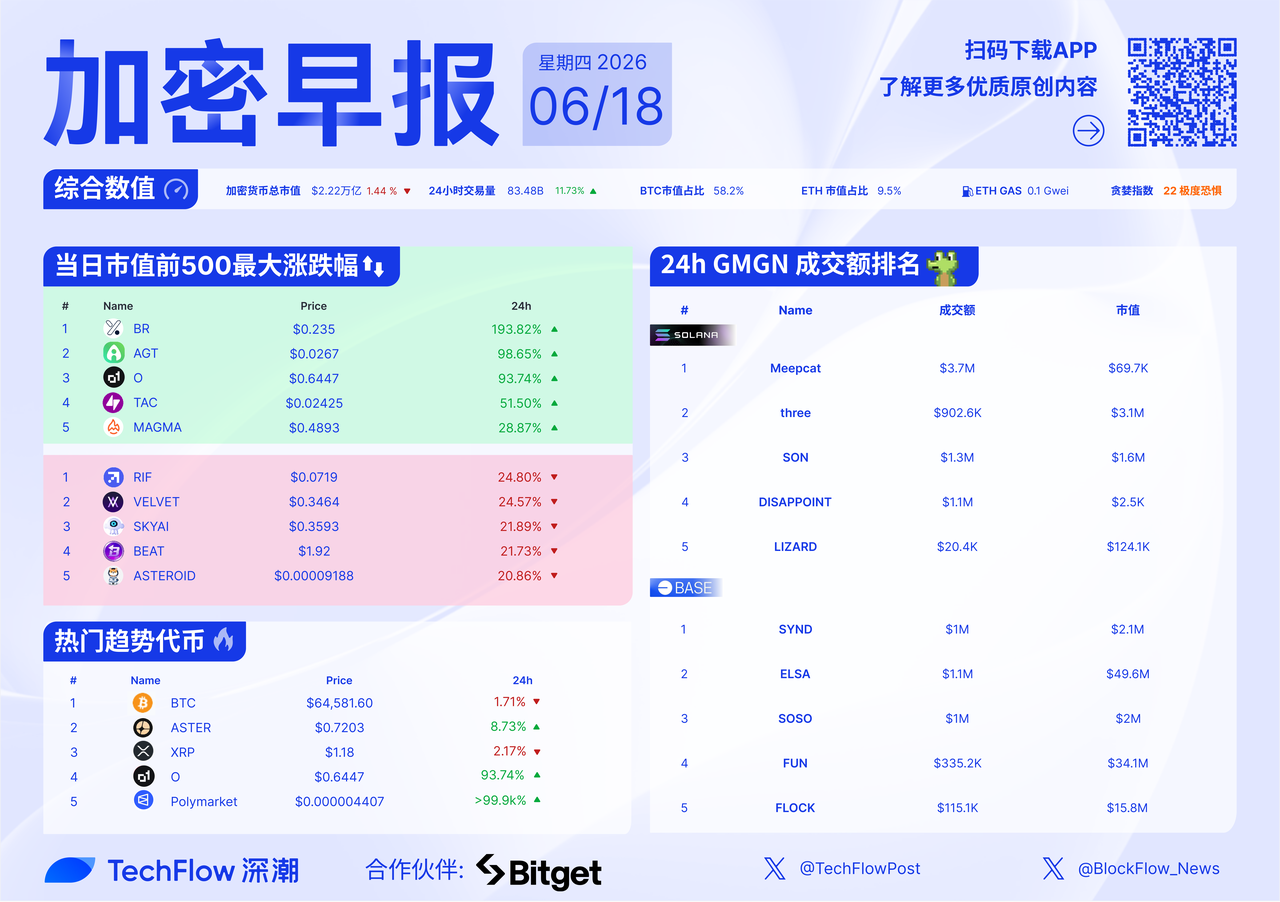
Recommended Reading
Research Report Deep Dive: MRVL’s Optical AI Breakthrough—Why Does Morgan Stanley’s Star Analyst Hold Off Despite High Valuation?
https://www.techflowpost.com/article/32101
While markets obsess over AI-driven growth, this report offers a rare contrarian perspective. MRVL’s financial performance, forward guidance, and AI business fundamentals are virtually flawless—yet Morgan Stanley maintains a neutral rating. The sole reason? A great company doesn’t automatically equal a great investment. For investors tracking AI chips, optical modules, and optical interconnects, the article’s greatest value lies not in affirming MRVL’s strength—but in reminding readers: once all positive catalysts are fully priced in, the critical question shifts from “Will growth happen?” to “Can growth still exceed market expectations?”
Bernstein Report: Agentic AI Elevates CPUs from Supporting Role to Lead Actor—Overweight Hygon Information
https://www.techflowpost.com/article/32100
If you still view semiconductors through the lens of “GPU = biggest AI beneficiary,” this Bernstein report merits attention. It highlights an easily overlooked insight: In the agentic AI era, AI system efficiency hinges not only on GPUs but also on CPUs responsible for orchestration, inference scheduling, and resource management. The report even forecasts a sixfold expansion of the server CPU market over the next five years—and names Arm, AMD, and Hygon Information as key beneficiaries. Whether you invest in AI infrastructure, semiconductor equities, or track capital flows across the next wave of AI value chains, this piece delivers a fresh, non-mainstream narrative.
CEX AI Arms Race: Entry Point or Infrastructure—Which Strategy Fits You Better?
https://www.techflowpost.com/article/32089
If you’ve recently tracked AI initiatives from exchanges like Binance, OKX, and Bitget, this article deserves your attention. Rather than superficially comparing “whose AI is stronger,” it dissects the two fundamental strategic paths underlying CEX AI competition—building user-facing entry points versus constructing foundational infrastructure. From agent products and toolchain capabilities to security mechanisms and real-world task testing, the article maps which solution best suits different user profiles. For traders leveraging AI for execution, building automated strategies, or assessing how AI may reshape exchange competition, this is a deeply practical and industry-informed analysis.
Interview with Arthur Hayes: AI Is Draining Market Liquidity—BTC Likely Below $100K by Year-End
https://www.techflowpost.com/article/32099
Arthur Hayes’ latest thesis isn’t simply bearish on Bitcoin—it posits AI as a global liquidity “black hole.” He notes that since ChatGPT ignited the AI boom, newly created capital hasn’t flowed into crypto markets but has instead been continuously absorbed by data centers, compute infrastructure, and AI-related capital expenditures—explaining why Bitcoin has significantly underperformed AI-themed equities over the past two years. In his view, AI investing is fundamentally a bet on accelerating capital expenditure growth. Yet as AI capex growth potentially moderates around 2027—and amid high oil prices, persistent inflation, and potential U.S. political headwinds toward AI regulation—the AI bubble may face a major correction. When that occurs, Bitcoin and risk assets could decline together in the short term. But once AI ceases to be the market’s dominant narrative, liquidity may finally flow back into crypto markets. Accordingly, Hayes has temporarily liquidated multiple crypto positions, pivoting to U.S. Treasuries and energy stocks—and expects Bitcoin to remain below $100,000 by year-end.
Waller’s Debut: No Rate Cut, No Hike—But Preparing to “Say Less”?
https://www.techflowpost.com/article/32098
At his first Federal Open Market Committee (FOMC) meeting as Fed Chair, Waller is highly likely to hold rates steady—neither cutting nor hiking. Markets are gradually accepting a new reality: persistent inflation, robust labor markets, and AI bubble risks have eliminated near-term room for monetary easing. At the same time, Waller may push to reduce officials’ public commentary and diminish the influence of the dot plot—marking a shift for the Fed from “frequent communication” to a new phase of “speak less, observe more.”
Join TechFlow official community to stay tuned
Telegram:https://t.me/TechFlowDaily
X (Twitter):https://x.com/TechFlowPost
X (Twitter) EN:https://x.com/BlockFlow_News
 深潮TechFlow