MicroStrategy Model Failing? Imitator Holding 30,000 Bitcoins Sees Pre-IPO Investors Collectively Refuse to Fund
TechFlow Selected TechFlow Selected
MicroStrategy Model Failing? Imitator Holding 30,000 Bitcoins Sees Pre-IPO Investors Collectively Refuse to Fund
Adam Back's Blockstream can no longer raise funds in the capital market.
 Navigating Web3 tides with focused insights
Author: Claude, TechFlow
TechFlow Editor's Note: BSTR, the Bitcoin treasury company of Blockstream co-founder Adam Back, and SPAC company Cantor Equity Partners I (NASDAQ ticker CEPO) jointly announced on July 8 that both parties will not complete the merger according to the original agreement of July 2025, the private investment in public equity (PIPE) tied to the transaction is no longer required to be completed, and the shareholders' meeting originally scheduled for July 10 is postponed indefinitely. This deal was originally set to go public with 30,021 BTC and up to $1.5 billion in fiat PIPE. Bitcoin is currently around $64,000, nearly halved from the historical high of $126,000 last October. After the stock price premium supporting the "Bitcoin treasury company" model disappears, whether this financing machine can restart depends on the next SEC filing.
Adam Back, the inventor of Hashcash, holding 30,000 BTC in hand, cannot raise money in the capital market.
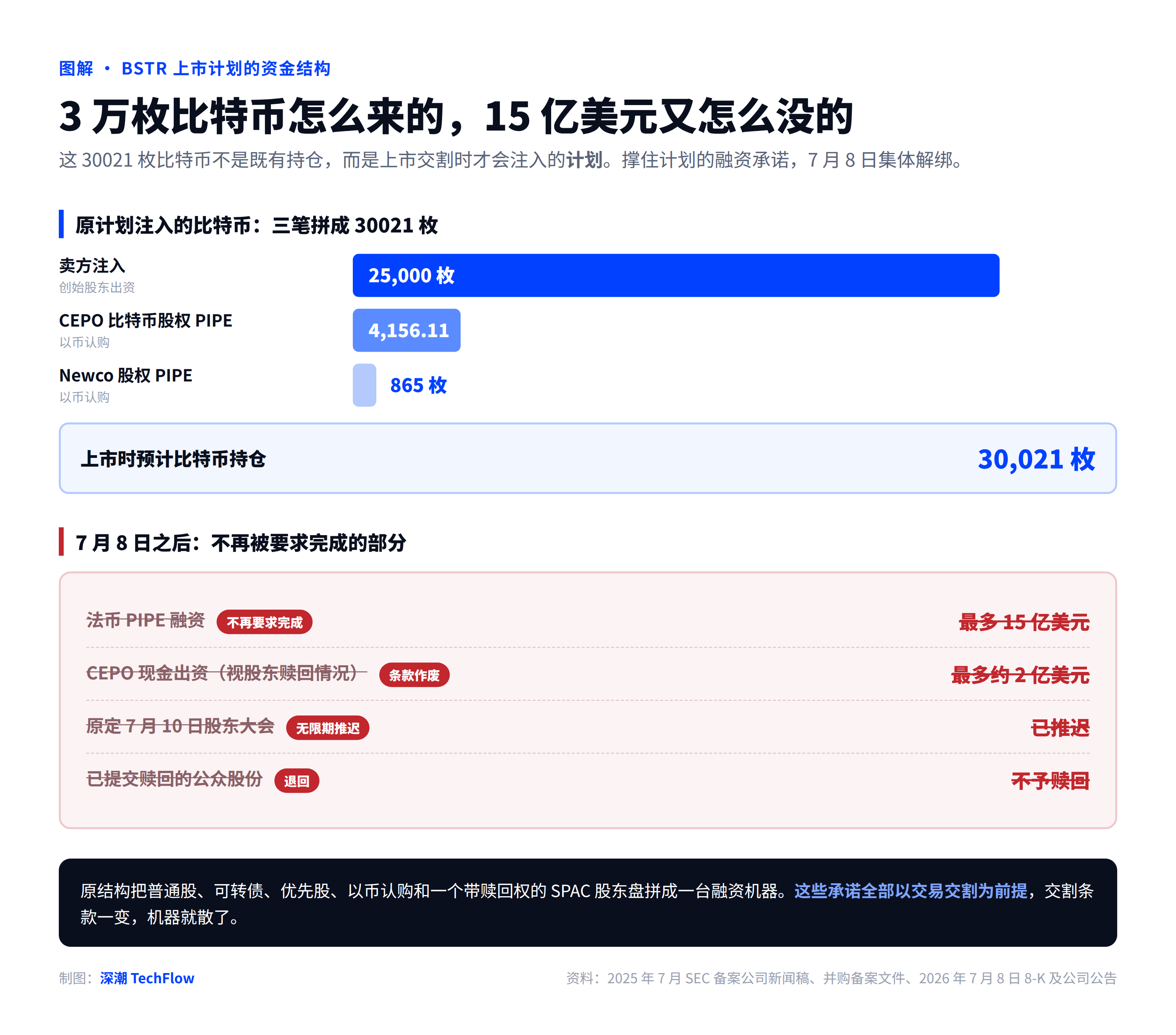
On July 8, Cantor Equity Partners I filed an 8-K document with the SEC, disclosing that it is discussing a modified transaction structure and terms with BSTR Holdings, on the grounds of "better reflecting current market conditions." The most critical sentence in the document is: both parties will not complete the transaction according to the original merger agreement signed on July 16, 2025, and the private placement tied to the transaction is no longer required to be completed.
The company announcement released on the same day added two points: the shareholders' meeting originally scheduled for July 10 is postponed indefinitely; public shares for which redemption applications have been submitted will be returned and not redeemed.
Bitcoin didn't crash; what crashed is the financing structure for buying Bitcoin.
How Big Was the Original Deal: 30,000 BTC
BSTR's selling point from the start was scale.
According to the company press release submitted to the SEC in July 2025, BSTR expected to have 30,021 BTC on its balance sheet at the time of listing, plus up to $1.5 billion in fiat PIPE financing, 5,021 BTC in kind PIPE, 25,000 BTC from founding shareholders, and up to approximately $200 million in cash from Cantor Equity Partners I (depending on shareholder redemptions).
The number 30,021 is not a single block; detailed merger documents break it down into three parts: 25,000 injected by the seller, 4,156.11 from CEPO Bitcoin equity PIPE, and 865 from Newco equity PIPE. In addition, there are cash equity, convertible bonds, preferred shares, and subscription commitments denominated in Bitcoin, all premised on the successful closing of the transaction.
These commitments are the true load-bearing walls. They turn a pile of Bitcoin into a financing machine facing the public market: common stock, convertible bonds, preferred shares, Bitcoin subscriptions, plus a SPAC shareholder base with redemption rights, five sources of capital pieced together.
Adam Back himself serves as BSTR's CEO, and the transaction narrative revolves around "Bitcoin per share," rather than simply passive holding.
After the July 8 announcement stated that the private placement does not need to be completed, the question becomes whether the new terms can bring these funds back.
The Engine is Stock Price Premium, Not Bitcoin
The operating logic of the "Bitcoin treasury company" model is actually separate from whether Bitcoin rises or falls.
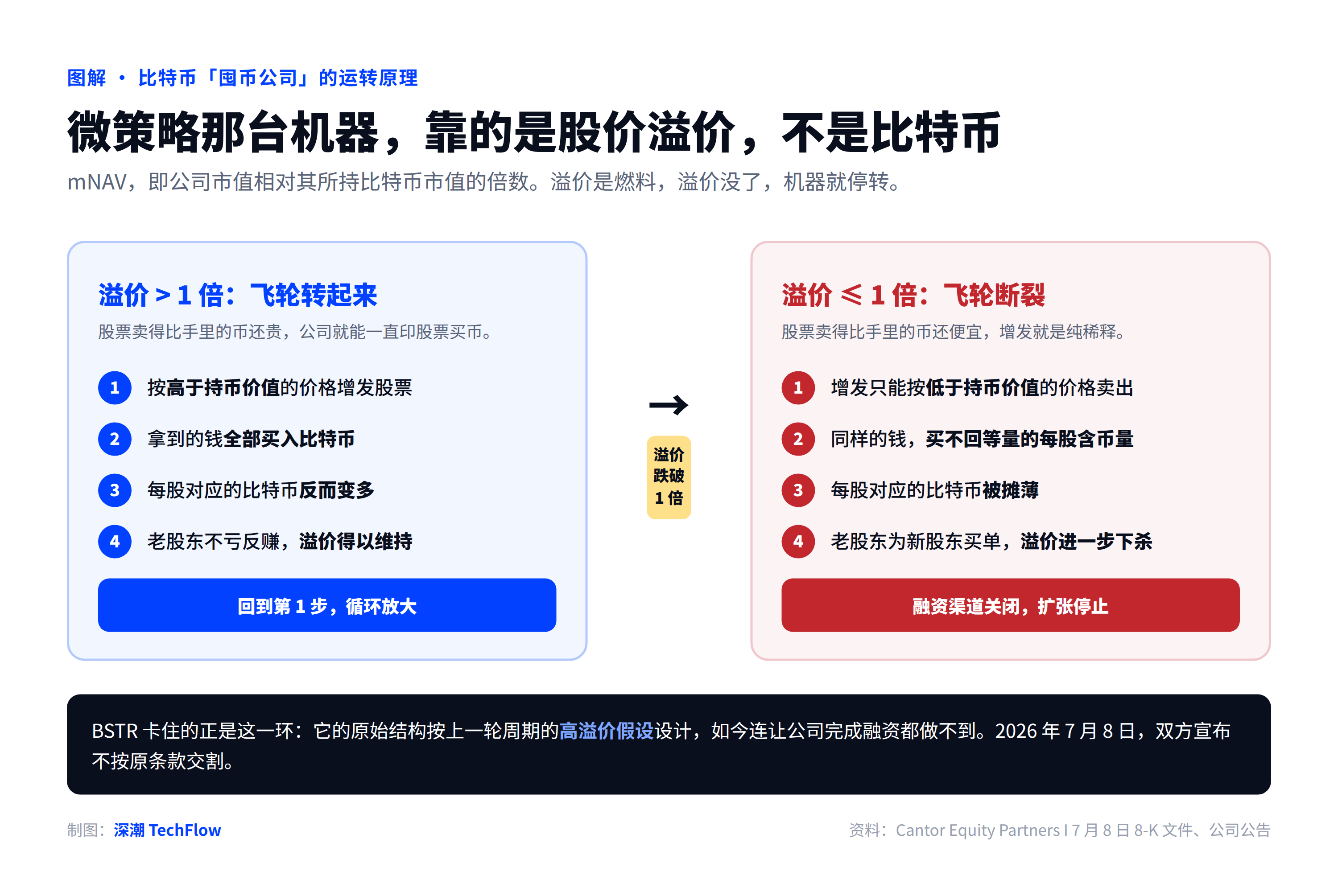
The key indicator is called mNAV, meaning the multiple of the company's stock market value relative to the market value of the Bitcoin it holds. If a company's market value is 2 times the value of its holdings, the mNAV is 2. This premium is the fuel for the entire machine: the company issues additional stock at a price higher than net assets, uses the money to buy more Bitcoin, the Bitcoin per share increases instead, shareholders gain rather than lose, and then repeat. MicroStrategy (now Strategy) rolled out based on this cycle.
Once the premium converges to 1x or even falls below 1x, this cycle breaks. Issuing additional stock to buy coins no longer thickens the per-share content, but instead dilutes old shareholders. The machine stops.
BSTR's problem lies exactly here. The original structure was designed based on the premium assumptions of the previous cycle, and no one is willing to pay for those assumptions now. So this time it is not "whether the premium can be maintained after the stock lists," but rather the premium assumption cannot even enable the company to complete financing.
The Entire Sector is Under Pressure
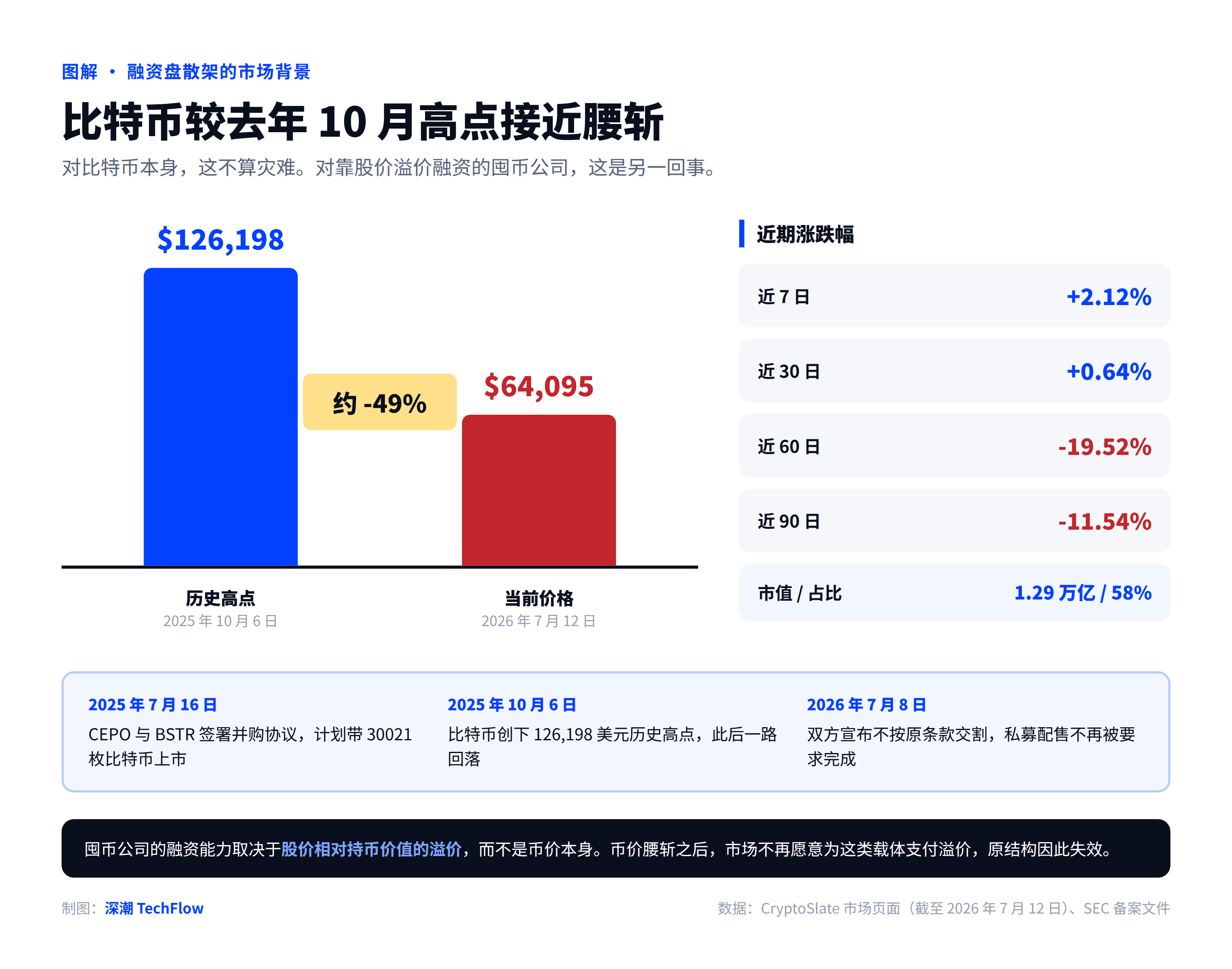
Bitcoin quoted at around $64,000 on July 12, with a market cap of approximately $1.27 trillion, accounting for about 58% of the crypto market. This price has fallen about 49% from the historical high of $126,200 set on October 6 last year, and dropped about 19.5% in the near 60 days.
For Bitcoin itself, this is not a disaster. For Bitcoin treasury companies relying on premium financing, this is another matter.
Other news from the same week can serve as a reference. American Bitcoin, involving Eric Trump, was forced to implement a 1-for-15 reverse stock split to maintain NASDAQ's minimum stock price requirement; it holds about 8,000 BTC. Strategy's preferred stock once fell below par value in June. Metaplanet's stock price has already fallen below its holding value. In early July, another American Bitcoin treasury company cleared all its Bitcoin holdings under debt and NASDAQ compliance pressure.
At the same time, capital is moving elsewhere. AI computing power company CoreWeave just completed a $20 billion financing round.
The Next SEC Filing is the True Verdict
Cantor and BSTR are still negotiating; the original terms have been voided.
If both parties reach a new agreement, new SEC documents will emerge to amend or supplement the registration statement and proxy voting materials. That document will answer three questions: how much of the 30,021 BTC scale remains, how much of the original PIPE commitment remains, and what price investors now require to put up money.
According to market data cited by TFTC, CEPO's stock price is currently around $10.5, close to its trust value. This position itself is a signal: the market has not given any premium to this transaction.
The risk items listed in the July 8 document itself are almost the negotiation list for what comes next: public shareholder redemptions, public float ratio, liquidity, exchange listing, Bitcoin price volatility, competition, regulatory uncertainty, and the difficulty of expanding Bitcoin accumulation and treasury operations.
For readers holding Bitcoin treasury stocks, the implication of this matter falls into two categories:
If the new treaty preserves the scale of 30,000 BTC, retains substantial investor commitments, and does not shift costs heavily onto new shareholders, it indicates that this model can be repriced in a low-premium environment without dying.
If the new terms reduce the holding scale, raise capital costs, weaken investor protection, or rely more on dilution to raise money, it means the next batch of Bitcoin treasury companies cannot consume the premium bonus left from the previous cycle. People who buy this type of stock are essentially paying for someone else's restructuring.
BSTR is now a public stress test for the entire sector. The test results are written in the next SEC filing.
Join TechFlow official community to stay tuned
Telegram:https://t.me/TechFlowDaily
X (Twitter):https://x.com/TechFlowPost
X (Twitter) EN:https://x.com/BlockFlow_News
 深潮TechFlow