Robinhood’s Transformation Journey in Wealth Management
TechFlow Selected TechFlow Selected
Robinhood’s Transformation Journey in Wealth Management
2025 marks a watershed year in Robinhood’s history, as it transforms into a comprehensive, mature, and highly competitive “super financial app.”
 Navigating Web3 tides with focused insights
By @BlazingKevin_, Researcher at Blockbooster
Robinhood entered a pivotal inflection point in its business model in 2025. By expanding its wealth management offerings—including launching IRA retirement accounts with disruptive fee structures, introducing high-yield cash products, and rolling out full-fledged Robinhood Banking services—Robinhood successfully steered its young user base away from frequent options and cryptocurrency trading toward long-term saving and investing.
In 2025, Robinhood’s financial results fully validated the success of this strategy: annual net revenue reached a record $4.5 billion, up 52% year-on-year; annual net income totaled $1.9 billion, up 35% year-on-year; assets under custody (AUC) for retirement accounts hit $26.5 billion at the end of Q4, surging 102% year-on-year; total platform assets reached $324 billion, up 68% year-on-year; and annual net deposits amounted to $68 billion.
This article analyzes Robinhood’s 2025 wealth management trajectory using data, and explores its strategic advantages across five core dimensions: customer acquisition and asset migration mechanisms, evolution of monetization models, ecosystem integration, brand repositioning, and operational cost structure.
1. Customer Acquisition and Asset Migration Mechanisms
Traditional wealth management typically relies on financial advisors for costly customer acquisition and relationship maintenance. In contrast, Robinhood adopted highly internet-native subsidy and incentive mechanisms to break down barriers to asset migration—and thereby rapidly capture assets under management (AUM).
1.1 Matching Subsidies: The Economics of “Buying AUM”
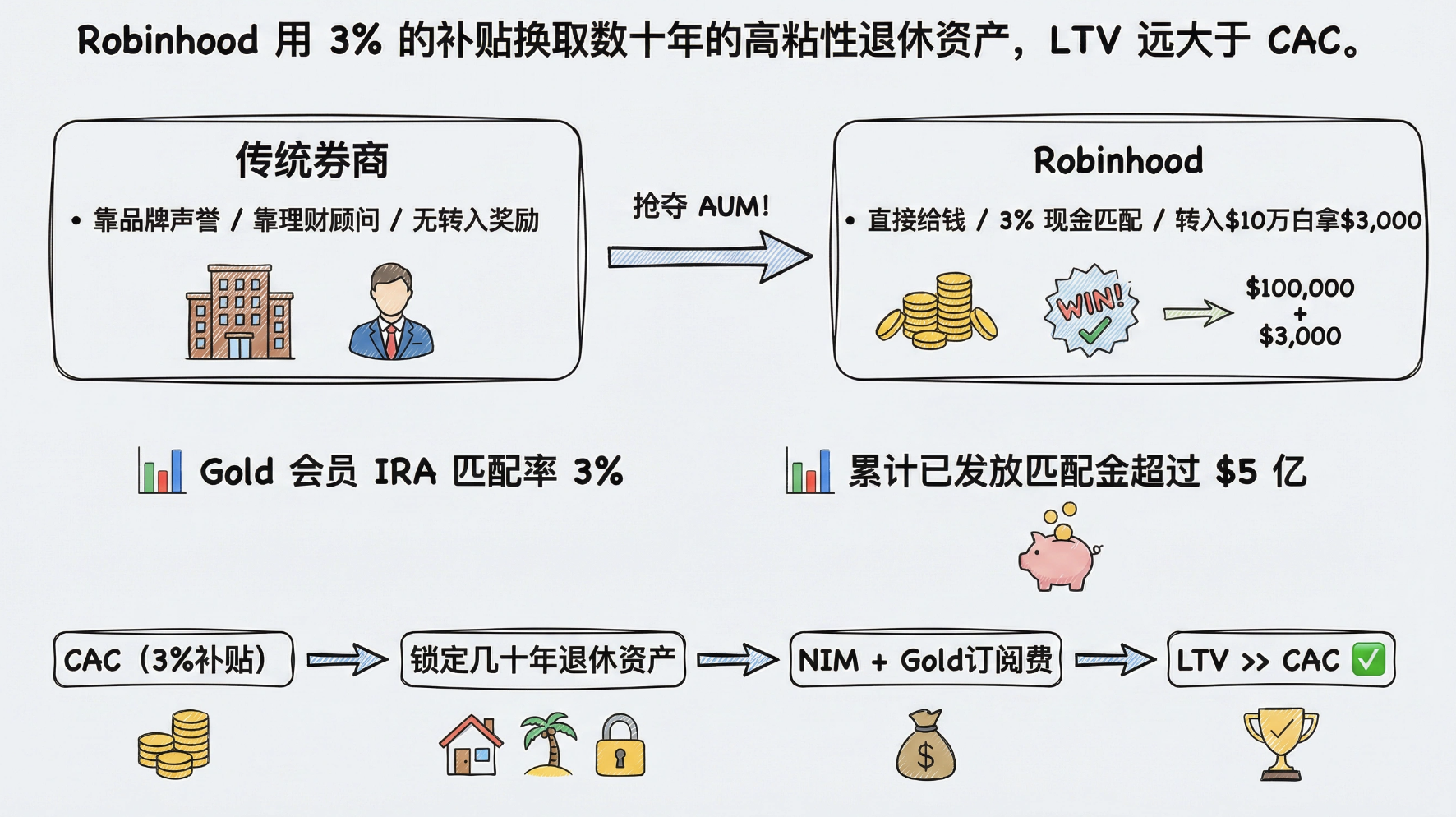
Traditional retirement account providers (e.g., Fidelity, Charles Schwab) rely primarily on brand reputation and advisory services to attract clients. Robinhood pursued a far more direct—and aggressive—strategy: cash matching subsidies. It used real money to reduce users’ psychological friction in migrating accounts.
For Robinhood Gold members, the platform offers up to a 3% match on IRA deposits (1% for non-members). Based on the 2025 IRS contribution limit of $7,000 for individuals under age 50, users can receive up to $210 in free matching funds annually. Even more aggressively, Robinhood also provides up to a 3% match on rollover assets transferred from other brokers’ 401(k) or IRA accounts. This means a user transferring $100,000 in 401(k) assets into a Robinhood IRA receives an immediate $3,000 cash bonus.
Is this economically sound? We can assess it through the lens of customer acquisition cost (CAC) versus lifetime value (LTV). As of year-end 2025, users had collectively received over $500 million in matching funds tied to retirement account rollovers and contributions. Robinhood treats this expenditure as CAC. Given the extreme stickiness of retirement accounts—often held for decades—these assets generate long-term net interest margin (NIM), potential advisory fees, and lock users into Gold membership ($50/year). Compared with traditional brokerages’ often hundreds-of-dollars-per-customer CAC and high churn rates, Robinhood’s 3% subsidy secures decades-long, highly sticky assets—yielding an LTV vastly exceeding its CAC.

1.2 Frictionless Account Migration: A Technological Decisive Edge
Subsidies alone are insufficient—if the transfer process is cumbersome, users will still hesitate. Robinhood leveraged technology to dramatically lower the barrier for users switching from traditional brokerages.
By integrating the Automated Customer Account Transfer Service (ACATS), Robinhood enabled seamless cross-brokerage asset transfers. Users simply input their prior brokerage account details within the app—even without manually liquidating existing assets—and Robinhood’s clearing system automatically executes the asset transfer in the background. For outgoing transfer fees charged by certain brokerages (typically $75), Robinhood reimburses them under qualifying conditions. This “one-click搬家” experience completely dismantled the asset migration barriers erected by traditional institutions relying on cumbersome processes.
2. Monetization Evolution: From Payment for Order Flow (PFOF) to Recurring Revenue
Historically, Wall Street criticized Robinhood for its heavy reliance on payment for order flow (PFOF) and high-frequency trading. While extremely lucrative during bull markets, this model proved highly fragile in bear markets. In 2025, Robinhood successfully transitioned to a more stable, asset-management-driven monetization model.
2.1 Net Interest Margin (NIM): Attracting Deposits via High-Yield Cash Products
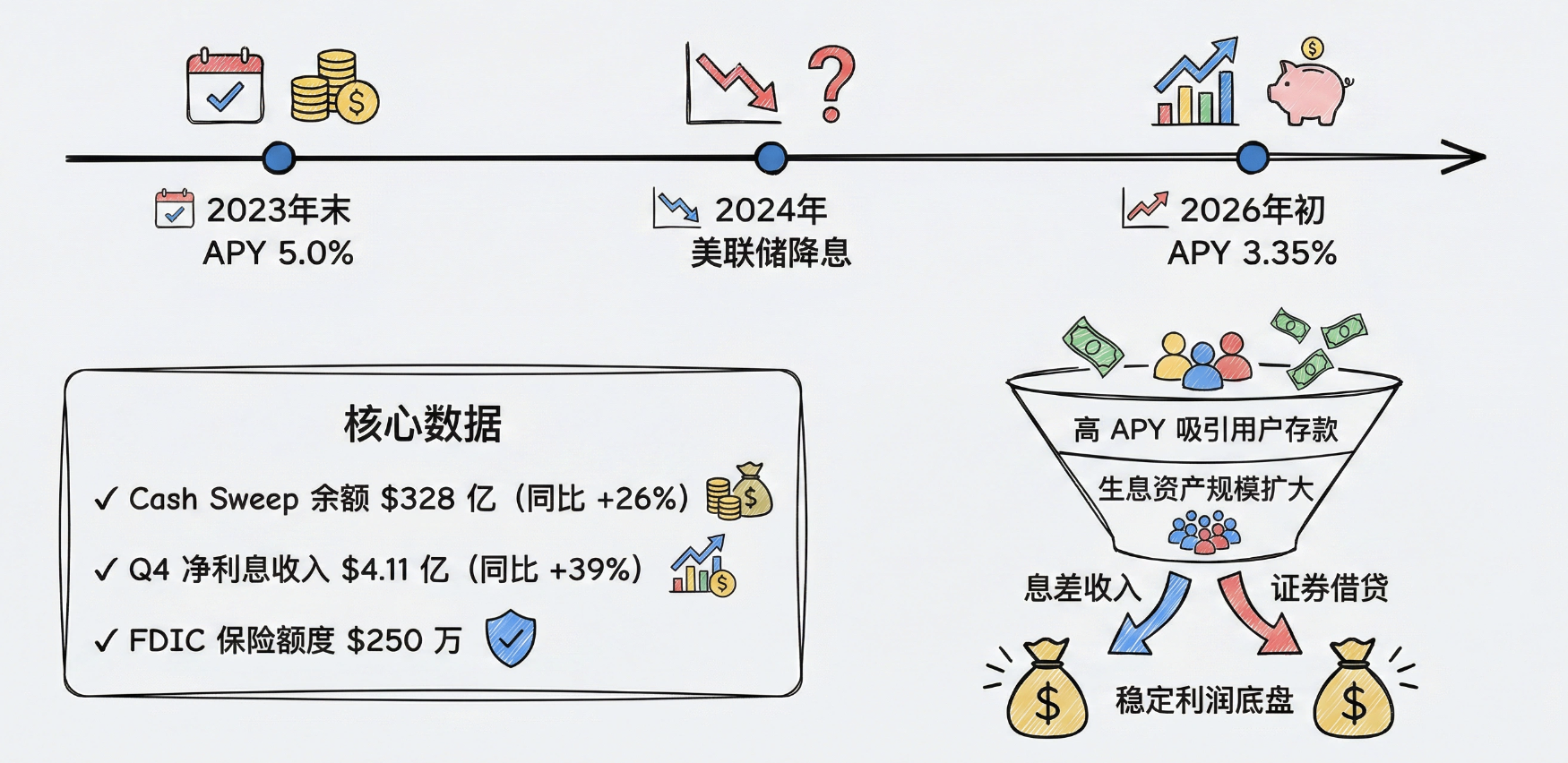
By offering highly competitive cash yields, Robinhood liberated “cash management” from traditional banks’ low-yield traps—thus attracting massive deposits.
At end-2023, the APY on uninvested cash for Robinhood Gold members peaked at 5.0%, far exceeding the national average savings account rate at the time. As the Fed cut rates, the APY gradually adjusted (to 3.35% by early 2026), yet remained well above major banks’ checking account rates. In Q4 2025, Robinhood’s Cash Sweep balance grew 26% year-on-year to $32.8 billion.
This massive pool of interest-bearing assets generated substantial net interest income. In Q4 2025, net interest income rose 39% year-on-year to $411 million—driven primarily by growth in interest-earning assets and securities lending activity. Under specific interest-rate cycles, this “interest-spread arbitrage” model delivers exceptional profit stability.
2.2 Subscription Economy (Robinhood Gold): SaaS-ification of Financial Services
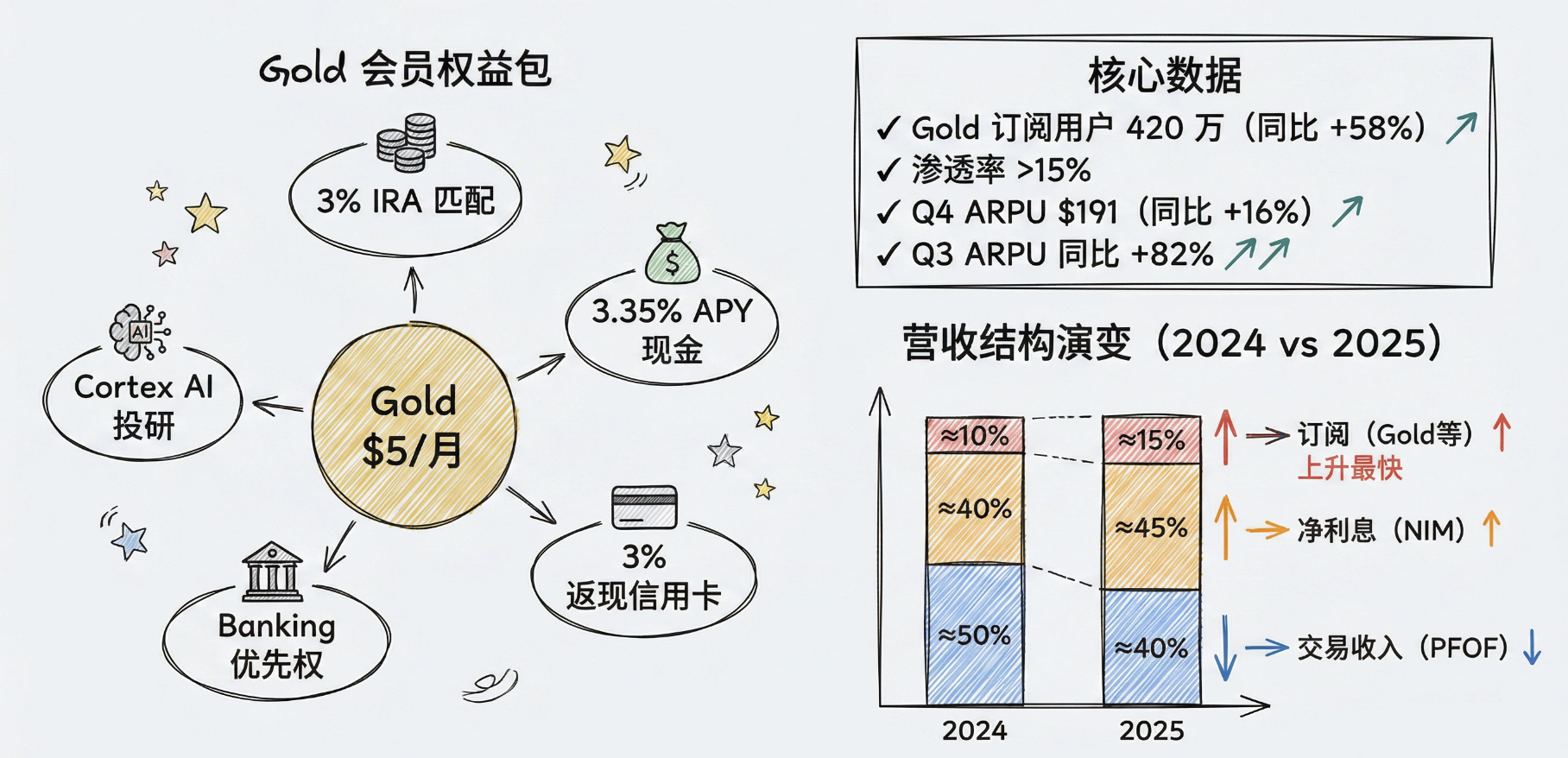
The Robinhood Gold subscription service ($5/month or $50/year) sits at the heart of Robinhood’s monetization evolution. For a monthly fee, users gain access to high-yield cash, in-depth research reports, 3% IRA matching, and a credit card offering 3% cashback across all categories—an attempt to “SaaS-ify” financial services.
As of Q4 2025, Robinhood Gold subscribers reached a record 4.2 million—a 58% year-on-year increase—and penetration among its 27 million funded accounts exceeded 15%. This subscription model significantly boosts user stickiness and average revenue per user (ARPU). ARPU rose 16% year-on-year to $191 in Q4, and surged 82% year-on-year in Q3.
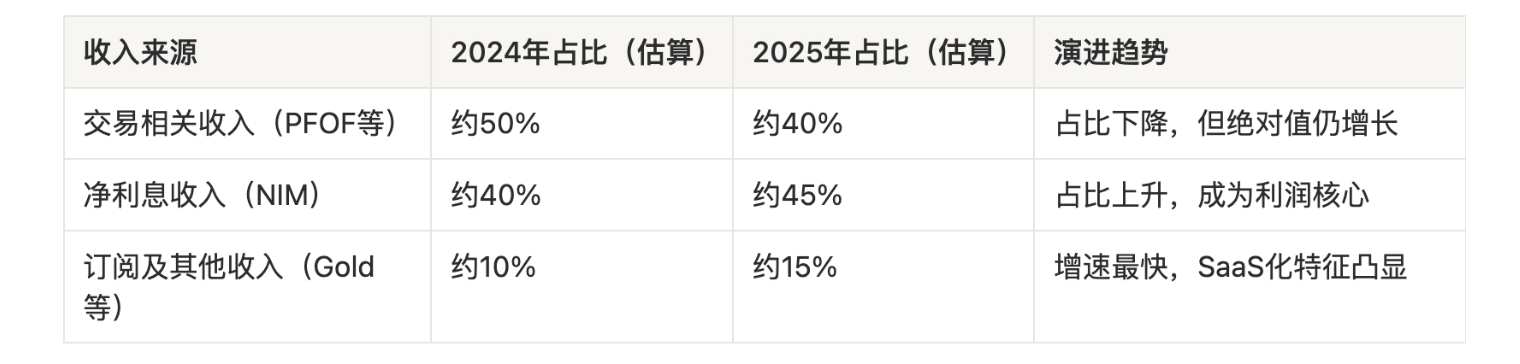
The table below illustrates the evolution of Robinhood’s revenue mix:
3. Ecosystem Integration
Young users dislike downloading multiple apps to manage finances. Robinhood deeply understands this—and is building a super-app spanning investing, saving, spending, and borrowing.
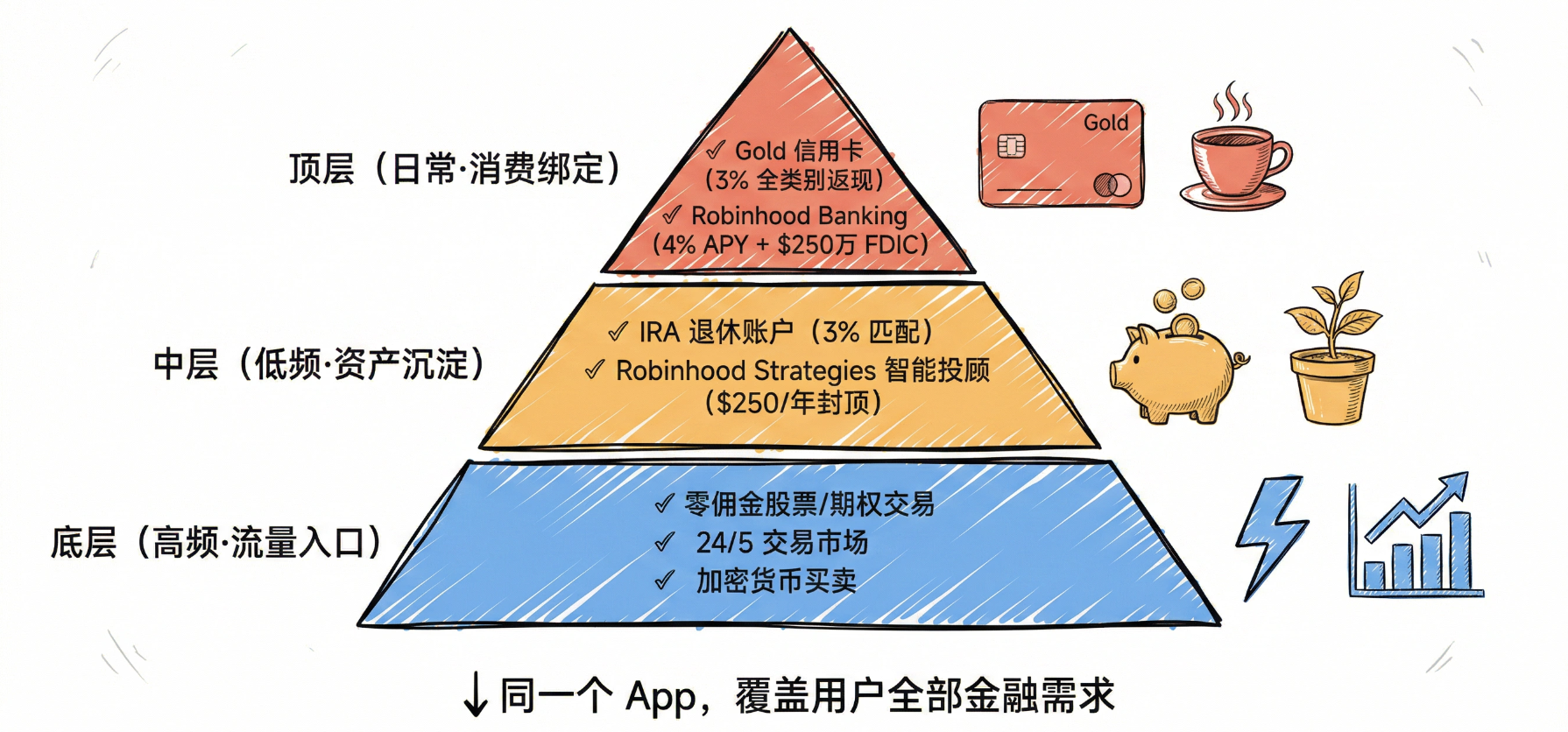
3.1 One-Stop Experience: Seamless Integration Across High- and Low-Frequency Use Cases
In 2025, Robinhood launched or upgraded multiple products, forming a complete ecosystem loop:
- High-frequency use cases: commission-free stock/options trading, 24/5 trading markets, crypto buying/selling.
- Low-frequency defensive use cases: IRA retirement accounts (3% match), Robinhood Strategies smart advisory (capped annual fee of $250 for Gold members).
- Daily spending use cases: Robinhood Gold credit card (3% cashback), Robinhood Banking (4% APY on savings, FDIC-insured).
Seamlessly integrating high-frequency speculative trading with low-frequency retirement investing and daily spending—all within one app—is Robinhood’s killer feature.
3.2 Traffic Conversion: Smooth Cross-Selling from “IPOs” to “Retirement”
Robinhood commands the massive traffic traditional asset managers dream of—27 million accounts as of end-2025. Its core strategy: leverage high-frequency trading (e.g., meme stocks, crypto) and high-yield cash as traffic acquisition channels, then smoothly cross-sell low-frequency but high-value wealth management products.
For example, when a 22-year-old Gen Z user downloads Robinhood to trade Dogecoin, they’re drawn in by the 5% cash yield and sign up for Gold. The app then pushes a targeted notification: “As a Gold member, you’ll get a 3% match on your IRA deposit.” Once their assets reach $100,000, the system recommends “smart advisory for just $250/year.”
This conversion path—from “traffic funnel” to “asset accumulation”—enables Robinhood to acquire high-net-worth customers at extremely low marginal cost.
4. Trust Building
4.1 Regulatory Compliance & Security Backing: Leveraging Traditional Finance’s Safety Net
To convince users to entrust decades of retirement savings to Robinhood, the company cleverly leveraged traditional finance’s safety infrastructure to endorse its innovative products.

SIPC Protection & Additional Insurance: Robinhood highlights its status as a Securities Investor Protection Corporation (SIPC) member (providing $500,000 baseline protection), and supplements this with commercial insurance offering up to $50 million in securities protection and $1.9 million in cash protection per client.
FDIC Deposit Insurance: When promoting Cash Sweep and Robinhood Banking, the platform partners with multiple banks to provide up to $2.5 million in FDIC deposit insurance per user—far exceeding the standard $250,000 coverage offered by conventional banks.
This “safer than traditional banks” narrative powerfully alleviates young users’ trust concerns about emerging fintech platforms.
5. Operational Cost Structure
Robinhood’s ability to offer 3% IRA matching and a $250-capped advisory fee stems not only from confidence in LTV—but also from its vastly superior labor productivity and underlying technology costs relative to traditional institutions.
5.1 Technology-Driven Automation & High Labor Productivity
Robinhood has no sprawling physical branch network or army of financial advisors. All its advisory services—including ETF portfolio recommendations from Robinhood Strategies—are highly automated, relying on algorithmic models for asset allocation and rebalancing.
This “light-asset” model delivers astonishing labor productivity. Public data shows Robinhood employed approximately 2,900 people as of end-2025. With $4.5 billion in annual revenue, its revenue per employee stands at $1.55 million. By comparison, traditional financial giants employing tens of thousands of staff typically generate only half—or even less—of that figure per employee.
5.2 Declining Marginal Costs: The Power of In-House Clearing
Robinhood severed dependence on third-party clearing firms (e.g., Apex Clearing) as early as 2018, building its own proprietary clearing system. This infrastructure investment delivered massive operating leverage amid the 2025 asset-scale explosion.
When AUC surged from $193 billion to $324 billion, the self-built, highly automated clearing system incurred near-zero marginal cost for processing additional trades and asset transfers. According to macro-level trend data, Robinhood’s full-year 2025 operating expenses totaled $2.379 billion; despite a 52% revenue surge, operating expense growth remained relatively contained—directly driving GAAP net income to $1.9 billion and significantly boosting adjusted EBITDA margin.
6. Evolving User Profile
The core driver behind Robinhood’s wealth management success is the profound shift in investment behavior among its young user base.
6.1 Youthful User Base: Structural Advantage
Per ARK Invest research, Gen Z and millennials comprise 63% of Robinhood’s user base—versus just 14% at Charles Schwab and comparatively modest shares at Vanguard. Robinhood’s median user age hovers around 32–35 (2025 data), while traditional brokerages like Schwab serve clients averaging over age 50.
This structural advantage also manifests in asset density per client. Currently, Schwab’s average AUC per client is ~$250,000—far higher than Robinhood’s current ~$12,000. Yet this gap fundamentally reflects age disparity. As Robinhood’s young users enter peak wealth accumulation years, this gap will narrow steadily.
6.2 From “Meme Stocks” to “Long-Termism”: A Profound Shift in Investment Behavior
Robinhood CEO Vlad Tenev noted in late 2025 a clear trend emerging: 19-year-old Gen Z users are actively opening retirement accounts.
Data supports this. Per USA Today’s citation of latest savings data, Gen Z’s retirement savings rate has risen for multiple consecutive years—reaching 6.2% in 2025, up from 5.9% in 2024—while savings rates for all other age groups declined. Fidelity data shows Gen Z investors allocate up to 95% of their IRA contributions to Roth accounts—demonstrating sharp awareness of long-term tax optimization.
6.3 Capturing “The Largest Intergenerational Wealth Transfer in Human History”
Over the coming decades, roughly $12.4 trillion in assets are projected to transfer from Baby Boomers to Millennials and Gen Z. Given Robinhood’s overwhelming market share among younger demographics, these users—who inherit wealth—are highly likely to retain those funds within the Robinhood ecosystem they know and prefer—rather than migrate them to the traditional brokerages their parents use.
Conclusion: The Rise of a Financial Super-App
2025 marks a watershed moment in Robinhood’s history. It successfully shed its label as “a casino for retail speculation,” transforming instead into a comprehensive, mature, and fiercely competitive “financial super-app.”
The core logic of this transformation lies in Robinhood’s deep understanding of its users’ lifetime value. A 22-year-old Gen Z user today may only buy a few ETFs on Robinhood. Tomorrow, they’ll open an IRA and claim the 3% match. Next year, they’ll roll over their workplace 401(k) into Robinhood. A few years later, once their assets grow to $100,000, they’ll activate Robinhood Strategies for capped-fee professional advice. Ultimately, when they inherit wealth from their parents, they’ll naturally deposit it into Robinhood Banking.
Through aggressive acquisition mechanisms, stable recurring revenue models, a one-stop ecosystem, a repositioned trust-based brand, and an ultra-low-cost structure, Robinhood has built the perfect infrastructure to capture “the largest intergenerational wealth transfer in human history.”
Join TechFlow official community to stay tuned
Telegram:https://t.me/TechFlowDaily
X (Twitter):https://x.com/TechFlowPost
X (Twitter) EN:https://x.com/BlockFlow_News