Robinhood is building a financial institution tailored for the new generation
TechFlow Selected TechFlow Selected
Robinhood is building a financial institution tailored for the new generation
Robinhood's ultimate goal is not merely to become another brokerage, but to evolve into the core financial operating system for a new generation of investors through its rapid product iteration capabilities and integrated platform experience.
 Navigating Web3 tides with focused insights
Author: Nicholas Grous, Varshika Prasanna, ARK Invest
Translation: Nicky, Foresight News
TL;DR
Robinhood's business model began with a structural challenge to the traditional brokerage profit model—commissions and fees. Its "commission-free" strategy is not simply a pricing tactic but a core design aimed at lowering investment barriers for retail investors. This move triggered structural changes across the industry, forcing legacy giants to follow suit and objectively reshaping both the business models and consumer expectations of the retail brokerage sector.
A three-tiered progressive strategic framework:
-
Expansion of brokerage services: Using commission-free stock trading as its foundation, Robinhood built a young, mobile-native user base. It then systematically expanded its offerings into options, cryptocurrencies, and even prediction markets, aiming to become a comprehensive, multi-asset trading platform that integrates trading behavior with culture and entertainment to enhance user engagement.
-
Building a financial ecosystem: Leveraging the brokerage relationship, the company extends into adjacent areas such as banking, credit, retirement, and wealth management through its subscription service, Robinhood Gold. This strategy aims to increase user stickiness and lifetime value by integrating multiple financial service verticals. The key lies in using technological advantages to reduce costs in traditional sectors (e.g., low account minimums, no annual fee credit cards), returning savings to users, and thus building competitive moats.
-
Positioning for generational wealth transfer: At the top level of this strategy is positioning for the anticipated intergenerational wealth transfer. Robinhood’s high penetration among younger generations places it structurally to inherit future transfers of stocks, retirement accounts, and cash. Its product expansion aligns platform capabilities with incoming asset classes, transforming current user scale into future assets under management (AUM).
Robinhood’s ultimate goal is not merely to become another brokerage, but to evolve into the core financial operating system for a new generation of investors through rapid product iteration and an integrated platform experience. Its success will depend on whether it can systematically convert early brokerage users into deep users across its entire financial ecosystem and effectively capture a share of assets during the long-term generational wealth transfer.
Introduction
For decades, traditional financial institutions profited from brokerage commissions, options fees, overdraft penalties, and advisory charges. With few alternatives and high switching costs, consumers felt trapped, while banks and brokerages misinterpreted this inertia as loyalty to their extractive, user-unfriendly models.
Robinhood emerged in response. With a clear mission to “democratize access to finance for all,” the company launched commission-free trading via a simple, mobile-first interface. This reset consumer expectations, forced the entire industry to lower fees, and opened institutional-grade asset classes to the masses.
This article analyzes Robinhood’s winning strategy:
-
Mastering the brokerage business: Explaining how Robinhood democratized brokerage services and reshaped the industry landscape.
-
Integrating a personal financial product suite: Detailing how Robinhood integrates various services into a unified ecosystem.
-
Wealth transfer megatrend: Analyzing demographic trends that could position Robinhood at the heart of a total addressable market (TAM) exceeding $600 billion.
We aim to guide readers through Robinhood’s three-stage product roadmap: redefining brokerage, integrating broader financial products, and preparing for generational wealth transfer. Each stage builds upon the previous one, expanding the company’s reach into banking, lending, crypto, and wealth management. As shown below, the brokerage business sits at the core of all Robinhood’s activities. As the entry point for a new generation of investors, Robinhood’s brokerage is the cornerstone of its ecosystem—a multi-layered product suite touching every aspect of consumers’ financial lives.
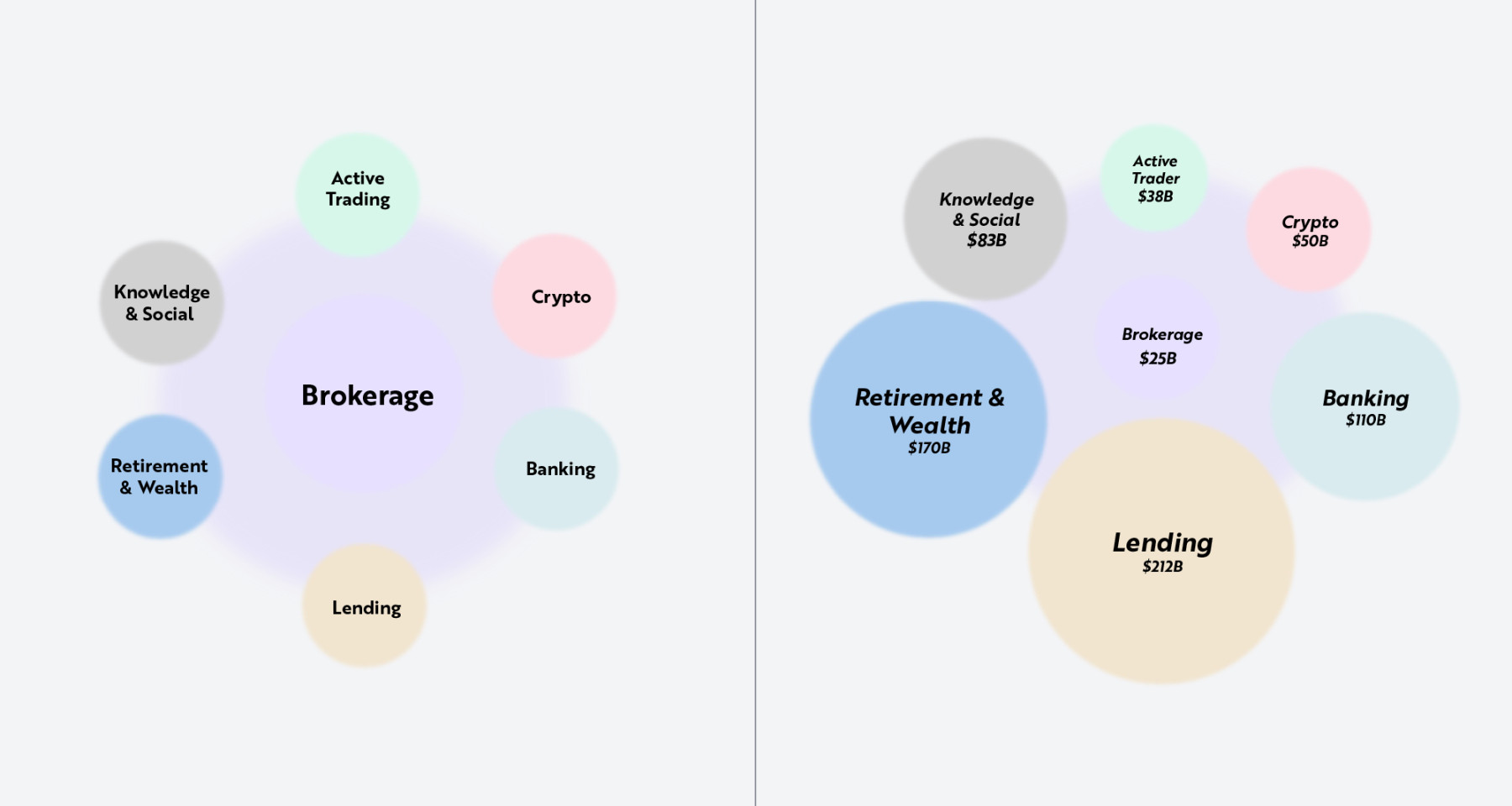
Note: The left chart shows how brokerage acts as a bridge connecting other adjacent financial service verticals. The right chart estimates the total addressable market (TAM) for each vertical. Source: ARK Investment Management LLC, based on Robinhood data as of September 15, 2025. For informational purposes only, not investment advice, and does not constitute a recommendation to buy, sell, or hold any securities.
Mastering the Brokerage Business
In this section, we explore Robinhood’s disruption of the brokerage industry and its product expansions into active trading and cryptocurrency markets. When founded in 2013, most online brokers charged $7–$10 per stock trade. The average retail investor spent hundreds of dollars annually just to participate in markets—a significant barrier for Millennials and Gen Z, who often start investing with small amounts. Options trading posed similar hurdles, with brokers charging per-contract fees on top of commissions. In fact, most traditional platforms were designed for professionals, deterring mobile-first consumers.
Robinhood’s brokerage offering changed this overnight and became the foundation of its business. By eliminating commissions and creating a seamless, mobile-first interface, the company opened the door for a new generation of investors. Many industry incumbents dismissed this model as unsustainable, yet it quickly became the industry standard, forcing giants like Charles Schwab, E*TRADE, Fidelity, and TD Ameritrade to adopt the same approach. This shift led to structural realignment in the brokerage industry, lowered investment barriers, and returned billions of dollars to consumers.
By broadening access early and attracting younger demographics, Robinhood has steadily increased its market share in stocks, options, crypto, and margin trading, as shown below. Its market share continues to grow, surpassing 7% in options and nearing 1% in stock trading.
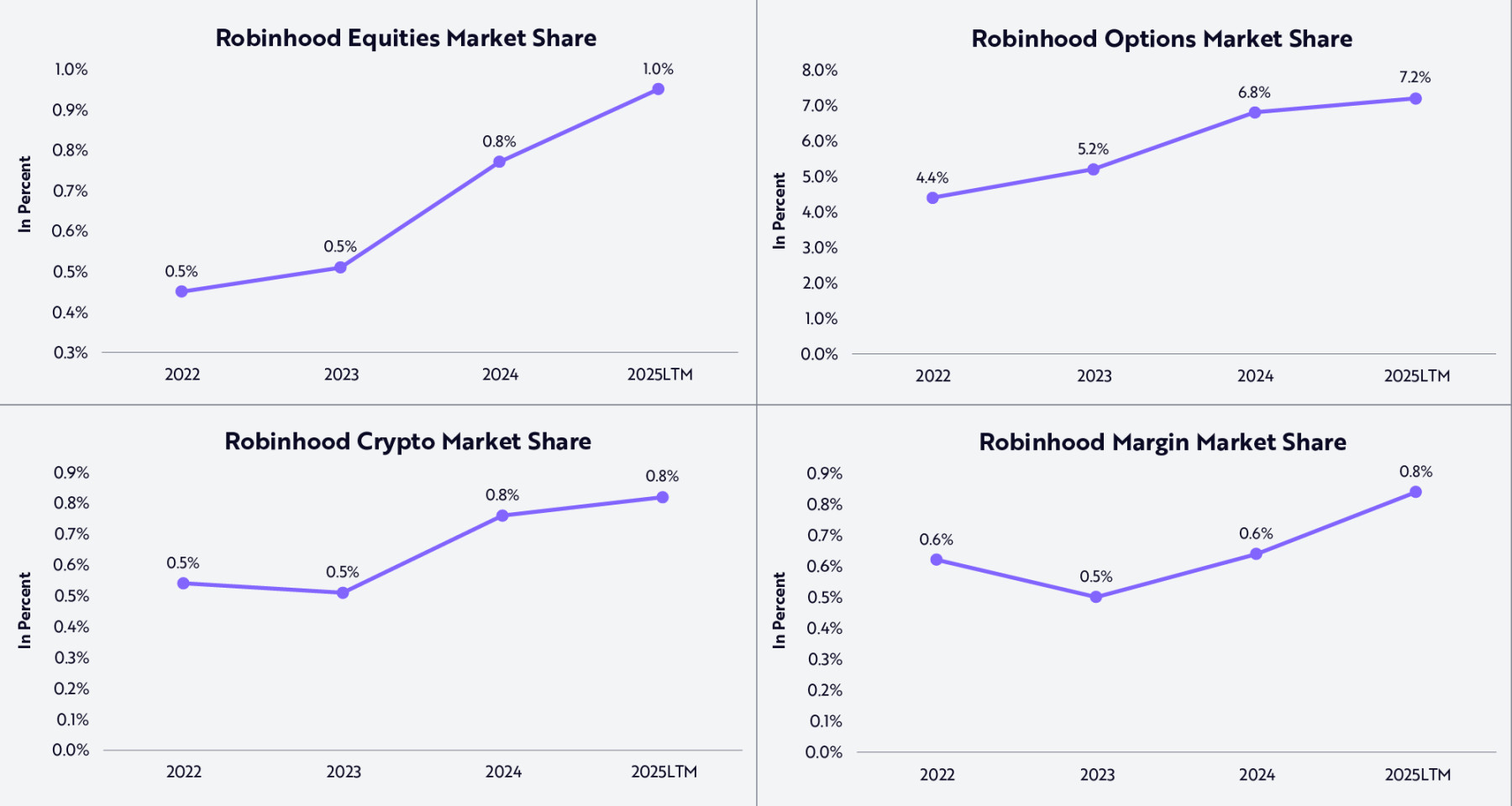
Source: ARK Investment Management LLC, based on Robinhood data as of September 15, 2025. For informational purposes only, not investment advice, and does not constitute a recommendation to buy, sell, or hold any securities. Past performance is not indicative of future results.
Despite growing market share, Robinhood currently holds only a small fraction of the overall market—highlighting both its progress in these multi-trillion-dollar markets and its vast potential. Scaling the brokerage business remains central to Robinhood’s operations and customer needs. For Millennials and Gen Z, brokerage services often represent their first meaningful connection to financial markets. Unlike previous generations who typically started investing in their thirties, today’s late teens and early twenties are entering the market much earlier.
As shown below, Gen Z begins investing at an average age of 19, Millennials at 25—significantly earlier than Gen X (32) and Baby Boomers (35). In our view, platforms like Robinhood have made investing accessible, enabling young people to be influenced by the explosion of financial content online and establishing investing as a core part of their financial identity.
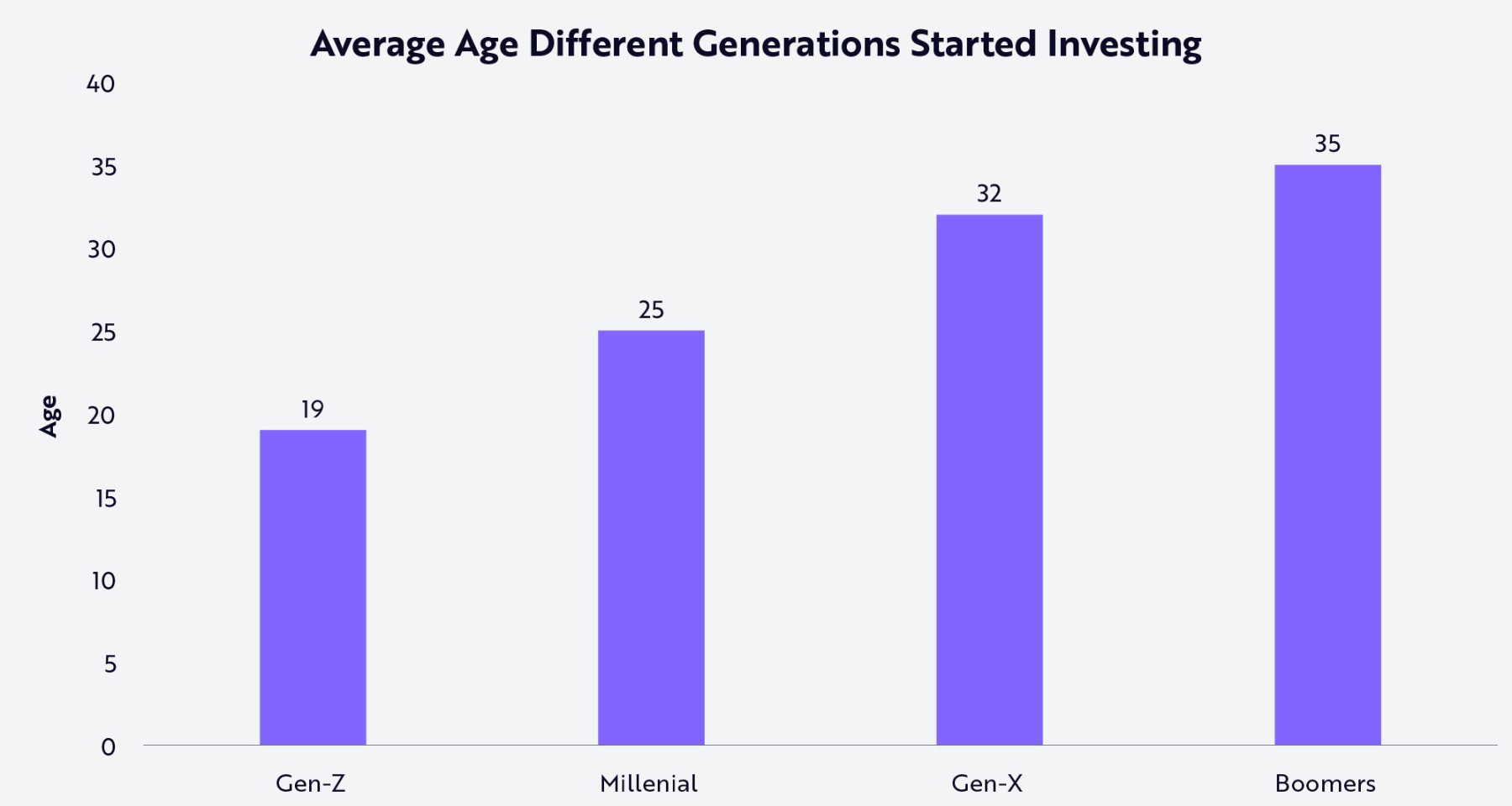
Source: ARK Investment Management LLC, based on Charles Schwab data from March 18, 2024. Note: The survey asked, “At what age did you start investing?” without defining “investing.” For informational purposes only, not investment advice, and does not constitute a recommendation to buy, sell, or hold any securities.
With investment concepts and educational content widely shared on social media and digital platforms, Millennials and Gen Z are exposed to investing at a much younger age. Survey responses below indicate that unprecedented access to knowledge and research tools has sparked their interest and helped them understand the investment process.
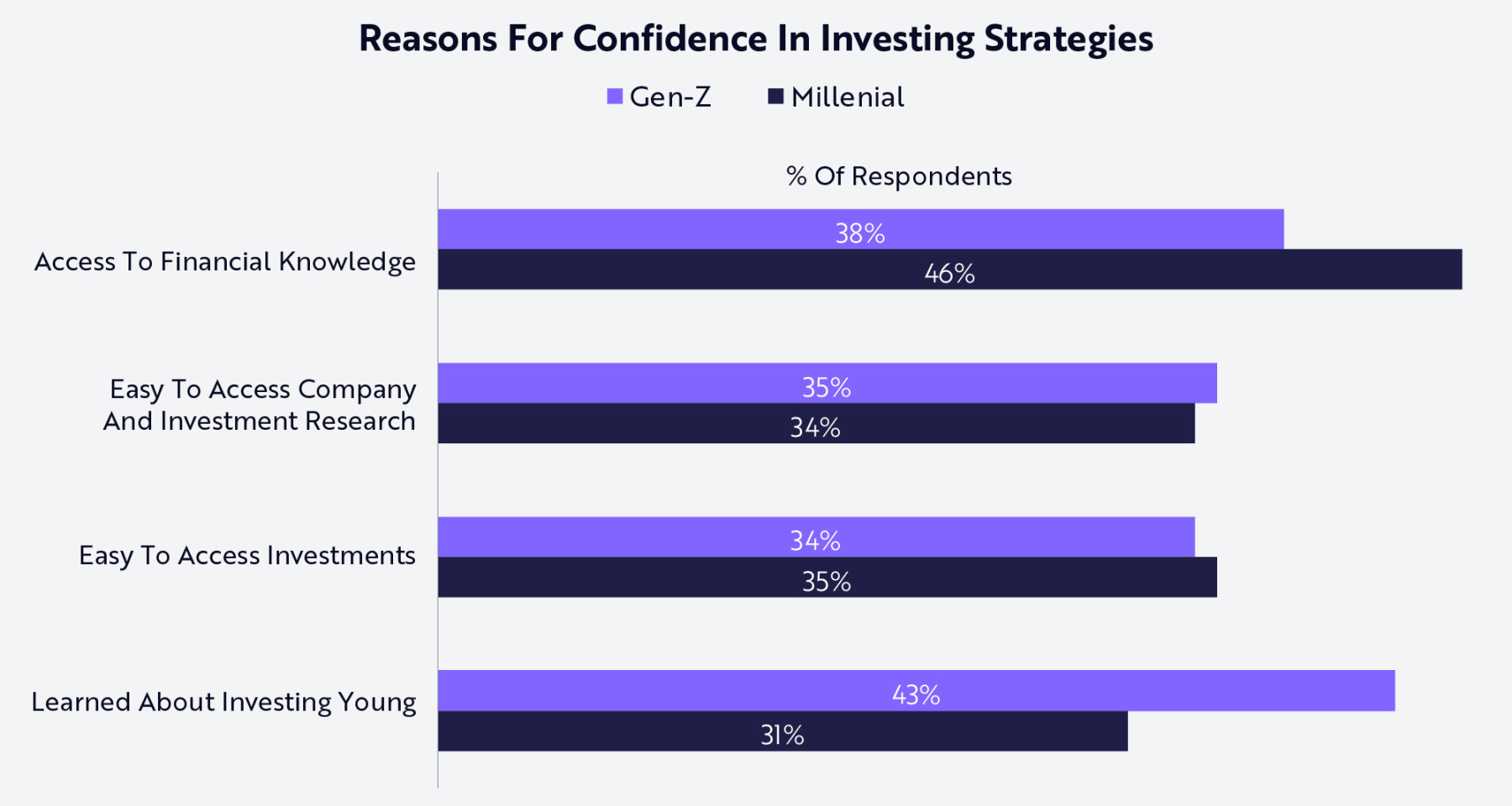
Source: ARK Investment Management LLC, based on Charles Schwab data from March 18, 2024. For informational purposes only, not investment advice, and does not constitute a recommendation to buy, sell, or hold any securities.
The rise of investment content on social media explains why Robinhood introduced social features and expanded its product line with more tradable instruments to boost engagement. Today, Robinhood is advancing in three directions: advanced trading tools, prediction markets, and crypto infrastructure. These initiatives continue to position Robinhood as a hub where finance, culture, and technology converge, allowing users to trade anything, anytime, anywhere.
Robinhood Legend offers users advanced trading tools. Through these, the company aims to close the product gap with legacy brokers, attract active traders, and serve more sophisticated retail investors transitioning from casual to advanced strategies.
Robinhood’s move into prediction markets highlights the convergence of finance, culture, and entertainment. For young investors, stock trading naturally extends their participation in sports, social media, and cultural events. By integrating Kalshi’s prediction market exchange, Robinhood enables users to trade on real-world outcomes, adding a socially driven, interactive dimension to its brokerage. Since launching in October 2024, Robinhood has achieved broad retail coverage, capturing about two-thirds of the market share from competitors alongside Kalshi, as shown below.
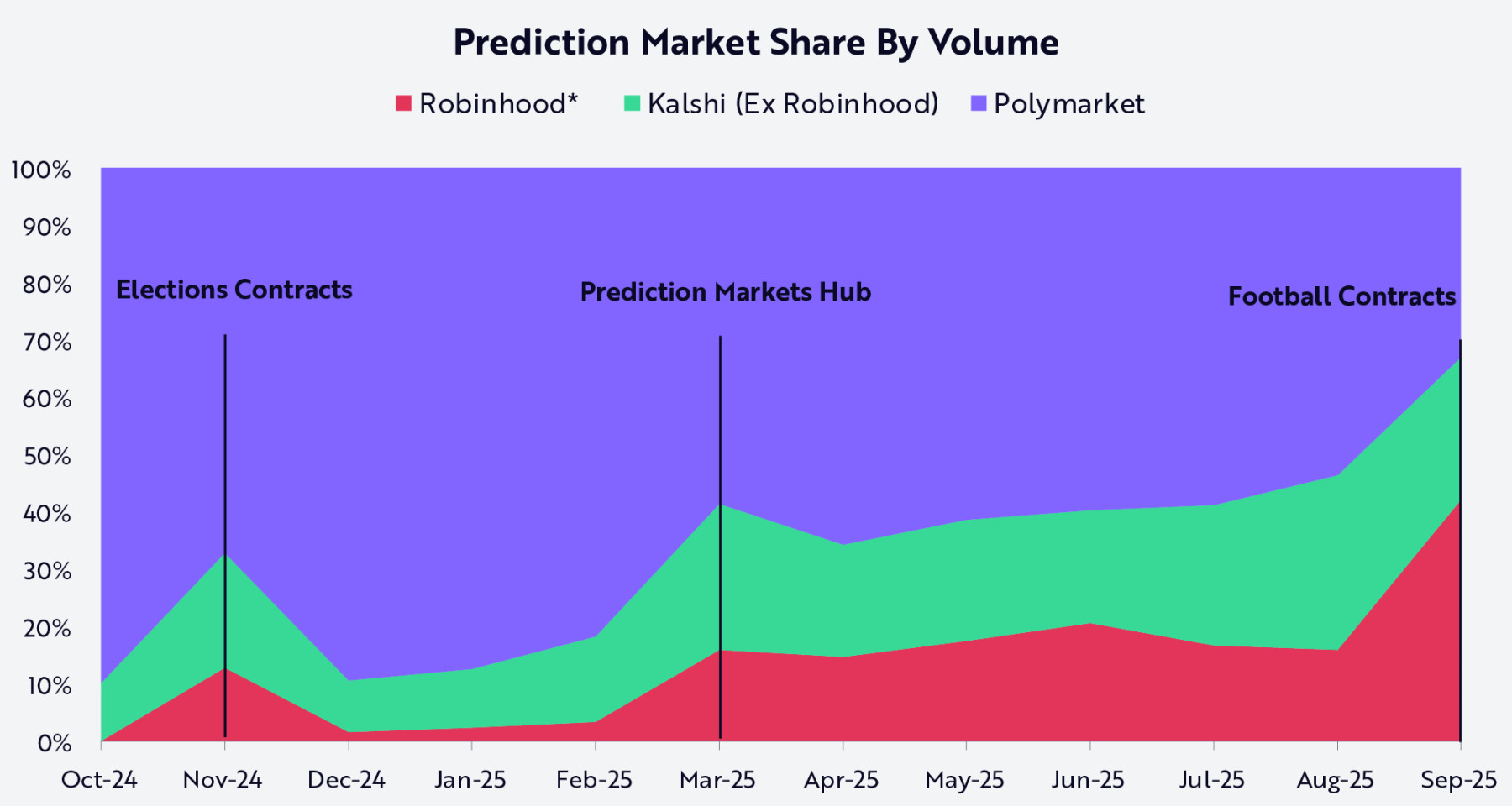
Note: Robinhood monthly trading volume based on management commentary and cumulative estimates provided by management. Source: ARK Investment Management LLC, 2025. Analysis uses multiple external data sources as of September 25, 2025. For informational purposes only, not investment advice, and does not constitute a recommendation to buy, sell, or hold any securities.
Digital assets have become central to Robinhood’s long-term strategy. The company has expanded its token lineup to include Solana, Pepe, and XRP, now supporting 42 tokens, while offering U.S. customers higher staking yields on Ethereum and Solana than competitors. Earlier this year, Robinhood launched tokenized U.S. stocks and ETFs for EU clients on Arbitrum and announced plans to build its own Layer 2 blockchain. Built on Arbitrum’s architecture, this network will support real-world asset tokenization, seamless cross-chain bridging, self-custody, and eventually 24/7 settlement—blurring the lines between traditional finance and digital assets.
By integrating advanced trading tools, prediction markets, and blockchain products, Robinhood empowers young investors to trade anything, anytime, anywhere. Critically, this expanded scope allows Robinhood to establish the closest brokerage relationship with this investment-savvy generation. As investing becomes central to personal finance, brokerage platforms are becoming gateways to broader financial services. On this foundation, Robinhood is poised for its next phase: integrating a comprehensive personal financial product suite.
Integrating a Personal Financial Product Suite
Robinhood’s first strategic phase broke down barriers for young consumers to enter brokerage. Its success stemmed not only from zero commissions but also from building a mobile-first platform emphasizing simplicity, intuitive design, and seamless user experience. Now, Robinhood is applying the same playbook to compete across broader financial services.
Unlike standalone brokerage, personal finance is not a single product but an interconnected network of services including banking, lending, retirement, wealth management, and financial literacy. Integrating these verticals into a unified ecosystem is Robinhood’s next strategic goal.
In the following sections, we examine Robinhood’s expanding product suite centered around the Robinhood Gold subscription service. According to our research, the Gold service—targeting a TAM exceeding $600 billion—is to Robinhood what Prime is to Amazon: a subscription model that increases customer engagement and delivers greater value to more users.
Robinhood Gold Service
Priced at $5 per month or $50 annually, Robinhood Gold offers professional-grade features including Morningstar research reports, Nasdaq Level II market data, higher-yield cash management, credit card access, managed accounts, and margin trading. Traditionally, these features could cost hundreds or even thousands of dollars annually. By bundling them into an affordable subscription, Robinhood positions Gold not only as a predictable revenue stream but also as a connector to its broader ecosystem. The goal is simple: make every Robinhood user a Gold user.
As shown below, the steadily rising attach rate of Robinhood Gold highlights the company’s effective combination of product innovation and targeted marketing. Incremental value-added services—such as higher APY, 3% IRA match, brokerage deposit bonuses, and the Gold credit card—continuously strengthen the subscription’s value proposition. Creative promotions like sweepstakes provide additional incentives. Newer cohorts show significantly higher attach rates—a strong signal that Robinhood’s ongoing enhancement of Gold is resonating and driving up customer lifetime value.
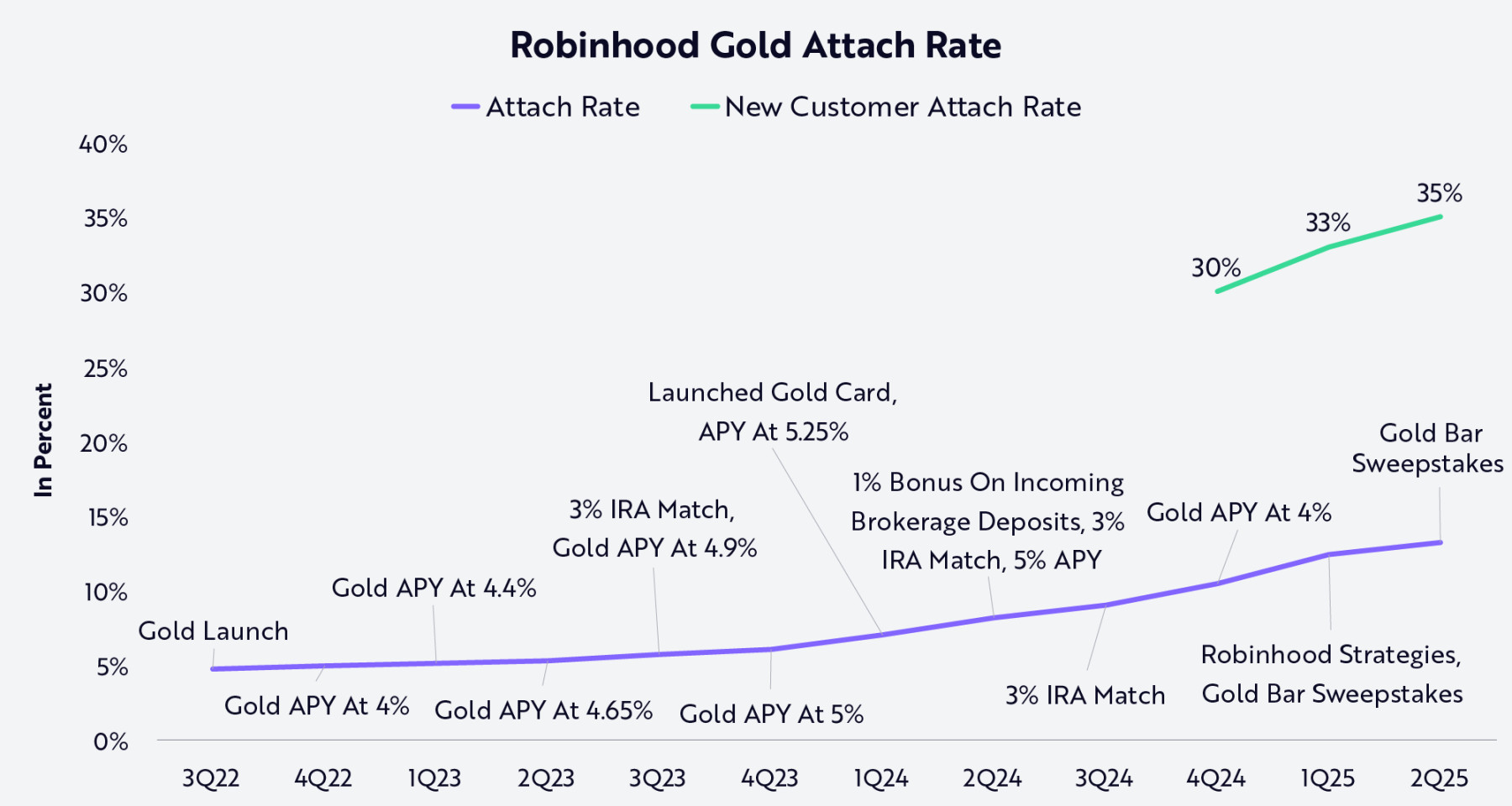
Note: “Attach rate” refers to the proportion of users who are both Robinhood cash account holders and Robinhood Gold subscribers. Source: ARK Investment Management LLC, based on Robinhood data as of September 15, 2025. For informational purposes only, not investment advice, and does not constitute a recommendation to buy, sell, or hold any securities. Past performance is not indicative of future results.
Banking
Banking is a major component of Robinhood’s expansion strategy. Through partner banks, its cash management program pays interest on idle balances and eliminates overdraft fees, minimum balance requirements, and account maintenance fees. This protects Robinhood’s customers from the ~$10 billion in overdraft penalties U.S. banks collected in 2024, returning profits traditionally captured by legacy institutions back to users. Launched this year, Robinhood Banking will gradually expand into a full suite including direct deposit, bill pay, cash disbursement, peer-to-peer transfers, and debit cards. Thus, Robinhood is evolving from a trading platform into a comprehensive financial services provider.
Credit and Lending
Credit cards have long been a key profit center for banks, relying on annual fees, high interest rates, revolving balances, and interchange fees. In contrast, the Robinhood Gold Credit Card charges no additional fees beyond the base Gold subscription, offers rewards competitive with premium cards, and integrates seamlessly with the entire Robinhood platform. In short, Robinhood enhances consumer purchasing power by cutting costs while increasing its share of users’ spending.
The chart below compares the Robinhood Gold Credit Card with competing products.

Source: ARK Investment Management LLC, 2025, based on Holzhauer 2025 and Moffitt 2025 data as of September 15, 2025. For informational purposes only, not investment advice, and does not constitute a recommendation to buy, sell, or hold any securities.
The credit card is not Robinhood’s only lending product. For Gold members, Robinhood now serves as a referral partner for Sage Home Loans, offering more competitive mortgage options with lower fees. Through this partnership, Gold subscribers can access mortgage or refinance rates up to 0.75% below national averages, with no minimum asset balance requirement. Additionally, Robinhood provides a $500 closing cost credit.
Retirement and Wealth Management
With the launch of Robinhood Strategies, Robinhood has extended its model into wealth management. In traditional finance, only high-net-worth clients access professionally managed portfolios (managed accounts), which typically require minimums of $100,000 to $1 million. Through Robinhood Strategies, Gold subscribers can open a managed account with just $50 and pay an annual fee of only 0.25%, far below the 1% charged by traditional advisors. As shown in the comparison chart below, Robinhood caps annual fees at $250, meaning customers pay no more regardless of how much they invest.
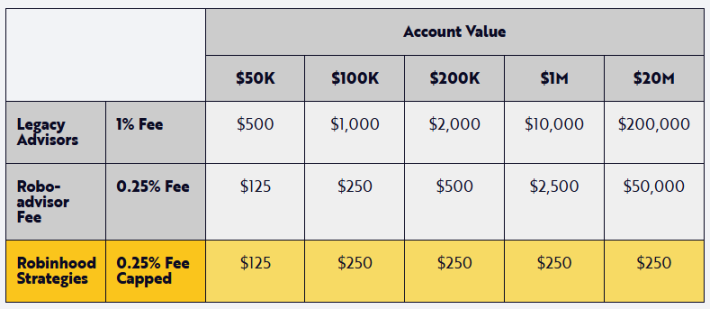
Source: ARK Investment Management LLC, 2025, based on Robinhood data as of September 15, 2025. For informational purposes only, not investment advice, and does not constitute a recommendation to buy, sell, or hold any securities.
By lowering the barrier to managed accounts, Robinhood is democratizing portfolio management for retail investors: reducing fees, simplifying processes, and broadening access. This positions “managed strategies” as a mass-market gateway to financial planning and wealth management.
Robinhood further expanded its wealth management offerings by acquiring TradePMR, a leading RIA custody and portfolio management platform. As more Millennials and Gen Z investors seek professional guidance to monitor and manage growing portfolios, Robinhood gains access to a rapidly expanding ~$7 trillion RIA market. This partnership connects RIA advisors with a highly attractive new customer base, while enabling Robinhood to offer a best-in-class referral program through its app, allowing users to seamlessly connect with custodial advisor services. Going forward, Robinhood and TradePMR plan to upgrade the tech platform and optimize advisor-client matching, delivering an integrated, mobile-first wealth management experience that extends beyond self-directed trading.
Financial Literacy and Social Features
While expanding financial services for retail investors, Robinhood is also advancing financial literacy. Its app offers a rich library of articles and courses covering topics from stock market basics to advanced concepts like ETFs, IPOs, and cryptocurrencies, meeting the learning demands of Millennials, Gen Z, and others interested in financial markets. Guided onboarding modules and contextual explanations (e.g., walkthroughs on stock detail pages) embed financial education into the user journey, lowering barriers and building confidence for making key financial decisions.
The younger generation increasingly relies less on financial advisors or traditional institutions for financial advice. Instead, social media platforms have become hubs for financial education. As shown below, user-generated financial advice, market commentary, and engaging memes create vibrant community interactions daily.
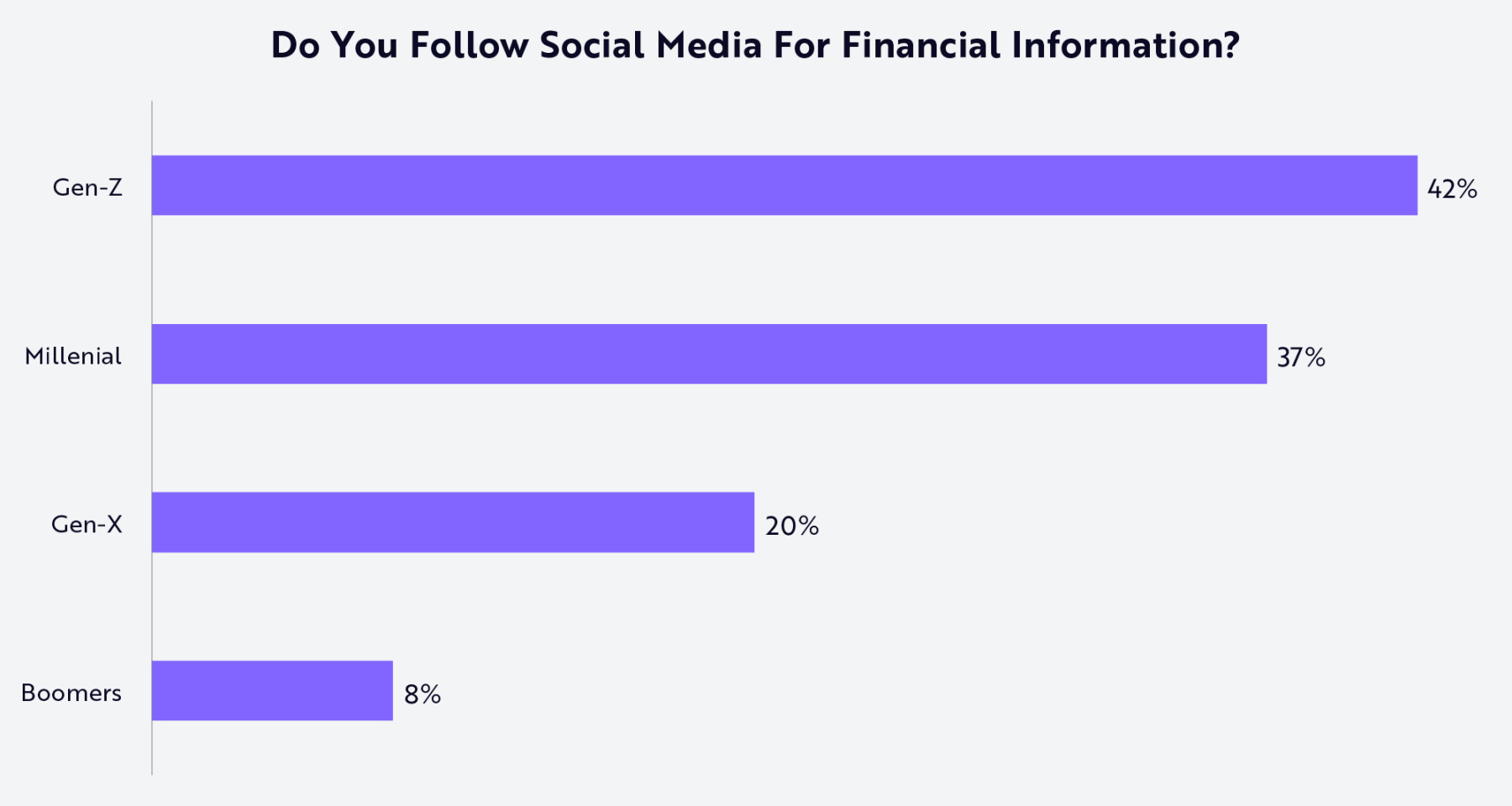
Source: ARK Investment Management LLC, based on Charles Schwab data as of September 15, 2025. For informational purposes only, not investment advice, and does not constitute a recommendation to buy, sell, or hold any securities.
Through Robinhood’s social features, investors can share verified trades, discuss strategies, and engage with others, turning investing from a solitary act into a collaborative experience. In a social environment rife with misinformation, bots, and unreliable advice, Robinhood’s trade verification feature adds transparency and credibility to community discussions. Features like the Prediction Market Hub position the platform at the intersection of trading, culture, and community, creating a space where retail investors can connect, learn, and grow together.
To leverage advances in artificial intelligence, Robinhood launched Cortex—an AI-powered investment tool designed to help investors understand markets. From stock briefings that explain price movements to customized trade builders that help users explore new strategies, Robinhood is using AI to democratize financial knowledge for its young retail audience. Cortex has the potential to evolve into a fully functional mobile AI financial assistant. Riding the wave of social media and AI, Robinhood’s product suite is becoming a personal financial operating system with holistic insights into users’ finances, enhancing engagement, trust, and retention in ways no single product can achieve.
Robinhood’s pace of product iteration is becoming key to realizing its vision of becoming the go-to personal financial operating system. As shown below, the company consistently launches new products across financial services year after year. Each product suite enhances Robinhood’s utility, strengthening the entire ecosystem globally.
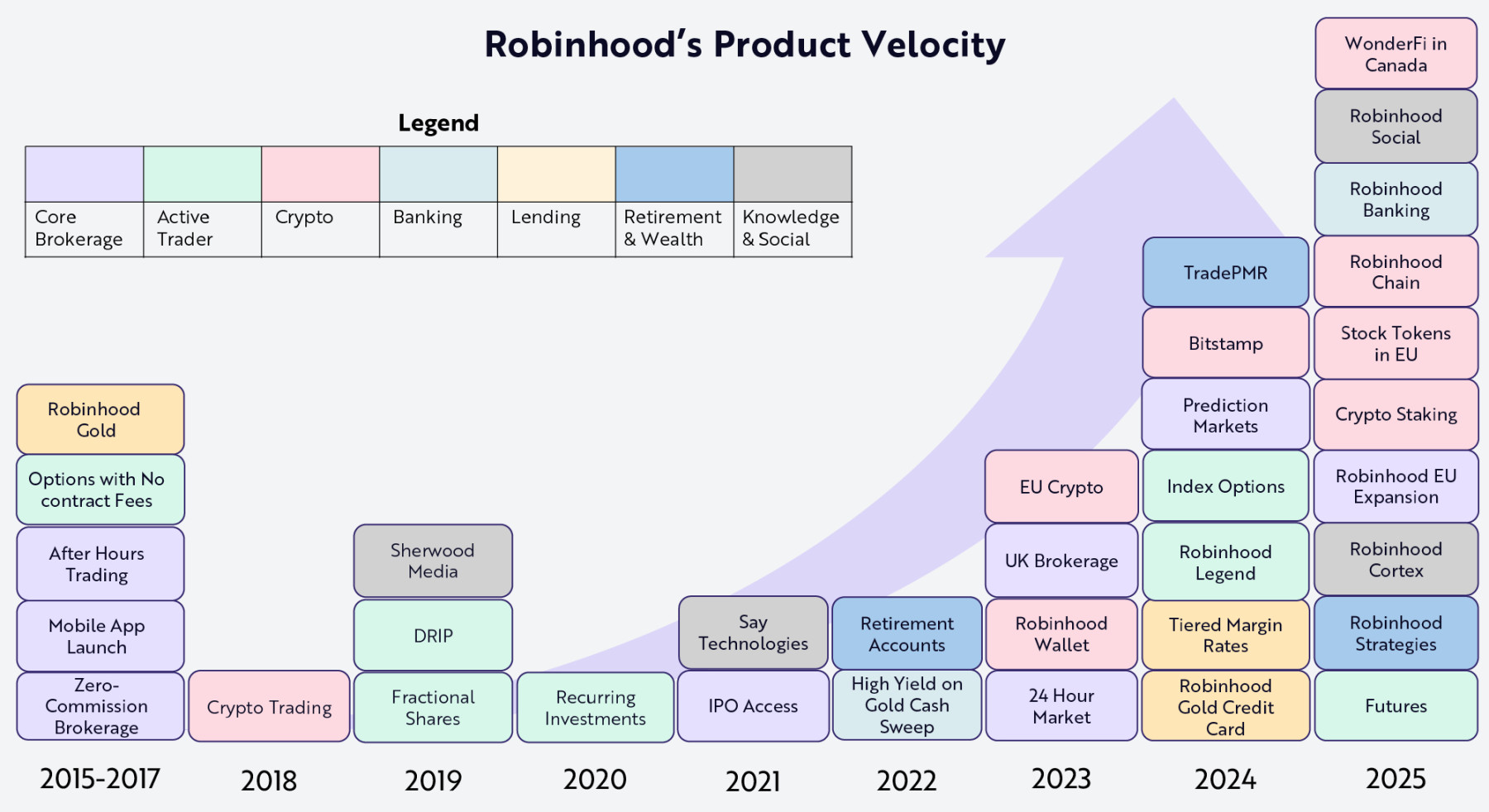
Source: ARK Investment Management LLC, based on Robinhood data as of September 15, 2025. For informational purposes only, not investment advice, and does not constitute a recommendation to buy, sell, or hold any securities.
Robinhood’s sustained, rapid product development is translating into deeper user engagement. Data shows that from the end of Q4 2022 bear market to Q2 2025, customer asset balances grew nearly fourfold—from ~$2,700 to ~$10,500 (see chart below).
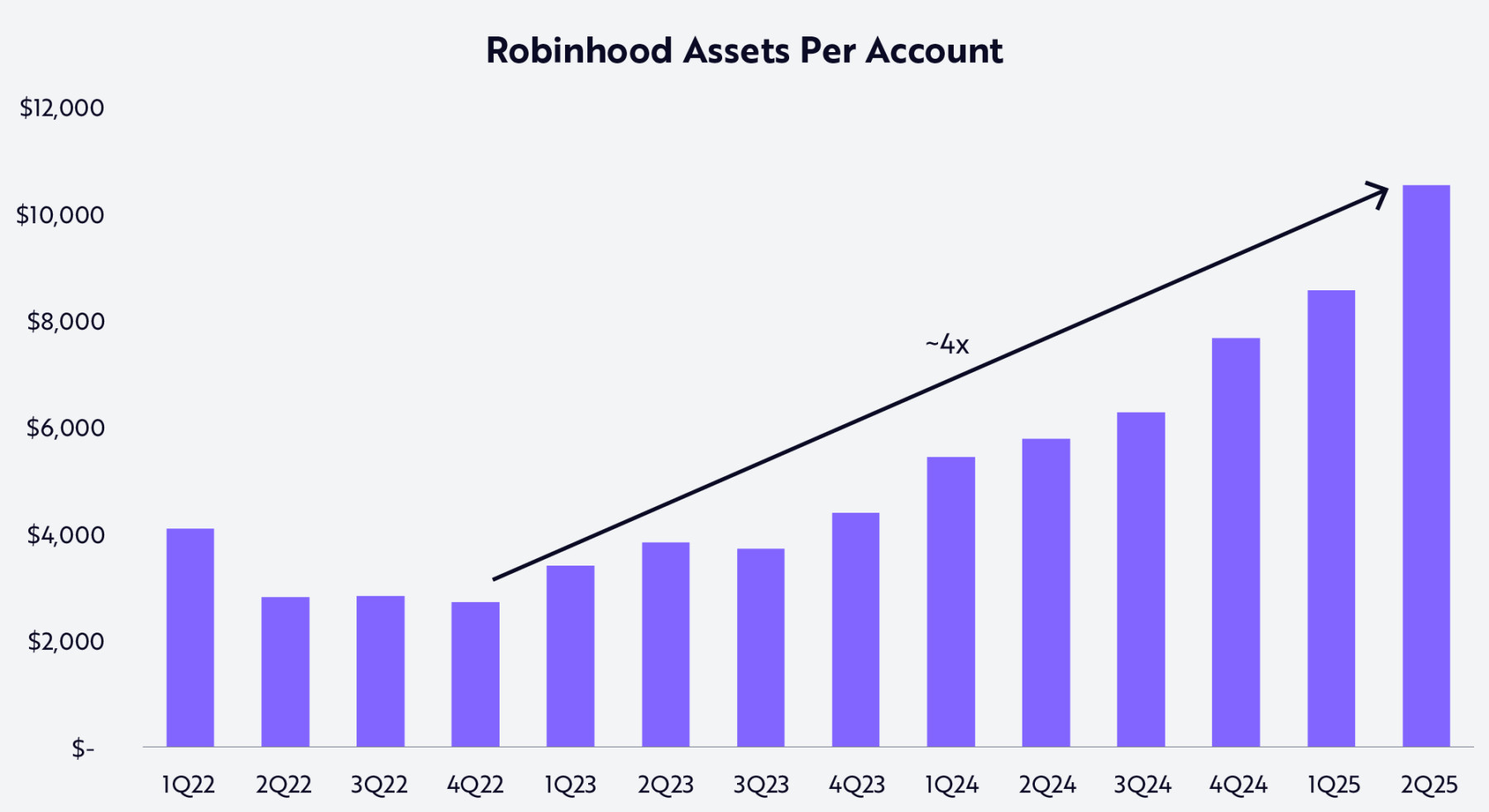
Source: ARK Investment Management LLC, analysis based on multidimensional Robinhood data as of September 25, 2025 (primarily financial filings, available upon request). For informational purposes only, not investment advice, and does not constitute a recommendation to buy, sell, or hold any securities.
As Robinhood transforms traditional brokerage services and redefines multiple consumer finance verticals, it is uniquely positioned to become the first truly mobile-native financial operating system—and thus benefit most from one of the biggest opportunities in modern financial history: generational wealth transfer.
Generational Wealth Transfer
Over the coming decades, a record ~$124 trillion in assets will transfer from Baby Boomers to their heirs—including Millennials and Gen Z. During this transfer, assets will move from an “analog generation” reliant on physical branches and advisor relationships to a “digital-native generation” fluent in seamless, mobile-first platforms.
Robinhood holds a structural advantage—its number of Millennial and Gen Z accounts is nearly twice that of Vanguard and almost four times that of Charles Schwab (see chart below). In fact, 63% of Robinhood’s users are Millennials and Gen Z, compared to just 14% at Schwab. Put differently, as shown below, nearly 60% of Schwab’s current clients are still Baby Boomers.
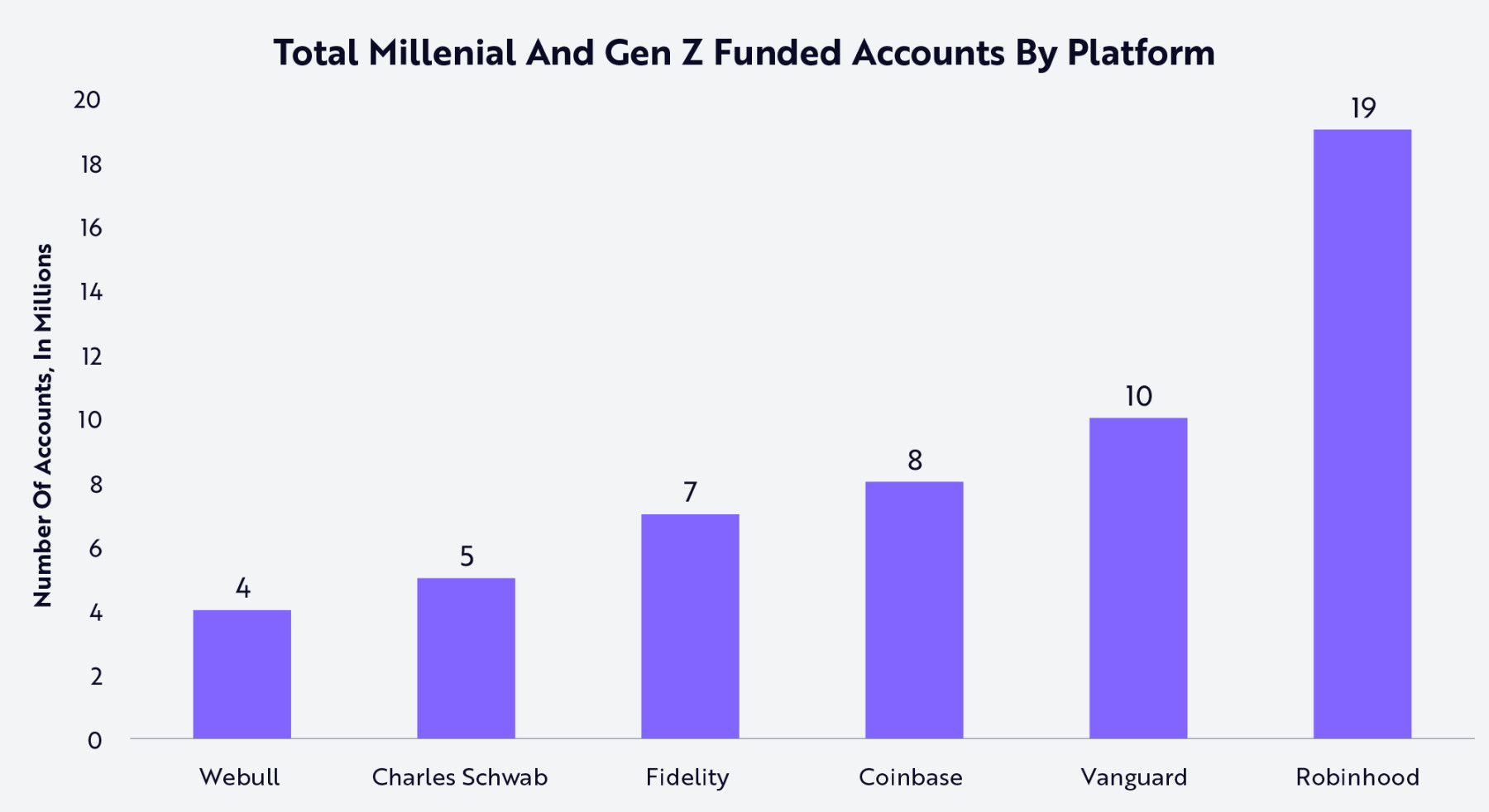
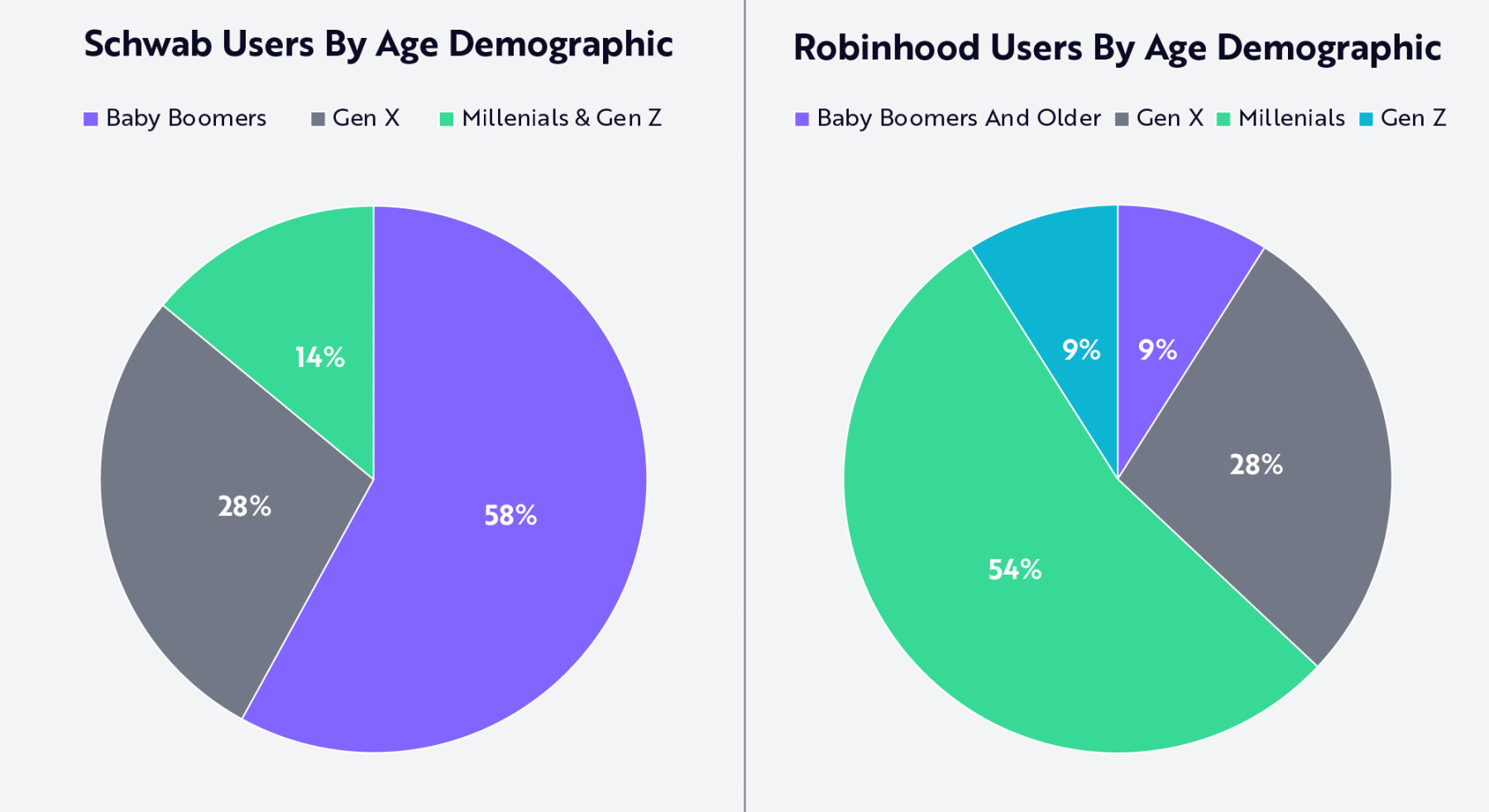
Source: ARK Investment Management LLC, 2025. Analysis based on multiple external data sources as of September 25, 2025 (including Robinhood 2025 data). For informational purposes only, not investment advice, and does not constitute a recommendation to buy, sell, or hold any securities.
The cultural shift accompanying this wealth transfer also signals a transformation in expectations for how financial services should work. Baby Boomers built their financial lives in an analog world dependent on physical branches, paper statements, and long-term advisor relationships. Millennials and Gen Z, however, prefer intuitive, mobile-native platforms offering digital-first communication, commerce, and entertainment experiences, along with seamless, transparent, and personalized financial services. Our research indicates that Robinhood, with its rapid product iteration and innovation, is better positioned to win over Millennial and Gen Z investors than either new entrants or legacy institutions attempting to modernize their offerings.
Robinhood is uniquely positioned to serve the trillions of dollars soon to change hands. To capture a disproportionate share of this $124 trillion wealth transfer, Robinhood has dramatically evolved its product suite. As shown below, roughly one-third of transferred assets (~$40 trillion) will consist of stocks (the foundation of Robinhood’s brokerage) and mutual funds. Another $22 trillion will involve retirement accounts like 401(k)s and IRAs—areas Robinhood has expanded into over recent years. Cash and deposits represent $5 trillion, easily served by Robinhood’s banking features. Real estate is another $40 trillion opportunity—a long-term play where Robinhood may enter via services ranging from mortgage lead generation to property tokenization.
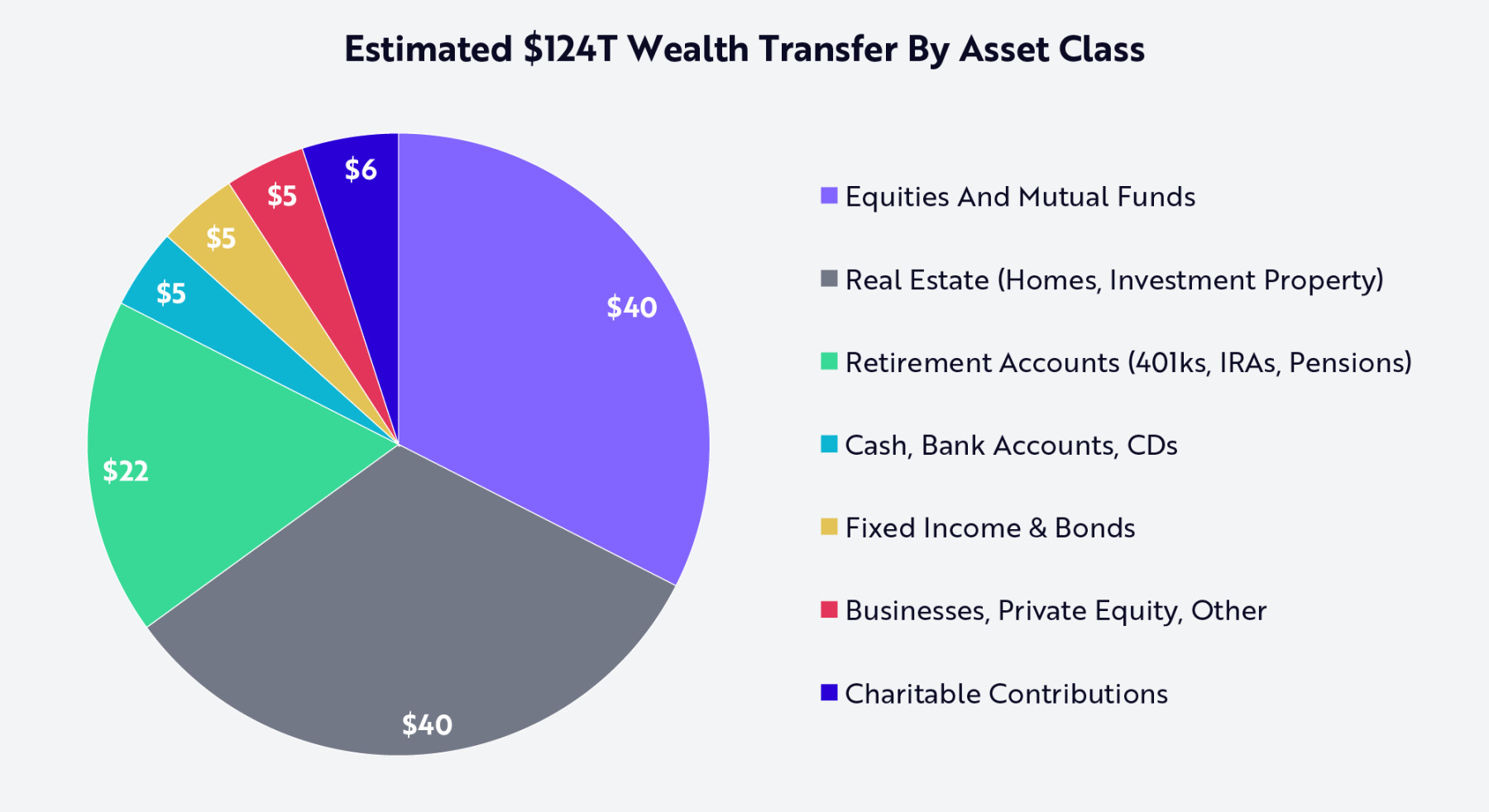
Source: ARK Investment Management LLC, based on Furio 2025 and Lichtenberg 2025 data as of September 15, 2025. For informational purposes only, not investment advice, and does not constitute a recommendation to buy, sell, or hold any securities.
With leading market share among young investors and a product suite aligned with the trillions in wealth about to transfer, Robinhood is not only poised to close the gap with traditional financial institutions but also has the opportunity to fundamentally redefine the economics of financial services. As shown below, due to its older, wealthier client base, Schwab’s average assets under custody (AUC) per client is ~$250,000—far above Robinhood’s current levels. However, as Millennials and Gen Z inherit these assets and consolidate their financial lives on the Robinhood platform, this dynamic could reverse over time.
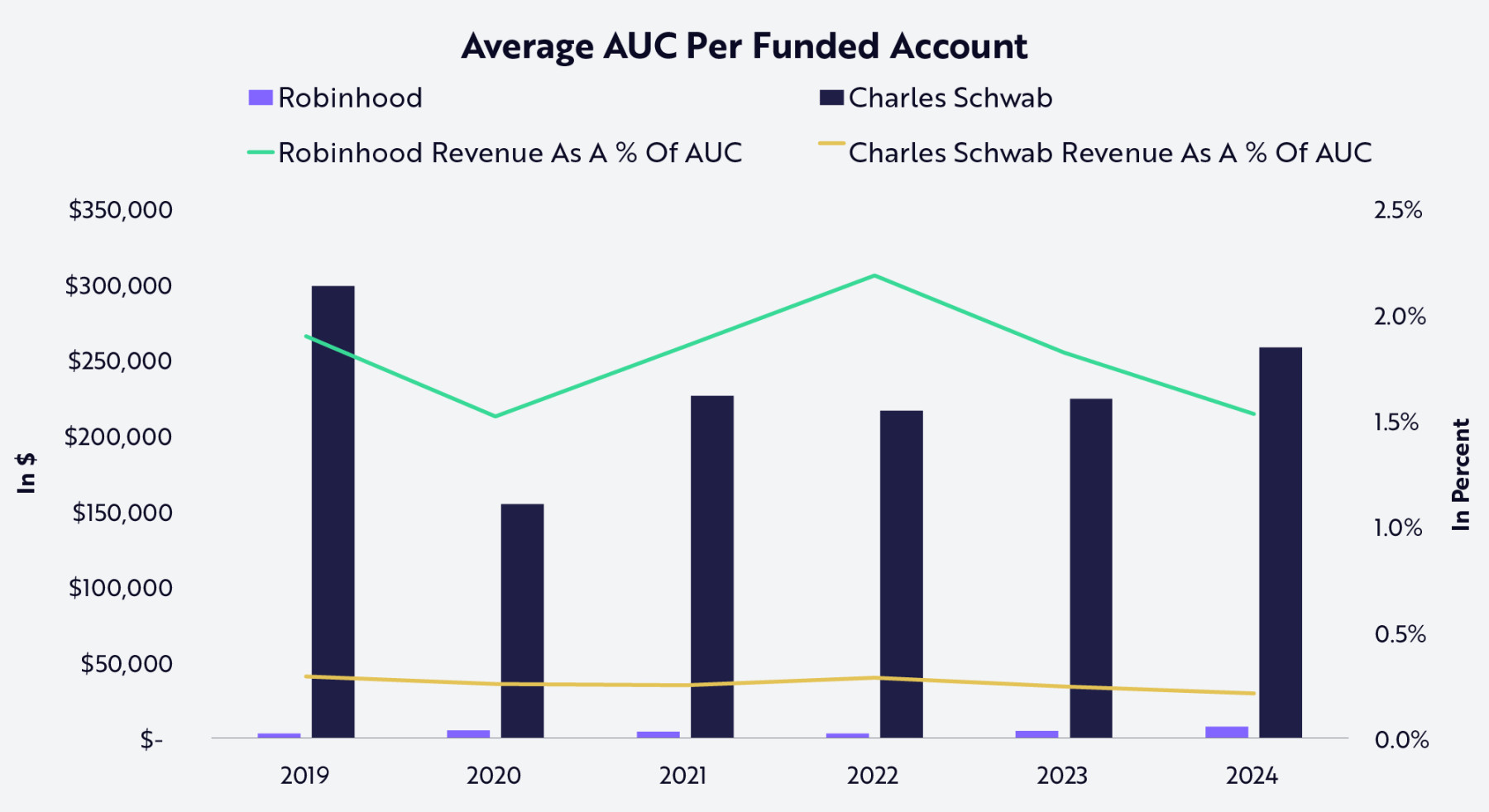
Source: ARK Investment Management LLC, analysis based on multiple external data sources as of September 25, 2025 (primarily Robinhood and Schwab financial filings). For informational purposes only, not investment advice, and does not constitute a recommendation to buy, sell, or hold any securities. Past performance is not indicative of future results.
Conclusion: Robinhood’s Potential Average Revenue Per User
Our research suggests that Robinhood, having matured its strategy of disrupting brokerage through zero commissions and intuitive mobile-first design, and combining it with rapid expansion into retirement, banking, credit, and advisory services, is well-positioned to capture a significant share of the ongoing generational wealth transfer. Its bundled service strategy is deepening user engagement, expanding wallet share, and laying the groundwork for monetization across multiple verticals—paving the way for Robinhood to become one of the most important financial operating systems for the next generation.
As Robinhood continues to scale, we believe its monetization flywheel will strengthen significantly. Tokenization and prediction markets will enable users to trade anything, anytime, anywhere; as more users adopt premium services, Gold subscriptions are expected to grow; as idle cash flows into cash management, revenue sharing will expand; as transactions flow through its credit card, lending economics will improve; and Cortex will accumulate value by delivering increasingly personalized AI guidance.
Each incremental dollar of revenue not only improves Robinhood’s unit economics but also increases the value delivered to consumers—creating a virtuous cycle: growth drives engagement, and engagement fuels further growth.
As shown below, Robinhood’s average revenue per user (ARPU) could grow from ~$130 in 2024 to over $430 by 2030. This growth is expected to come from a balanced mix of trading activity, interest income, and diversified, sustainable revenue streams.
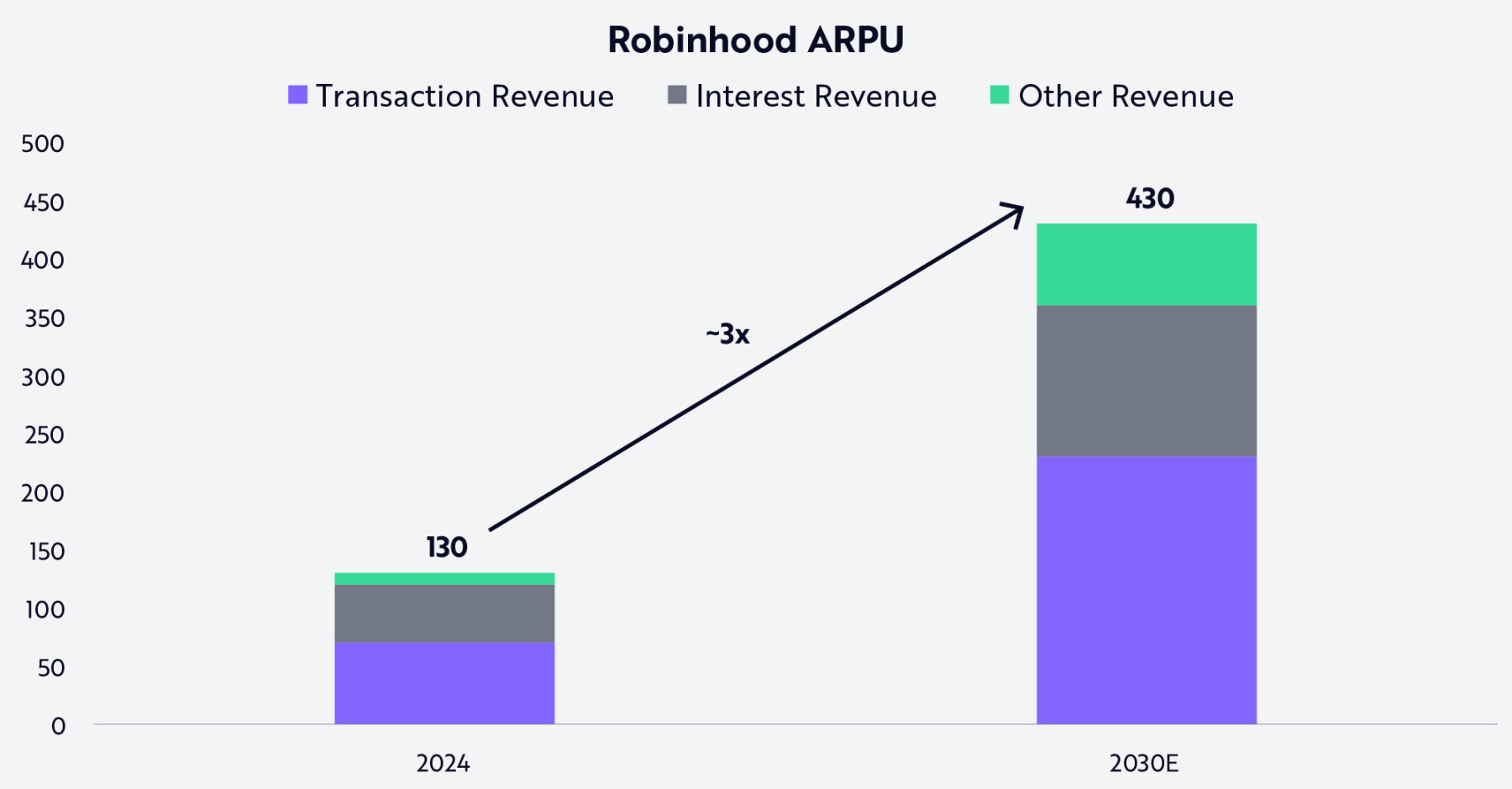
Source: ARK Investment Management LLC, analysis based on multidimensional Robinhood data as of September 25, 2025 (primarily financial filings). For informational purposes only, not investment advice, and does not constitute a recommendation to buy, sell, or hold any securities. Forecasts are inherently limited and should not be relied upon.
Someday, Robinhood may resemble traditional financial institutions like Charles Schwab in terms of asset and revenue scale. But more likely, as a tech company built for digital natives, Robinhood may redefine what a financial institution can be. Decades from now, Robinhood may not be remembered merely as a brokerage, but as a defining platform that reshaped the architecture of consumer finance.
Join TechFlow official community to stay tuned
Telegram:https://t.me/TechFlowDaily
X (Twitter):https://x.com/TechFlowPost
X (Twitter) EN:https://x.com/BlockFlow_News
 @ARKInvest