COIN vs HOOD: A $160 Billion Showdown
TechFlow Selected TechFlow Selected
COIN vs HOOD: A $160 Billion Showdown
Two radically different approaches to solving the same problem: how to bring cryptocurrency to the masses.
 Navigating Web3 tides with focused insights
Writing: Thejaswini MA
Translation: Baihua Blockchain
A war is quietly unfolding in your pocket, and most people aren't even aware of it.
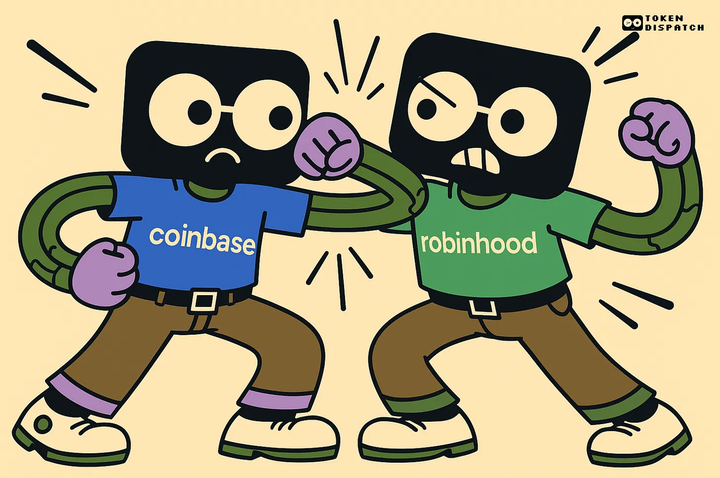
Two major U.S. financial apps—Robinhood and Coinbase—are running drastically different experiments on millions of users. Robinhood ranks 14th in the App Store’s finance category, while Coinbase ranks 20th; both have market valuations around $80 billion. They target young investors but believe the other is fundamentally wrong.
Both experiments have seen some degree of success.
The Essence of Robinhood and Coinbase
These two companies are not traditional competitors but rather conducting different experiments on the same test subject (us).
Robinhood sees pain points in finance and asks: "What if we fix all the annoying parts?" They offer 15 cryptocurrencies, zero-commission trading, and an interface simple enough for anyone to buy Tesla stock without a finance degree. Their philosophy: you don’t need to know how sausages are made to enjoy a hot dog.
Coinbase takes the opposite approach, asking: "What if we rebuild the entire financial system on blockchain technology?" Coinbase charges higher fees than rivals like Robinhood but builds a platform for users who want full access to the crypto ecosystem, offering over 260 cryptocurrencies. They're betting that traditional finance will eventually move on-chain and aim to become the infrastructure powering this transition.
Coinbase CEO Brian Armstrong said: "Over the next five to ten years, our goal is to become the leading financial services app globally because we believe crypto is eating financial services, and we are the number one crypto company. All asset classes—money market funds, real estate, securities, debt—will go on-chain."
The two companies went public months apart in 2021, each with an $80 billion valuation, both targeting mobile-first young investors—but their products feel designed for entirely different species.
This isn't a battle for dominance but a race to serve two different financial futures.
The Race to Expand Crypto Products
Both companies are accelerating expansion into crypto products—but in very different ways.
Recent announcements show Robinhood attempting to leapfrog Coinbase directly. In June, they launched Robinhood Chain—their own Layer-2 network supporting tokenized stocks and crypto trading, with future plans for assets like SpaceX and OpenAI. European users can now trade tokenized U.S. stocks around the clock, not just during market hours. This brings the 24/7 trading model expected by crypto users to traditional assets.
They’ve also introduced ETH and SOL staking, acquired Bitstamp—the oldest crypto exchange in Europe—for $200 million—and plan to launch crypto perpetual futures for European users. The crypto infrastructure they’re building integrates seamlessly with their existing stock-trading experience, rather than simply tacking crypto features onto a traditional brokerage.
All of this—the chain, tokenized stocks, low fees—is built for the next generation of investors who will inherit trillions of dollars.
In the fee war, Robinhood's crypto trading fees are about 40 basis points (0.4%), while Coinbase may charge up to 1.4% or more for comparable trades. Buying $1,000 worth of Bitcoin costs about $4 on Robinhood versus over $14 on Coinbase.
Robinhood profits via payment for order flow, where market makers pay to execute retail trades—a model similar to their stock trading business. This mature system allows them to offer "free" trades while still making money.
But Coinbase offers something Robinhood cannot match: true ownership of cryptocurrency. On Robinhood, what you buy is essentially an IOU—a receipt showing Robinhood owes you crypto assets. You can't transfer Bitcoin to your own wallet or use it elsewhere—you can only buy and sell within the Robinhood app. You can't participate in DeFi, stake most tokens, or use crypto for anything beyond buying and selling.
For most people, this doesn’t matter—they just want exposure to crypto, not utility. But for users who want advanced crypto functionality, Coinbase is the only realistic option among major U.S. platforms.
Q2 Earnings Breakdown
This summer’s earnings reports revealed how these two models are performing.
Robinhood delivered strong results. Total revenue rose 45% year-over-year to $989 million. Crypto revenue surged 98% to $160 million (increasing from 10% of total revenue last year to 16% this quarter), despite a relatively flat overall crypto market. They have 26.5 million active accounts and $279 billion in assets under custody, up 99% year-over-year. The acquisition of Bitstamp added approximately 520,000 new crypto users, generating $7 billion in notional crypto trading volume in June after closing.
Platform assets reached $279 billion, up 99% YoY, with net deposits of $13.8 billion. Active accounts grew 10% to 26.5 million, and cash balances jumped 56% to $32.7 billion, indicating increased share of customer wallets.
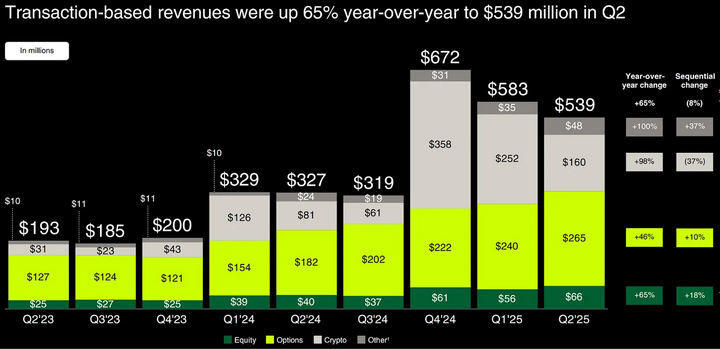
Coinbase faced a "tough quarter." Total revenue dropped 26% from Q1 to $1.5 billion, missing analyst expectations. Trading revenue fell 39% due to shrinking retail activity. Shares dropped 16% on earnings day as investors tried to determine whether this was a temporary slump or a signal of trouble for its high-fee model.
But calling this quarter a failure misses the bigger picture. Coinbase reported $1.4 billion in net income, compared to $512 million in adjusted EBITDA, largely driven by $1.5 billion in unrealized gains from its investment portfolio and strategic crypto holdings. Even excluding these one-time gains, adjusted net income was $33 million, showing underlying profitability.
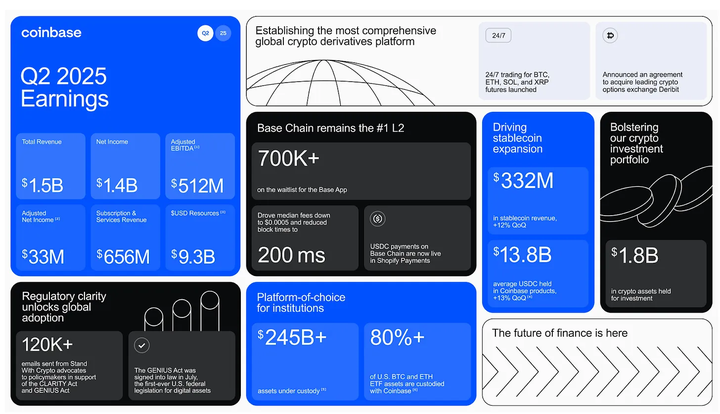
Higher operating expenses were primarily due to a one-time $307 million loss from a data breach in May. Core costs (technology, admin, marketing) actually declined, demonstrating cost discipline. USDC stablecoin revenue hit $332 million with average balances growing 13%. Custodied assets reached a record high of $245.7 billion. Prime Financing balances also hit a new high—part of Coinbase Prime, which provides custody, trading, lending, and financing services for hedge funds and family offices.
Coinbase continues launching new products: new derivatives, expansion of the Base chain, and the Coinbase One Card. Despite lower revenue, fundamentals remain solid.
Coinbase’s Infrastructure Empire
Coinbase’s infrastructure strategy is more complex. They custody $245.7 billion in assets for institutions, capturing a large share of the institutional crypto market. When you buy a Bitcoin ETF through your 401k, there's a good chance it's using Coinbase infrastructure.
Coinbase is the primary custodian for over 80% of U.S. Bitcoin and Ethereum ETFs, managing around $113.4 billion (out of $140 billion in total crypto ETF assets). When BlackRock needs to store billions in Bitcoin for IBIT or Fidelity for FBTC, they turn to Coinbase. PayPal uses Coinbase’s backend when launching its PYUSD stablecoin, and so does JPMorgan when building crypto payment rails.
Coinbase has 240+ institutional clients, 420+ liquidity providers, and regulatory licenses most competitors can’t match. Its custody business is chartered by the New York State Department of Financial Services—an approval process that takes years and is difficult for others to replicate.
Its “full-service trading platform” strategy is starting to pay off. They’ve launched perpetual futures with up to 10x leverage, bringing derivative trading previously only available on overseas platforms to U.S. retail users. They’ve integrated decentralized exchanges directly into the app, allowing users to trade any token on Ethereum or Base without leaving Coinbase.
Their Base Layer-2 network processed over 54,000 token launches in a single day—surpassing Solana. Base’s real advantage lies in integration with Coinbase’s broader ecosystem: ETF issuers can use it for instant settlement, enterprises can tokenize assets directly, and retail users gain access to institutional-grade infrastructure.
Robinhood’s Generational Takeover
While Coinbase builds infrastructure for institutions, Robinhood executes one of the smartest long-term plays in finance: capturing people before they get rich.
This is a strategy Disney mastered. In the early 20th century, Disney captured children’s hearts through animation and theme parks, forming emotional bonds before they had money. When those kids grew up and earned income, loyalty translated into spending on movies, merchandise, streaming, and vacations—creating a multi-generational cash machine.
Robinhood dominates young investors, and traditional brokerages should be worried:
About 50% of customers are Millennials, 25% Gen Z, and 20% Gen X.
Robinhood users start investing at an average age of 19–22, far younger than Millennials on other platforms (who typically start in their 20s) or Baby Boomers (who started in their 30s).
Robinhood guides new users to complete their first sale quickly—not to encourage excessive trading, but because locking in actual gains (even just $50) creates an emotional hook that keeps users coming back.
Its "all-in-one finance" expansion follows this logic. Robinhood Gold (a $5 monthly subscription) includes a 3% cashback credit card, high-yield savings, retirement matching, and margin discounts. Gold subscribers grew 60% YoY to 2 million. These users rely on Robinhood for banking, credit cards, and retirement.
The platform now holds $279 billion in assets, positioning itself for the massive intergenerational wealth transfer of $84–124 trillion expected over the next 20 years from Baby Boomers to younger generations. Robinhood is betting that if they establish user habits early, they won’t need to predict inheritance patterns—just be ready when the wealth arrives.
Who’s Winning?
The two companies have similar market caps: Robinhood at $81 billion, Coinbase at $85 billion. Year-to-date performance tells a different story: Robinhood is up 135%, while Coinbase is up only 30%, much of it in the past month.
BofA analyst Craig Siegenthaler recently raised Robinhood’s price target to $119 while cutting Coinbase’s from $383 to $369, citing: "Robinhood’s explosive growth in crypto revenue versus Coinbase’s overreliance on volatile altcoin trading that retail users are abandoning."
Coinbase’s global market share dropped from 5.65% to 4.56%, slightly recovering in July, while Kraken gained the most U.S. market share this year. Coinbase faces a dilemma: lowering fees hurts margins, while maintaining high fees risks losing traders. They’ve chosen margins, introducing fees on stablecoin trades that were previously free—while Robinhood’s rates are about 50% lower.
Mizuho, after meeting with Robinhood CEO Vlad Tenev, reiterated its $120 price target, praising the company’s crypto resilience and aggressive push into tokenized stocks. They noted: "Opportunities in European tokenized stocks, upstream and teen market expansion, 15% net deposits from competitors, focus on NPS and execution, and crypto price inelasticity are impressive."
But Coinbase holds institutional credibility. While other exchanges compete on trading fees, Coinbase is building relationships with institutions that will shape the integration of crypto and traditional finance over the next decade.
Neither company will disappear. They serve different user needs, and both demands are growing. This isn’t a winner-takes-all battle—it’s more like market segmentation: Robinhood for mainstream finance, Coinbase for crypto infrastructure.
It reveals two competing visions of how people will interact with money in the future:
Robinhood believes the financial future will be "invisible"—abstracted, simplified, embedded in lifestyle apps, making finance part of the environment.
Coinbase bets on winning trust through architecture.
Neither is right or wrong—just different goals. One pursues simplicity and trust, the other builds foundational infrastructure.
Join TechFlow official community to stay tuned
Telegram:https://t.me/TechFlowDaily
X (Twitter):https://x.com/TechFlowPost
X (Twitter) EN:https://x.com/BlockFlow_News