








Pantera Partner: Rapid Adoption of AI Agents Benefits Blockchain; Most Investors Underestimate the Opportunity
TechFlow Selected TechFlow Selected
Pantera Partner: Rapid Adoption of AI Agents Benefits Blockchain; Most Investors Underestimate the Opportunity
The rapid proliferation of AI agents is a strong long-term tailwind for blockchain activity.
 Navigating Web3 tides with focused insights
Authors: Cosmo Jiang & Sam Lehman
Translated by TechFlow
TechFlow Intro: In this article, a Pantera Capital partner presents a clear argument: blockchain is unnecessary for AI agents during the early stages of automation—but once fully autonomous agent-to-agent trading emerges, traditional financial infrastructure will become entirely obsolete.
This is not vague speculation. Rather, it offers concrete reasoning across three dimensions—identity, payment, and trust. For readers seeking to understand why the “AI + crypto” narrative holds water, this article is well worth reading in full.
Full Text Below:
February 27, 2026 | Cosmo Jiang, Sam Lehman
The viral rise of OpenClaw (formerly Clawdbot) marks a generational leap in autonomy. When these AI agents begin interacting with one another—negotiating and transacting in some cases—the agentified future shifts from science fiction to reality.
OpenClaw is merely the starting point of an accelerating journey. Trillions of dollars are flooding into AI. U.S. hyperscale cloud providers alone are projected to spend over $650 billion on AI in 2026—roughly ten times the inflation-adjusted cost of the Apollo Program.
Starting from simple chatbots, AI systems are rapidly evolving into fully autonomous agents. These AI agents do more than generate content—they become economic actors capable of reasoning, acting, transacting, debating, and coordinating—without real-time human oversight. The impact of this transformation will be ubiquitous, but its deepest effects may be felt in commerce.
Estimates suggest that by 2030, AI-agent-mediated global consumer commerce could reach $3–5 trillion. Even if only 10% of that volume evolves into fully programmatic agent-to-agent transactions, annual machine-native settlement traffic would still amount to hundreds of billions of dollars.
This naturally raises a question: What kind of financial and coordination infrastructure is truly native to AI agents?
Today’s commerce is designed for humans: identity verification, bank intermediaries, legal contracts, settlement cycles, and manual oversight. Autonomous software cannot walk into a bank branch to open an account, physically sign documents, or wait days for ACH settlement. Agents require infrastructure that is programmable, always-on, globally accessible, permissionless, and—by default—machine-verifiable.
Blockchain satisfies all these constraints—and we’re already seeing this dynamic unfold.
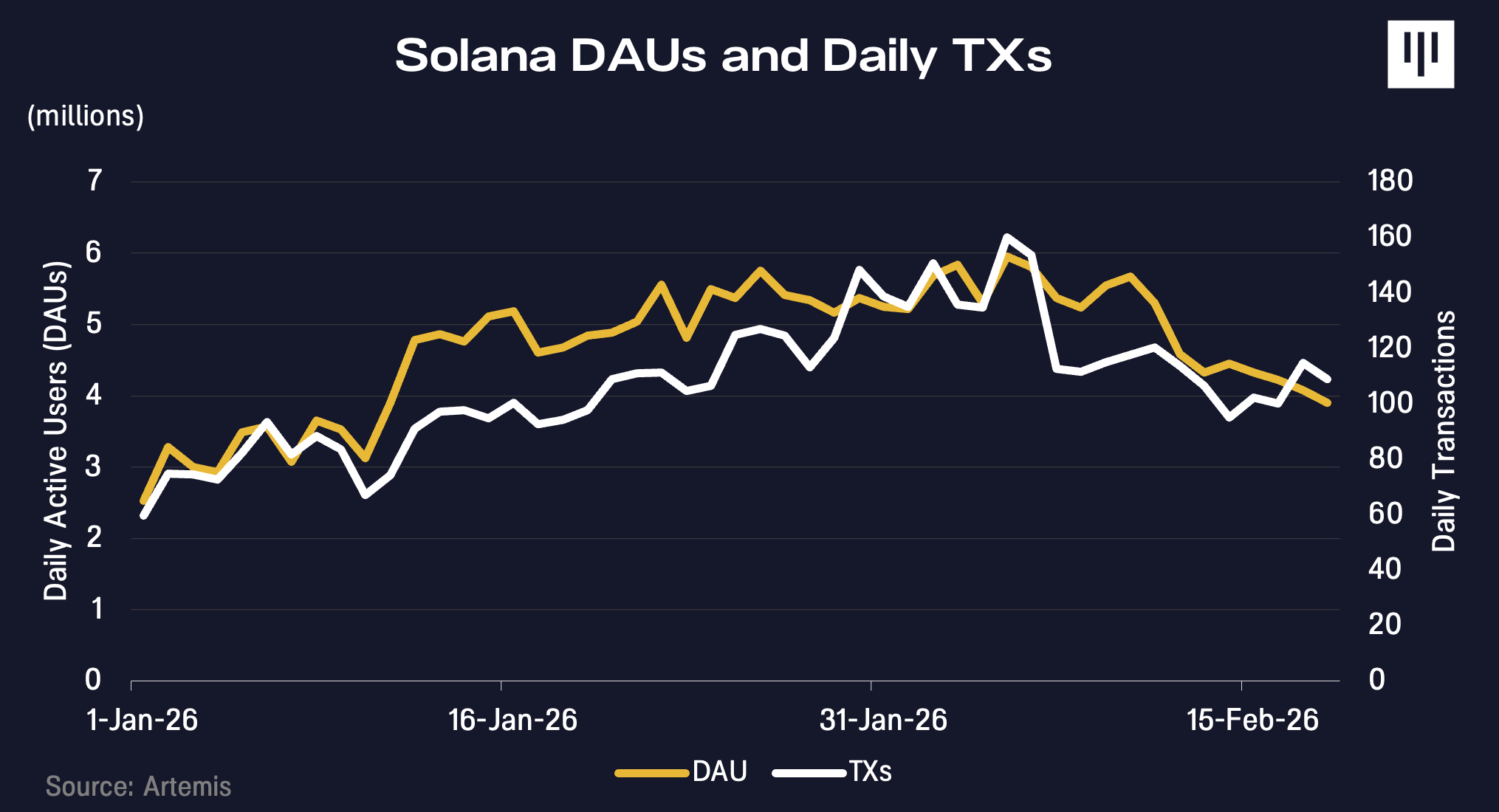
Concurrent with OpenClaw’s viral breakout in January, Solana’s transaction volume and active addresses also began climbing. Evidence from Moltbook—an AI agent social network built on Solana—suggests agent activity may be one contributing factor behind this growth.
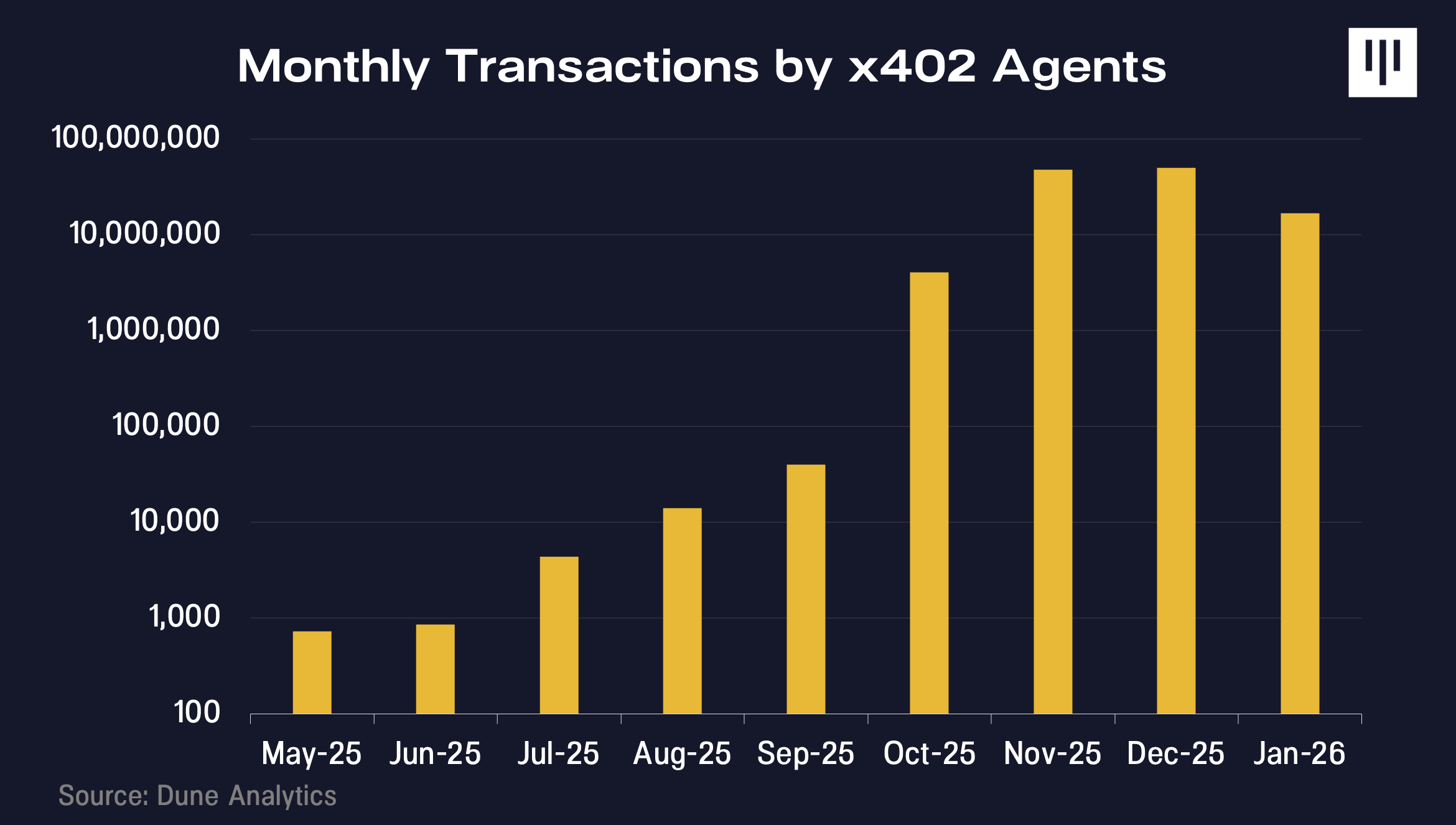
x402 is an internet-native payment protocol developed by Coinbase, enabling AI agents to pay for digital resources in real time—without accounts or complex, high-friction authentication flows. Since launching in 2025, its transaction volume has accelerated steadily.
We remain in early days. Today’s examples are more directional than definitive. But if investors are excited about the possibilities of AI innovation, they shouldn’t overlook why we believe the blockchain track will be foundational to unlocking a fully autonomous agent world.
Many will rightly point out that today’s AI agents don’t need blockchain—at least not yet. And that’s true in the near term. But we believe this is a shortsighted view.
McKinsey recently published a framework categorizing AI-driven commercial automation into six levels—from basic subscription assistants (Level 0) to fully autonomous agent-to-agent commerce (Level 5). The key insight: Levels 0 through 4 do not require new financial rails. In each case, a human identity stands behind the transaction. Users have already authenticated on ChatGPT, Amazon, or Perplexity and linked credit cards. When agents transact, they act as proxies for those humans—inherit their identities, payment credentials, and legal standing.

The infrastructure supporting such commerce—shared payment tokens, chargeback systems, fraud detection—already exists via Visa or Stripe and works quite well.
The blockchain rail becomes critical only at Level 5 and beyond: when agents trade directly with other agents without human instruction; when there is no human identity to inherit; when payments must be programmable, conditional, and settled in milliseconds; and when agents require portable, cross-platform reputation.
So long as humans retain ultimate economic responsibility, traditional rails suffice. Once agents become independent economic actors, the constraints change entirely.
To understand where value accrues—and why blockchain matters—we must imagine the logical end state of agent AI. We’re moving toward a world where agents are not just human assistants, but independent economic actors. Some are created by companies or individuals; others are generated autonomously by agents themselves, forming increasingly self-sufficient systems capable of reasoning, allocating capital, and transacting—without real-time human oversight.
If humans don’t designate transaction channels (e.g., visiting a bank, using Stripe, opening a blockchain wallet), agents will rationally select the fastest, most reliable, globally accessible rails—with minimal friction and minimal dependencies. When the alternative is opening a bank account and waiting days for ACH settlement during limited banking hours, agents will naturally choose permissionless, always-on blockchain rails.
We identify three core constraints driving agents toward blockchain rails:
Identity & Access: How do we track the unique identities of AI agents transacting with and registering for services? When traditional credit scoring and fraud detection systems are built for humans with physical footprints operating within legal jurisdictions, what should new reputation systems look like?
Currency & Payments: What form of currency is needed when agents execute thousands of micropayments, perform conditional payments, and dramatically increase cross-jurisdictional commerce? What form of account is needed when agents cannot walk into a bank branch to open one?
Trust-Minimized Transactions: How can AI agents avoid dispute friction requiring human arbitration—or other forms of centralized trust—systems they may be unable or unwilling to access?
Identity & Access
Before an agent pays, its counterparty must know who—or what—it’s dealing with.
Traditional identity systems are built for humans. They rely on government-issued IDs, physical signatures, and other credentials—assuming the entity on the other end is a legal person.
Autonomous AI agents lack all of these. They cannot walk into a bank to open an account, nor sign legally binding contracts. Yet if we expect agents to transact autonomously, they need some way to prove they are legitimate and authorized to act.
Connecting an agent to your bank account multiplies the problem. How do you conduct anti-money laundering (AML) checks on software? Who bears liability if the agent acts autonomously? What happens if it’s compromised?
In simple scenarios, agents can inherit their owner’s credentials (e.g., ChatGPT Checkout). But this model doesn’t scale. Multiple agents require separable permissions and spending limits. Problematic behavior must be isolated without freezing all agents. These use cases demand verifiable agent identities—not borrowed human ones.
This is where blockchain-based identity comes in. Using cryptographic techniques, agents can prove authorization to act on behalf of a specific individual or company—without revealing sensitive personal information. Think of it as a digital power of attorney—immediately verifiable anywhere, by anyone, without contacting lawyers or querying databases.
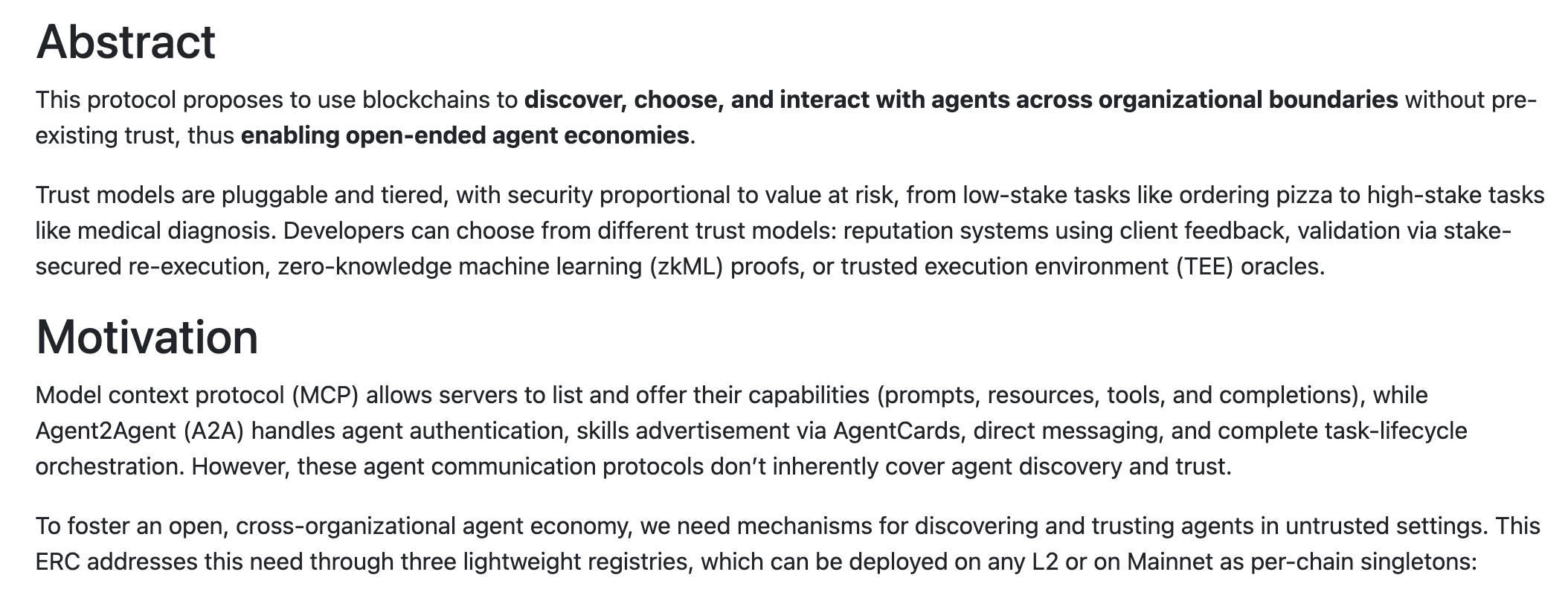
Emerging standards like Ethereum’s ERC-8004 propose on-chain registries where agents can establish verifiable credentials and accumulate transaction history and reputation over time. An agent that has successfully completed thousands of undisputed transactions differs meaningfully from a brand-new agent with zero history—and that reputation is portable across platforms.
This matters because trust is the prerequisite for commerce. Merchants spent years building systems to block bots and scrapers. In an agent-driven economy, they now need to figure out how to whitelist the right bots. Cryptographically secure, verifiable identities let merchants build trust without human guarantees.
Programmable Currency & Micropayments
Traditional payment rails are designed for human-scale transactions. When you pay for a coffee or a pair of jeans, credit card fees (typically 2–3% plus ~$0.30 per transaction) are negligible.
But agent-to-agent commerce operates at a completely different scale. An agent writing code might initiate 10,000 API calls in a single task. A price-comparison agent may query hundreds of data providers. Payments must settle in milliseconds, repeatedly, down to fractions of a cent.
Credit card networks aren’t optimized for this behavior. Minimum fees make micropayments economically unviable. Fraud systems freeze accounts exhibiting high-frequency machine behavior. Transaction speeds lag far behind high-performance blockchain protocols.
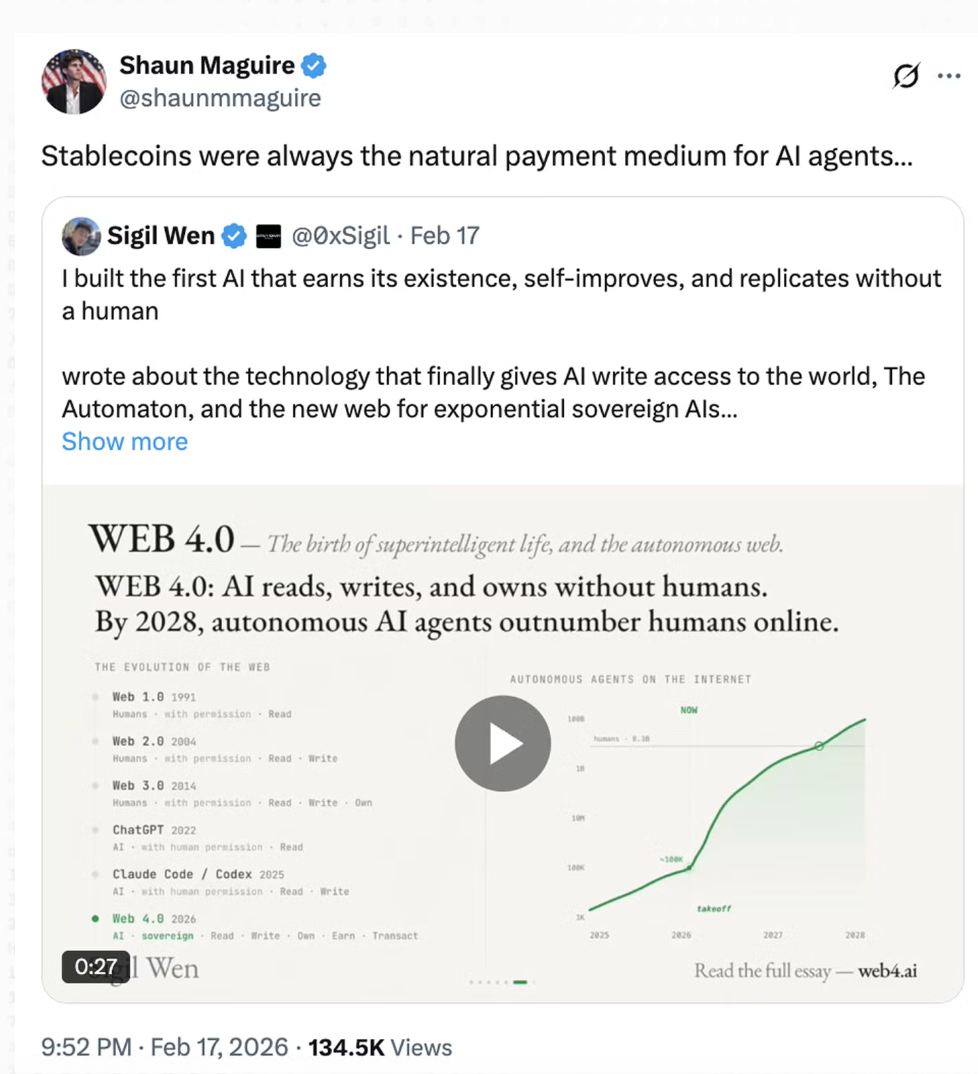
Stablecoins and programmable money are uniquely suited here. On-chain transactions can be subdivided into extremely small units, with settlement costs approaching fractions of a cent. More importantly, because payments are programmable, they can be conditional: pay X only if the API returns valid data; release funds only upon successful computation; stream payments in real time as services are consumed—not prepaying a lump sum you may never fully use.
Programmability also improves capital efficiency. Today, you typically need to pre-fund agents before accessing new services—estimating usage and locking up capital upfront. With smart contracts and on-chain collateral, agents can prove solvency before service delivery—without transferring payment.
Blockchain delivers financial infrastructure aligned with how agents work: autonomous, high-frequency, conditional, and capital-efficient.
Trust-Minimized Transactions
Traditional commerce embeds trust in intermediaries. Payment processors manage chargebacks. Banks provide settlement guarantees. Courts resolve disputes. Contracts ultimately depend on human legal systems for enforcement.
This framework becomes inefficient when billions of low-value transactions span multiple jurisdictions. An AI agent trading with another AI agent may lack access to—or choose not to rely on—a particular jurisdiction’s legal system. Cross-border enforcement may be slow, costly, and uncertain.
Blockchain reduces reliance on these brittle trust systems by encoding execution logic directly into smart contracts. For example, smart contracts enable funds to be held in escrow and released only upon fulfillment of predefined conditions. Settlement is deterministic—immune to chargeback risk. Rules are transparent and verifiable in advance by both parties. No reliance on legal remedies is required.
For large-scale autonomous agents, reducing dependence on centralized intermediaries and human arbitration lowers friction, increases predictability, and enables programmable scalability. This lower-friction infrastructure may expand the economic frontier—enabling activities uneconomical under traditional enforcement models. Agent commerce powered by blockchain rails could accelerate global GDP growth.
The question isn’t whether agent commerce will arrive—but on what infrastructure it will run.
As AI agents become autonomous economic actors, the number of economic actors in the global economy will grow exponentially. Agents will require digitally native financial rails—a technical stack capable of handling programmable settlement, high-frequency micropayments, permissionless coordination, and trust-minimized identity systems. These principles are precisely the foundational design goals of blockchain.
We believe it’s reasonable to conclude: the rapid proliferation of AI agents represents a powerful long-term tailwind for blockchain activity. Early evidence already exists—and we believe most investors significantly underestimate the value-creation opportunity embedded within it.
Join TechFlow official community to stay tuned
Telegram:https://t.me/TechFlowDaily
X (Twitter):https://x.com/TechFlowPost
X (Twitter) EN:https://x.com/BlockFlow_News
 Pantera Capital


