








Six Years Since DeFi Summer: How Will the Decentralized Finance Revolution Continue?
TechFlow Selected TechFlow Selected
Six Years Since DeFi Summer: How Will the Decentralized Finance Revolution Continue?
A string of theft incidents continues to erode industry credibility, while the wave of tokenizing traditional financial assets is gaining momentum—potentially reshaping the entire sector’s development trajectory.
 Navigating Web3 tides with focused insights
By Liam 'Akiba' Wright
Translated by Saoirse, Foresight News
The $292 million rsETH theft from KelpDAO occurred at an especially inopportune moment for the DeFi sector. Prior to this incident, market confidence had already been severely shaken by Drift Protocol’s security vulnerability on April 1 and Venus Protocol’s March collapse. In the wake of the KelpDAO breach, approximately $10 billion exited the DeFi sector over the ensuing weekend.
This confluence of crises has made DeFi’s mounting challenges increasingly difficult to ignore. Although the open-source, decentralized financial system remains operational, it is gradually losing its status as the default onchain financial gateway. Stablecoins, tokenized U.S. Treasuries, and compliant settlement rails are expanding rapidly—while permissionless native protocols continue suffering a market-wide trust discount.
A widely circulated “2026 Hacks Leaderboard” on X vividly reflects the industry’s current pessimism.
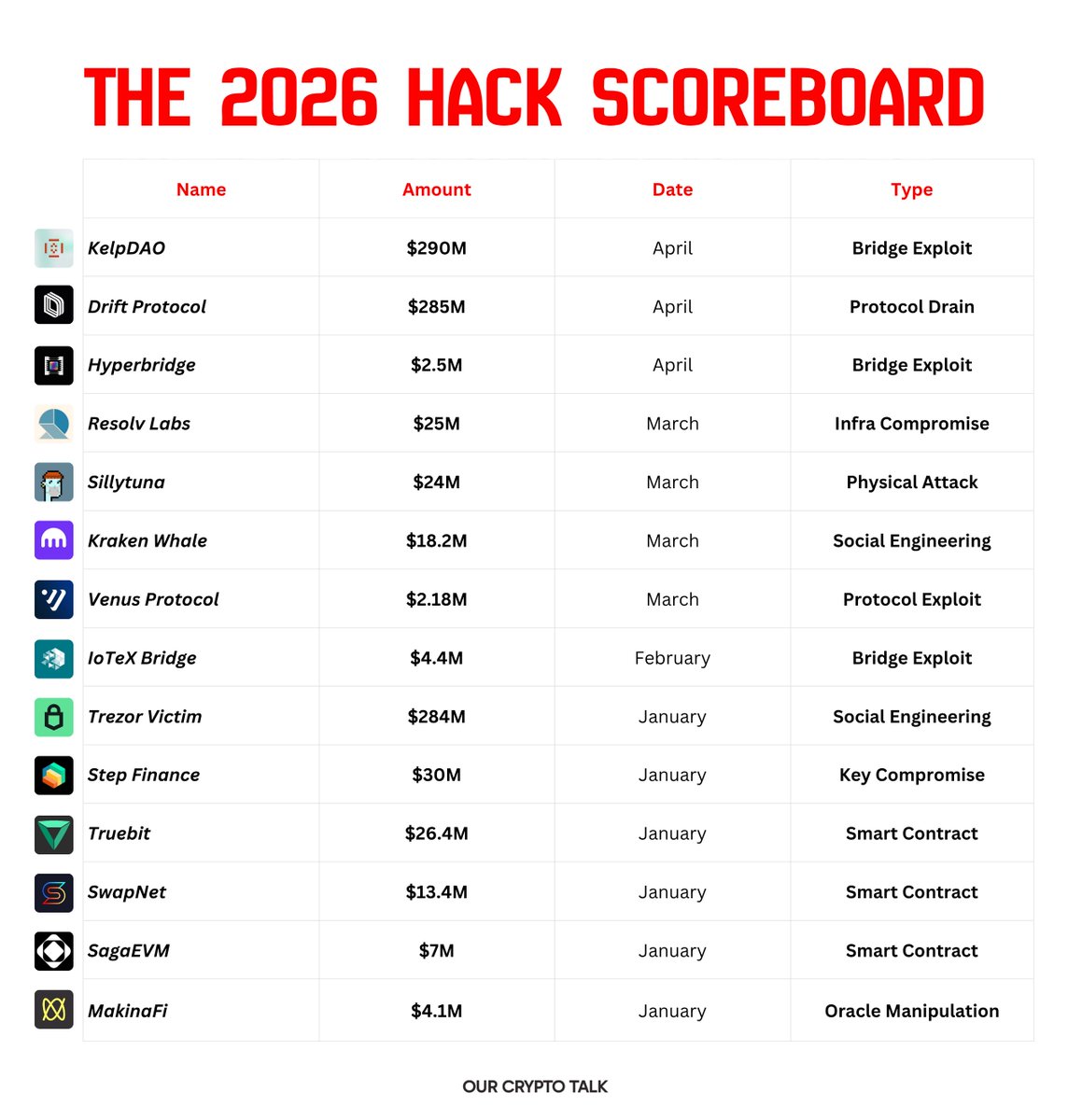
2026 Hacks Leaderboard (Source: Our Crypto Talk)
Some security incidents have been fully analyzed; others remain unresolved; and many blur the lines between protocol vulnerabilities, cross-chain bridge failures, and user asset theft. This article focuses primarily on confirmed security events in 2026 and analyzes the broader industry structural shifts they reveal.
Today’s industry landscape bears little resemblance to the peak of DeFi Summer in 2020 or the 2021 bull market—those golden eras now exist only in memory. Back then, DeFi told a compelling story of open, efficient, composable finance. By 2026, those same traits persist—but no longer carry automatic prestige or market faith.
Each major theft raises users’ trust cost of participating in DeFi. Meanwhile, the fastest-growing and most secure segment of onchain finance is shifting toward payment networks, tokenized Treasuries, and compliant tokenized products—not the complex native DeFi token ecosystems of old.
The industry’s true test today lies in whether open-source DeFi can rapidly rebuild market trust and retain its position as the dominant onchain gateway. At present, the sector isn’t heading toward extinction—it’s being squeezed.
DeFi’s Security Risks Extend Far Beyond Smart Contract Bugs
After a major hack, it’s easy to fall into the trap of attributing every incident solely to smart contract code flaws. Drift Protocol’s ~$285 million loss proves this mindset is outdated.
Chainalysis, an onchain analytics firm, revealed that the attack stemmed from privilege abuse, admin pre-signed operation vulnerabilities, and fake collateral—not simple coding errors. The market has thus realized that much of DeFi’s risk now resides in governance permissions, signature mechanisms, and operational architecture.
This fundamental shift changes the underlying objects users must trust. Code audits and battle-tested contracts remain important—but no longer cover the full risk surface: signing nodes, cross-chain bridges, oracles, and market parameter configurations all harbor vulnerabilities. As protocols span multiple blockchains, governing councils, liquidity platforms, and collateralized derivatives, their attack surface expands far faster than decentralized narratives can evolve.
Venus Protocol’s post-mortem exposed similar issues—albeit in different form. Attackers inflated asset valuations to borrow and extract ~$14.9 million, leaving over $2 million in bad debt. Though the root cause differed from Drift’s, the conclusion was identical: even top-tier DeFi lending platforms remain vulnerable to asset crises when liquidity is thin and structural anomalies exist at the periphery.
Then came KelpDAO’s sudden collapse. According to CryptoSlate, the vulnerability triggered roughly $10 billion in DeFi-wide capital flight—and forced freezes across all rsETH-related markets. Even after market sentiment stabilized and outflow figures were revised downward, the signal remained unmistakable: when confronted with cross-chain complexity, collateral uncertainty, and systemic contagion risk, users’ first instinct is to withdraw funds.
This trend aligns with TRM’s 2026 Security Report: infrastructure attacks accounted for the majority of industry losses in 2025—surpassing pure smart contract vulnerabilities.
DeFi’s trust crisis grows harder to isolate because what the industry must defend is no longer just code itself—but the entire complex operational stack built atop it.
Onchain Finance Is Still Growing—Just Flowing Into Safer Products
Aggregate capital flows do not support claims of “DeFi’s total collapse.” CryptoSlate’s April data shows:
- USDT market cap reached $185 billion; USDC market cap hit $78 billion;
- TRON’s stablecoin supply totaled $86.958 billion; Solana’s stablecoin supply totaled $15.726 billion.
Ethereum still hosts core native-DeFi capital reserves—the market reflects capital concentration shifts, not wholesale exit.
The low-volatility yield space shows even clearer migration trends. As of March 12, 2026, tokenized U.S. Treasury holdings reached $10.9 billion, held by over 55,000 addresses.
Users continue leveraging blockchain for settlement and asset ownership verification—but are unwilling to allocate capital to structurally complex, high-risk native DeFi projects.
Market bifurcation is stark:
Trust pressure and capital outflow signals:
- KelpDAO’s $292 million theft triggered ~$10 billion in industry-wide capital flight;
- Drift’s permission vulnerability halved its TVL;
- Venus exposed lending risks stemming from thin liquidity and recurring bad debt.
Onchain growth tailwinds:
- Combined USDT + USDC market cap totals ~$263 billion;
- Tokenized U.S. Treasury holdings reached $10.93 billion, held by >55,000 addresses;
- Visa continues rolling out USDC settlement, building institutional-grade stablecoin infrastructure.
Capital is clearly concentrating in products with transparent logic, robust collateralization, and institutional onboarding readiness.
Visa’s 2026 Stablecoin Strategy Report merits special attention: its data shows stablecoin supply grew over 50% in 2025—from $186 billion at year-start to $274 billion at year-end—and declares 2026 the “Year One” for institutional stablecoin deployment—signaling stablecoins’ mainstream normalization.
Settlement infrastructure shows similar momentum. Visa reports its annualized USDC monthly settlement volume now exceeds $3.5 billion.
Though this figure represents a small share of the overall stablecoin market, its implications are profound: compliant traditional financial infrastructure is integrating directly with onchain networks—no longer needing to rely on native DeFi’s full ecosystem narrative.
The Core Industry Competition: Who Will Control Future Onchain Infrastructure?
CryptoSlate previously noted that compliant institutions are competing for a $330 billion onchain capital pool—including ~$317 billion in stablecoins and nearly $13 billion in tokenized Treasuries.
These funds consistently seek speed, programmability, and 7×24 settlement advantages—and market attention centers on leading assets and foundational settlement networks—not niche governance experiments.
The contrast with the 2021 bull cycle is stark.
In prior cycles, DeFi served both as foundational infrastructure and end-user product: innovation origin, high-yield source, and prototype for future finance—all converged here. By 2026, onchain finance’s future is being stripped of native DeFi’s chaotic risks—and repackaged.
Tokenized funds enable round-the-clock transfer and rapid liquidation; stablecoins handle payments and treasury operations; institutions enjoy blockchain benefits while tightly controlling compliance, counterparty risk, and market structure.
CryptoSlate’s project shutdown report states that over 80 crypto projects formally ceased operations or entered liquidation in Q1 2026. While not limited to DeFi alone, this statistic underscores one clear reality: capital has exhausted its patience for projects lacking long-term value, stable returns, or real-world utility.
Crypto spot ETFs follow the same macro-trend. Compliant products continue absorbing market capital and attention—users and institutions alike prefer infrastructure that delivers blockchain advantages without native DeFi’s elevated trust burden.
This leaves native DeFi with a distinct, albeit narrower, role: open composability and permissionless innovation retain value—as a financial primitive R&D lab. DeFi pioneers new models and iterates through trial-and-error before compliant products absorb and scale them.
The industry’s core tension remains trust compression.
Native open-source DeFi is ceding narrative dominance. Without rapid trust rebuilding, operational architecture optimization, and demonstrable irreplaceability of its complex designs, it will gradually lose its position as the front-end gateway to onchain finance.
The industry’s central contest is now clear: who will capture the next wave of onchain demand—and currently, safer, compliant onchain packaged products hold the advantage.
Join TechFlow official community to stay tuned
Telegram:https://t.me/TechFlowDaily
X (Twitter):https://x.com/TechFlowPost
X (Twitter) EN:https://x.com/BlockFlow_News
 @CryptoSlate


